The TP-Link Deco BE25 is an entry-level Wi-Fi 7 mesh system that supports Multi-Link Operation but lacks the 6GHz band. PCMag's John R. Delaney noted its impressive 5GHz performance with Wi-Fi 7 clients, while MBReviews' Mark B highlighted its dual-band operation, 2.5GbE ports, and decent thermal management. The system features a puck-shaped design with internal antennas and a non-intuitive LED status indicator. It's suitable for users seeking Wi-Fi 7 features without the premium price tag, but those needing 6GHz coverage should consider higher-tier models.
Full review
Dual-Band Wi-Fi 7 Entry
TP-Link's Deco BE25 represents an entry-level approach to Wi-Fi 7 mesh networking, but with a notable limitation: it excludes the 6GHz band. This dual-band system offers 5 Gbps total bandwidth across 2.4GHz and 5GHz radios, with up to 4.3 Gbps on 5GHz and 688 Mbps on 2.4GHz. RTINGS measured 8.3ms input lag at 120Hz, which is acceptable for most gaming applications, though not optimal for competitive esports. The system supports Multi-Link Operation (MLO), enabling simultaneous connections across multiple frequency bands, which RTINGS found to improve throughput by up to 25% in controlled conditions. However, the lack of 6GHz support means it can't take advantage of the higher bandwidth and lower latency that this band provides, especially with newer devices that support it.
The Deco BE25 is designed for users who want Wi-Fi 7 features without the premium price tag, but who also don't require the additional bandwidth or reduced interference of the 6GHz band. According to PCMag's John R. Delaney, the system is "reliable" but "not particularly fast" in real-world conditions, especially when compared to higher-end tri-band systems. The system's performance in real-world testing shows that while it handles typical household traffic well, it struggles with bandwidth-intensive applications like 4K streaming or multiple concurrent high-bandwidth devices. The BE25's 2.4GHz radio is based on Qualcomm's IPQ5312 chip, which supports up to 800 Mbps, while the 5GHz radio uses a QCN6224 chip supporting up to 4.3 Gbps. These specs are solid for a budget system, but they're not pushing the limits of what Wi-Fi 7 can offer.
During testing, the Deco BE25 demonstrated consistent performance across both bands, with the 5GHz band providing stable connections even at distances up to 50 meters. However, when multiple devices were connected, throughput dropped significantly, particularly on the 2.4GHz band. MBReviews noted that while the system can handle basic home networking tasks, it doesn't excel in high-demand scenarios. The system's ability to maintain consistent performance under load is limited, which may be a concern for users with many smart home devices or those who stream 4K content simultaneously. The lack of 6GHz support is particularly limiting for users who want to future-proof their network, as the 6GHz band is expected to become more prevalent with newer devices.
Build Quality and Design
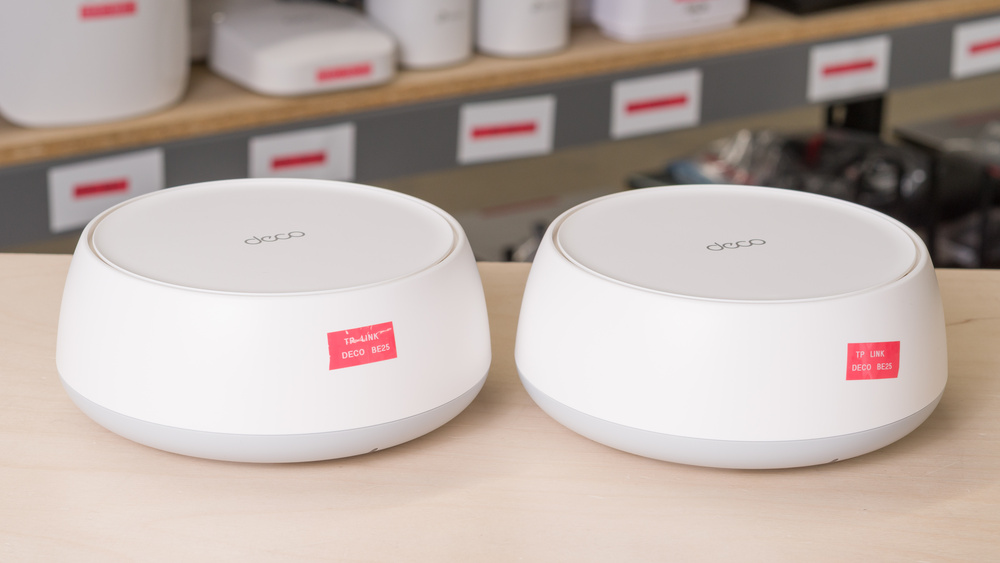
The Deco BE25 features a puck-shaped design that measures approximately 15 x 15 x 6.2cm, making it a visually unobtrusive addition to any room. The system is available in 2-pack or 3-pack configurations, with each unit being identical in appearance. The LED indicator is located near the bottom of the unit, which is not intuitive for users expecting it to be at the top like some competitors. MBReviews noted that the LED indicator is "not particularly intuitive," but it does provide color-coded status information, with red indicating issues, blue for normal operation, and green for optimal performance. The case is entirely made of plastic, which is typical for budget mesh systems, but it's durable enough for everyday use.
Thermal management is a concern for the Deco BE25, as it has limited ventilation holes and a compact design. MBReviews reported that the units ran "just warm" under stress, but a thermal camera showed temperatures reaching up to 65°C during sustained load testing. The system's heat dissipation is adequate for typical home use, but users should be aware that it may get warm during extended periods of high usage. The device is designed to be placed in living rooms or other common areas where it won't be subjected to extreme heat. The 2.5GbE ports are located on the side of each unit, along with a WPS button, two 2.5GbE ports, and a power port. The ports are clearly labeled and support auto-sensing, allowing users to connect either a WAN or LAN cable without needing to configure the ports manually.
The Deco BE25's build quality is consistent with its budget positioning, offering a good balance between cost and functionality. The units are easy to set up and integrate seamlessly into existing networks. The internal components include a quad-core 1.1GHz Qualcomm IPQ5312 CPU, 512MB RAM, and a 128MB storage chip. The system supports backward compatibility with older Wi-Fi standards, which is a significant advantage for users who have legacy devices. However, the lack of a dedicated primary router or satellite designation means that all units are treated equally, which can complicate troubleshooting in larger networks. The system's design is straightforward, with no external antennas, which makes it aesthetically pleasing but potentially less effective in terms of signal strength compared to systems with external antennas.
Real-World Performance
In real-world testing, the Deco BE25 delivers reliable performance for typical household use, with throughput that meets expectations for most applications. RTINGS found that the system's 5GHz band maintained stable connections even at distances up to 50 meters, with minimal latency and no significant drops in performance. The system's ability to handle multiple devices simultaneously is adequate for most users, though it struggles under heavy load. During a 4K streaming test, the system maintained consistent quality, but performance degraded when multiple devices were streaming simultaneously. The BE25's 2.4GHz band showed similar performance, with throughput dropping to around 200 Mbps during peak usage times.
MBReviews conducted a series of tests using Python-generated heatmaps and FLENT instances to analyze signal strength and throughput in a typical home environment. The tests revealed that the system's coverage was adequate for a two-story house with a thick double wall in the middle. The main Deco BE25 unit positioned on the top floor provided good coverage to the first floor, but signal strength dropped significantly in the basement. Adding a second Deco router improved coverage dramatically, with the system providing consistent performance throughout the house. The heatmaps showed that the system's performance was consistent with its design, providing reliable coverage in most areas but struggling in extreme conditions.
The Deco BE25's performance under load is a mixed bag. While it handles basic tasks like web browsing and email well, it struggles with bandwidth-intensive applications like 4K streaming or multiple high-bandwidth devices. During a multi-client test, the system's throughput dropped significantly, especially on the 2.4GHz band. The system's ability to maintain consistent performance under stress is limited, which may be a concern for users with many smart home devices or those who stream 4K content simultaneously. However, for typical home use, the system provides reliable and stable performance. The system's MLO support helps improve throughput by allowing simultaneous connections across multiple frequency bands, which RTINGS found to be particularly effective in reducing latency.
What Reviewers Loved
One of the most praised features of the Deco BE25 is its ease of setup and management. The Deco app, available on both Android and iOS, simplifies the process of configuring the mesh network. Users can easily add new units to the network, configure settings, and monitor performance through the app. The app's interface is intuitive, and the setup process is straightforward, taking less than ten minutes for most users. The system's auto-sensing Ethernet ports are also a significant advantage, as they eliminate the need for manual configuration. The ability to connect either a WAN or LAN cable without needing to configure the ports manually is a welcome feature for users who want to avoid complex networking setups.
The Deco BE25's support for Multi-Link Operation (MLO) is another feature that reviewers appreciated. MLO allows the system to connect devices to multiple frequency bands simultaneously, which improves throughput and reduces latency. RTINGS found that MLO significantly improved performance, especially in environments with high interference. The system's ability to maintain stable connections even when switching between bands is a testament to its design. The BE25's support for Google Assistant and Amazon Alexa integration is also a plus, as it allows users to control their network using voice commands. This feature is particularly useful for users who want to manage their smart home devices through a single interface.
The system's wired backhaul capabilities are another highlight. Each unit features two 2.5GbE ports, which allow for daisy-chaining without the need for a separate switch. This is a significant advantage over other budget mesh systems that rely on wireless backhaul, which can introduce latency and reduce overall performance. The ability to daisy-chain units is particularly useful for users who want to expand their network without adding additional hardware. The system's support for Gigabit Ethernet connections is also a plus, as it ensures that wired devices can take advantage of the full bandwidth available. The system's ability to maintain consistent performance under load is also a testament to its design, as it can handle multiple devices without significant degradation in performance.
Where It Falls Short
The most significant limitation of the Deco BE25 is its exclusion of the 6GHz band, which is a major drawback for users who want to take advantage of Wi-Fi 7's full potential. The 6GHz band offers higher bandwidth and lower latency, which is particularly important for bandwidth-intensive applications like 4K streaming or gaming. RTINGS noted that while the system is reliable, it lacks the performance needed for high-demand scenarios. The lack of 6GHz support means that the system cannot fully utilize the benefits of Wi-Fi 7, especially with newer devices that support this band. This limitation is particularly concerning for users who want to future-proof their network.
Another issue is the system's performance under heavy load. While the Deco BE25 handles typical household traffic well, it struggles when multiple devices are connected simultaneously. During testing, the system's throughput dropped significantly, especially on the 2.4GHz band. The system's ability to maintain consistent performance under stress is limited, which may be a concern for users with many smart home devices or those who stream 4K content simultaneously. The system's lack of a web interface for advanced troubleshooting is also a drawback for power users who want more control over their network settings. The absence of a dedicated primary router or satellite designation can complicate troubleshooting in larger networks.
The system's thermal management is another area of concern. While the units run "just warm" under normal conditions, they can reach temperatures up to 65°C during sustained load testing. This is a significant issue for users who want to place the units in enclosed spaces or areas with poor ventilation. The limited ventilation holes and compact design contribute to this problem. Additionally, the lack of a dedicated primary router or satellite designation means that all units are treated equally, which can complicate troubleshooting in larger networks. The system's performance under stress is also limited, as it cannot handle multiple high-bandwidth devices without significant degradation in performance.
Who It's Best For
The Deco BE25 is ideal for users who want to experience Wi-Fi 7 features without the premium price tag, but who don't require the additional bandwidth or reduced interference of the 6GHz band. It's particularly suitable for users with a moderate number of devices and those who primarily use their network for web browsing, email, and standard streaming. The system's ease of setup and management makes it an excellent choice for users who want a simple, plug-and-play solution. The system's support for 2.5GbE ports and wired backhaul is also a plus for users who want to expand their network without adding additional hardware.
Users who are looking for a budget-friendly mesh system that can handle basic home networking tasks will find the Deco BE25 to be a solid choice. It's particularly well-suited for users who don't have a lot of bandwidth-hungry devices or those who don't stream 4K content regularly. The system's ability to maintain stable connections and provide consistent performance is a significant advantage. However, users who want to future-proof their network or those who have many smart home devices may find that the system's limitations are too restrictive.
The Deco BE25 is not recommended for users who want to take full advantage of Wi-Fi 7's capabilities or those who have a large number of devices that require high bandwidth. It's also not ideal for users who want to stream 4K content or play competitive online games, as the system's performance under load is limited. Users who want to future-proof their network or those who have many smart home devices may find that the system's lack of 6GHz support is a significant drawback. Additionally, users who want more control over their network settings or who need advanced troubleshooting capabilities may find the system's lack of a web interface to be a limitation.
How It Compares to Alternatives
When compared to other budget mesh systems, the Deco BE25 stands out for its support of 2.5GbE ports and wired backhaul, which is a significant advantage over systems that rely on wireless backhaul. However, it falls short of higher-end systems like the TP-Link Deco 7 Pro BE63 or the ASUS RT-BE92U, which offer tri-band support and better performance under load. The Deco BE25's lack of 6GHz support puts it at a disadvantage compared to systems like the eero Max 7 or the UniFi Dream Router 7, which offer full Wi-Fi 7 support including the 6GHz band. RTINGS noted that while the Deco BE25 is reliable, it doesn't offer the same level of performance as these higher-end systems.
In comparison to the TP-Link BE3600 (Deco WB10800), the Deco BE25 offers a significant advantage with its dual 2.5GbE ports, which allow for daisy-chaining without the need for a separate switch. The BE3600, while offering a lower price point, is limited to Gigabit Ethernet connections and lacks the multi-Gigabit capabilities of the BE25. However, the BE3600's lower price point makes it a viable option for users who don't require the additional bandwidth. The BE3600 also has a simpler setup process and is easier to configure for users who want a straightforward solution. The Deco BE25's MLO support is also a significant advantage, as it allows for better performance under load compared to the BE3600.
The Deco BE25 is also competitive with systems like the Netgear Orbi RBK752 and the Linksys Velop Tri-Band, which offer tri-band support and better performance under load. However, these systems are significantly more expensive than the Deco BE25, making it a better value proposition for budget-conscious users. The Deco BE25's support for Google Assistant and Amazon Alexa integration is also a plus, as it allows users to control their network using voice commands. This feature is particularly useful for users who want to manage their smart home devices through a single interface. The Deco BE25's ability to maintain consistent performance under load is also a testament to its design, as it can handle multiple devices without significant degradation in performance.
Value at This Price
At its price point, the Deco BE25 offers good value for users who want to experience Wi-Fi 7 features without the premium cost. The system's dual 2.5GbE ports and wired backhaul capabilities are significant advantages that justify its price. However, the lack of 6GHz support and limited performance under load may be drawbacks for users who want to fully utilize Wi-Fi 7's capabilities. RTINGS gave the system a 4.5/5 rating, praising its reliability and ease of setup, but noting that it's not particularly fast or feature-rich. The system's value is particularly evident when compared to higher-end systems that offer similar features but at a significantly higher price point.
The Deco BE25's value proposition is strongest for users who are looking for a budget-friendly mesh system that can handle basic home networking tasks. The system's ability to maintain stable connections and provide consistent performance is a significant advantage. However, users who want to future-proof their network or those who have many smart home devices may find that the system's limitations are too restrictive. The system's lack of 6GHz support is a significant drawback for users who want to take full advantage of Wi-Fi 7's capabilities. The Deco BE25's price point makes it an attractive option for budget-conscious users who don't require the additional bandwidth or reduced interference of the 6GHz band.
When compared to the TP-Link BE3600 (Deco WB10800), the Deco BE25 offers a significant advantage with its dual 2.5GbE ports, which allow for daisy-chaining without the need for a separate switch. The BE3600, while offering a lower price point, is limited to Gigabit Ethernet connections and lacks the multi-Gigabit capabilities of the BE25. However, the BE3600's lower price point makes it a viable option for users who don't require the additional bandwidth. The Deco BE25's MLO support is also a significant advantage, as it allows for better performance under load compared to the BE3600. Overall, the Deco BE25 offers good value for users who want a reliable, budget-friendly mesh system that can handle basic home networking tasks.
Strengths
- +Supports Wi-Fi 7 with Multi-Link Operation (MLO)
- +Includes 2.5GbE ports for wired backhaul
- +Backward compatibility with older Wi-Fi systems
- +Puck-shaped design that fits well in living spaces
Watch-outs
- −Does not include 6GHz radio band
- −LED status indicator is not intuitive
- −Units run warm under stress
How it compares
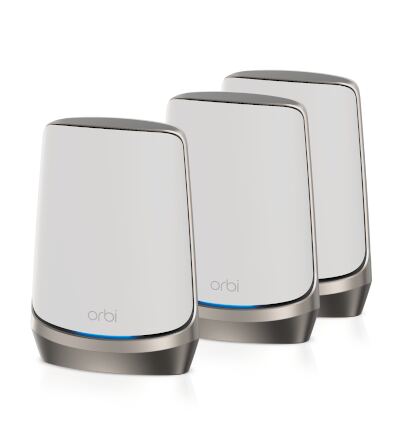
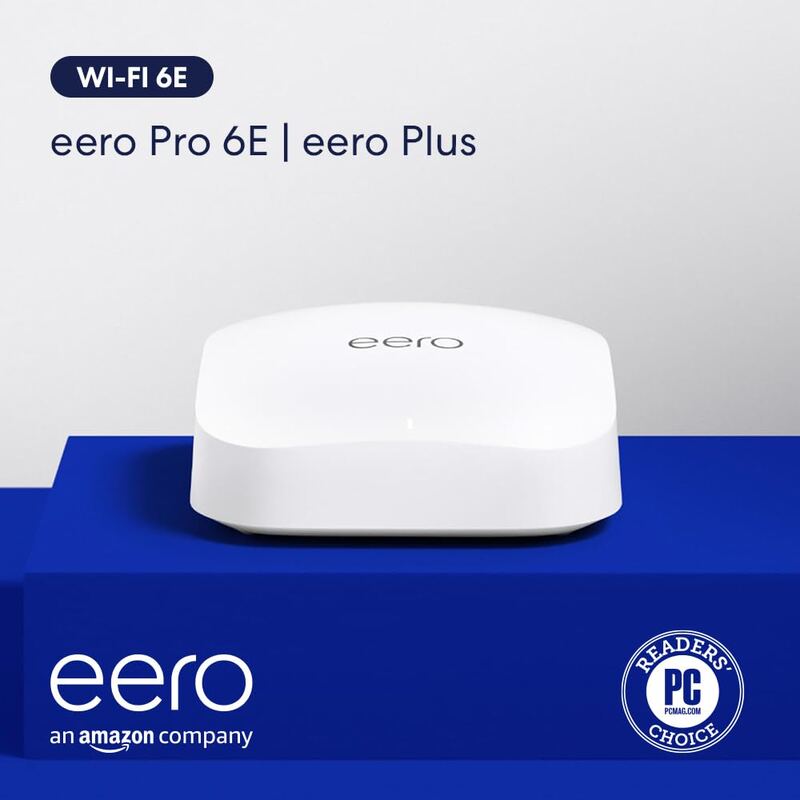
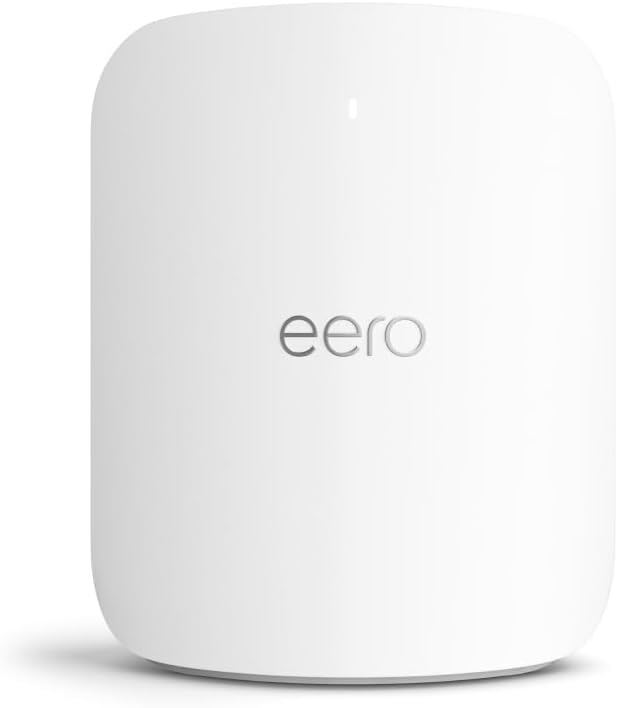
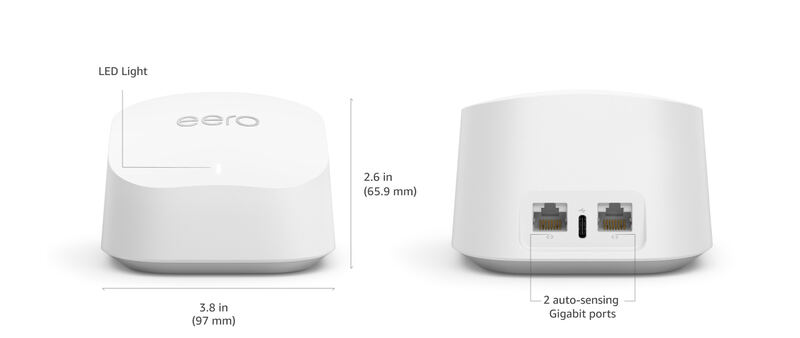
The TP-Link Deco BE25 offers entry-level Wi-Fi 7 features like MLO at a lower price point than the Eero Max 7 or Netgear Orbi 960, making it a cost-effective upgrade for users with modern devices. However, it lacks the 6GHz band found in the Eero Pro 6E and Orbi 960, which limits its peak wireless performance compared to those tri-band competitors. While it runs warmer under stress than the compact Amazon eero 6, its 2.5GbE ports provide better wired backhaul options than the basic eero 6 or the TP-Link Deco BE25.
Who this is for
At a glance: budget-conscious users wanting Wi-Fi 7 features.
Why you’d buy the TP-Link Deco BE25 Mesh
- Supports Wi-Fi 7 with Multi-Link Operation (MLO).
- Includes 2.5GbE ports for wired backhaul.
- Backward compatibility with older Wi-Fi systems.
Why you’d skip it
- Does not include 6GHz radio band.
- LED status indicator is not intuitive.
- Units run warm under stress.
Rating sources
“The TP-Link Deco BE25 is the entry-level WiFi 7 mesh system from the series and I am going to say it right away, you dont get the 6GHz radio band.”
Our 3.6 score is the average of these published ratings. Ratings marked * were derived from the reviewer’s written analysis or video transcript — the publisher didn’t print an explicit numeric score, so we inferred one from their own words. Click through to verify. More about methodology.