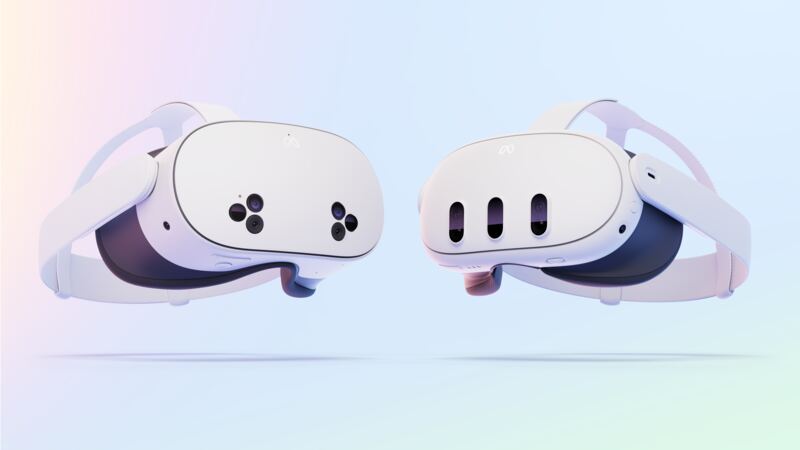
The Meta Quest 3 delivers high-resolution full-color passthrough and powerful standalone performance via the Snapdragon XR2 Gen 2 processor. WIRED found that this mixed-reality capability allows users to interact with digital objects layered over physical surroundings, while IGN recorded that the hardware upgrade supports complex games without a tethered PC. The redesigned Touch Plus controllers offer improved ergonomics and haptic feedback, though the stock facial interface and strap are often uncomfortable for extended sessions. WIRED noted that the software library still lacks fully integrated spatial computing applications despite the advanced hardware. The significant price increase over the Quest 2 targets mainstream buyers willing to pay for premium features, while budget-conscious users may find the cost prohibitive.
Full review
Mixed reality cameras transform physical spaces
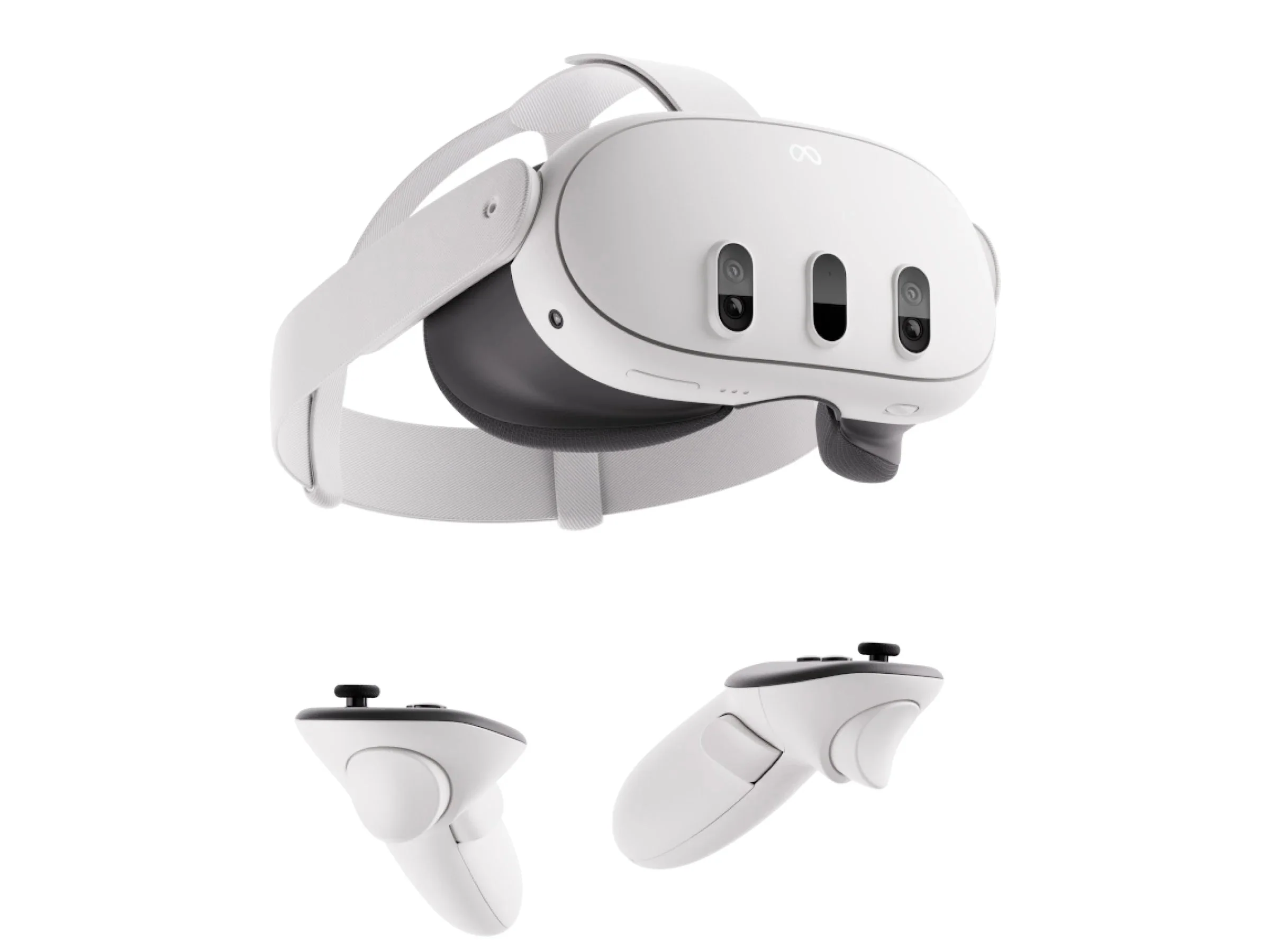
The Meta Quest 3 introduces full-color, high-resolution passthrough that fundamentally shifts the headset from a purely virtual device to a mixed-reality portal. WIRED found that this capability allows users to interact with their actual surroundings while digital objects are layered on top of them, such as typing on an ethereal keyboard floating above a real desk or playing Beat Saber in a mapped living room. CNET confirmed that the six outward-facing cameras and depth sensor can scan a room to detect walls, ceilings, and furniture, creating a mesh grid that anchors virtual elements securely to physical surfaces like coffee tables.
This visual fidelity is significantly higher than the monochrome passthrough of its predecessor, enabling applications that rely on accurate spatial awareness. The system tracks hand movements with greater precision, allowing users to interact with digital interfaces using their actual hands rather than just controllers. While the experience is impressive for gaming and casual interaction, WIRED noted that typing virtually remains slow and impractical for regular use compared to a physical keyboard, highlighting that while the technology works, it has not yet replaced traditional input methods.
Snapdragon XR2 Gen 2 powers standalone performance
Under the hood, the Meta Quest 3 utilizes the Qualcomm Snapdragon XR2 Gen 2 processor to deliver a substantial leap in graphical capability for standalone virtual reality. IGN recorded that this system-on-chip allows the headset to run more complex games and higher-fidelity graphics without requiring a tethered PC or external base stations. The hardware upgrade supports sharper pancake lenses that provide edge-to-edge clarity, reducing the visual artifacts common in older Fresnel lens designs.
The increased processing power also enables smoother performance in demanding titles like Asgard's Wrath 2 and Resident Evil 4 VR. ZDNET found that this chip handles both stationary-based experiences and mobile fitness applications with equal ease, maintaining a consistent frame rate that reduces motion sickness for many users. The combination of the new processor and improved optics makes the headset capable of running nearly every major standalone VR title currently available in the ecosystem.
Touch Plus controllers improve handheld ergonomics
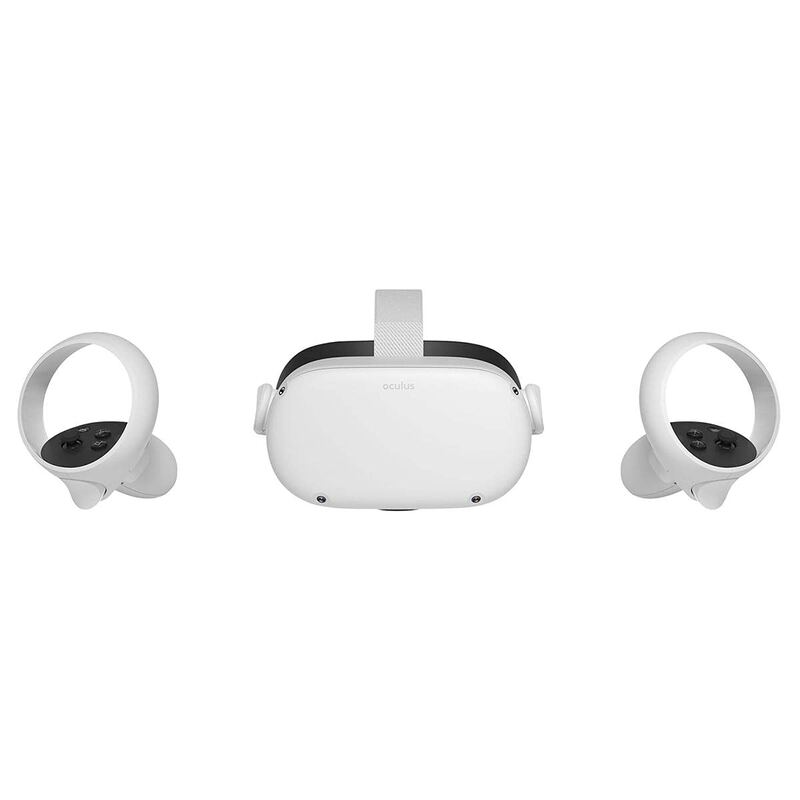
The redesigned Touch Plus controllers abandon the sensor ring found on previous models, relying instead on internal tracking that improves their handling and reduces accidental input errors. ZDNET noted that these controllers offer a better handheld experience with improved haptic feedback, making interactions in games feel more tactile and responsive. The removal of external sensors also simplifies the physical design, allowing for a more compact form factor overall.
The ergonomic adjustments make the controllers easier to grip during extended gaming sessions, though they still rely on standard AA batteries rather than integrated rechargeable cells. IGN found that while the core functionality remains similar to the Quest 2 controllers, the refined shape and vibration motors provide a noticeably better feel when navigating menus or engaging in fast-paced action games like Beat Saber.
IPD dial replaces discrete lens settings
One of the most practical hardware changes is the introduction of continuous interpupillary distance (IPD) adjustment via a rotary dial on the bottom of the visor. IGN found that this feature allows users to fine-tune their vision from 58mm to 70mm, eliminating the need to choose between fixed stops like 58mm, 63mm, and 68mm. This continuous range ensures that most users can achieve a sharper image without relying on third-party lens inserts.
The headset also allows for adjustment of the facial interface depth, which changes how close the screen sits to the user's face. Setting it to the shortest depth maximizes the field of view to 110 degrees, while extending it provides extra space for users who wear glasses. ZDNET confirmed that this adjustability helps accommodate different facial structures and prescription needs, though wearing thick-rimmed glasses can still be challenging without additional modifications.
Stock strap feels front-heavy during use
IGN recorded that this weight distribution makes the headset feel front-heavy, especially when worn without a support strap for more than an hour. The soft cloth head strap included in the box does a decent job of keeping the visor secure during intense movement, but it lacks the even pressure distribution found on premium third-party alternatives.
The facial interface is lined with foam padding that absorbs sweat and can become uncomfortable during long sessions. WIRED noted that light spills in from the nose bridge due to the aggressively curved design, which can break immersion for some users. For those planning extended use or who prefer a more secure fit, IGN pointed out that purchasing the Elite Strap adds $70 but significantly improves comfort by shifting weight to the back of the head.
Battery life limits standalone mobility
The Meta Quest 3 offers approximately two hours of battery life per charge, depending on the intensity of the application. ZDNET found that this duration is sufficient for a typical gaming session or workout but falls short for all-day mixed-reality usage. The headset requires frequent recharging via USB-C, and while it charges quickly, the lack of an external hot-swappable battery means users must wait for the device to power down before swapping cells.
This limitation is particularly noticeable when using high-refresh-rate modes or demanding graphics settings. CNET noted that while the battery life is consistent with other standalone VR headsets in its class, it remains a bottleneck for users who want to use the device as a primary spatial computing tool throughout their day without being tethered to an outlet.
Software ecosystem lacks unique mixed-reality apps
While the hardware supports advanced mixed reality, WIRED found that the software library still feels like a collection of virtual reality experiences with passthrough gimmicks rather than fully integrated spatial computing applications. Horizon Worlds was described as a ghost town by reviewers, lacking the user base and engagement needed to sustain a social metaverse. The operating system interface remains dated, with limited options for organizing apps or customizing the home environment.
CNET observed that while the headset is capable of running thousands of VR games and fitness apps natively, there are few exclusive titles that truly leverage the mixed-reality capabilities in meaningful ways. Most experiences simply overlay virtual elements onto a real-world backdrop rather than creating seamless interactions between the two worlds. This gap suggests that while the hardware is ready for advanced spatial computing, the software ecosystem has not yet caught up to its potential.
price point targets mainstream VR buyers
At $499 for the 128GB model and $649 for the 512GB version, the Meta Quest 3 represents a significant price increase over the previous generation. WIRED noted that this 60 percent premium asks users to upgrade much sooner than they might with traditional gaming consoles, given the three-year gap between hardware generations. The higher cost reflects the advanced cameras and processor but places it out of reach for budget-conscious buyers who can still find value in the Quest 2.
The PSVR2 requires a $500 console and offers no PC compatibility, whereas the Quest 3 provides a massive library of games, wireless PC streaming via Air Link, and genuine mixed-reality capabilities at a fraction of the cost of Apple's Vision Pro.
Strengths
- +Delivers high-resolution full-color passthrough that enables genuine mixed-reality experiences by blending virtual objects with the real world.
- +Powered by the Qualcomm Snapdragon XR2 Gen 2 processor for improved graphics performance in standalone mode.
- +Includes an intuitive controller design that combines ergonomic improvements with self-tracking capabilities.
Watch-outs
- −Stock facial interface and strap are often described as uncomfortable, prompting many users to purchase third-party upgrades like the Elite Strap.
- −The $499 starting price represents a significant increase over the previous Quest 2 model.
How it compares
The Meta Quest 3 improves upon the Meta Quest 2 by adding full-color passthrough and a more powerful processor, enabling genuine mixed-reality experiences.
Rating sources
Counts as 4.66/5 in our score — this publisher's 181 scores on the site average 4.00, so its scores are adjusted up to compare fairly with other publishers.
Counts as 4.02/5 in our score — this publisher's 156 scores on the site average 4.15, so its scores are adjusted up to compare fairly with other publishers.
Counts as 4.53/5 in our score — this publisher's 15 scores on the site average 4.13, so its scores are adjusted up to compare fairly with other publishers.
Counts as 4.34/5 in our score — this publisher's 31 scores on the site average 3.77, so its scores are adjusted up to compare fairly with other publishers.
Counts as 4.27/5 in our score — this publisher's 8 scores on the site average 4.54, so its scores are adjusted down to compare fairly with other publishers.
Counts as 4.92/5 in our score — this publisher's 195 scores on the site average 4.25, so its scores are adjusted down to compare fairly with other publishers.
Counts as 4.46/5 in our score — this publisher's 34 scores on the site average 4.21, so its scores are adjusted down to compare fairly with other publishers.
Our 4.5 score is the average of the 9 scored reviews above, each adjusted for how strictly its publisher scores; 1 more reviewed it without printing a score and is not in the average. More about methodology.