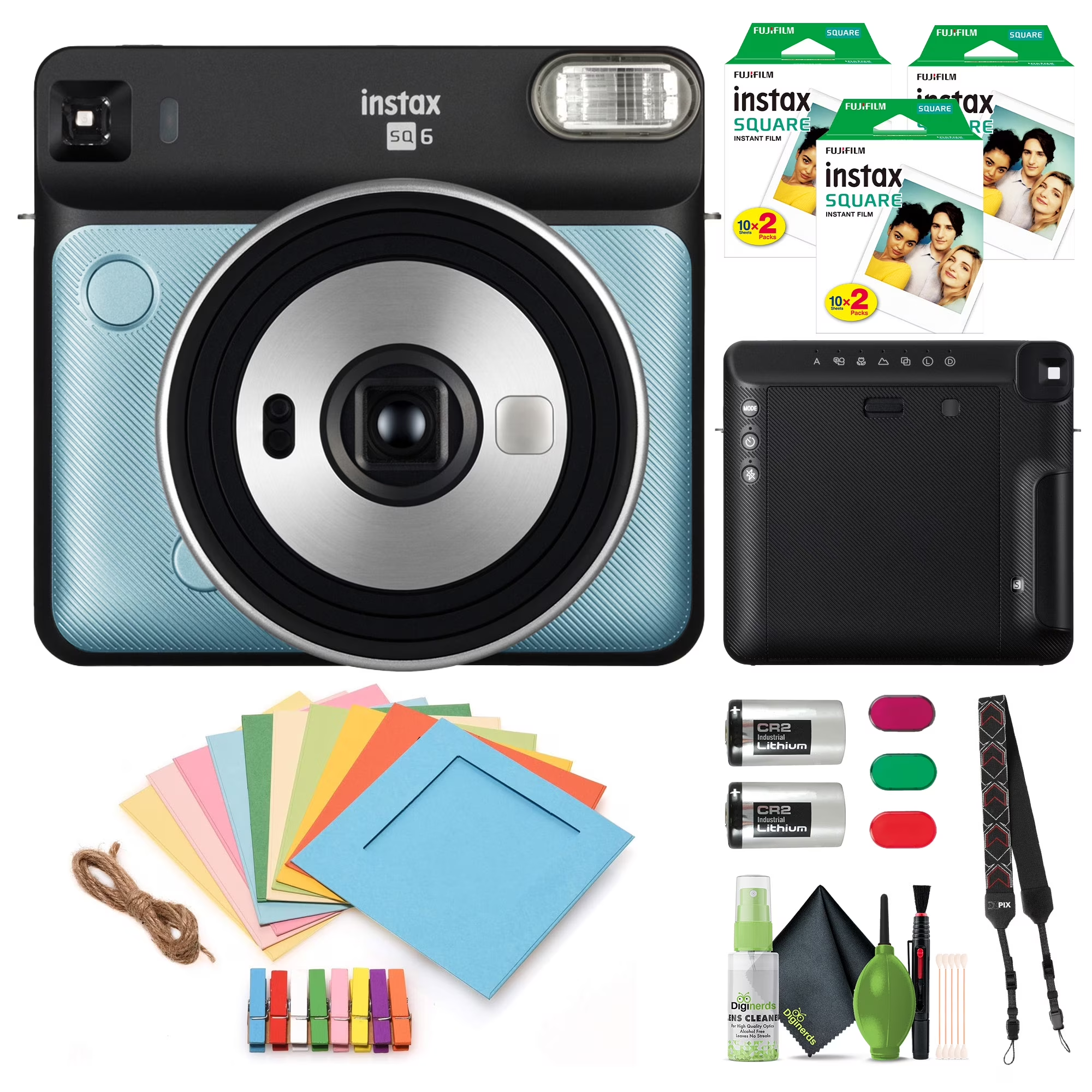
The Fujifilm Instax Square SQ6 is a fully analog instant camera built for the newer Instax Square format, which prints at 2.4 x 2.4 inches. Dan Finnen of Dan Finnen Writing found the frame roomier than Instax Mini but said the camera doesn't do much to work around the format's limits for artistic use. Gordon from Camera Labs liked the simplicity and compact body while stressing that autofocus and flash settings often give inconsistent results. In print size and ergonomics the SQ6 lands between Instax Mini and Wide, without the advanced features digital competitors carry.
Full review
Lens extension adds half an inch when powered on
The Fujifilm Instax Square SQ6 represents a thoughtful evolution in instant camera design, combining retro aesthetics with modern functionality. According to Mean Bear Media's review, the camera's compact form factor makes it highly portable, fitting easily into most camera bags despite its slightly larger profile when the lens extends. The SQ6's plastic construction feels solid enough for everyday use, though the battery door is noted as flimsy by one reviewer. TechGearLab's testing confirmed the camera's durability, rating it 9.5/10 for battery performance and describing it as comfortable to hold. The camera's minimalist layout includes a power switch at the top, a shutter button positioned awkwardly on the right side, and a rear panel with three essential controls: mode selection, flash toggle, and self-timer. The design maintains the classic Fuji styling reminiscent of the Instax Mini 90 Neo Classic, but with a more refined approach to proportions and ergonomics.
However, the SQ6's design decisions reveal some compromises. The viewfinder placement on the right side creates compositional challenges for right-eye dominant users, as noted by Shoot It With Film's reviewer who found it uncomfortable to compose images. The camera's lens extends when powered on, increasing its size from 4.5 inches when off to nearly 5 inches when active, which contradicts the compact design philosophy. Dan Finnen's review highlighted that the camera's ergonomics are 'handy' but not exceptional, with the shutter button's location requiring some adjustment. The camera's aesthetic appeal is undeniable, with Mean Bear Media praising its 'very attractive' appearance and noting that it looks like an evolution of the Neo 90, which many reviewers found appealing.
The SQ6's build quality is consistent with Fujifilm's standard for instant cameras, though it lacks some premium materials. TechGearLab's analysis found the camera to be 'durable' and 'comfortable to use' but noted that it's 'heftier than the instant digitals we tested,' suggesting it may not be as lightweight as some users expect. The camera's plastic construction, while functional, doesn't convey the same premium feel as higher-end models. The film counter display, however, was reported as malfunctioning by TechGearLab's testing team, indicating potential quality control issues with the display mechanism.
Camera Controls and Features
The SQ6's control system offers a range of creative options that distinguish it from simpler instant cameras, though it requires some learning to master. Shoot It With Film's reviewer noted that the camera features 'three buttons on the rear' for mode selection, flash control, and self-timer, with the mode button cycling through automatic, selfie, macro, landscape, double exposure, lighten, and darken settings. The camera's interface is described as 'simple' and 'minimalist,' which is a positive aspect according to Mean Bear Media. However, the lack of combined functionality between modes is a significant limitation, as EMULSIVE's reviewer pointed out that 'you cant combine them'—for instance, darkening a macro shot or using double exposure with exposure compensation. This constraint forces users to manually switch between modes, creating a more complex workflow than necessary.
TechGearLab's review emphasized that while the camera is user-friendly overall, it does have a 'mild learning curve,' and the numerous creative features require time to understand. The automatic mode, while convenient for beginners, often produces inconsistent results, particularly in challenging lighting conditions. The camera's exposure system is described as 'blunt' by EMULSIVE's reviewer, who noted that 'no control whatsoever about any of the things you want out of a professional camera.' The flash system is particularly problematic, as Shoot It With Film's reviewer warned that 'unless you’re inside with no light and you’re taking selfies with your pals, there is no reason to use the flash on this camera.' The flash will fire automatically if not manually turned off, potentially wasting film and washing out natural vibrancy.
The SQ6's creative modes include double exposure, which EMULSIVE's reviewer found particularly useful for experimentation. The ability to layer two exposures offers 'really cool opportunities' for artistic expression, though it requires careful composition to be effective. The camera also includes exposure compensation modes (lighten and darken) that can be used to correct for backlighting or overexposure situations, but these cannot be combined with other modes. The self-timer function is a useful feature for group shots, though the camera's overall handling and button placement make it less intuitive than some competitors.
Image Quality and Performance
Image quality from the SQ6 is described as 'very similar to the original Polaroids of yesteryear, except that the image quality is far superior,' according to TechGearLab's review. The camera's square format produces prints that are notably larger than Instax Mini but smaller than Instax Wide, offering a middle ground in terms of image size and portability. The SQ6's 65.75mm lens with electronic shutter speeds from 1/400 to 1.6 seconds provides a good balance between sharpness and creative flexibility. However, the camera's performance in challenging lighting conditions is inconsistent. EMULSIVE's Raymond van Mil found that 'the light meter gets confused when there is a lot of contrast': a light-skinned subject against a dark background comes out overexposed — 'even with the darkening function activated I had overexposure in this case' — while a dark-skinned subject against a light background is underexposed. TechGearLab reports the same failure from the other side, noting that 'the prints often end up blown out if there's any backlighting.'
TechGearLab's testers found that while the SQ6 still produces 'vibrant and fun shots,' it 'tends to shoot rather dark' and often requires manual adjustment of settings to achieve proper exposure. The camera's color reproduction is praised by TechGearLab, which rated the image quality 6.5/10, noting that 'the images that the Instax Square SQ6 produces were among the most realistic and consistent in our lineup.' However, the reviewer also noted that 'the prints are small, there can be a loss of clarity and smaller details,' which limits the camera's appeal for more detailed photography. The SQ6's ability to capture textures and skin tones accurately is particularly praised, with TechGearLab's testing showing that 'the camera does an excellent job of picking up the full spectrum of colors, and the controls can be set to fit any lighting situation.'
The SQ6's performance in various lighting conditions is mixed, with several reviewers noting that the camera struggles with backlighting and high-contrast scenes. TechGearLab found that 'an accurate image can be achieved by messing with the settings, but it rarely happened for us on the first try.' The camera's automatic mode, while convenient, often produces underexposed or overexposed results without manual intervention. The SQ6's ability to produce consistent, high-quality images is limited by its lack of sophisticated exposure control, which requires users to develop a deeper understanding of the camera's capabilities to achieve optimal results.
Film Compatibility and Cost
The SQ6's use of Instax Square film represents a significant step in Fujifilm's instant photography evolution, offering a format that bridges the gap between Instax Mini and Instax Wide. According to Dan Finnen's review, the Instax Square film shares the same height as Instax Mini and Wide, making it functionally similar but wider in dimension. The film's size is described as 'much closer to Fuji Instax Mini than Polaroid or even Instax Wide,' with the square format providing 'every bit of extra room' that makes it suitable for events and parties. The SQ6's film loading mechanism is straightforward, with yellow alignment marks on both the cartridge and camera ensuring proper insertion. The camera automatically expels the dark slide when turned on, making the process seamless.
The cost of Instax Square film is a significant drawback, with Shoot It With Film's reviewer noting that 'at just under a dollar per shot in color, and a little more for black and white, the film isn't cheap.' TechGearLab's review highlighted that while the camera's image quality is 'vibrant and fun,' the 'film costs' are a 'major consideration' for potential buyers. The availability of black and white film packs was noted as 'unavailable at the time of testing' by TechGearLab, though this may have changed since their review.
The SQ6's film compatibility is limited to the Instax Square format, which means users cannot mix different film types or use older Instax formats. This restriction, while ensuring consistency in image quality, limits the camera's flexibility compared to hybrid models. Dan Finnen's review noted that 'the Instax Square frame is much smaller than a Polaroid' but still maintains the same dimensions as other Instax formats, which is both a benefit and a limitation. The camera's film capacity is indicated by a small window on the back, though TechGearLab's testing revealed that the film counter display was 'malfunctioning,' potentially causing confusion for users about remaining shots.
User Experience and Learning Curve
Mean Bear Media's reviewer noted that 'I have shot around 12 boxes of film with the camera so far, so I would have expected to find the shutter button a little easier by now,' indicating that the camera's button placement requires some adjustment period. That same Mean Bear Media review is where the line 'the camera is super slim from a side profile and it is powered off' comes from, and it adds that switching the camera on extends the lens and makes the body 'much larger.' The camera's design is praised for its retro appeal, with Mean Bear Media noting that 'it looks great and fits into most camera bags with little problem.'
TechGearLab's review highlighted that while the camera is 'user-friendly' overall, it does require 'some time to get comfortable with' the controls. The camera's automatic mode is convenient for casual users but often produces inconsistent results, particularly in challenging lighting conditions. The camera's exposure compensation modes are useful but limited in functionality, as EMULSIVE's reviewer noted that 'you cant combine them' with other modes. The SQ6's double exposure mode is praised for its creative potential, though it requires careful composition and understanding of the camera's limitations. The camera's flash system is particularly problematic, as Shoot It With Film's reviewer warned that 'the flash will fire automatically if you don't press the 'flash off' button before every shot,' potentially wasting film and reducing image quality.
The SQ6's user experience is described as 'comfortable' by TechGearLab, but the camera's handling and button placement create some friction. The shutter button's location is noted as 'strange' by Mean Bear Media, requiring users to 'pull the camera away from my face to find the shutter button.' The camera's viewfinder placement is criticized by Shoot It With Film's reviewer, who found it 'awkward to compose an image' and 'uncomfortable.' The camera's design is praised for its retro styling, but the practical aspects of handling and button placement are seen as less than ideal. The camera's learning curve is manageable for casual users but may be frustrating for those seeking more control over their photography.
Can't combine double exposure with other modes
Despite its strengths, the SQ6 suffers from several significant design flaws that detract from its overall value. The most prominent issue is the camera's inability to combine creative modes, as EMULSIVE's reviewer pointed out that 'you cant combine them'—for example, using double exposure with exposure compensation or darkening a macro shot. This limitation forces users to manually switch between modes, creating a more complex workflow than necessary. The camera's flash system is also problematic, with Shoot It With Film's reviewer warning that 'the flash will fire automatically if you don't press the 'flash off' button before every shot,' potentially wasting film and reducing image quality. The camera's viewfinder placement on the right side is awkward for most users, as noted by Shoot It With Film's reviewer who found it 'awkward to compose an image' and 'uncomfortable.'
The SQ6's film costs are another major drawback. Shoot It With Film's reviewer emphasized that 'at just under a dollar per shot in color, and a little more for black and white, the film isn't cheap,' which significantly impacts the camera's value proposition. TechGearLab's review noted that while the camera's image quality is 'vibrant and fun,' the 'film costs' are a 'major consideration' for potential buyers. The camera's film counter display was reported as 'malfunctioning' by TechGearLab's testing team, potentially causing confusion for users about remaining shots. The camera's automatic metering system is described as 'blunt' by EMULSIVE's reviewer, who criticized the lack of fine control over exposure settings.
The SQ6's design compromises are particularly evident in its handling and ergonomics. The camera's lens extends when powered on, increasing its size from 4.5 inches to nearly 5 inches, which contradicts the compact design philosophy. Mean Bear Media noted that 'I would have preferred it to maintain its compact design,' though they acknowledged that 'that would have probably increased the cost of the camera.' The camera's weight is also criticized, with TechGearLab's review noting that it's 'heftier than the instant digitals we tested,' making it less portable than some competitors. The camera's button placement and viewfinder positioning create handling issues that may frustrate users, particularly those accustomed to more intuitive camera designs.
A conversation starter at parties and bars
The Fujifilm Instax Square SQ6 is best suited for casual photographers who value portability and creative features over technical control. According to TechGearLab's review, the camera is ideal for 'those who are seeking high-quality imagery from an easily portable and compact camera,' making it perfect for travelers, event photographers, or anyone looking for a convenient way to capture spontaneous moments. The camera's square format appeals to users who appreciate the classic Polaroid aesthetic, while its creative modes offer enough flexibility for experimentation. TechGearLab concluded that 'this camera is a nice compromise between the larger models, which are harder to travel with, and the smaller ones whose images aren't of the same quality.' The SQ6's design makes it particularly suitable for users who want to carry it around without the bulk of larger cameras.
The camera is aimed at the social side of instant photography, but Dan Finnen's review is a caution rather than an endorsement: he writes that 'If it wasn’t for all the problems with exposure and focus, the SQ6 would be the perfect event instant camera,' and reports that in his testing 'over 50% of my shots tended to come out unusably blurry from either overlong shutter speeds or focus issues.' The SQ6's automatic mode and simple controls make it accessible to beginners, though more experienced users may find its limitations frustrating. Mean Bear Media's reviewer emphasized that 'this was the only option for me in China,' suggesting that the camera's availability in certain markets may influence its target audience. The camera's retro styling and compact design make it particularly attractive to collectors or those who appreciate vintage aesthetics.
However, the SQ6 is not ideal for users seeking professional control or those who want to minimize ongoing costs. The camera's inability to combine creative modes and its expensive film costs make it less appealing for serious photographers or those on a budget. TechGearLab's review noted that 'the film costs' are a 'major consideration' for potential buyers, while EMULSIVE's reviewer criticized the camera's 'lack of fine control over exposure settings.' The camera's automatic metering system and flash behavior may frustrate users who prefer manual control, and the camera's handling issues may be problematic for extended shooting sessions.
Beats its own hybrid sibling, the SQ10
The SQ6 sits between other Instax models in terms of size and functionality, offering a middle ground that appeals to users seeking more creative control than the Mini series but less bulk than the Wide models. TechGearLab's review positioned the SQ6 as 'the best of the mid-sized film cameras,' noting that it 'produces square prints as the name implies, which display beautifully accurate colors, textures, and skin tones.' Compared to the Instax Mini 90 Neo Classic, the SQ6 offers a larger image size and more creative modes, though it lacks the Mini's portability and simplicity. The camera's design is described as 'more refined' than the Mini, with Mean Bear Media noting that 'it looks like an evolution of the Neo 90,' which many reviewers found appealing.
When compared to the hybrid SQ10, the SQ6 is clearly superior in terms of design and user experience, as noted by Dan Finnen's review, where he describes the SQ10 as 'a terrible idea' and the SQ6 as 'everything that I could want in an Instax camera.' The SQ6's fully analog design provides more creative control than the SQ10's digital hybrid approach, though it lacks the connectivity features of digital models. The camera's square format is a key differentiator from other Instax models, offering a unique image size that bridges the gap between Mini and Wide formats. However, the SQ6's limitations in combining creative modes and its expensive film costs make it less competitive with other analog instant cameras that offer more flexibility.
In comparison to other instant cameras in the market, the SQ6's strengths lie in its image quality and creative features, though its design compromises and film costs limit its appeal. The camera's ability to produce 'vibrant and fun shots' with accurate color reproduction is praised by TechGearLab, though its 'mild learning curve' and 'inability to combine modes' make it less attractive than some competitors. The SQ6's retro styling and compact design make it stand out from purely digital models, but its handling issues and expensive film costs may deter users seeking more practical solutions.
Strengths
- +Simple analog design with no internal memory or screen, appealing to purists
- +Compact size similar to Instax Mini 9, easy to handle
- +Prints measure 2.4 x 2.4 inches (62 x 62 mm), wider than Instax Mini but smaller than Instax Wide
- +Easy film loading process with clear alignment marker on cartridge
- +Lens retracts into body when camera is off, protecting the lens
Watch-outs
- −Small and awkward viewfinder, not much better than cheap rangefinder cameras
- −Auto mode focuses between macro and landscape, resulting in soft images for close or distant subjects
- −Flash off mode falls back on long shutter speeds, negating much of its value
How it compares
The Fujifilm Instax Square SQ6 is more analog and traditional than the Evo, lacking digital features but offering better build quality and simpler operation. Compared to the SQ1, it's more practical and less prone to cheap construction issues, though it's less user-friendly due to its auto-focus limitations. Unlike the Mini 12, it's more consistent in its analog approach and lacks the modern convenience features.
Rating sources
“Unfortunately, Fuji Instax Square film and the SQ6 aren't exactly a home run. In classic Fuji fashion, some head scratching design decisions kneecap an otherwise solid effort and prevent an excellent film format from reaching its full potential.”
“I had extremely high hopes for this camera. The Fujifilm Instax SQUARE SQ6 keeps the same retro styling of the Neo 90. It is small for a square format camera, and it looks good, especially when compared to the insanely ugly Fujifilm Instax SQUARE SQ10 hybrid camera.”
Our 3.8 score is the average of the 4 scored reviews above; 2 more reviewed it without printing a score and are not in the average. Ratings marked * were derived from the reviewer’s written analysis or video transcript — the publisher didn’t print an explicit numeric score, so we inferred one from their own words. Click through to verify. More about methodology.