Verdict
Ranked #4 of 5Reviewed by Mike Hunter·May 25, 2026

Framework Desktop (Ryzen AI Max+ 395)

Averaged from 1 published rating + 2 derived from review text
The verdict

The Framework Desktop puts AMD's Strix Halo silicon into an open, repairable chassis aimed squarely at local AI. PCWorld awarded it 4.5/5 and an Editors' Choice, writing that 'it's not just for tinkering, this machine can legitimately run the latest AI models locally, something few desktops this size can do.' With 128 GB of LPDDR5X-8000 unified memory, AMD's driver can assign up to 96 GB as VRAM, enough to run GPT-OSS 120B, which AMD says runs about ten times faster than Llama 3 70B on this chip. ServeTheHome called it 'our third-favorite AMD Strix Halo mini PC so far,' and Tom's Hardware noted 'the mix of powerful graphics and plentiful RAM is why Framework is pushing this as an AI system.' It runs Windows or Linux, so the full open-source AI stack is available, unlike on the Mac Studio. Bandwidth and price are the limits.
Framework Desktop (Ryzen AI Max+ 395)

Full review

Local LLM Performance

Framework designed the Desktop with local AI as a headline use case, and the hardware backs that up. PCWorld, which named it an Editors' Choice at 4.5/5, wrote that 'it's not just for tinkering, this machine can legitimately run the latest AI models locally, something few desktops this size can do.' The enabler is the 128 GB of LPDDR5X-8000 unified memory: AMD's Adrenalin driver lets the system assign up to 96 GB as VRAM, leaving 32 GB for the OS, which is enough to load GPT-OSS 120B. AMD reports that on the Ryzen AI Max+ 395, GPT-OSS 120B runs roughly ten times faster than Llama 3 70B, reflecting how well the architecture handles the newer mixture-of-experts models.

The honest limit is bandwidth. At 256 GB/s the Framework Desktop sits in the same tier as the GMKtec EVO-X2 and Beelink GTR9 Pro, since they share the same Strix Halo silicon, and far behind the Mac Studio M4 Max's 546 GB/s. That means 70B-class dense models run at mid-pack speeds, in the 6-8 tokens-per-second range, rather than the Mac Studio's 20-plus. The Framework's strength is fitting very large models in memory at a reasonable price, not generating tokens at the highest possible rate.

Build Quality and Repairability

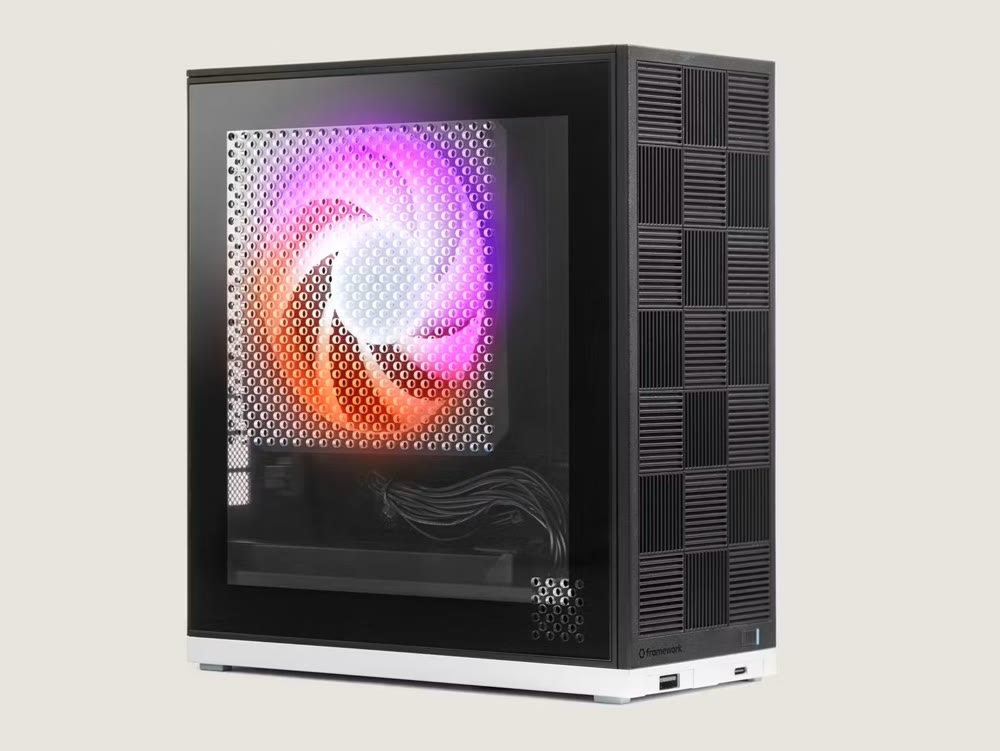
Framework's identity is openness, and the Desktop carries it through. PCWorld observed that 'Framework obsesses over details, from manuals to helpful hints etched into the materials themselves,' a level of documentation almost unheard of in mini PCs. The chassis is a compact 4.5-liter box, and the front panel uses customizable tiles so owners can personalize the look. The catch, flagged by Tom's Hardware, is that the RAM is soldered: 'the soldered RAM is effectively required for the bandwidth this system needs,' so Framework's usual upgradeability does not extend to memory.

Everything else is serviceable in the Framework tradition: storage, the cooler, and the standard-size components can be accessed and swapped, and the system involves some self-assembly out of the box. Tom's Hardware summarized the appeal as 'a fresh take on the mini PC, blending a small form factor with the deep customization found in Framework's laptops.' The Verge framed it as 'a Windows-or-Linux version of Apple's Mac Studio,' which captures both its ambition and its niche.

Platform and Software

The Framework Desktop's biggest advantage over the Apple machines in this group is platform freedom. It runs Windows or Linux, so the entire open-source AI ecosystem, Ollama, llama.cpp, vLLM, ROCm-targeted builds, and Linux-native serving stacks, is available, where the Mac mini M4 Pro and Mac Studio M4 Max are locked to macOS and Metal. For developers who want to script, containerize, or cluster their inference setup with standard Linux tooling, that openness is decisive.

AMD's software has matured to make the large memory usable for AI, most importantly the driver feature that reallocates up to 96 GB of the 128 GB pool as VRAM. That is what turns a nominally integrated-graphics box into a machine that can hold a 120B model. Buyers should expect the AMD AI software experience to be less turnkey than Apple's MLX/Metal path, but the trade is full control and the broadest model and framework compatibility. AMD has been shipping steady ROCm and driver improvements for the Strix Halo platform, and the large addressable VRAM pool means the Framework can load models that would force a discrete-GPU system to spill into slow system RAM, an advantage it shares with the unified-memory Apple machines but at a far lower entry price.

Gaming and General Use

Because it carries the Radeon 8060S iGPU, the Framework Desktop is a credible after-hours gaming and general productivity machine, not just an AI appliance. PCWorld described it as 'a compact, small-form-factor desktop that packs serious power and can be used for productivity, gaming, and AI alike.' It handles 1080p gaming comfortably and runs everyday workloads quietly, so it can serve as a single do-everything box rather than a dedicated inference server sitting idle between sessions.

The Verge added a necessary caveat: while it is 'small and powerful even for 1080p gaming, for the price you can get a full-on gaming rig with discrete graphics.' So the Framework Desktop is a strong all-rounder whose gaming is a bonus, not its reason to exist. Its value rests on the AI capability and the platform openness; the gaming and productivity competence simply make the purchase easier to justify as a primary computer.

Where It Falls Short

The two real limitations are bandwidth and price relative to alternatives. At 256 GB/s it cannot match the Mac Studio M4 Max for token speed, so anyone optimizing purely for inference throughput on 70B models will find the Mac faster. And as The Verge noted, for the money a discrete-GPU gaming PC offers more raw graphics power, so the Framework only makes sense if the 128 GB of unified memory is something you will actually use. Tom's Hardware put it plainly: 'if you don't use all of the RAM, you might be better off with a cheaper system.'

The soldered memory is a philosophical wrinkle too: a company known for upgradeable hardware shipped a non-upgradeable memory pool, justified by the bandwidth requirement but still a limit. And the self-assembly, while well documented, is more involved than the plug-and-play GMKtec EVO-X2 or Beelink GTR9 Pro. None of these are dealbreakers for the target buyer, but they narrow the audience.

Value at This Price

The Framework Desktop's value hinges entirely on whether you use the 128 GB of memory. ServeTheHome captured the shifting calculus: 'a few weeks ago, many would consider $1999 for the base price of a 128GB memory system to be high. Now given the spike in DDR5 pricing that feels quite reasonable.' Because the unified memory is what lets the box hold 120B-class models, buyers who actually run large models get strong value, while those who do not are paying for capacity they will not touch.

Tom's Hardware made the counterpoint plainly: 'if you don't use all of the RAM, you might be better off with a cheaper system,' and The Verge noted a discrete-GPU gaming rig offers more graphics power for the money. Against the GMKtec EVO-X2, which uses the same silicon, the Framework asks a small premium for its openness, documentation, and customizable chassis. That premium is worth it for buyers who value repairability and the Framework ethos; for pure price-per-performance on the same silicon, the EVO-X2 edges it out.

Who It's Best For

The Framework Desktop is for the open-platform enthusiast who wants 128 GB of local-LLM headroom without Apple's price or ecosystem lock-in. Developers and homelabbers who live in Linux, value repairability and documentation, and want to run very large models, including 120B-class mixture-of-experts models, on their own terms are the core audience. It is the machine to buy when platform freedom and the ability to fit big models matter more than raw token speed.

It is not the pick for someone chasing the fastest inference, who should pay up for the Mac Studio M4 Max, nor for a buyer who wants the absolute lowest price for the same silicon, where the GMKtec EVO-X2 undercuts it, nor for anyone who wants dual 10GbE for clustering, where the Beelink GTR9 Pro leads. But for the open, repairable, large-memory AI desktop, the Framework Desktop is the standout.

Strengths

  • +128 GB LPDDR5X-8000 unified memory lets you assign up to 96 GB as VRAM for local models
  • +Explicitly built and marketed for local LLM work; runs GPT-OSS 120B at usable speeds
  • +Framework's hallmark repairability and documentation, including a customizable front tile panel
  • +Runs Windows or Linux, opening up the full open-source AI toolchain the Mac Studio cannot
  • +Compact 4.5-liter chassis that doubles as a capable productivity and 1080p gaming PC

Watch-outs

  • Soldered LPDDR5X means no future memory upgrades despite Framework's repairable reputation
  • 256 GB/s bandwidth trails the Mac Studio M4 Max badly, so token speed is mid-pack
  • Expensive versus a gaming PC with discrete graphics if you don't use the full 128 GB
  • Requires some self-assembly, more involved than the plug-and-play mini PCs here

How it compares

The Framework Desktop runs the same AMD Ryzen AI Max+ 395 silicon and 128GB of unified memory as the GMKtec EVO-X2 and Beelink GTR9 Pro, so it fits the same 120B-class models at the same roughly 256 GB/s bandwidth, well below the Mac Studio M4 Max. It differentiates on platform and ethos: an open, repairable chassis running Windows or Linux, which the macOS-only Mac mini M4 Pro and Mac Studio M4 Max cannot match. Versus the GMKtec EVO-X2 it trades some plug-and-play convenience for Framework's documentation and customizable tile front; versus the Beelink GTR9 Pro it gives up dual 10GbE networking. Choose it for the most open 128 GB local-LLM box.

Who this is for

At a glance: Open-platform tinkerers who want 128 GB of local-LLM headroom on Windows or Linux.

Why you’d buy the Framework Desktop (Ryzen AI Max+ 395)

  • 128 GB LPDDR5X-8000 unified memory lets you assign up to 96 GB as VRAM for local models.
  • Explicitly built and marketed for local LLM work; runs GPT-OSS 120B at usable speeds.
  • Framework's hallmark repairability and documentation, including a customizable front tile panel.

Why you’d skip it

  • Soldered LPDDR5X means no future memory upgrades despite Framework's repairable reputation.
  • 256 GB/s bandwidth trails the Mac Studio M4 Max badly, so token speed is mid-pack.
  • Expensive versus a gaming PC with discrete graphics if you don't use the full 128 GB.

Rating sources

Our 4.4 score is the average of these published ratings. Ratings marked * were derived from the reviewer’s written analysis or video transcript — the publisher didn’t print an explicit numeric score, so we inferred one from their own words. Click through to verify. More about methodology.
Frequently asked questions

Is the Framework Desktop (Ryzen AI Max+ 395) worth buying?
The Framework Desktop puts AMD's Strix Halo silicon into an open, repairable chassis aimed squarely at local AI. PCWorld awarded it 4.5/5 and an Editors' Choice, writing that 'it's not just for tinkering, this machine can legitimately run the latest AI models locally, something few desktops this size can do.' With 128 GB of LPDDR5X-8000 unified memory, AMD's driver can assign up to 96 GB as VRAM, enough to run GPT-OSS 120B, which AMD says runs about ten times faster than Llama 3 70B on this chip. ServeTheHome called it 'our third-favorite AMD Strix Halo mini PC so far,' and Tom's Hardware noted 'the mix of powerful graphics and plentiful RAM is why Framework is pushing this as an AI system.' It runs Windows or Linux, so the full open-source AI stack is available, unlike on the Mac Studio. Bandwidth and price are the limits.
What is the Framework Desktop (Ryzen AI Max+ 395)'s biggest strength?
128 GB LPDDR5X-8000 unified memory lets you assign up to 96 GB as VRAM for local models
What is the main drawback of the Framework Desktop (Ryzen AI Max+ 395)?
Soldered LPDDR5X means no future memory upgrades despite Framework's repairable reputation
What sources back the 4.4/5 rating?
Our 4.4/5 rating is the average of scores from 3 independent ai mini pcs for local llm reviews — pcworld, servethehome, and tomshardware. Click any source on the product page to read the original review.

How it compares

See all 5
Apple Mac Studio M4 Max
#1 · Top Score

Apple Mac Studio M4 Max

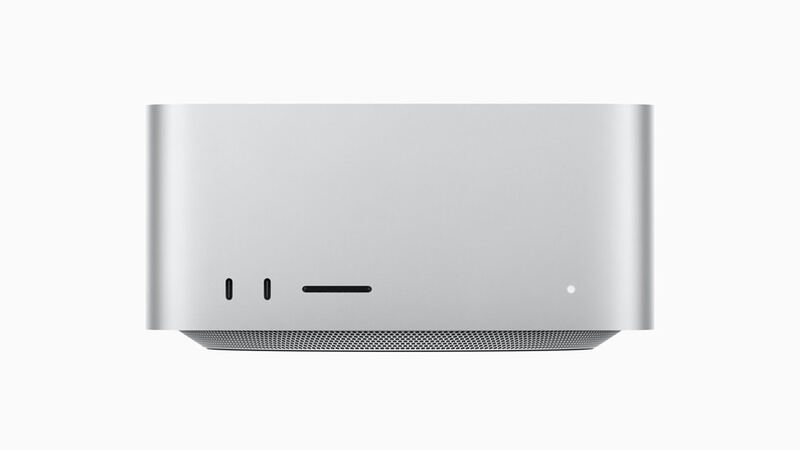
The Mac Studio M4 Max posts the highest memory bandwidth in this group at 546 GB/s, roughly double the Mac mini M4 Pro (273 GB/s) and the GMKtec EVO-X2 and Beelink GTR9 Pro (256 GB/s), which is why it generates tokens fastest on 70B models. Its memory ceiling of 128 GB matches the Strix Halo boxes for model size but at far higher bandwidth and price. Choose it over the Mac mini M4 Pro when you need both more than 64 GB and the fastest Apple inference; choose a GMKtec EVO-X2 or Framework Desktop instead if you want 128 GB on Linux or Windows at a fraction of the cost.

Mac mini M4 Pro 64 GB
#2

Mac mini M4 Pro 64 GB

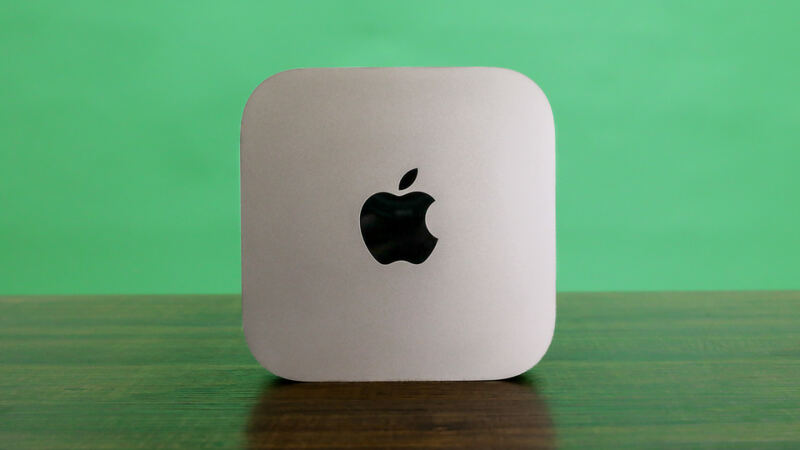
The Mac mini M4 Pro is the value Apple pick: at 273 GB/s it has higher bandwidth than the 256 GB/s Strix Halo boxes (GMKtec EVO-X2, Beelink GTR9 Pro, Framework Desktop) for single-user 70B inference, but it is capped at 64 GB, so it cannot hold the 120B-class models those 128 GB machines fit. The Mac Studio M4 Max doubles both its bandwidth and memory ceiling for roughly the price increase. Pick the Mac mini M4 Pro if your models top out near 70B and you want Mac polish and silence at a lower price than the Mac Studio M4 Max; step up to a 128 GB box if you need more headroom.

GMKtec EVO-X2
#3

GMKtec EVO-X2

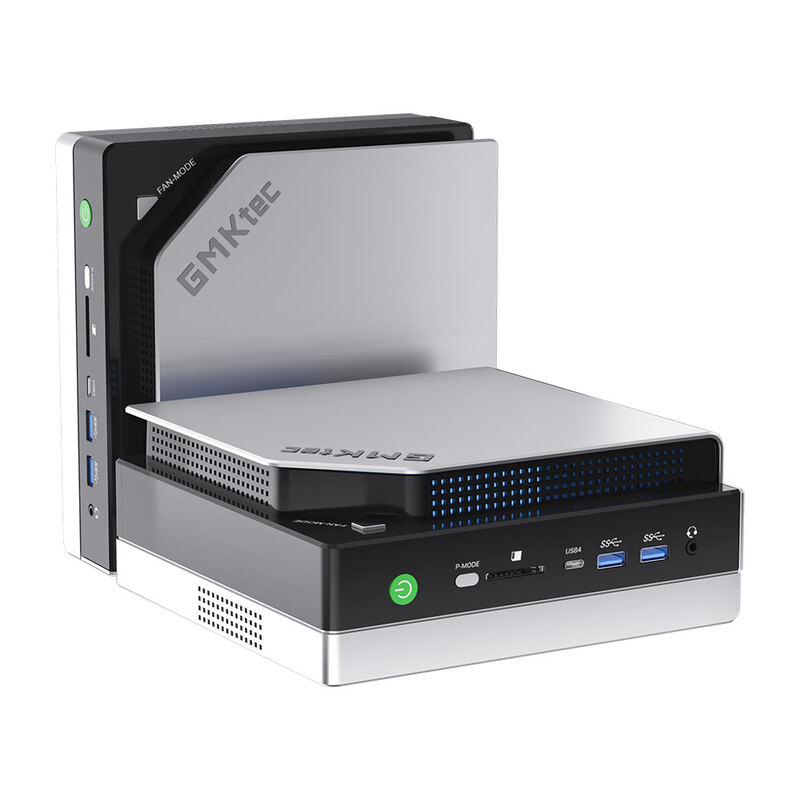
The GMKtec EVO-X2 is the best-value 128 GB box for local-LLM users whose models outgrow 64 GB. Its 128GB of unified memory at 256 GB/s fits 120B Q4 models the Mac mini M4 Pro cannot, far cheaper than the Mac Studio M4 Max. It shares the same Strix Halo silicon as the Beelink GTR9 Pro and Framework Desktop, so all three deliver effectively identical throughput; the EVO-X2 wins on price and fan-control buttons but loses dual 10GbE to the Beelink GTR9 Pro and the open, repairable chassis to the Framework Desktop. Pick it for the cheapest path to 128 GB of model headroom.

Beelink GTR9 Pro
#5

Beelink GTR9 Pro

The Beelink GTR9 Pro shares the same AMD Ryzen AI Max+ 395 silicon and 128GB of unified memory at 256 GB/s as the GMKtec EVO-X2 and Framework Desktop, so the three deliver effectively identical local-LLM throughput (~6-8 tokens/sec on 70B Q4). It differentiates on networking and chassis: dual 10GbE ports for AI clustering plus an industrial metal case. If you don't need the 10GbE, the GMKtec EVO-X2 saves money for the same performance, and the Framework Desktop offers a more open platform. Versus the Mac mini M4 Pro it doubles memory headroom; versus the Mac Studio M4 Max it is far cheaper but much lower bandwidth.

Framework Desktop (Ryzen AI Max+ 395)
4.4/5· $1,999
Buy at frame.work