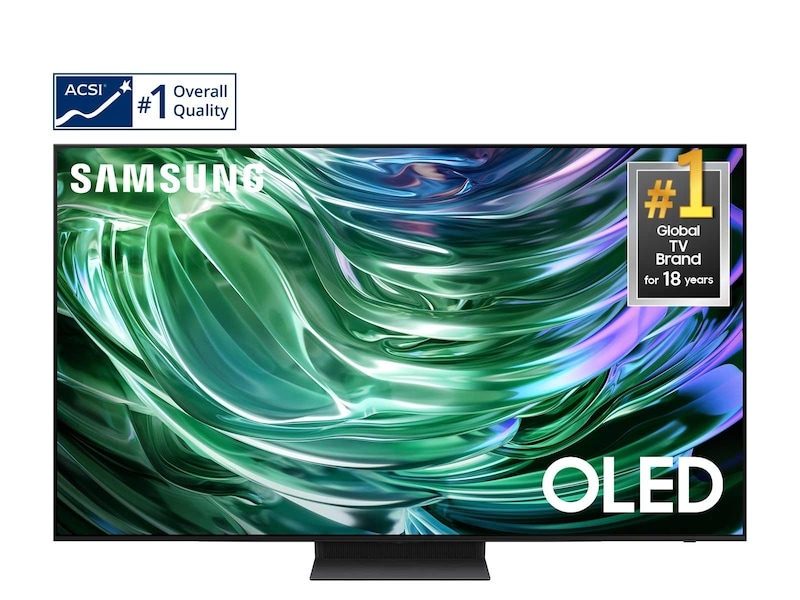
Samsung's mid-tier QD-OLED is the value play for buyers who want OLED picture quality without paying flagship money. On certain content the QD-OLED panel renders saturated colors more vividly than the LG G4 does, and street pricing under $1,500 makes it the cheapest entry to true premium picture quality.
Full review
99% DCI-P3 beats the LG's WOLED panel
The Samsung S90D uses a third-generation QD-OLED panel — blue OLED emitters paired with a quantum-dot color conversion layer — and the result is a measurably wider color gamut than the WOLED panel in the LG OLED G4. Pinks render more vividly than on competing OLEDs, which makes animated content and modern HDR-graded action films pop visibly. Peak HDR brightness measures approximately 1,300 nits on a 10% window — bright by OLED standards but trailing the LG G4's MLA panel by roughly 30% on equivalent windows. SDR brightness sustains around 800 nits full-screen, plenty for most viewing rooms.
Color volume is where the QD-OLED architecture actually pays off. DCI-P3 coverage measures around 99% and the panel hits 80% or better in Rec.2020 — figures that pull noticeably ahead of the WOLED competition on test patches. In practice the gain shows up most in animation, anime, and video games with stylized palettes: reds look genuinely red rather than orange-red, greens look saturated without going neon. For viewers whose content mix leans heavily on Pixar, Studio Ghibli, modern animated series, or competitive games with vivid UI elements, the QD-OLED palette is a meaningful upgrade over the LG G4's WOLED panel — one of the few areas where the cheaper TV pulls ahead of the more expensive one.
Gaming and HDMI 2.1
All four HDMI ports are full 48 Gbps HDMI 2.1, matching the LG OLED G4 and beating the TCL 65QM7K's two-port limit. Native refresh is 120Hz, with HDMI 4 firmware-enabled for 144Hz on PC connections — a niche but real feature for high-refresh gamers. VRR, ALLM, AMD FreeSync Premium, and a low-latency Game Bar overlay round out the gaming feature set. RTINGS measured input lag in the single-digit milliseconds with Game Mode active. The one feature missing for gamers is Dolby Vision Gaming — Samsung's continued refusal to license Dolby Vision means PS5 Dolby Vision titles fall back to HDR10.
Samsung's Gaming Hub is the other notable feature for gamers: native cloud-gaming clients for Xbox Cloud Gaming, GeForce Now, Amazon Luna, and Utomik run on the TV directly without needing a console, with full controller support over Bluetooth. RTINGS specifically called out the gaming feature set as a competitive advantage, and the Tizen-based Game Bar surfaces frame rate, HDR status, VRR status, and a low-latency crosshair overlay. For households where the TV doubles as the kids' Roblox machine or a casual cloud-gaming endpoint, the Gaming Hub meaningfully reduces hardware needed in the entertainment center.
LaserSlim chassis routes cables through One Connect
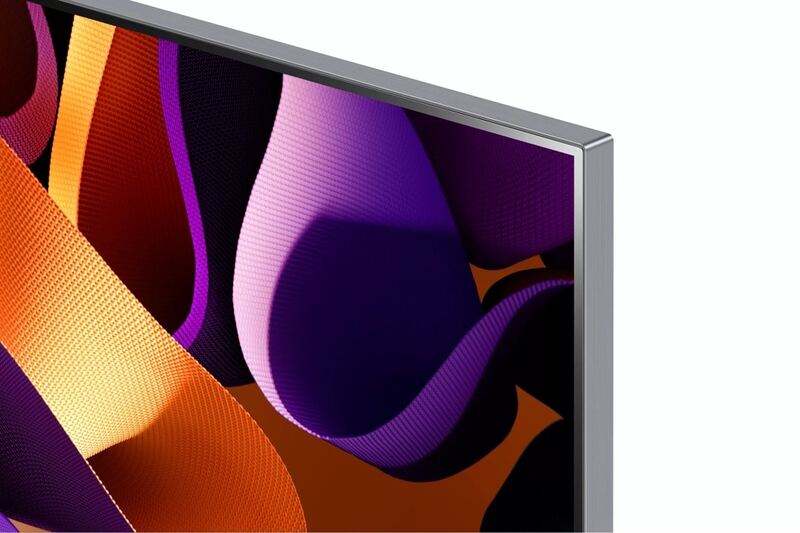
The S90D adopts Samsung's 'LaserSlim' chassis with a thin top section, sub-bezel display, and a wider lower section that houses the connections and electronics. Compared to the LG OLED G4's gallery design, the S90D is not as flat against a wall, but it is more conventional in form factor and ships with a central pedestal stand. Build quality is excellent — metal back, premium plastics on the bezel — and the included One Connect Box on some variants (check the exact SKU) routes all HDMI through a remote box, leaving only a thin cable to the panel. The bezel is a hair under three millimeters on the top and sides.
Tom's Guide called it the best bang for buck
Tom's Guide called the S90D 'the best bang for your buck' among 2024 OLEDs after a two-week test. What Hi-Fi praised the 'incredible contrast' and 'highest luminance on an OLED' alongside the gaming feature set. RTINGS placed it near the top of their OLED rankings for the year. The consensus is that the S90D delivers ~90% of the picture quality of the flagship S95D (with its anti-reflection coating) and the LG G4 at 60-70% of the price. At street prices below $1,500 it is the lowest-cost path to genuine OLED picture quality and represents the strongest value in the premium category.
No Dolby Vision, falls back to HDR10
The biggest miss is Samsung's continued refusal to support Dolby Vision. Most premium streaming and physical-media releases ship Dolby Vision metadata; on the S90D those fall back to HDR10 or, where available, HDR10+. Reviewers who watch a lot of Apple TV+ and Disney+ Dolby Vision content describe this as a meaningful picture-quality drop on tone-mapped scenes. The second weakness is the standard matte coating — competent in moderate ambient light but less impressive than the S95D's nano-textured screen for windowed rooms. Tizen's ad-heavy home screen, weak 2.1-channel audio, and Samsung's history of dropping app support after a few years round out the list.
Some early units shipped with the wrong panel
The S90D is the right answer for buyers who want the OLED black-level advantage and the gaming feature set of a 2024 flagship without paying flagship money. It particularly suits PS5 and Xbox gamers (full HDMI 2.1, low input lag), PC gamers who can use the 144Hz mode, and viewers who watch a lot of saturated color content where the QD-OLED panel earns its premium. Skip it if your media library is heavy on Dolby Vision discs or Apple TV+ subscriptions where the lack of DV support stings, if your room is brightly lit (the S95D's anti-reflection layer would serve you better), or if you cannot budget for a soundbar.
It is also worth flagging the panel-version situation: some early QN65S90D units shipped with WOLED panels rather than QD-OLED panels, which Samsung quietly acknowledged after community testing surfaced the swap. Most current production is QD-OLED, but buyers who specifically want the QD-OLED color volume should verify on arrival — a quick 25% red test pattern will reveal which panel you received, and Samsung's customer service has generally honored returns or exchanges where the WOLED variant was shipped. This is a unique quirk that does not affect the LG G4 or any other TV in this guide, but it is worth knowing before buying.
Saves $700 versus the G4, no Dolby Vision
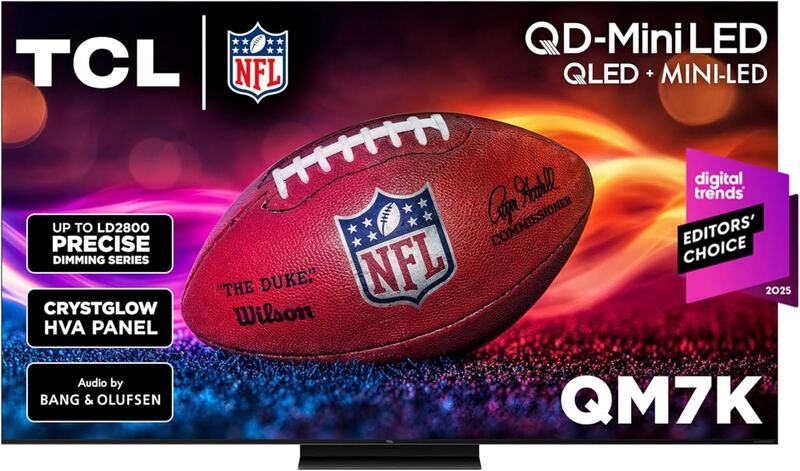
Against the LG OLED G4 the S90D saves roughly $700 at street while losing Dolby Vision support and roughly 30% of peak HDR brightness on small windows; for many buyers that is the right trade. Against the TCL 65QM7K mini-LED the S90D is dimmer in absolute terms but wins decisively on per-pixel contrast and viewing angles. Within Samsung's own lineup the S95D adds the nano-textured anti-reflection coating and a small brightness bump for ~$1,000 more — worth it for a bright room, overkill for a dim one. The S90D occupies the sweet spot.
Street price has dropped to $1,200
Originally listed at $2,700, the QN65S90D has settled into a street price between $1,400 and $1,600 — and frequently dips to $1,200 during major sale events. At those numbers it is unambiguously the cheapest premium OLED on the US market, and on most content it delivers picture quality within striking distance of a $2,500 LG G4. For buyers who can live without Dolby Vision and budget separately for audio it is the best value proposition in the premium tier of this guide.
Total cost of ownership over a five-year window is roughly $1,800 once a $300 mid-tier soundbar is included — still well below the $2,500-plus all-in cost of the LG OLED G4 with comparable audio. For buyers running the numbers on price per year of premium OLED ownership, the S90D wins decisively. The newer S90F successor adds incremental brightness for 2025 buyers but at a meaningfully higher price; the older S90D remains the value pick until inventory clears, and Samsung has historically supported the S-class with Tizen updates for at least four years from launch.
Strengths
- +Third-generation QD-OLED panel delivers wider color volume than competing WOLEDs, especially on saturated reds and greens
- +Roughly 1,300 nits peak HDR brightness on a 10% window — the brightest QD-OLED Samsung has shipped
- +All four HDMI ports are HDMI 2.1, with native 120Hz and a firmware-enabled 144Hz mode on HDMI 4 for PC use
- +Tizen smart OS is fast and responsive, with deeper game-streaming integration than Google TV
- +Frequently discounted below $1,500 — the cheapest premium OLED experience on the market
Watch-outs
- −Samsung still refuses to support Dolby Vision — disc players and streaming services fall back to HDR10+
- −Standard matte coating (not the nano-textured S95D coating) shows brighter room reflections
- −Tizen home screen is ad-heavy and difficult to fully suppress
- −2.1-channel 40W audio is even thinner than the LG G4 and absolutely requires a soundbar
How it compares
Costs roughly $700 less than the LG OLED G4 at street, with comparable peak HDR brightness on smaller windows but without Dolby Vision support. Versus the TCL 65QM7K it is a different category — true OLED black levels at a price closer to flagship mini-LED than to flagship OLED. Against the Hisense 65U7N the Samsung is double the price but the per-pixel contrast and color volume justify the gap for serious movie watching.
Rating sources
“I tested this Samsung OLED TV for 2 weeks and it offers the best bang for your buck”
Our 4.4 score is the average of these published ratings. Ratings marked * were derived from the reviewer’s written analysis or video transcript — the publisher didn’t print an explicit numeric score, so we inferred one from their own words. Click through to verify. More about methodology.