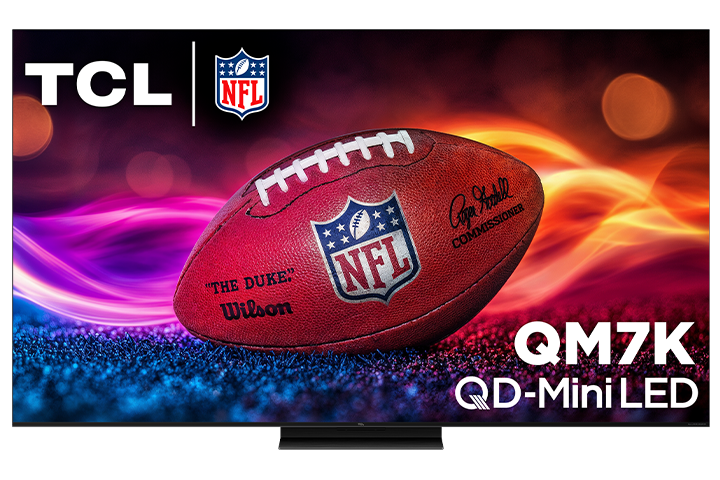
TCL's 2025 mid-range QD-mini-LED is the price-performance king of this guide. Measured peak HDR brightness lands in the same neighborhood as premium mini-LEDs at well under half the price, helped by a meaningfully upgraded local dimming optical stack, and the Onkyo-tuned audio punches above its weight. You give up viewing angles to the VA panel, and the Google TV firmware still has rough edges.
Full review
TechRadar's 4.5-star pick for the price
The TCL QM7K is the 2025 update to the QM7 — TCL's mid-range mini-LED line — and the changes between generations are real. TechRadar described it as 'a fantastic TV for the price' with 'impressive brightness and contrast, especially when viewing 4K HDR programs, and good sound quality,' awarding 4.5 out of 5 stars. The 65-inch model delivers peak HDR brightness around 2,600 nits using TCL's CSOT HVA panel, an LD2500 Precise Dimming local dimming system, and the new Halo Control optical layer that physically directs LED light to reduce blooming. Tom's Guide praised the panel as 'a full step up from bargain-priced sets' but noted a few 'small missteps,' which the very competitive price more than offsets.
In real-world viewing the brightness number translates into HDR content that looks closer to a premium mini-LED than to a value mini-LED — Apple TV+'s reference HDR demos, Dolby Vision blockbusters from disc, and bright sports broadcasts all benefit. The HVA panel architecture (Huaxing Vertical Alignment, CSOT's variant of VA) targets deeper native blacks than the IPS panels common at this price tier, which combines with the local dimming to give the picture a satisfying punch even before HDR metadata kicks in. SDR cable and YouTube content benefit from the AIPQ Pro processor's upscaling, which is materially better than what TCL shipped on the prior QM7 generation.
Local Dimming and Halo Control
TCL's headline 2025 improvement is the Halo Control optical stack — a microlens layer over the mini-LED zones that confines light spread more tightly to lit zones. RTINGS noted the QM7K brings hardware changes over the prior generation, including its local dimming, and rated it 8.4 for mixed usage. For sports, gaming, and bright HDR content blooming is essentially invisible; for dark-room movie watching it shows up in edge cases around subtitles and starfield-on-black sequences but is meaningfully better than the prior generation.
Onkyo-tuned audio outperforms most TVs this cheap
TCL partnered with Onkyo (and on the 75-inch and 85-inch models, Bang & Olufsen) for the QM7K's audio tuning, and the result is one of the few sub-$1,500 TVs where the built-in audio is genuinely listenable. The 2.1-channel 40W system handles dialogue clearly and pushes enough bass to make Atmos action scenes engaging. It does not replace a soundbar with a separate subwoofer, but it is closer to that benchmark than the LG OLED G4's thin 4.2-channel system or the Hisense U7N's flatter 2.1-channel implementation. Buyers without budget for a soundbar will be noticeably happier with the QM7K's audio than with most of its peers.
Dolby Atmos decoding works correctly through both the built-in speakers and over eARC to a separate soundbar — a quality-of-life detail that not every TV in this price range gets right. The audio settings menu surfaces a useful 'Voice Boost' option that dynamically lifts vocal frequencies for late-night TV watching, and a 'Night Mode' that compresses dynamic range so loud explosions don't wake the house. These are features traditionally reserved for premium TVs, and their inclusion at $999 reinforces the broader QM7K theme of premium feature trickle-down.
Long-Term Durability and Warranty
TCL's standard warranty is one year, which is shorter than the LG OLED G4's five-year panel coverage but matches what Hisense and Samsung offer in this price tier. Most QM7K failures reported on forums cluster around firmware glitches in the first 90 days that get patched, and isolated reports of backlight zone failures after 18-24 months. Buyers concerned about long-term reliability can extend coverage through Allstate or Asurion for $80-130 over four years, which keeps total ownership cost well below the LG G4 even with the protection plan.
Gaming Features and HDMI
The QM7K ships native 144Hz refresh with the Game Accelerator 288 mode (motion interpolation up to 288 fps perceived), ALLM, VRR up to 144Hz, AMD FreeSync Premium Pro, and a low-latency Game Bar. Input lag in Game Mode measures in the single-digit milliseconds. The HDMI port loadout is two HDMI 2.1 ports of four total, which means a soundbar via eARC plus a single console at full bandwidth. Multi-console households should consider the LG OLED G4 or Samsung QN65S90D, both of which offer four HDMI 2.1 ports. For single-console gaming this is a non-issue.
VA viewing angles fade past 25 degrees
TCL ships their TVs warm by default and the QM7K is no exception — out-of-box Filmmaker Mode is closer to neutral but most users will need to spend 15-20 minutes tweaking color temperature and Local Contrast settings to extract the best picture. VA-panel viewing angles fall off noticeably past about 25 degrees off-axis, which can be a problem in wide living rooms. The Google TV firmware occasionally drops Dolby Vision passthrough after long uptime, requiring a reboot to recover — a long-standing issue across TCL's 2024-2025 lineup that firmware updates have improved but not fully fixed. The remote is functional but plastic and cheap-feeling.
Reviewers also flagged a subtle frame-rate-judder issue on 24fps content fed from streaming sources — the panel handles native 24p from disc cleanly with Motion Clarity off, but Netflix and Amazon Prime's 24p-over-60Hz signal can produce occasional stutter on slow horizontal pans. The fix is enabling 'Action Smoothing' at minimum strength, which most cinephiles dislike on principle but which materially improves the streaming experience. Long-term warranty coverage is only one year — much shorter than the 5-year LG panel warranty on the OLED G4 — which is the cost of the aggressive pricing.
Built for bright rooms on a $1,000 cap
The QM7K is the right answer for buyers with a bright living room and a budget capped around $1,000 — sports fans, families with daytime TV habits, anyone whose room has windows or skylights that an OLED would struggle in. It's also the best pick for a primary living-room TV where you want premium-tier brightness and a strong audio system without splitting the budget across a TV and a soundbar. Skip it if you sit far off-axis from the screen (the VA viewing angles are a real limit), if you watch primarily dark-scene Dolby Vision content where an OLED would shine, or if you need three or more HDMI 2.1 ports for multiple consoles plus a PC.
Double the brightness of the LG, at half price
Within this guide the QM7K's nearest rival is the Hisense 65U7N — same price tier, same panel category, similar overall scores. The TCL adds the Halo Control optical stack, the higher 144Hz refresh, anti-reflective coating, and the Onkyo audio tuning; the Hisense counters with slightly lower street pricing. Against the Samsung QN65S90D the comparison is OLED vs mini-LED at a $600 spread — the TCL is dramatically brighter and the Samsung is dramatically blacker. Against the LG OLED G4 the picture is double-the-brightness, half-the-price, but black levels are fundamentally lower.
AVS Forum named it Top Choice for 2025
At $999 the 65QM7K is genuinely shocking value — measured peak HDR brightness within striking distance of TVs three times the price, premium-tier gaming features, Onkyo audio tuning, and Dolby Vision plus HDR10+ support. AVS Forum named it 'AVSForum Top Choice for 2025,' which captures the consensus that this is the best mini-LED value of the year. Buyers comparison-shopping a mid-range living-room TV should default to the QM7K unless a specific feature pushes them elsewhere.
Sale pricing has bottomed around $849 during Prime Day and Black Friday events, which compresses the value gap against the Hisense U7N to under $100 — at that pricing the QM7K becomes the unambiguous best buy in its tier. The 75-inch and 85-inch SKUs share the same panel and dimming technology and scale up the audio to a B&O-tuned 2.1.2-channel system, which is one of the most aggressive built-in audio offerings on any TV under $2,000. Buyers eyeing a larger living-room TV should weigh the 75QM7K against jumping a tier to the LG OLED C4 in the same size.
Strengths
- +Peak HDR brightness around 2,600 nits on the 65-inch model — within striking distance of premium mini-LEDs costing three times as much
- +LD2500 Precise Dimming with the new Halo Control optical stack noticeably reduces blooming compared to the QM7 predecessor
- +144Hz native refresh, ALLM and VRR, Game Accelerator 288 mode — strong gaming feature set at the price
- +Onkyo-tuned 2.1-channel audio with Dolby Atmos is competitive with $300 entry-level soundbars
- +Anti-reflective screen coating handles bright living-room ambient light better than the Hisense U7N
Watch-outs
- −Off-axis viewing on the VA panel falls off harder than the IPS-based competition
- −Google TV implementation occasionally drops Dolby Vision passthrough until the TV is rebooted
- −Only 2 of 4 HDMI ports are HDMI 2.1 — trails the LG OLED G4 and Samsung QN65S90D
- −TCL's color calibration ships warm by default; budget some time for picture mode tweaking
How it compares
Against the Hisense 65U7N at a similar price point the TCL adds the Halo Control optical stack, a higher refresh rate, and anti-reflective coating; the Hisense counters with marginally lower street pricing. Versus the LG OLED G4 the trade is OLED black levels for double the brightness at half the price. Compared to the Samsung QN65S90D the TCL gives up OLED per-pixel contrast for substantially more peak brightness — better for bright rooms.
Rating sources
“A fantastic TV for the price with impressive brightness and contrast”
“A full step up from bargain-priced sets with good picture quality”
Our 4.1 score is the average of these published ratings. More about methodology.