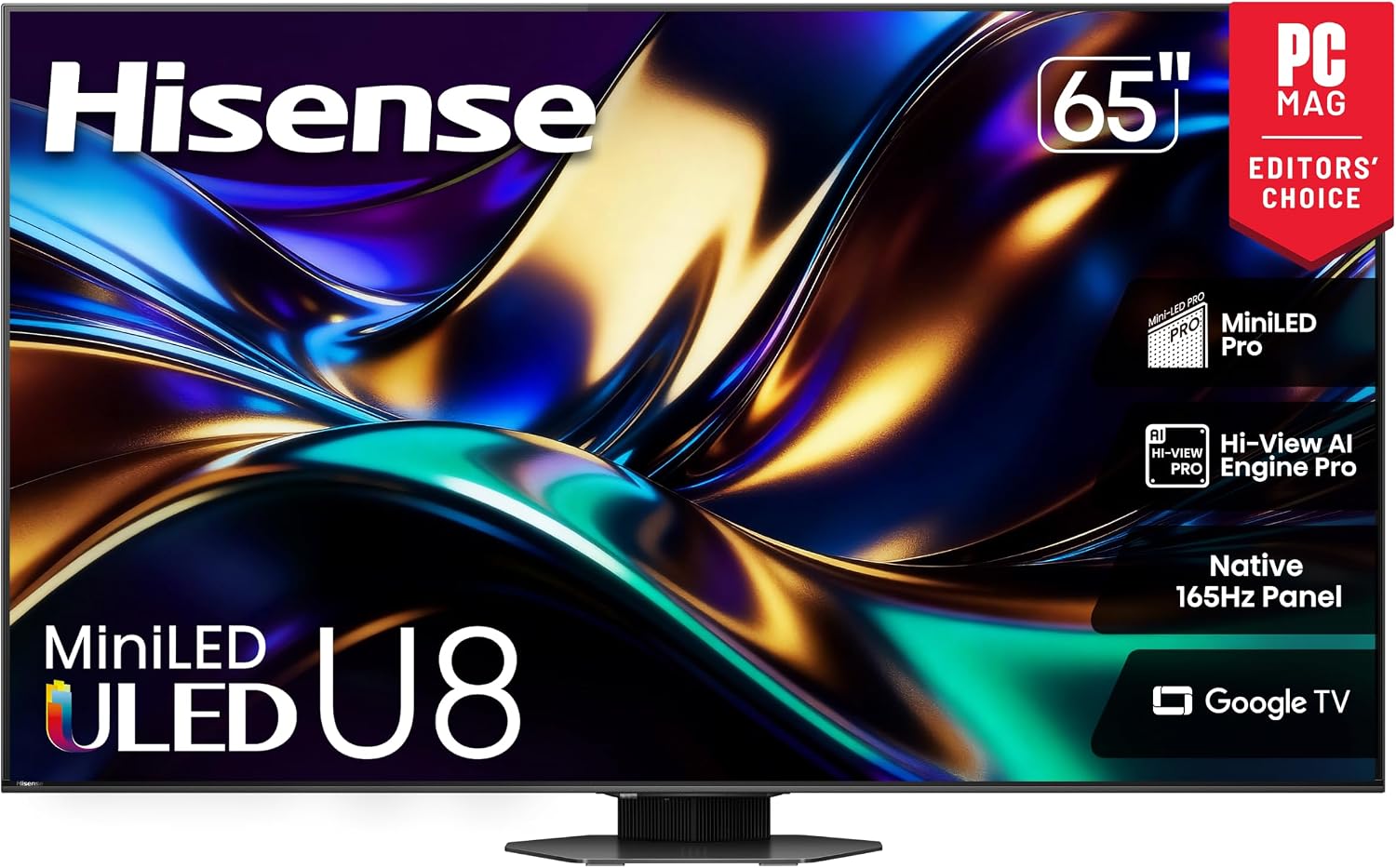
The Hisense U8QG is a 2025 mini-LED TV built around brightness. PCMag measured 3,200 nits on an 18% window and gave it an Editors' Choice; CNET calls it the brightest TV its reviewer has formally reviewed; RTINGS, which bought the 65-inch model, rates it great for mixed usage. The trade-offs the testers agree on are a mediocre viewing angle and HDR tone mapping that runs bright, and PCMag found only three HDMI ports.
Full review
Brightness measured by three outlets
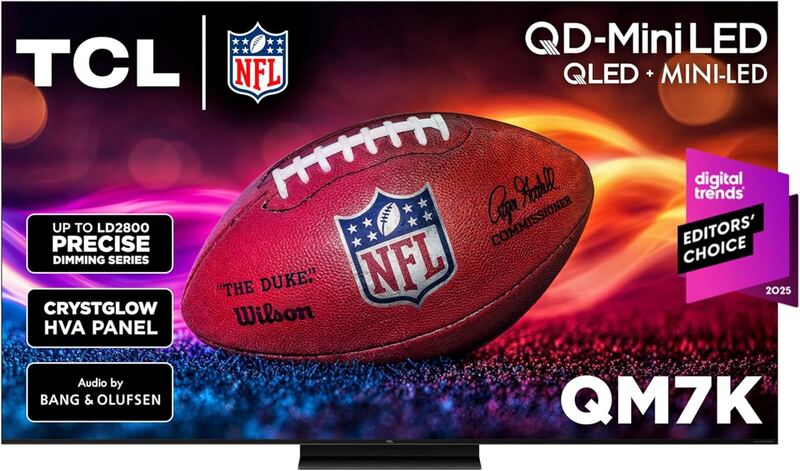
PCMag measured 845 nits with a full-screen white field and 3,200 nits with an 18% field in HDR Theater mode on the 65-inch set, which it says is significantly brighter than the Hisense U8N (2,755 nits) and the TCL QM7K (2,092 nits) at the same 18% field. CNET calls the U8QG the brightest TV its reviewer has formally reviewed so far.
RTINGS, which bought and tested the 65-inch model, lists exceptional HDR brightness in all scenes and outstanding SDR brightness, and says the set barely loses image quality in a well-lit room.
Contrast and blooming
RTINGS describes very deep blacks with minimal blooming around highlights and subtitles. PCMag saw almost no light bloom with an 18% white field against black, though it noticed some slight bloom around bright, colorful objects on fully black backgrounds in test footage. CNET found very little blooming of objects on black backgrounds and says the set held up well against an OLED in its side-by-side comparison.
Gaming and inputs
PCMag measured input lag of 10.1 milliseconds with a 4K60 signal and 4.3ms at 1080p120, and notes the 165Hz native refresh rate and AMD FreeSync Premium Pro support. RTINGS lists low input lag at higher refresh rates, but also slow pixel transitions that leave fast motion with some blur when gaming.
PCMag counted three HDMI ports on its 65-inch sample, one fewer than most TVs, plus a side USB-C port that accepts DisplayPort video at up to 4K165 but without HDR.
Where it falls short
RTINGS rates the viewing angle as only okay, so the picture degrades for wide seating arrangements, and it found sub-par PQ EOTF tracking that makes HDR content look brighter than intended. CNET also saw some loss of high-brightness detail: the set blew out white in a Spears and Munsil test scene mastered at 4,000 nits, and colors turned grey off-axis.
Strengths
- +PCMag measured 3,200 nits on an 18% field and 845 nits full-screen in HDR
- +Very deep blacks with minimal blooming, per RTINGS
- +Low input lag: 10.1ms at 4K60 and 4.3ms at 1080p120 in PCMag's tests
- +165Hz native refresh rate with AMD FreeSync Premium Pro, per PCMag
- +Holds picture quality in a well-lit room, per RTINGS
Watch-outs
- −Viewing angle is only okay, per RTINGS
- −HDR content looks brighter than intended due to sub-par PQ EOTF tracking, per RTINGS
- −PCMag counted only three HDMI ports on the 65-inch model
- −Slow pixel transitions blur fast motion in games, per RTINGS
How it compares
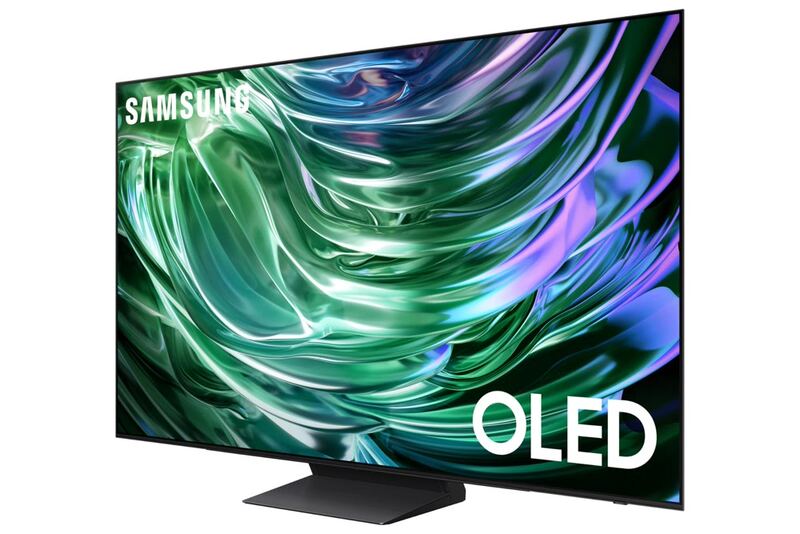
PCMag measured it at 3,200 nits on an 18% field against 2,092 nits for the TCL QM7K, so it is the brighter of the two mini-LED sets on this page. Unlike the LG OLED evo G4 and Samsung S90D OLEDs, it is an LCD with a mini-LED backlight, and RTINGS and CNET both note some blooming and off-axis color loss that OLEDs avoid.
Rating sources
Counts as 4.38/5 in our score — this publisher's 87 scores on the site average 3.98, so its scores are adjusted up to compare fairly with other publishers.
Counts as 4.16/5 in our score — this publisher's 181 scores on the site average 4.00, so its scores are adjusted up to compare fairly with other publishers.
Counts as 4.21/5 in our score — this publisher's 34 scores on the site average 4.21, so its scores are adjusted down to compare fairly with other publishers.
Our 4.3 score is the average of these published ratings, each adjusted for how strictly its publisher scores. More about methodology.