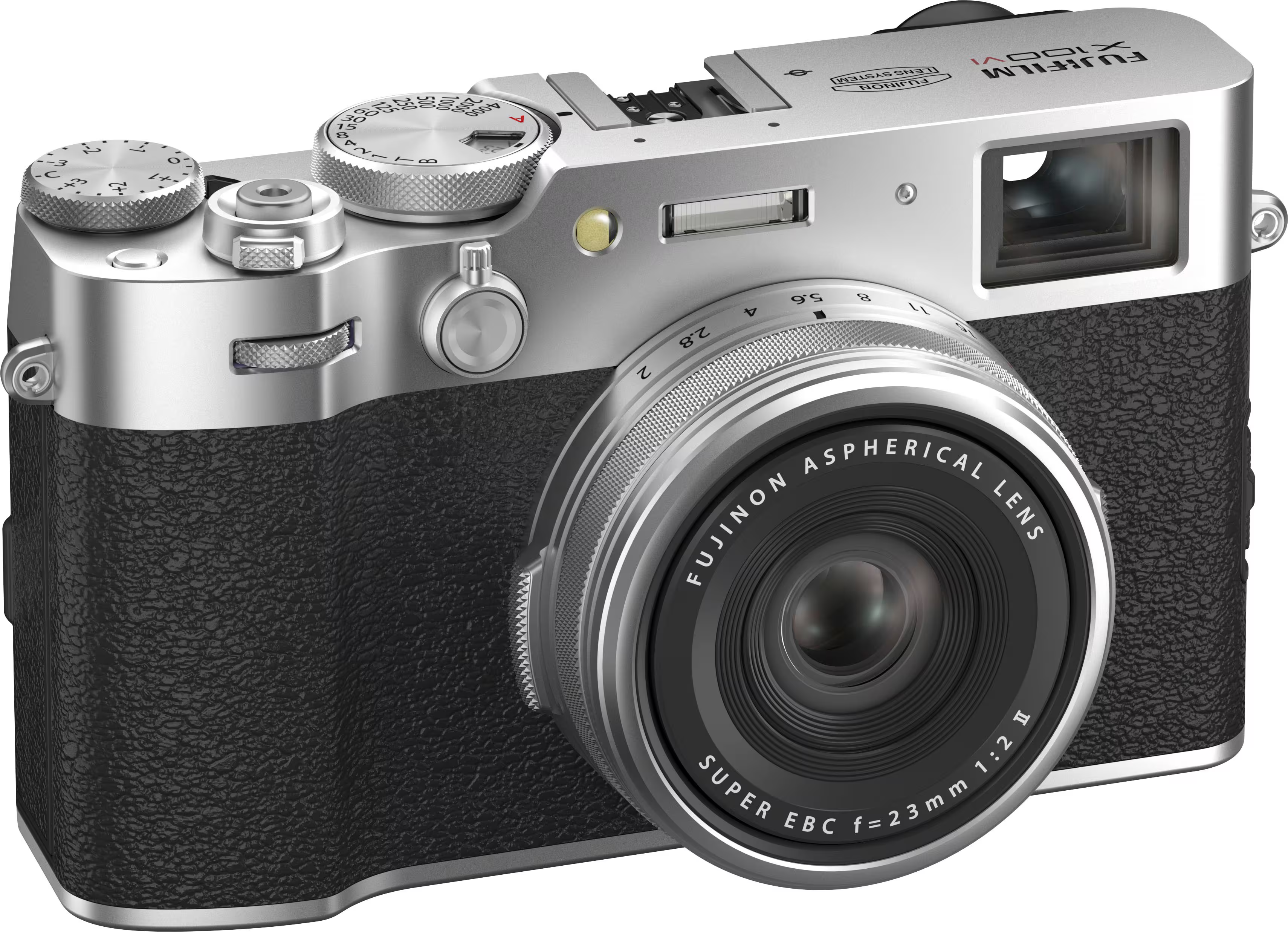
The Fujifilm X100VI is a fixed-lens APS-C camera with a 40MP sensor and a 35mm equivalent F2 lens. Reviewers praised its high-resolution image capture, in-body stabilization, and the extensive film simulation options, including the new Reala ACE and Eterna Bleach Bypass modes. It adds camera-to-cloud functionality for direct uploads to Adobe Frame.io. Some users felt build quality slipped next to its predecessor, and overheating came up in warm environments. Enthusiasts who want a compact, high-quality fixed-lens camera with extensive creative controls are the fit.
Full review
Design Evolution
The Fujifilm X100VI represents a minimal evolution from its predecessor, the X100V, with the most notable change being the addition of in-body image stabilization. According to dpreview.com, the camera's dimensions are nearly identical to the X100V, with only a 2mm increase in depth and 43g added weight. However, the physical changes extend beyond just the IBIS unit. The OVF/EVF selector lever now features a rugged tab for better grip, and the AF assist LED is slightly larger. The drive/delete button has shifted to the right for easier access when using the viewfinder. The tripod mount has been repositioned forward due to the IBIS unit's downward extension. As noted by Jonas Rask Photography, the camera's exterior design changes are so subtle that initial unboxing can easily confuse users with an X100V, with differences only noticeable when comparing bottom plates side-by-side.
Build Quality and Reliability
Build quality has been a significant point of contention among reviewers, with mixed experiences reported. SnapByFox's Roman Fox noted a drop in build quality compared to the X100V, citing loose dials and buttons that lack the firm, reassuring click of previous models. The camera's production shift from Japan to China appears to have affected consistency, with early units experiencing issues like scratched bodies and misaligned media doors. ChurchXStreet's Gajan Balan reported the opposite on his own copy — "From Mexico City, to Toronto, to Helsinki, to New York, and even the Arctic, the X100VI delivered in all sorts of environments" — and aimed his criticism at Fujifilm's release strategy rather than at build defects. Scott Tucker Photography's review highlighted that the VI's build quality has degraded compared to the V, with squishy buttons and un-tactile controls that don't match the camera's premium price point. However, some users have noted improvements in later production batches, suggesting Fujifilm may have refined manufacturing processes over time.
Sensor and Image Quality
The X100VI's 40MP BSI CMOS APS-C sensor, shared with the X-H2 and X-T5, delivers high levels of detail capture. Dpreview.com notes that the sensor's ability to make the most of this resolution bump is not in question, though the lens's performance remains the limiting factor. The camera features Fujifilm's X Processor V, which brings machine-learning trained subject recognition algorithms for animal, bird, automobile, motorcycle, bike, airplane, and train detection. The camera offers 14 film simulations, including the new Reala ACE, Nostalgic Neg, and Eterna Bleach Bypass modes. Scott Tucker Photography emphasized that while the image quality doesn't feel noticeably better than the X100V, the higher resolution sensor provides better detail and microcontrast. However, the camera's JPEGs don't offer a significant advantage over the X100V, with some reviewers noting that the files produced are similar to those from the X-T5 and X-H2, which utilize the same sensor technology.
Autofocus Performance
Autofocus performance has seen significant improvements over the X100V, with dpreview.com noting that the machine-learning trained subject recognition algorithms provide better accuracy and speed. The camera offers wide-tracking or single point approaches for focus acquisition, and subject tracking has improved to a noticeable degree. However, reviewers have noted that the autofocus isn't perfect out of the box, requiring users to customize 2-3 settings for optimal performance. ChurchXStreet's Gajan Balan reported that while the autofocus has matured, there were still instances where focus would miss or subject tracking would be fooled. Scott Tucker Photography noted that the operational speed of the camera, including AF stickiness, menu navigation, and shutter response time, has increased significantly. The camera's ability to track subjects in video mode has also improved, though some users noted that IBIS in video mode still produces jittery footage.
In-Body Stabilization
The addition of in-body image stabilization (IBIS) is the most significant feature of the X100VI, though Fujifilm notes that the IS performance drops from 6.0EV correction to 5.5EV when using the viewfinder in optical mode. The stabilization system is immediately noticeable at low shutter speeds in both stills and video mode, as Scott Tucker Photography confirmed. However, the IBIS unit does not park when the camera is powered off, meaning it rattles around during transport, potentially leading to long-term issues. The system also causes the camera to get quite warm at modest environmental temperatures, with concerns about overheating in summer outdoor situations. The IBIS unit is described as the smallest and likely most fragile to date, according to Tucker's review. Despite these concerns, the stabilization system provides a significant advantage for handheld shooting, particularly in low-light conditions.
User Experience and Workflow
The X100VI offers a unique blend of functionality and ease of use, with multiple composition options including optical viewfinder, electronic viewfinder, hybrid mode, and tilting rear LCD. The camera's physical dials tied to camera settings provide a tactile experience that enhances workflow, as noted by ChurchXStreet's Gajan Balan. However, some reviewers have criticized the camera's handling, particularly the lack of a proper grip and the difficulty of using it with wrist straps. The camera's battery life is adequate for stills but not as good as the X-T5, and the memory card slot only supports UHS-I, which may be limiting for high-resolution photo and video capture. Scott Tucker Photography noted that while the camera's operational speed has increased, the pancake lens still produces grinding sounds during operation, though no lens-related problems have been reported despite these sounds.
Adds 14 film simulations including Reala ACE
Reviewers consistently praised the X100VI's portability and ease of use, with Scott Tucker Photography highlighting its ability to be easily carried and used all day. The camera's film simulations were also a major draw, with dpreview.com noting the addition of 14 film simulations including Reala ACE, Nostalgic Neg, and Eterna Bleach Bypass. The built-in ND filter is another feature that received positive attention, as it allows the f/2 lens to be used wide open in harsh daylight. The camera's ability to deliver great stills in the moment while being great to use was emphasized by ChurchXStreet's Gajan Balan, who described it as creating a great photography experience. The camera's ability to be operated with one hand and its unique mix of technology and rich collection of film simulations were also highlighted as key strengths.
Can overheat and shut down around 26-30°C
Despite its strengths, the X100VI has several notable shortcomings. The build quality has reportedly degraded compared to the X100V, with early production units experiencing issues like scratches, loose components, and misaligned parts. The camera's overheating issues in warm environments, particularly around 26-30°C, were noted by Roman Fox of SnapByFox, with some users reporting shutdowns during extended use. The IBIS system, while beneficial, has problems with not parking when powered off and causing the camera to get quite warm. Scott Tucker Photography criticized the camera's buttons and command wheels as squishy and un-tactile, which doesn't match the premium price point. Additionally, the WiFi file transfers are described as mind-bogglingly slow, and the camera's lack of weather sealing without external filters is a limitation for outdoor use. The camera's operational speed, while improved, still lags behind some competitors in certain areas.
Suited to documentary shooters, not weatherproof pros
The Fujifilm X100VI is best suited for photographers who value portability, ease of use, and a unique shooting experience over cutting-edge technical specifications. It's ideal for documentary photographers, travel shooters, and those who want a camera that can be easily carried and used in various environments. The camera's film simulations and built-in ND filter make it particularly appealing to those who enjoy vintage-style photography. However, it may not be the best choice for professional photographers who require maximum reliability and weather sealing, or those who need the absolute highest resolution output. The camera's overheating issues in warm environments and the degraded build quality in early production units make it less suitable for users who require maximum durability. For those seeking a camera that delivers a fun, unique photography experience with excellent JPEGs and a great shooting workflow, the X100VI remains a strong contender.
Strengths
- +40MP BSI CMOS APS-C sensor delivers high detail capture
- +In-body image stabilization rated at up to 6EV of correction
- +14 film simulations including Reala ACE, Nostalgic Neg, and Eterna Bleach Bypass
- +Built-in Wi-Fi supports camera-to-cloud upload to Adobe Frame.io
Watch-outs
- −Build quality perceived as slightly degraded compared to X100V
- −Overheating issues reported in warm climates
Rating sources
“The X100VI gains the Reala ACE film simulation first seen in the GFX 100 II. Alongside this are added the Nostalgic Neg and Eterna Bleach Bypass simulations, taking the total number to 14 simulate”
“My experience with the X100VI has been mixed. Let's start with the negatives and then move to the positives.”
“It has been that perfect to me. But then again, so was the S, the T and the F.”
Our 3.7 score is the average of the 4 scored reviews above; 1 more reviewed it without printing a score and is not in the average. Ratings marked * were derived from the reviewer’s written analysis or video transcript — the publisher didn’t print an explicit numeric score, so we inferred one from their own words. Click through to verify. More about methodology.