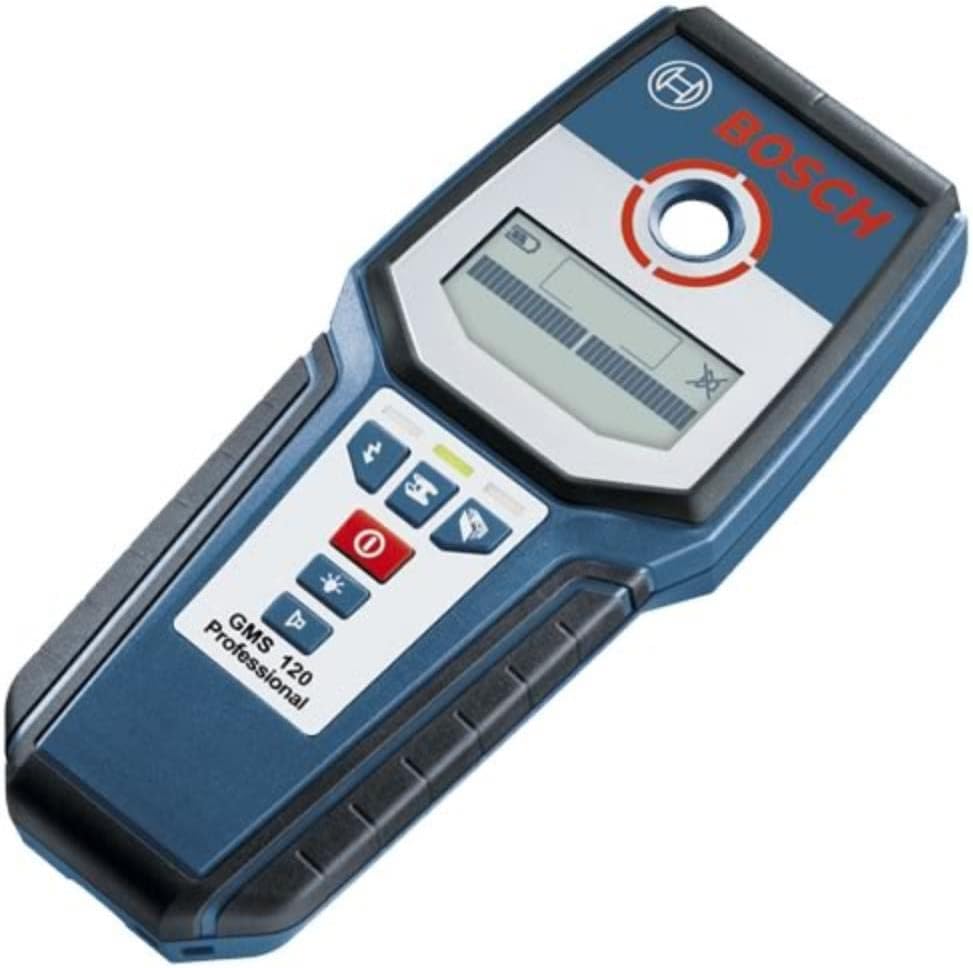
The Bosch GMS120 Wall Scanner is a multi-detection device that finds wood studs, metal objects like rebar and copper, and live wiring. Tools In Action reviewer praised its accuracy and large screen with multiple alert options, while YouTube reviewers highlighted its automatic center finder and convenient pencil-marking hole. However, it struggles with detecting live wires in conduit and isn't 100% accurate in all wall types, requiring multiple scans in some cases. This makes it a solid choice for general home and professional use but not ideal for specialized electrical work.
Full review
Multi-material detection capabilities
Bosch GMS120 Wall Scanner demonstrates robust multi-detection functionality across various materials, with specific performance metrics that vary by material type. According to Tools In Action, the scanner detects steel up to 4-3/4 inches in cured concrete, copper wiring up to 2 inches, non-ferrous metals up to 3-1/8 inches, and wood up to 1-1/2 inches. OneProjectCloser's testing confirmed the device's ability to locate copper pipe and live wire reliably, with the scanner finding center points consistently for these metallic objects. However, the same reviewer noted difficulties in pinpointing exact locations, particularly with live wiring, which appeared as scattered signals rather than clear center indicators. The device's performance with wood studs showed mixed results, where OneProjectCloser found the center point to be more like the left edge rather than the actual center, suggesting a calibration or detection pattern issue specific to wood materials. Tools In Action's review emphasized that the scanner's accuracy improved when users took time to calibrate properly and passed over objects multiple times, indicating that optimal performance requires user technique rather than just device capability alone.
Accuracy in real-world applications
Real-world accuracy testing reveals that while the Bosch GMS120 performs well in controlled environments, its reliability varies significantly in practical applications. Tools In Action reported that the scanner was 'pretty much dead on accurate with the center line of the object' when users took time to calibrate properly and passed over objects multiple times. However, OneProjectCloser's testing showed that the device struggled with wood stud detection, where the found center was actually the left edge rather than the true center. The reviewer noted that the scanner performed better when detecting known studs around switch and outlet boxes, suggesting that the device works more reliably with existing reference points. The inconsistency in wood detection was further highlighted by the fact that the device could find metal studs through plaster, but had difficulty with wood studs in similar conditions, indicating that material composition affects detection accuracy differently than expected.
Operational interface and user experience
The operational interface of the Bosch GMS120 features a straightforward design with only six buttons, including a power button, backlight control, audible alert toggle, and three mode selection buttons for wood, metal, and AC wiring detection. Tools In Action praised the large screen and multiple alert systems (audible, visual, and display) as user-friendly features that provide redundancy in detection confirmation. OneProjectCloser noted that while the display was large, it was difficult to read when the backlight was turned on, especially when not looking straight at the scanner, which was described as 'a bit disappointing.' The device's user experience was further evaluated through a test setup involving drywall with embedded objects, where the scanner's light ring, audio signal, and display all indicated results. The reviewer noted that the marking hole was convenient for marking detected items, and the device's ability to detect objects through various wall types including drywall, cured concrete, and plaster was considered a significant advantage over simpler stud finders.
Battery life and power requirements
The Bosch GMS120 operates on a standard 9V battery and weighs 1.7 pounds according to Tools In Action's review, though Both reviewers noted the device's battery-powered operation, with Tools In Action emphasizing that the unit is 'a good size where it fits in your hand nicely and is easy to slide along the wall.' The battery life was not specifically measured in either review, but the 9V power source was presented as a standard and convenient power solution. OneProjectCloser's test setup included a 9V battery as part of the included accessories, with the reviewer noting that the device came with a protective case, hand strap, and 9V battery. The reviewers did not provide specific runtime figures, but the lightweight design and battery operation were considered practical advantages for handheld scanning applications.
Comparison to competing models
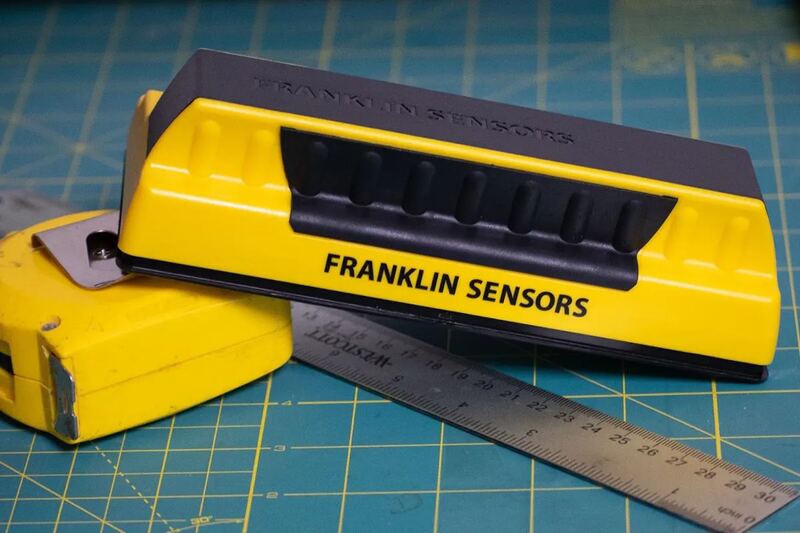
When compared to other stud finders and wall scanners, the Bosch GMS120 stands out for its multi-detection capabilities and professional-grade features, though it faces competition from both budget and premium models. Tools In Action noted that while the device offers more than just wood stud detection, it's not as sophisticated as higher-priced alternatives, but 'for the price and what this scanner can do, its hard to beat.' OneProjectCloser's test revealed that the device performed better than many other stud finders available, particularly in detecting copper pipe and live wire, though it was noted that some cheaper models might have been more reliable for basic stud detection. The reviewer suggested that while the Bosch GMS120 is more reliable than many alternatives, it's not necessarily the best for live wiring detection, with better performance seen in dedicated electrical detection tools. The comparison with the Franklin Sensors ProSensor 710 mentioned by OneProjectCloser indicates that while the Bosch GMS120 offers multi-detection, the Franklin model had not failed users yet, suggesting that established brands with simpler designs might still be preferred by some professionals.
Limitations in specific detection scenarios
Despite its multi-detection capabilities, the Bosch GMS120 shows notable limitations in specific detection scenarios, particularly with live electrical wiring in conduit and certain wall materials. Tools In Action reported difficulty finding live electrical when wires were in conduit, noting that 'this was very hard to pick up when the wire was in conduit' but that 'when I switched to metal, it would find the conduit right away.' The reviewer also mentioned that for live wire not in conduit, the device 'did a pretty good job' but was not 'great' in detection accuracy. OneProjectCloser's testing showed that the device performed well with copper pipe and live wire, but had issues with wood stud detection, where the center point was consistently misaligned. The reviewer noted that the device worked better with metal studs through plaster than with wood studs, suggesting that material density and composition affect detection accuracy differently. Additionally, the display readability issues noted by OneProjectCloser, particularly with backlighting, were identified as a significant limitation for usability in darker environments.
Professional suitability and recommendations
The Bosch GMS120 Wall Scanner is positioned as a professional-grade tool that offers multi-detection capabilities beyond simple stud finding, making it suitable for users who need to detect various materials behind walls. Tools In Action recommended the device for users who need to detect wood and metal objects, stating that 'for the price and what this can do, its hard to beat' and that 'you can get something less expensive for just wood and you can pay a lot more for something more sophisticated.' The reviewer emphasized that the large screen, audible alerts, and visual alerts provide multiple confirmation methods, which is valuable for professional applications. However, OneProjectCloser noted that while the device is more reliable than many other stud finders, it's not necessarily the best for live wiring detection, and suggested that users looking specifically for electrical detection might want to consider alternatives. The device's performance with different wall types was considered a strength, with both reviewers noting its ability to operate over drywall, cured concrete, and plaster. The reviewer recommended the Bosch GMS120 for users who need multi-material detection capabilities but acknowledged that it might not be the best choice for those who primarily need wood stud detection.
Strengths
- +Detects wood studs, metal objects including rebar and copper, and live wiring
- +Large, easy-to-read screen with battery life and detection strength indicators
- +Includes 9V battery and comes with a storage pouch and belt clip
- +Features illuminated ring that indicates detection status with green/yellow/red lights
- +Has automatic center finder function for locating stud centers accurately
Watch-outs
- −Difficulty detecting live electrical wires in conduit
- −Not 100% accurate in all wall conditions, requiring multiple scans
How it compares
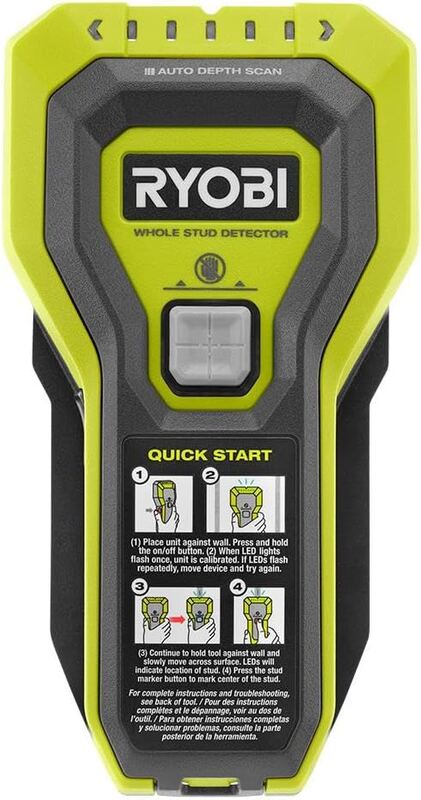
The Bosch GMS120 excels in detecting live electrical wiring, a capability not found in the Ryobi Whole Stud Finder or Zircon HD70 models. It's more accurate than the Hanmatek SF4, which lacks advanced features, but it's less precise than the Franklin Sensors ProSensor 710 in detecting stud edges. Compared to the C.H. Hanson Magnetic Stud Finder, it's more complex but offers better electrical safety, though it's less reliable in detecting live wires in conduit.
Rating sources
“The Bosch GMS120 Wall scanner comes into play.”
“The GMS120 did an excellent job locating the copper pipe and found center every time. The wall scanner also found the live wire very quickly.”
“I really like that. On the front here you've got your different modes that you'll be going through. On the back here this is where you're putting your 9-volt battery. Already includes a 9-volt battery somewhere in the box in here. There's a 9-volt battery.”
“I know I've got lots of electrical in this wall and it's lighting up yellow well there you go maybe not trust it for electrical but you can trust it for the drywall screws and find a stud”
Our 3.9 score is the average of these published ratings. Ratings marked * were derived from the reviewer’s written analysis or video transcript — the publisher didn’t print an explicit numeric score, so we inferred one from their own words. Click through to verify. More about methodology.