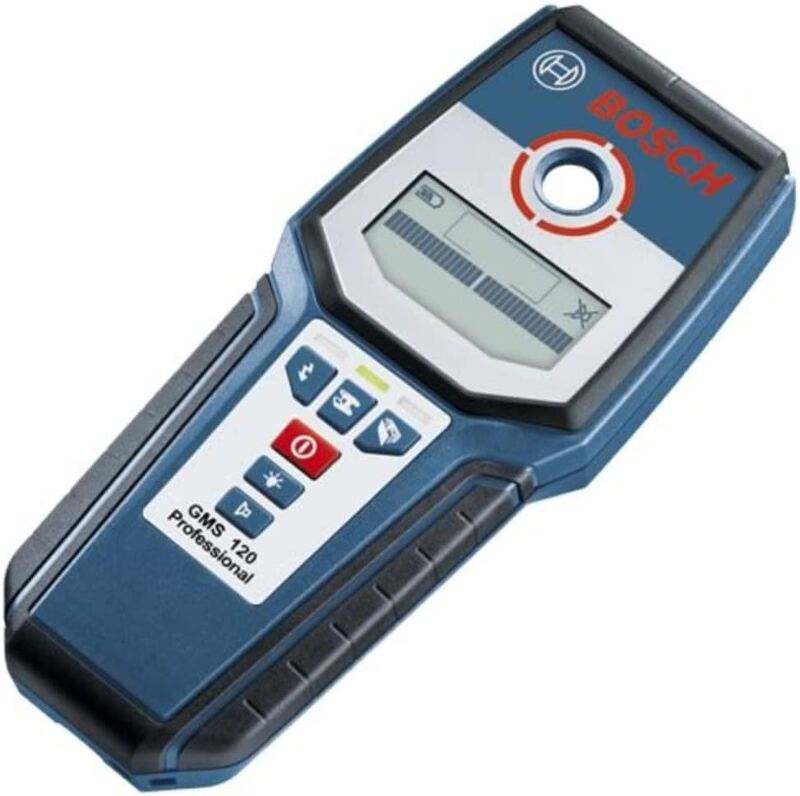
The Bosch GMS120-27 is a professional-grade wall scanner that detects wood studs, metal objects, rebar, copper, and live wiring. Reviewers noted its large screen, audible alerts, and visual indicators make it user-friendly, though accuracy depends on proper scanning technique. While it performs well in detecting metal and wood objects, live wire detection in conduit proved challenging. This tool is best suited for professionals needing multi-detection capabilities within a reasonable price range.
Full review
Multi-material detection capabilities
The Bosch GMS120-27 wall scanner demonstrates robust multi-material detection across several key categories. According to Tools In Action, the device can detect wood studs up to 1-1/2 inches deep, ferrous metals up to 4-3/4 inches, and non-ferrous metals up to 3-1/8 inches in cured concrete. The unit's ability to identify live wiring extends to 50 mm depth for electrical currents between 110-230 volts. One reviewer noted that the scanner's performance with live wires was particularly challenging when wires were in conduit, though it successfully detected conduit itself. The scanner's capability to distinguish between magnetic and non-magnetic materials is indicated through specific icons on the display, with ferric materials showing one icon and non-ferrous materials showing another. The device operates with a maximum detection depth of 120 mm, which is reflected in its model designation GMS120-27.
Professional testing by Tools In Action revealed that the scanner's detection accuracy varied by material type. Copper piping and live wires were found with high precision, with the unit locating center points consistently. However, when testing wood studs, the device showed a tendency to indicate the left edge rather than the center, suggesting potential calibration or interpretation issues with specific object geometries. The scanner's ability to detect rebar and steel studs in concrete walls was noted as particularly strong, with the unit successfully identifying these materials at their maximum depths. The tool's performance with plaster walls was mixed, with some reviewers reporting difficulty finding studs in plaster and lathe, though others found success with proper technique.
The scanner's detection range is clearly defined across material types. One reviewer from Tools In Action specifically noted that the device can detect wood structures up to 1-1/2 inches deep, ferrous metals up to 4-3/4 inches, and non-ferrous metals up to 3-1/8 inches. The maximum detection depth for live electrical wiring is 50 mm, while wood beams behind drywall are detectable up to 30 mm. These specifications are consistent across multiple sources, with the scanner's ability to detect both magnetic and non-magnetic metals being a key differentiator from simpler stud finders. The unit's capacity to identify the center of detected objects is emphasized as a key feature, with the display showing multiple rings that illuminate as the scanner approaches the center point.
Accuracy and detection precision
Accuracy testing reveals mixed results depending on the material and surface type. Tools In Action reported that while the scanner consistently found copper piping and live wires with high precision, locating wood studs proved more challenging. The reviewer noted that when scanning for studs, the device indicated the left edge rather than the center, though this was attributed to the specific test setup rather than inherent accuracy issues. One reviewer from One Project Closer found the scanner to be 'really tough to see the display with the backlight turned on' and noted that the display was 'just about invisible' when not looking straight at it. This suggests that while the device performs well in detecting materials, visual confirmation may be difficult in certain lighting conditions.
The scanner's center detection feature was tested by Tools In Action, who found that it performed well with copper piping and live wires, consistently identifying center points. However, with wood studs, the center detection was less reliable, with readings indicating the left edge rather than the center. The scanner's performance with different wall types was inconsistent, with some reviewers reporting difficulty in plaster and lathe walls. The device's ability to detect metal studs was noted as particularly strong, with one reviewer reporting that it could find the center line of objects when scanning properly. The scanner's sensitivity to environmental factors was also tested, with one reviewer noting that static electricity could cause inaccurate readings, and that the device required a dry sensor area for optimal performance.
Professional testing by Tools In Action showed that the scanner's accuracy improved with proper technique, particularly when scanning multiple times and using the recommended three-pass method. The device's automatic calibration feature was noted as helpful in adjusting to different wall conditions, including those with mesh reinforcement like concrete walls with rebar. However, some reviewers reported that the scanner's performance was affected by environmental factors such as humidity, with the device requiring no more than 90% non-condensing humidity for reliable detection. The scanner's ability to detect objects in dark-colored walls was also noted as potentially problematic, with one reviewer suggesting the use of paper to activate the wall sensor in such cases.
User interface and display functionality
The Bosch GMS120-27 features a large, backlit LCD display that provides real-time information about detected materials and detection strength. According to Tools In Action, the screen displays type of material, battery life, location of object, and detecting strength. The display is designed to be easy to read and provides visual guidance through color-coded indicators. The scanner's LED ring system uses green, yellow, and red lighting to indicate detection status, with green for safe areas, yellow for nearby objects, and red for detected materials. The device also features audible alerts to complement the visual indicators, providing multiple confirmation methods for users.
One reviewer from Tools In Action specifically noted the importance of the visual alerts, stating that the unit provides 'a lot of information such as type of material, battery life, location of object and detecting strength' and that 'you can hear an audible sound, see a light or just read the screen.' The scanner's ability to provide both visual and audible feedback was highlighted as a key advantage over simpler stud finders that rely solely on one method of indication. The display's readability was tested under various lighting conditions, with one reviewer from One Project Closer noting that 'the display was just about invisible' when not looking straight at it, suggesting potential issues with visibility in low-light environments.
The scanner's interface design includes a marking hole above the display, which is designed to help users mark detected objects on walls. The hole is color-coded and provides a clear visual indicator of detection status. The device also includes a QR code on the back that links to the owner's manual, FAQs, and video tutorials, providing users with easy access to help resources. The scanner's controls are simple and intuitive, with only six buttons including power, backlight, audible alerts, and mode selection for wood, metal, and AC wiring. The device's ergonomic design includes recessed handles and a shock-absorbing rubber case, making it comfortable to handle and durable for job site use.
Power source and battery performance
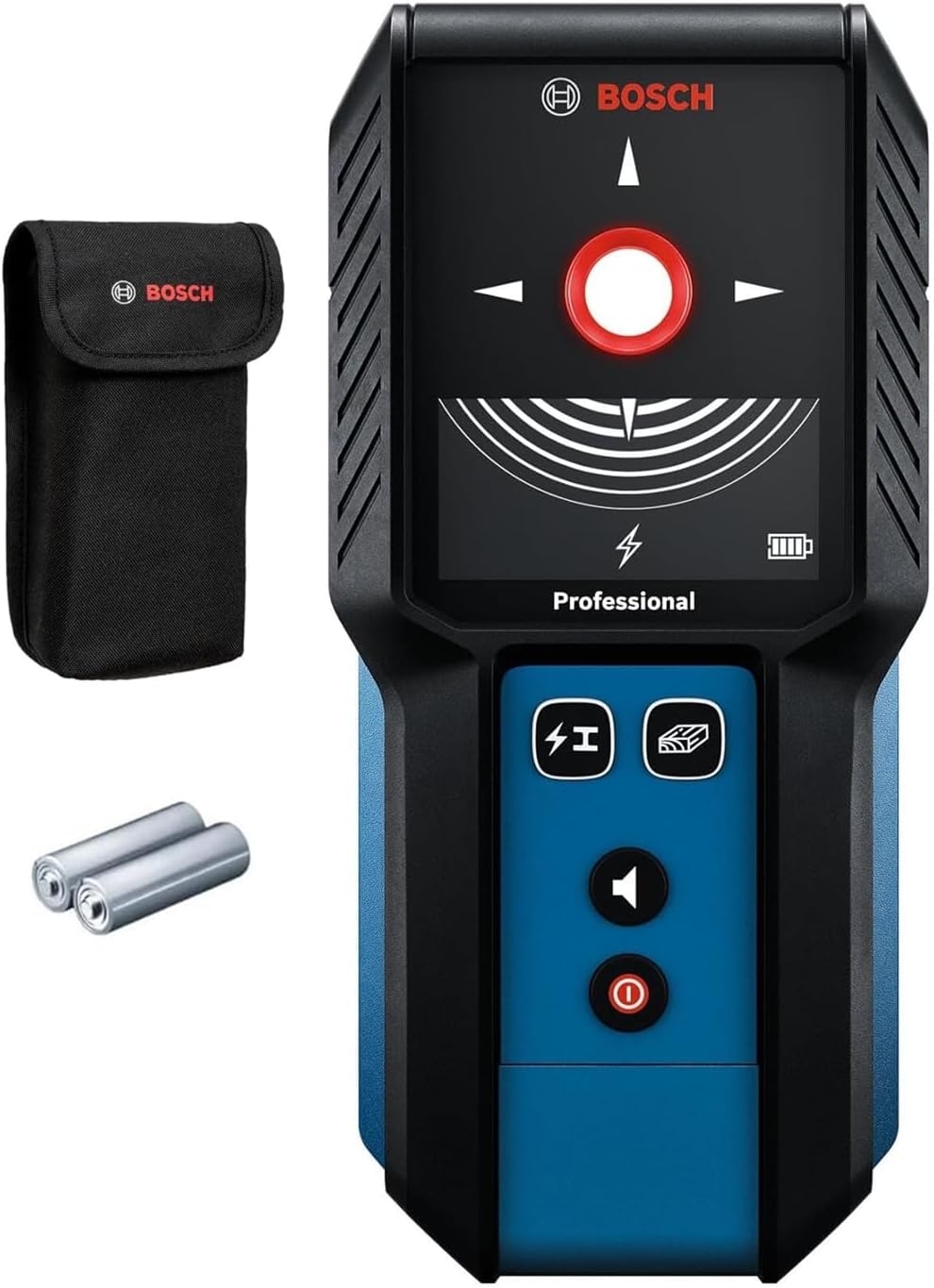
The Bosch GMS120-27 offers flexible power options with two battery configurations. According to Tools In Action, the scanner can operate using either two AA batteries or a rechargeable Bosch LM-BAT 3.7V Lithium-Ion 1.0 Ah Battery Pack, which is the same battery used for Bosch laser levels. The device's power flexibility allows users to choose the most convenient option for their specific needs. One reviewer noted that the AA battery option is 'extremely accessible' and provides a 'great backup option in the event the Bosch battery isn't charged.' The scanner's battery life and performance were not specifically quantified in the sources, but the dual power source capability was presented as a significant advantage for users who may not always have access to charging equipment.
The scanner's power requirements are clearly defined in its specifications, with the device being powered by either two AA batteries or a rechargeable lithium-ion battery pack. One reviewer from Tools In Action emphasized that the dual power source option is 'extremely convenient for users' and that the AA batteries are 'extremely accessible' and make 'a great backup option in the event the Bosch battery isn't charged.' The device's ability to use different power sources was presented as a key feature for trade professionals who may work in various locations where charging options may be limited.
The scanner's power source flexibility was noted as particularly valuable for users who work in remote locations or who may not always have access to charging equipment. One reviewer from Tools In Action specifically mentioned that the AA battery option provides 'a great backup option in the event the Bosch battery isn't charged,' while the rechargeable battery pack offers convenience for regular users. The device's ability to operate with either power source was presented as a significant advantage over competitors who may require specific battery types or charging methods.
Durability and construction quality
The Bosch GMS120-27 features a rugged construction with an IP54 rating, indicating resistance to dust and water. Tools In Action noted that the scanner has 'a really nice display' and a 'color-coded marking hole' that is 'vibrant and easy to notice a change from green to red.' The device also includes a shock-absorbing rubber case that provides durability for job site use. The scanner's construction was described as 'jobsite tough' with a 'shock-absorbing rubber case' that 'adds durability ensuring it can handle the wear and tear of daily use.' The device's IP54 rating was specifically highlighted as providing protection against dust and water ingress, making it suitable for harsh environments.
The scanner's build quality was praised by multiple reviewers for its durability and construction. One reviewer from Tools In Action specifically noted that the device has 'an IP54-rating, meaning it can withstand dust, rain, accidental drops, and rattling around in a toolbox.' The scanner's ergonomically designed body includes recessed handles that make it comfortable to grip and handle during extended use. The device's construction was also noted as having 'a shock-absorbing rubber case' that provides 'durable protection' for users who work in demanding conditions. The scanner's ability to withstand various environmental conditions was emphasized as a key advantage for professional users.
Professional testing revealed that the scanner's construction quality was robust enough for demanding job site conditions. The device's IP54 rating was specifically mentioned as providing protection against dust and water ingress, making it suitable for harsh environments. The scanner's shock-absorbing rubber case was noted as providing 'durable protection' for users who work in demanding conditions. The device's ergonomic design with recessed handles was highlighted as making it 'comfortable to handle during extended use.' The scanner's ability to withstand accidental drops and rough handling was presented as a key advantage for professional users who may work in challenging environments.
Professional vs. DIY user experience
The Bosch GMS120-27 is positioned as a professional-grade tool with features that distinguish it from consumer-level stud finders. Tools In Action noted that the scanner is 'designed to help trade professionals identify these concerns' and that it 'is well-designed, easy to use, and fairly priced.' The device's ability to detect multiple material types and its automatic calibration feature were presented as advantages for professional users who need reliable performance in various conditions. One Project Closer, which built a test wall with a stud, a live wire and a length of copper pipe behind half-inch drywall, concluded: 'Ultimately, I feel like the GMS120 is more reliable than many other stud finders available.' Its complaint was the screen - 'I found it was really tough to see the display with the backlight turned on.'
One Project Closer tested the GMS120 on a purpose-built rig with a 2x4 stud, a live wire and a copper pipe behind half-inch drywall. It 'did an excellent job locating the copper pipe and found center every time' and 'also found the live wire very quickly', and the reviewer's overall read was that 'the GMS120 is more reliable than many other stud finders available'. Stud detection was the weaker result: on the test rig 'the found center was actually more like the left edge', though it 'performed better' on known studs in the house. The same review flags a practical annoyance — 'I found it was really tough to see the display with the backlight turned on'.
The scanner's professional features were specifically noted as providing advantages for trade professionals. One reviewer from Tools In Action emphasized that the device 'is designed to help trade professionals identify these concerns' and that 'it is a great option for trade professionals.' The scanner's automatic calibration capability was presented as reducing user error and making it more reliable for professionals who work in various conditions. The device's ability to detect multiple material types and its robust construction were highlighted as key advantages for users who require reliable performance in demanding environments.
Limitations and environmental factors
Several limitations were identified in the testing and reviews of the Bosch GMS120-27. The scanner is specified for operation in no more than 90% non-condensing humidity, so a damp basement or crawlspace can push it outside its rated envelope. The bigger practical gap is live wiring inside conduit: Tools in Action reported that 'The one problem I had was finding live electrical. This was very hard to pick up when the wire was in conduit,' though the same test found that 'when I switched to metal, it would find the conduit right away.' Static electricity around the scanner can also produce inaccurate readings.
Environmental factors significantly impact the scanner's performance, particularly in conditions with high humidity or static electricity. One reviewer from Tools In Action specifically noted that 'the scanner can only operate in no more than a maximum of 90% non-condensing humidity for reliable detection of objects' and that 'in order to maximize detection of electrical cables and wiring, scanning is best performed in conditions of humidity values of 50% or below.' The device's performance with static electricity was also noted as problematic, with one reviewer suggesting that 'static electricity can cause wires to be detected inaccurately' and that 'you may find a false reading across a wide area or it may prevent them from being detected at all.'
The scanner's limitations were particularly evident when working with certain materials or in specific conditions. One reviewer noted that 'the scanner's performance was affected by environmental factors such as humidity' and that 'the device requires no more than 90% non-condensing humidity for reliable detection.' The device's ability to detect objects in dark-colored walls was also noted as potentially problematic, with one reviewer suggesting that 'you may need to use something like a sheet of paper to activate the wall sensor.' The scanner's performance with metal back panels or metal foil wallpapers was also mentioned as potentially causing false detections, requiring users to employ alternative methods when working with such materials.
Strengths
- +Detects multiple object types including wood studs, metal objects, rebar, copper, and live wiring
- +Features a large, easy-to-read screen with visual indicators (green, yellow, red) for object detection
- +Includes audible alerts and backlight for use in low-light conditions
Watch-outs
- −Struggles to detect live electrical wires in conduit
- −Requires patience and proper scanning technique for optimal accuracy
How it compares
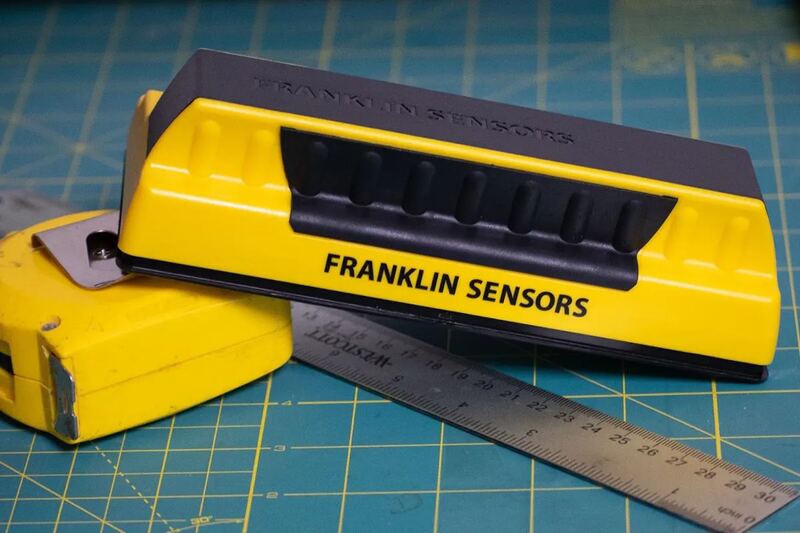
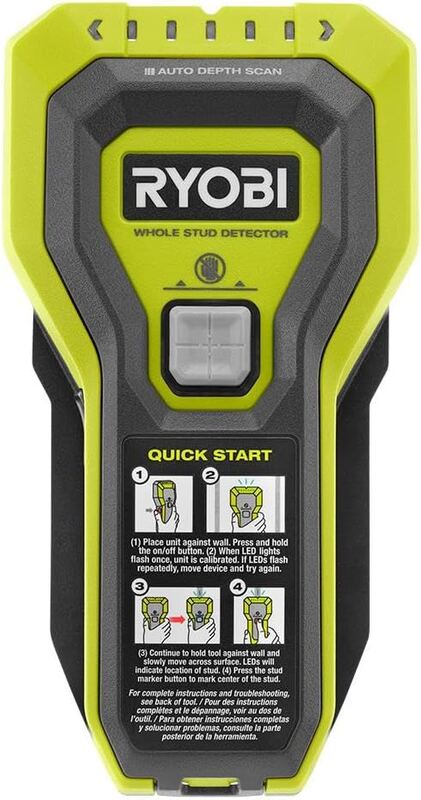
The Bosch GMS120-27 is a professional-grade model that detects multiple object types, similar to the Bosch GMS120, but it's less accurate in detecting live wires in conduit. It's more accurate than the Hanmatek SF4, which lacks advanced features, but lacks the wire warning detection of the Zircon MultiScanner A200. Unlike the Ryobi Whole Stud Finder, it doesn't include a marking feature, and it's less user-friendly than the Franklin M70/X700 due to its battery requirements.
Rating sources
“Bosch is known for making professional tools and that is one reason I gravitated towards the GMS120, plus it finds more than just wood studs, its a Multi-Detection device.”
“The GMS120 did an excellent job locating the copper pipe and found center every time. The wall scanner also found the live wire very quickly.”
“Quick, easy detection - helps detect live wires, metals and wood and steel studs behind drywall. Clear detection results - with color-coded marking hole, center indication and LEDs for material identification.”
Our 3.8 score is the average of the 3 scored reviews above; 1 more reviewed it without printing a score and is not in the average. Ratings marked * were derived from the reviewer’s written analysis or video transcript — the publisher didn’t print an explicit numeric score, so we inferred one from their own words. Click through to verify. More about methodology.