Reviewers rate the Samsung T7 Shield mainly on toughness: IP65 water and dust resistance plus 3-meter drop protection make it a reliable travel and outdoor drive. They also point to AES 256-bit hardware encryption and a 4TB capacity that is rare in Samsung's portable lineup. The soft silicone exterior attracts dust, and the top transfer speed of 1050MB/s only arrives if the host supports 10Gbps USB. Pick it when durability and security matter more than sleek looks or peak speed on older hardware.
Full review
IP65 rating held up under a water spray test
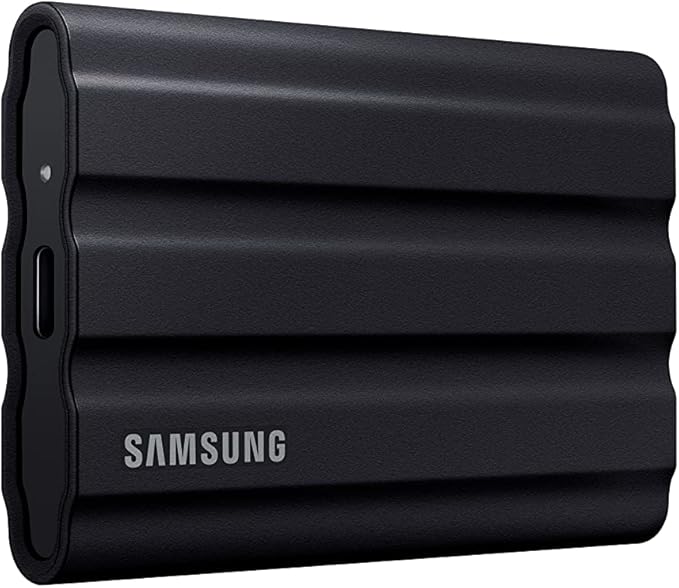
The defining characteristic of the Samsung T7 Shield is its ruggedized exterior, which sets it apart from the sleeker, aluminum-bodied standard T7. Reviewers consistently highlight the soft, textured silicone casing that wraps the drive, a design choice that significantly increases impact resistance. GearLab confirmed the drive’s IP65 rating by spraying it with water for three minutes and subsequently verifying that read and write speeds remained unaffected, proving the water resistance claim is functional rather than cosmetic. This rubberized shell also improves grip, preventing the drive from sliding off desks, though it comes with a tangible trade-off in weight. Shutter Muse noted that this added protection increases the drive's weight to approximately 7.44 ounces, making it noticeably heavier than the 2-ounce standard T7, yet still pocketable for most users.
Durability testing extends beyond water exposure to physical drops. The T7 Shield is rated for drops up to 9.8 feet, a specification that GearLab validated by performing a 9.8-foot drop test on the device. Despite the rigorous physical abuse, the drive continued to operate without data loss or performance degradation, reinforcing its position as a reliable tool for field work. However, the silicone material is not without its drawbacks; The SSD Review pointed out that the casing acts as a magnet for dust and lint, which becomes visible upon close inspection even on a brand-new unit. While this is largely an aesthetic annoyance, it suggests that the drive may require more frequent cleaning to maintain a pristine appearance compared to the smooth metal finish of its non-Shield counterpart.
Real-World Performance Metrics
Samsung claims sequential read speeds of 1050 MB/s and write speeds of 1000 MB/s, figures that GearLab’s testing largely corroborated under optimal conditions. When connected to a Mac, the drive achieved an average sequential read speed of 676 MB/s, tying with the SanDisk Extreme Portable V2, and demonstrated exceptional drag-and-drop performance. GearLab recorded transfer times of 2 seconds for 1GB, 6 seconds for 5GB, and 8 seconds for 10GB files, resulting in an impressive average speed of 583 MB/s, which was the fastest among the external hard drives tested. This performance makes the T7 Shield a top contender for photographers and videographers who need to offload large media files quickly without bottlenecking their workflow.
Performance consistency varies significantly depending on the host operating system and file types. On Windows, GearLab observed a notable drop in drag-and-drop efficiency, recording transfer times of 3 seconds for 1GB, 26 seconds for 5GB, and 53 seconds for 10GB, yielding an average of 236 MB/s. While still respectable, this is roughly half the speed seen on Mac and slower than the SanDisk Extreme V2 in similar tests. Shutter Muse’s testing revealed that performance remains steady even as the drive fills up; after copying roughly 3TB of data to the drive, the speed tests showed minimal degradation, indicating that the drive’s controller handles near-full capacity well. This consistency is crucial for professionals who cannot afford sudden slowdowns during large backups or video transfers.
Capacity Options and Pricing
The T7 Shield is available in 1TB, 2TB, and 4TB capacities, with the 4TB option representing a significant shift in Samsung’s strategy for portable storage. The SSD Review highlighted that Samsung rarely pushes high-capacity portable SSDs, making the 4TB model a notable exception. Priced at $429.99 MSRP, this capacity offers a cost-effective solution for users needing massive portable storage, though availability can be sporadic on major retailers like Amazon. The 1TB version is priced around $129.99 to $145 depending on the retailer, while the 2TB version sits at approximately $159 to $287. Shutter Muse noted that the price difference between the 1TB standard T7 and the 1TB T7 Shield is only about $10, making the Shield version a clear value add for the extra durability, especially since the 2TB versions are often priced identically.
Software and Security Features
Data security is a core component of the T7 Shield’s appeal, featuring 256-bit AES hardware encryption. Samsung provides the Portable SSD software, which allows users to set a password and encrypt the drive with minimal steps, ensuring that data remains secure even if the drive is lost or stolen. This hardware-based encryption is handled by the drive’s controller, meaning it does not consume host CPU resources, which helps maintain consistent transfer speeds. However, some reviewers noted that the Samsung Magician software, commonly used for firmware updates and drive health monitoring on internal Samsung SSDs, is not included with the T7 Shield. Users must download the Portable SSD software separately, which provides basic maintenance features but lacks the comprehensive suite of tools found in Magician.
10Gbps interface caps speed at 1050 MB/s
Despite its strengths, the T7 Shield has notable limitations that potential buyers should consider. The most significant constraint is its USB 3.2 Gen 2 interface, which caps transfer speeds at 10Gbps. Tom's Hardware criticized this limitation, noting that while 1050 MB/s is fast for an external drive, it lags behind newer competitors that offer 20Gbps or higher speeds. This means that users with newer computers equipped with USB4 or Thunderbolt 4 ports will not be able to fully utilize the drive’s potential, as the drive itself is the bottleneck. Additionally, the silicone casing, while durable, attracts dust and lint, which can be frustrating for users who prefer a clean aesthetic. The drive’s weight is also a consideration for ultralight travelers, as it is nearly four times heavier than the standard T7.
4TB capacity handles large RAW photo libraries
The Samsung T7 Shield is ideally suited for photographers, videographers, and field journalists who require a durable, high-speed storage solution that can withstand harsh environments. Its IP65 rating and 9.8-foot drop resistance make it a reliable companion for outdoor shoots or travel where equipment is subject to rough handling. The availability of a 4TB capacity also makes it an attractive option for professionals who need to store large amounts of high-resolution video or RAW photos on the go. Users who prioritize data security and convenience will appreciate the hardware encryption and cross-platform compatibility with Windows, Mac, and Android devices.
10Gbps ceiling disappoints USB4 and Thunderbolt buyers
Users who prioritize maximum transfer speeds above all else may find the T7 Shield lacking due to its 10Gbps limit. Those with newer computers featuring USB4 or Thunderbolt 4 ports might be better served by drives that support 20Gbps or higher speeds, such as the Samsung T7 Touch or other NVMe-based enclosures. Additionally, users who are sensitive to weight and bulk might prefer the standard Samsung T7, which is significantly lighter and more compact, albeit less durable. Budget-conscious buyers who do not need the extra protection might also opt for the standard T7, as the price difference is minimal for lower capacities, but the Shield version’s premium is justified only by its rugged features.
Strengths
- +IP65-certified water and dust resistance
- +3-meter drop resistance for durability
- +AES 256-bit hardware encryption for data security
- +Available in high 4TB capacity
Watch-outs
- −Silicone exterior casing attracts dust and lint
- −Requires 10Gbps USB port for maximum 1050MB/s speeds
Rating sources
Our 4.2 score is the average of the 4 scored reviews above; 1 more reviewed it without printing a score and is not in the average. More about methodology.