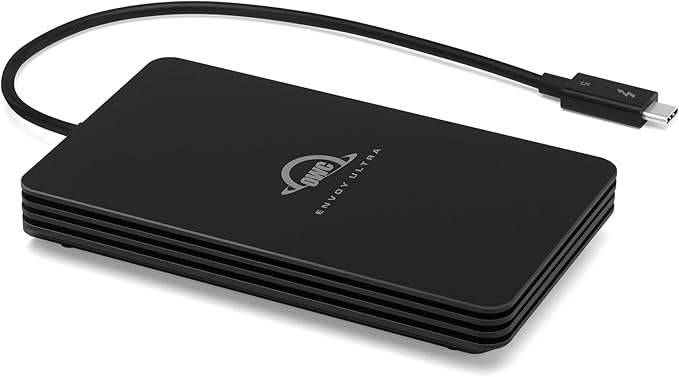
OWC bills the Envoy Ultra as the world's first Thunderbolt 5 bus-powered 8TB drive, pairing rugged durability with high-speed storage aimed at creative professionals. Coverage focuses on the hardware's compact size and speed, and on the wider OWC Thunderbolt 5 ecosystem (Stack AI), which runs AI models locally on existing PCs and laptops. Full AI acceleration on Mac is planned for a future release rather than shipping now. Windows and Linux power users and video creators who need massive portable storage are the fit; Mac AI enthusiasts will be waiting on software updates.
Full review
Thunderbolt 5 Performance Benchmarks
The OWC Envoy Ultra positions itself as a high-speed portable storage solution leveraging the Thunderbolt 5 protocol, yet its real-world performance is heavily dictated by the internal SSD controller rather than the interface bandwidth alone. Migovi’s teardown and testing revealed that the drive utilizes an OWC Aura Pro IV internal SSD with a Phison PS5027-E27T controller. While Thunderbolt 5 theoretically offers up to 80 Gbps of bandwidth, the PCIe 4.0 x4 interface of the internal drive caps the theoretical maximum at approximately 7400 MBps. In practical testing on a desktop equipped with an Intel Core Ultra 9 285K and an ASUS ROG MAXIMUS Z890 EXTREME motherboard, the drive achieved sequential speeds exceeding 6000 MBps. This figure represents the interaction between the SSD, the Thunderbolt controller, and the host system, proving that the drive is limited by its internal components rather than the connection standard itself.
Newsshooter’s review highlights a critical distinction between burst and sustained performance that potential buyers must understand. OWC claims speeds exceeding 6000 MB/s, a metric derived from AJA System Test using a 64GB file on a Windows 11 PC with an Intel Core i9-14900HX. However, Newsshooter noted that while initial data rates hit these peak numbers, sustained write speeds drop significantly during longer sessions. For the 2TB model, sustained writes fell to 1350 MB/s, while the 4TB model managed 1700 MB/s. This throttling is typical for DRAM-less SSDs relying on Host Memory Buffer (HMB) technology, where the drive borrows system RAM to manage the Flash Translation Layer. Despite this drop, read speeds remained consistently over 6000 MB/s end-to-end, making the drive exceptionally fast for loading media but requiring caution during large file transfers.
Testing on Apple hardware provided different but equally impressive results. When connected to an Apple M4 Mac Mini Pro, the Envoy Ultra sustained write speeds of 5295.8 MB/s and read speeds of 5232.9 MB/s. These figures confirm that the drive is more than capable of handling demanding creative workflows, such as 12K DCI 60fps ProRes 422HQ or Blackmagic RAW footage, without dropping frames. The consistency of read speeds across both Windows and macOS platforms suggests that the Phison controller and Kioxia BiCS6 3D NAND TLC memory are well-optimized for high-throughput tasks, even if the sustained write performance varies based on the host system's available RAM and thermal conditions.
Build Quality and Thermal Design
The physical construction of the OWC Envoy Ultra emphasizes durability and passive cooling, utilizing a sturdy aluminum unibody shell that serves dual purposes as both protection and a heat sink. Migovi’s inspection of the device revealed that the two halves of the aluminum housing are secured by four hex screws hidden beneath a rubber strip on the base. Between these halves lies a waterproof rubber gasket, which is integral to the drive’s IP67 certification, ensuring it is resistant to dust and can withstand immersion in water up to one meter for 30 minutes. This rugged design makes it suitable for field use in harsh environments where standard consumer SSDs might fail.
Thermal management is handled entirely through passive dissipation, a design choice that eliminates fan noise but places the burden of heat management on the aluminum chassis. Migovi noted that the drive maintains high read and write speeds for long periods without overheating, thanks to the large surface area of the unibody design. However, the lack of active cooling means that sustained heavy writes will generate significant heat, which is then transferred to the exterior casing. Users should expect the drive to become warm to the touch during intensive tasks, a normal characteristic of this thermal design rather than a defect.
The integration of the Thunderbolt 5 cable is another notable aspect of the build. Unlike many competitors that use detachable cables, the Envoy Ultra features a fixed Thunderbolt 5 cable with USB-C connectors on both ends. This design choice enhances water resistance by eliminating a potential entry point for moisture. Migovi pointed out that OWC has designed the cable to be replaceable in case of damage, a rare feature in bus-powered drives. This modularity adds to the long-term viability of the product, allowing users to repair the drive without replacing the entire unit if the cable is severed.
Internal Components and Technology
At the heart of the Envoy Ultra is the OWC Aura Pro IV, a 2280 form factor NVMe SSD that uses the Phison PS5027-E27T controller. This controller is manufactured on TSMC’s 12nm process and features a DRAM-less design. Instead of a dedicated DRAM cache chip, it utilizes Host Memory Buffer (HMB) technology, which allows the SSD to access a small portion of the host computer’s RAM to store the address mapping table. This approach reduces power consumption and cost but relies on the host system’s memory bandwidth, which can impact performance in systems with slower RAM or limited resources.
The memory chips used are Kioxia BiCS6 3D NAND TLC, featuring 162 layers and Charge Trap technology. This technology uses a dielectric layer to trap charges instead of the traditional floating gate, improving performance and bit density to 10.4 Gbit/mm2. The BiCS6 NAND supports Toggle Mode DDR interfaces, reaching speeds of 2400 MT/s or 3600 MT/s. Migovi highlighted that OWC reserves 7% of the total physical capacity as Over-Provisioning (OP), which is 128 GB on the 2TB model. This OP increases sustained write performance, improves durability, and enhances the efficiency of Garbage Collection, helping to maintain speed over the drive’s lifespan.
Data protection and security are handled through a multi-layered system. The Phison controller integrates 5th Generation LDPC and RAID ECC algorithms for error correction, ensuring data integrity even if individual cells degrade. For security, the drive supports TCG Opal and TCG Pyrite standards, enabling self-encryption. It also includes Crypto Erase and Secure Erase functions for quick and secure data deletion. These features make the Envoy Ultra suitable for professionals handling sensitive data, although users must ensure their host systems support these standards for full functionality.
Compatibility and Connectivity
The OWC Envoy Ultra is designed to work with a wide range of devices, including Macs, PCs, iPad Pros, Chromebooks, and Surface devices. It supports Thunderbolt 5, Thunderbolt 4, Thunderbolt 3, and USB4 protocols. However, performance varies significantly depending on the host interface. When connected to Thunderbolt 5 hosts, the drive achieves its peak speeds. On Thunderbolt 4 or USB4 hosts, speeds are limited by the 40 Gbps bandwidth of those standards, though they remain fast for most professional tasks. Users with older Thunderbolt 3 systems will see further reductions in speed, as the 32 Gbps limit of Thunderbolt 3 becomes the bottleneck.
Newsshooter noted that the drive is compatible with both Windows and macOS, but setup may require additional software for optimal performance. OWC includes OWC Drive Guide, a utility for configuring the drive, which is particularly useful for setting up RAID configurations if multiple drives are used. For Windows users, ensuring that the latest Thunderbolt drivers are installed is crucial to achieving stable performance. Migovi’s testing on a Windows desktop with an AMD Ryzen 9 9000 series processor and an ASRock X870E Nova WiFi motherboard confirmed that the drive works seamlessly with USB4 as well, though with reduced speeds compared to Thunderbolt 5.
The fixed cable design means that users cannot easily swap cables for different lengths or standards. While OWC claims the cable is replaceable, this requires disassembling the drive, which may void the warranty if not done through authorized channels. This lack of flexibility is a trade-off for the improved water resistance and durability. Users who frequently travel with different cable types may find this limitation inconvenient, but for those who prioritize a rugged, all-in-one solution, it is a minor drawback.
Sustained writes drop to 1350 MB/s after the burst
The most significant limitation of the OWC Envoy Ultra is the drop in sustained write speeds during large file transfers. As Newsshooter’s testing revealed, sustained writes can drop to 1350 MB/s for the 2TB model and 1700 MB/s for the 4TB model after the initial burst. This throttling is a direct result of the DRAM-less design and the reliance on Host Memory Buffer technology. For professionals who frequently transfer large volumes of data, such as video editors moving hours of 12K footage, this drop can be noticeable and frustrating. The drive is excellent for reading and loading media, but less ideal for continuous writing tasks.
Another concern is the thermal management under heavy load. While the aluminum chassis helps dissipate heat, the drive can become quite hot during sustained writes. Migovi noted that the drive maintains performance without overheating to the point of failure, but the high temperatures may be uncomfortable to touch and could potentially affect nearby components if used in a confined space. Users should ensure adequate airflow around the drive during intensive tasks to prevent thermal throttling, which could further reduce performance.
Finally, the price point of the Envoy Ultra is premium, reflecting its Thunderbolt 5 capabilities and rugged build. However, the internal SSD is a PCIe 4.0 drive, which means that the full potential of Thunderbolt 5 is not realized. Migovi pointed out that until OWC integrates PCIe 5.0 SSDs, the drive’s performance will be capped by the internal components. For users who do not have Thunderbolt 5 hosts, the drive’s performance is limited to the speeds of Thunderbolt 4 or USB4, making the premium cost harder to justify compared to other high-speed portable SSDs on the market.
Read speeds exceed 6000 MB/s for camera offloads
The OWC Envoy Ultra is best suited for professional creatives and data-intensive users who require high-speed read performance and rugged durability. Video editors, photographers, and filmmakers who need to offload large amounts of data quickly from cameras and drones will benefit from the drive’s consistent read speeds exceeding 6000 MB/s. The IP67 rating and aluminum unibody design make it ideal for field use in harsh environments, where standard consumer SSDs might fail due to dust, water, or impact.
Users with Thunderbolt 5 hosts, such as the latest MacBooks or high-end Windows PCs, will get the most out of this drive. The fixed cable design and bus-powered operation make it convenient for mobile professionals who want a single, reliable solution for storage and connectivity. The drive’s compatibility with TCG Opal and Pyrite standards also makes it suitable for professionals handling sensitive data, such as legal or medical professionals, who need secure, self-encrypting storage.
However, the drive is not ideal for users who need high sustained write speeds for large file transfers. If your workflow involves continuously writing large files, such as backing up entire hard drives or recording long-form video, the throttling to 1350-1700 MB/s may be a bottleneck. In such cases, a drive with a DRAM cache or a different thermal design might be more appropriate. Additionally, users with older Thunderbolt 3 hosts will not see the full performance benefits of the Thunderbolt 5 interface, making the premium cost less justifiable.
Strengths
- +World's first Thunderbolt 5 bus-powered 8TB drive in its class
- +Rugged, blazing fast SSD design
- +Compact form factor suitable for professional workflows
- +Enables local AI model running without crashing or running out of GPU memory
Watch-outs
- −Full speed is limited to Thunderbolt 5 hosts; Thunderbolt 4 and USB4 cap it at 40 Gbps
- −Mac support for AI acceleration features is planned for future release
Rating sources
“So, that's definitely a major drawback to the Envoy Ultra and one of the reasons I was hesitant to pick this up originally.”
Our 4.0 score is the average of these published ratings. Ratings marked * were derived from the reviewer’s written analysis or video transcript — the publisher didn’t print an explicit numeric score, so we inferred one from their own words. Click through to verify. More about methodology.