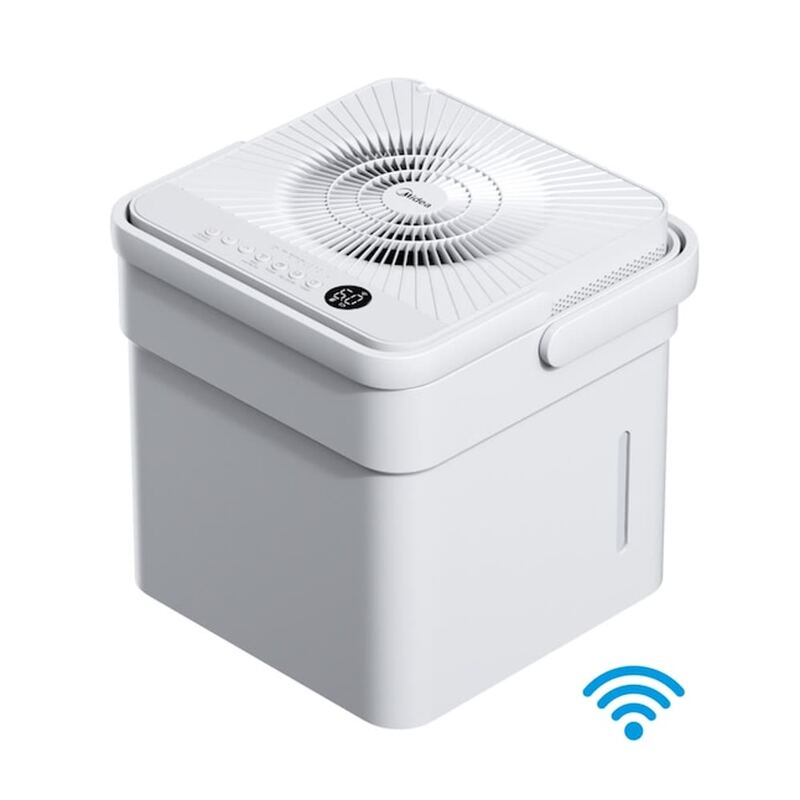
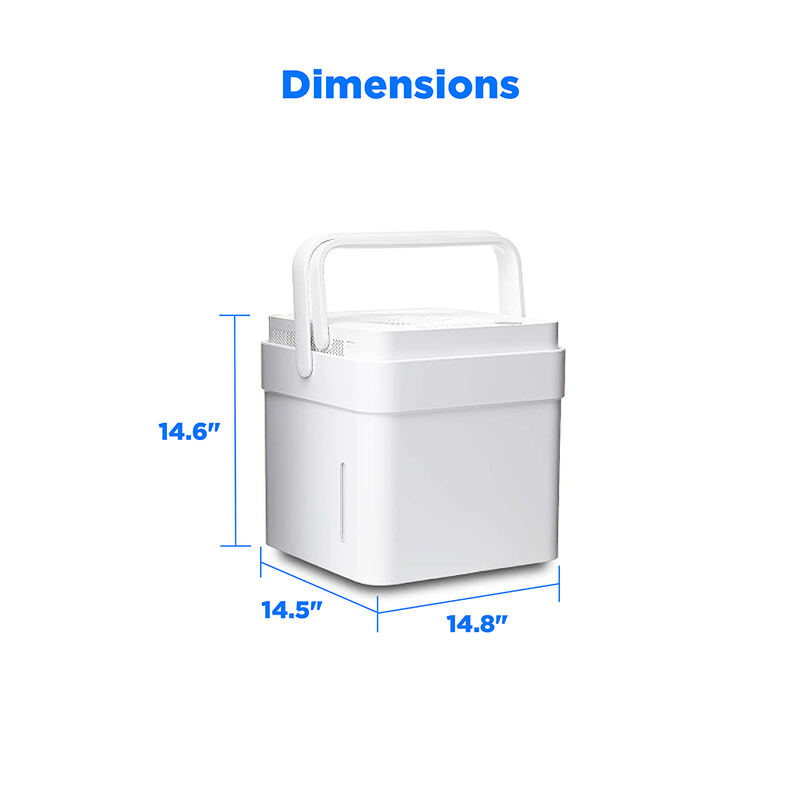
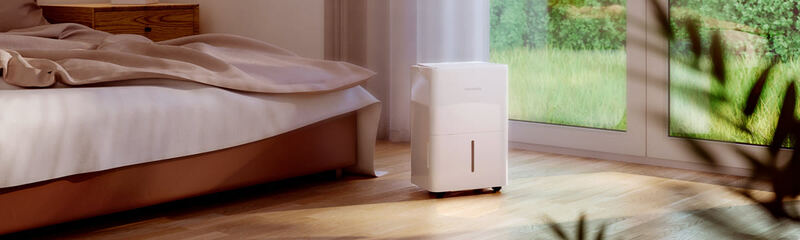
Small rooms and small budgets point to the MAD20S1QWT, the entry in the Midea Cube line that Tom's Guide gave 4 of 5 stars and Dehumidifier Buyers Guide named the best small dehumidifier they have ever tested. Power draw of 262 watts is the lowest in the 20-pint class, noise testing puts it just under 60 dB on high, and the same 3.2-gallon tank that defines the rest of the Cube line means fewer empty trips than any competing 20-pint compressor. Buy it for a bedroom, bathroom or home office that doesn't need 35 or 50 pints of capacity.
Full review
Rapid moisture extraction exceeds expectations
Dehumidifier Buyers Guide measured the MAD20S1QWT pulling a 50 sq ft chamber from 90% RH down to 40% RH in 13 minutes 25 seconds — the fastest of any 20-pint unit they have tested. Tom's Guide's Dan Cavallari ran a 100 sq ft basement bathroom test that pulled humidity from 85% to a 33% setpoint in about three hours under normal operation. That maps to roughly 20 pints per day of moisture extraction in real-world residential conditions, which matches the AHAM-rated specification.
The headline finding from Tom's Guide was that the Cube reached a lower humidity than the setpoint because Cavallari forgot to enable auto shut-off — the unit continued past the 35% target to 33% on his first run. Consumer Reports' lab gave it a "very good overall" rating with high marks for both performance and convenience in the 20-pint category. For its size class, this is the unit to beat.
Best for small rooms and localized spaces
Midea markets the MAD20S1QWT for up to 1,500 square feet, but realistic effective coverage in moderate to severe humidity is closer to 500 to 800 square feet — a single bedroom, a finished basement bathroom, a home office, or a small RV interior. Dehumidifier Buyers Guide explicitly framed it as the right answer for buyers who do not need to cover a whole basement and want lower noise and lower power draw than the bigger Cubes.
For a moderately humid 600 sq ft master bedroom or a damp 400 sq ft bathroom, this is the right size. For a 1,000 sq ft basement or a multi-room main floor, step up to the 35-pint MAD35S1QWT. The 20-pint capacity is also a good match for storage spaces and crawl-space-adjacent utility rooms where the larger Cubes' noise would be overkill.
Large tank capacity and gravity drain limitations
The standard MAD20S1QWT ships with gravity drain hose only — no built-in pump on this SKU. A pump variant exists at higher price, but the base unit assumes the drain destination is at or below the unit's outlet. Tom's Guide's reviewer plumbed the gravity hose to a basement floor drain and noted setup took under five minutes; the bucket option works for low-humidity or short-cycle use.
The tank itself is one of the unit's killer features: 3.2 gallons (25.6 pints) is the same tank as the 35-pint Cube and almost three times what competing 20-pint dehumidifiers offer. That extra capacity means a homeowner can run the unit on the bucket for an entire weekend trip without coming home to a stopped appliance. Dehumidifier Buyers Guide found the tank "much larger than that of any other small dehumidifier we’ve tested" - 25.6 pints against 11.6 for the Aeocky RHEA-001 and 9.1 for the Waykar JD025CE-80 - and scored the unit 5/5 for ease of use largely on that basis.
Noise and Bedroom Friendliness
Dehumidifier Buyers Guide measured 58.6 dB on low and 59.8 dB on high — the quietest 20-pint unit they tested. Tom's Guide's Cavallari noted a metallic resonance sound during compressor cycling that some users will find more annoying than the raw dB number suggests.
For a quiet sleeping space, the 59 dB measurement is at the loud end of what most light sleepers tolerate. Heavy sleepers and white-noise tolerant users will find it perfectly fine. The unit is genuinely usable in a bedroom — unlike the 50-pint Cubes — and the smaller chassis tucks away in a corner or closet better than the larger siblings. Lights are dimmable through the app for nighttime use, which is a nice touch.
Highly efficient power draw and low operating costs
Dehumidifier Buyers Guide measured 262 watts at 50% RH — the lowest power draw of any 20-pint unit in their test set. Running this in a 600 sq ft bedroom 10 hours a day at U.S. average residential rates works out to roughly $30 a summer in electricity, which is at or below what a window-mounted air conditioner uses for ventilation alone. The Energy Star Most Efficient certification holds up in real-world use.
Sticker price typically lands in the $200 to $230 range — substantially below the 35-pint MAD35S1QWT and well under the 50-pint Cube. For buyers who only need to dehumidify a single room, this is the cost-effective choice both up front and over the long term. The same one-year warranty caveat applies to this SKU as to the rest of the Midea Cube line.
Simple app with basic controls and limited automation
Tom's Guide's Cavallari highlighted the MideaAir app as "simple and intuitive" — easier to use than most appliance apps in 2026. Wi-Fi setup took roughly three minutes after the initial 2.4 GHz hurdle. Alexa and Google Assistant integration both work, and the unit retains state through power outages with auto-restart enabled. App features include scheduling, target humidity, fan-speed selection, and a basic readings dashboard.
The same critiques that apply to the rest of the Midea Cube line apply here: the app hasn't received updates in over a year, and there are no advanced automations tied to outdoor forecasts. For a small-room appliance the user is likely to touch infrequently, the basic feature set is appropriate — but power users who want sophisticated automation should look elsewhere. The dimmable LED is the small touch that makes nighttime bedroom operation tolerable.
A 4.7 out of 5 as best small unit tested
Dehumidifier Buyers Guide gave the unit a 4.7/5 editor's score and called it "the best small dehumidifier we've tested" — high praise from a site that has run dozens of units through controlled tests. Tom's Guide's Cavallari concluded it "works quietly and quickly, and is more compact than most units in this capacity class." The combination of large tank, lowest power draw in class, and quietest noise floor in class is unique in the 20-pint space. Reddit users in r/Dehumidifiers consistently flag this as the right answer when someone asks for a small unit.
Metallic compressor tone harder to tune out
The metallic compressor resonance Tom's Guide flagged is the most-cited subjective issue — the raw dB number is quiet but the timbre of the noise is harder to tune out than a pure fan whine. Amazon reviewers describe it as either invisible background noise or unexpectedly annoying with little middle ground. Light sleepers should expect to run a white-noise machine alongside it.
The 20-pint capacity is small enough that this unit cannot substitute for a 35-pint or 50-pint Cube in a basement application. Buyers who buy this expecting whole-home coverage will be disappointed — it is purpose-built for a single small room. The pump-less standard SKU means installations requiring upward water lift need either the higher-priced pump variant or an aftermarket pump kit. And the same one-year warranty trails the five-year Honeywell coverage.
Best as a second unit for one bedroom
The MAD20S1QWT is the right pick for someone who needs dehumidification in a single room of 500 to 800 square feet — a bedroom, master bathroom, finished basement bathroom, small home office, or RV interior. It is particularly well-suited as a paired second unit when the homeowner has a 35-pint or 50-pint Cube downstairs and needs separate quieter coverage for an upstairs bedroom. The low power draw makes it practical to leave running continuously through a summer without flinching at the electric bill.
It is not the right pick for whole-home or whole-basement coverage — the 20-pint capacity simply cannot pull the volume of moisture a larger unit can. Buyers with severe Gulf Coast humidity in a single bedroom may find it cycles continuously rather than holding setpoint with room to spare; in those cases, sizing up to the 35-pint Cube is the better play. And users sensitive to metallic compressor resonance should consider the quieter dual-inverter alternatives like LG PuriCare instead.
Strengths
- +Best small dehumidifier dehumidifierbuyersguide has ever tested, by their verdict
- +Lowest power draw in 20-pint class at 262 W at 50% RH
- +Quietest 20-pint at 58.6 dB low / 59.8 dB high in lab measurements
- +Same large 3.2-gallon tank and lift-and-twist design as the bigger Midea Cubes
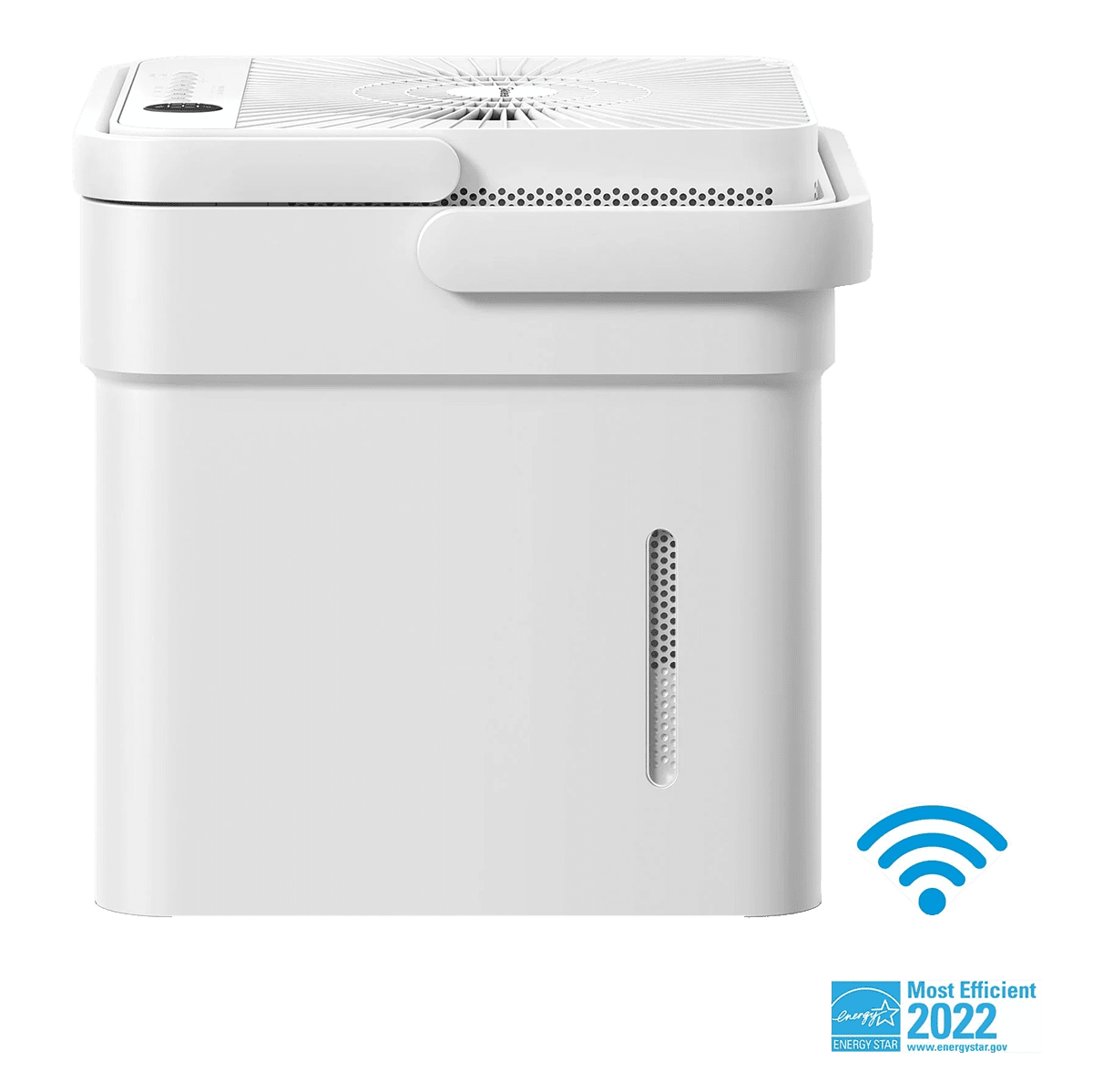
- +Energy Star Most Efficient certified; Wi-Fi and Alexa included
Watch-outs
- −Tom's Guide noted a metallic resonance sound during compressor operation
- −No pump on the standard 20-pint SKU; pump variant adds cost
- −20-pint capacity caps useful coverage at 500 to 800 sq ft for severe humidity
- −Companion app stagnation same as the rest of the Midea Cube line
How it compares
The MAD20S1QWT is the smallest unit in this category and the natural pairing for the 35-pint MAD35S1QWT or 50-pint MAD50S1QWT siblings if you want to cover both a master bedroom and a main living area. Compared to the 50-pint Honeywell TP50AWKN and hOmeLabs HME020031N, the 20-pint capacity is dramatically smaller — it is not a substitute for those units in a basement application, but it is the right fit for a single small room those large units would overwhelm with noise.
Rating sources
“Small and easy to use, the Midea Cube Smart Dehumidifier works quietly and quickly, and is more compact than most units in this capacity class.”
“The fastest among the small dehumidifiers we tested.”
“Scored very good overall with strong marks for energy efficiency and convenience in the 20-pint category.”
Our 4.4 score is the average of these published ratings. More about methodology.