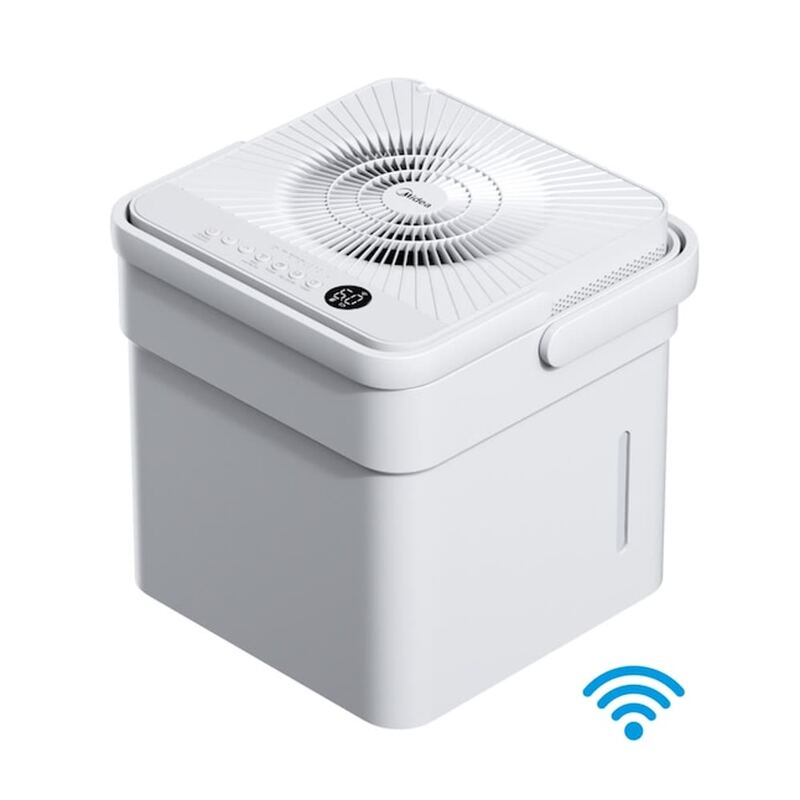
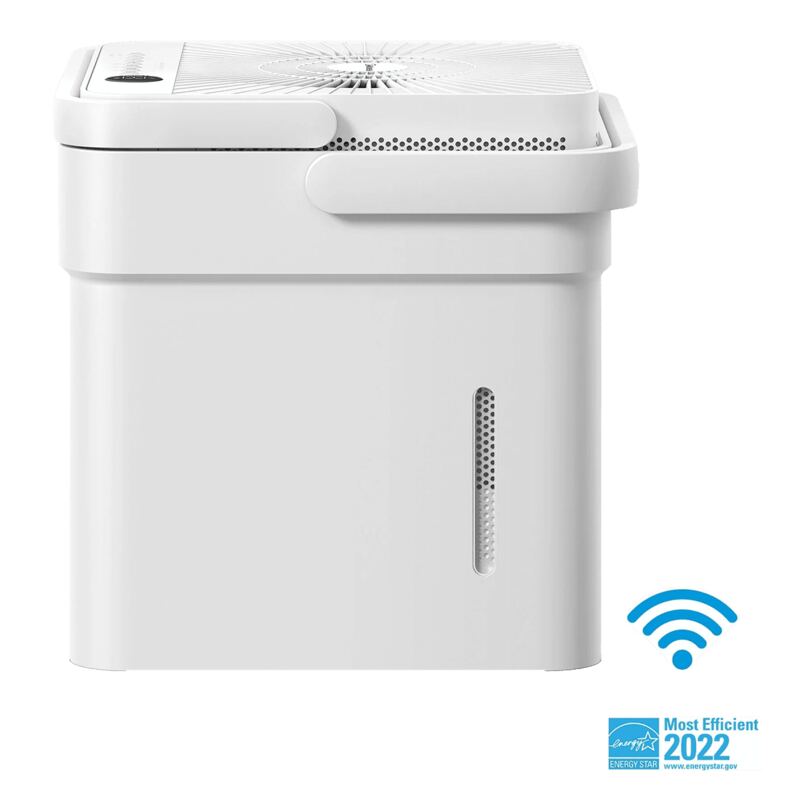
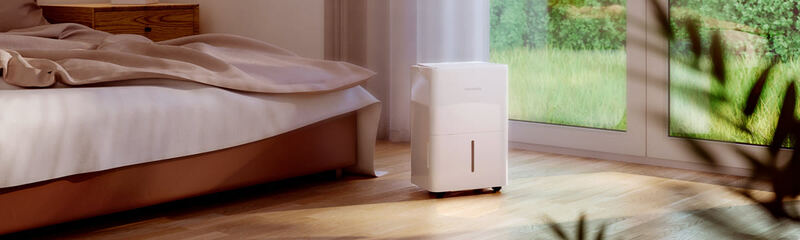
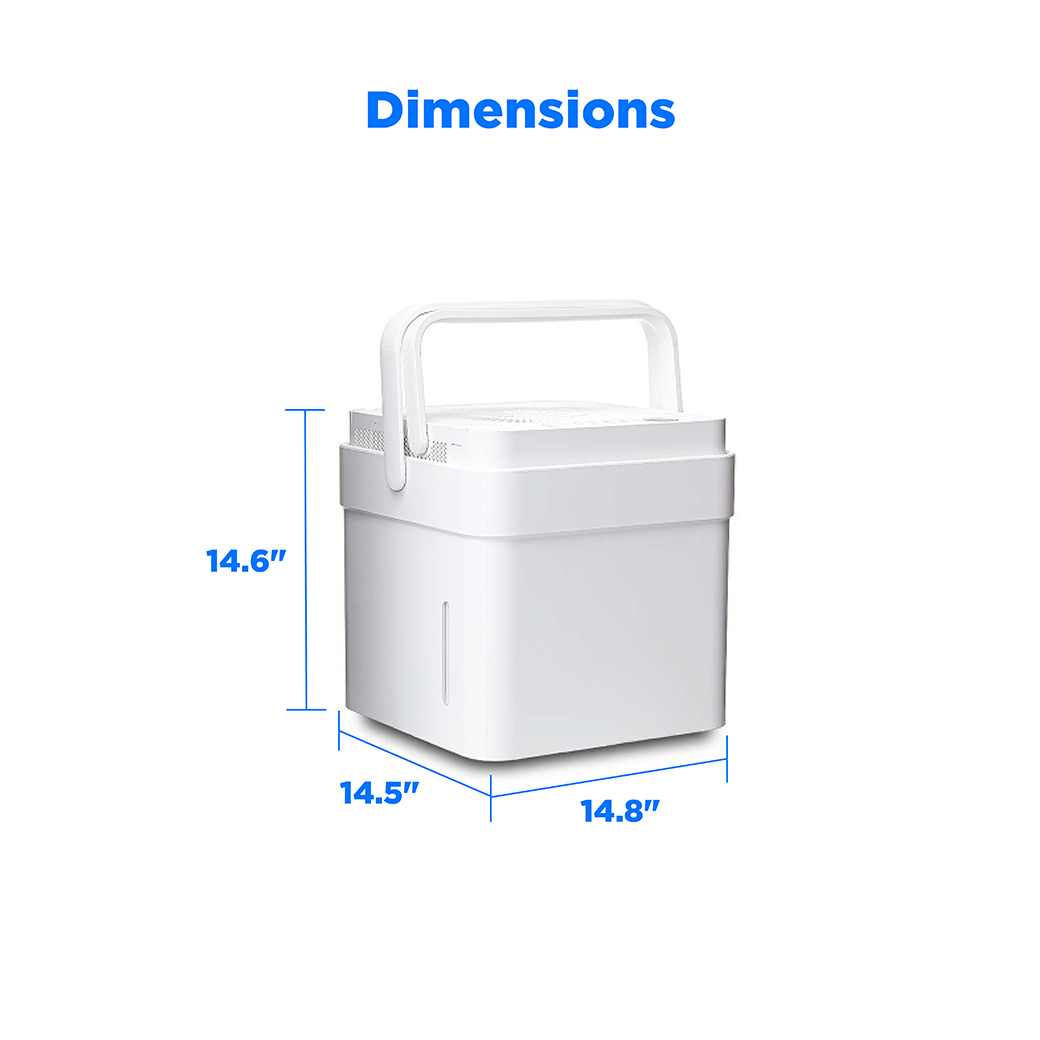
The MAD35S1QWT sits at the mid-capacity sweet spot of the Midea Cube line, and it was Consumer Reports' top-scoring mid-pint dehumidifier in 2026 testing. It carries over the cube chassis and the 3x-larger tank from the 50-pint sibling in a quieter, lower-wattage package for medium spaces. This SKU has no built-in pump, and real-world coverage lands closer to 1,500 sq ft than the marketing's 3,500 sq ft claim. In the rooms it actually suits, no other 35-pint unit matches its scores.
Full review
Top-tier moisture removal and efficiency
Consumer Reports gave the MAD35S1QWT the highest score in their three size categories for moisture removal — a clean win over every other 35-pint unit in their 2026 lab tests. Quietest.org's real-world testing showed the unit pulled roughly 21 pints per day in a basement at 70% RH and 75°F, climbing to 28 pints per day under hot-and-humid conditions of 80% RH and 85°F. Those numbers are realistic for a mid-capacity 35-pint compressor and put it in the same performance bracket as much louder competitors.
Dehumidifier Buyers Guide called it the best 35-pint dehumidifier currently on the market, citing the same combination of Energy Star efficiency, low noise, and large tank that earned the 50-pint sibling top honors. The unit hits target humidity quickly in rooms up to 1,500 square feet and holds setpoint with minimal cycling — which is also what keeps the lifetime energy bill manageable.
Effective coverage is closer to 1,500 square feet
Midea markets the unit for spaces up to 3,500 square feet, but quietest.org explicitly flagged that as inflated — real-world effective coverage is closer to 1,500 square feet for keeping target humidity, with the larger number applying only to occasional drying of a damp space. Buyers should size by realistic coverage: this unit is ideal for 800 to 1,500 square feet of living area, a finished basement under 1,800 square feet, or a single floor of a smaller home.
For anyone with a 3,000-plus square foot conditioned space, the 50-pint MAD50S1QWT or Honeywell TP50AWKN is the right step up. For a single bedroom or sub-500 square foot office, the 20-pint MAD20S1QWT in this lineup is the better fit on both noise and size. The 35-pint sits squarely in the middle: the right answer for a typical condo, smaller starter home, or finished basement family room.
Gravity drainage only and awkward bucket design
The MAD35S1QWT comes with a gravity-drain hose, but unlike the 50-pint sibling there is no built-in pump on this SKU. For installations where the drain destination is below the unit, that is fine — set up the hose and forget about it. For setups where the destination is above (utility sink halfway up a basement wall), the 35-pint Cube cannot service that geometry without an aftermarket pump kit.
When run on the bucket, the 3.2-gallon (25.6-pint) tank is the second-largest in this category — only the 50-pint Cube's 34-pint tank beats it. Quietest.org noted the tank emptying process is awkward because the bucket pours through an opening that doesn't quite line up with most kitchen sinks. The lift-and-twist storage mode is convenient for offseason garage stowage between summers.
Noise and Bedroom Friendliness
Quietest.org measured 50.4 dB on low and 52.2 dB on high — the quietest 35-pint unit they have tested, and meaningfully quieter than the 50-pint Cube's 65 dB low. Consumer Reports described the unit as "whisper-quiet" in their lab evaluation, which they reserve for the rare dehumidifier that disappears into background noise during normal living-space operation. It is genuinely livable in a living room with the TV on at moderate volume.
For bedroom placement, quietest.org cautions that even 50 dB is audible to light sleepers — "it's not silent, but it's manageable." Deep sleepers will tune it out, but anyone sensitive to fan noise should place it in an adjacent room. The MAD20S1QWT 20-pint sibling tests at similar low-dB readings with smaller capacity; the LG PuriCare line is the only consumer dehumidifier that consistently tests below 50 dB on low, but trades that for higher sticker price and shorter coverage.
Efficient energy use and lower upfront costs
The MAD35S1QWT is Energy Star Most Efficient certified and draws roughly 310 watts at 50% RH — substantially less than the 50-pint Cube's 512 W draw, which is the natural result of a smaller compressor. Over a summer running 10 hours per day at U.S. average residential rates, the energy cost lands in the $50 to $70 range — meaningful for budget-conscious buyers and a strong argument for sizing this rather than the 50-pint sibling when the room layout permits.
Sticker price typically lands $50 to $80 below the 50-pint MAD50S1QWT, putting it close to the hOmeLabs HME020031N's territory while offering meaningfully better noise and warranty experience. Like all Midea Cube SKUs, the one-year warranty is the weak point — Honeywell offers five years on the sealed system on its 50-pint, which is worth real money over a decade of ownership.
Reliable connectivity with outdated app functionality
The MAD35S1QWT shares the MideaAir SmartHome app with its 50-pint and 20-pint siblings. Wi-Fi, Alexa, and Google Assistant integration all work the same way — scheduling, target humidity, mode toggles, and a basic dashboard of readings. Quietest.org describes the smart features as a genuine strength, listing Wi-Fi remote humidity monitoring, scheduling and voice control among the reasons the Cube “hits a sweet spot of performance, design, and smart features that few competitors can match.” Voice commands respond within a second or two and the unit retains state through power loss.
The same app stagnation that affects the 50-pint Cube affects this SKU — MideaAir has not received feature updates in over a year as of mid-2026, and the basic UI feels older than 2026 expectations. Wi-Fi pairing requires a 2.4 GHz network, which can be a pain on modern mesh setups where the dehumidifier needs to be specifically connected to the legacy band. Once paired, the connection has been reliable in user reports.
Called the best 35-pint dehumidifier on the market
Consumer Reports' verdict drove much of the unit's reputation: highest score of any 35-pint unit in their lab in 2026, with top marks for energy efficiency and convenience. Dehumidifier Buyers Guide reinforced the verdict with the simple statement that this is "the best 35 pint dehumidifier currently on the market." Quietest.org's noise measurements explained why — the same compressor and fan architecture that makes the Cube line top performers, scaled down to a more livable 35-pint footprint. Home Depot customer reviews consistently echo the same praise: quiet, energy-efficient, and the large tank means less attention than 22-pint units demand.
Real coverage is 1,500 sq ft, not 3,500
The absence of a built-in pump on this SKU is the biggest functional limitation. Buyers who specifically need to lift water above the unit have to step up to the 50-pint MAD50S1QWT or accept an aftermarket pump kit. The 3,500 sq ft marketing claim is also inflated — quietest.org's testing pegged realistic coverage at 1,500 sq ft for holding target humidity, which is closer to half the advertised area.
The tank emptying experience is awkward — the bucket has to be lifted and rotated to pour cleanly into a sink, and full-tank weight at 26 pints is meaningful. The app's lack of recent updates raises long-term concerns about smart-feature support over the unit's expected eight-to-ten-year service life. And the one-year warranty trails the five-year coverage on Honeywell's competitors.
Fits 800 to 1,500 square foot starter homes
The MAD35S1QWT is the right pick for someone with 800 to 1,500 square feet of living area, a smaller finished basement, or a starter home with a single-floor footprint. It is particularly well-suited to placement in a living room or open kitchen where quiet operation matters and the gravity drain hose can run to a nearby drain. Consumer Reports' verdict makes it the safe default for mid-capacity buyers who are not sure which SKU to pick.
It is not the right pick for users who need pump drainage (step up to the 50-pint MAD50S1QWT) or for very small spaces under 600 sq ft where the 20-pint MAD20S1QWT fits better. Buyers who want maximum warranty coverage should consider the Honeywell TP50AWKN's five-year sealed-system policy instead. And anyone planning to drop this in a 3,000-plus square foot open-concept layout should size up — the 35-pint cannot hold setpoint in that volume of conditioned air.
Strengths
- +Quietest in class at 50.4 dB low / 52.2 dB high in quietest.org testing
- +Consumer Reports gave it the highest score of any mid-capacity dehumidifier in 2026 testing
- +Same lift-and-twist cube design and 3x larger tank as the 50-pint Midea sibling
- +Wi-Fi, Alexa, and Google Assistant integration at no subscription cost
- +Energy Star Most Efficient certified for low operating cost
Watch-outs
- −No built-in pump — gravity drain only on this SKU
- −Marketing claims 3,500 sq ft but real-world coverage is closer to 1,500 sq ft per quietest.org
- −Companion app has not received feature updates in over a year
- −One-year warranty lags Honeywell's five-year coverage on the 50-pint sibling
How it compares
The MAD35S1QWT shares the same cube chassis and large-tank advantage as the 50-pint MAD50S1QWT and 20-pint MAD20S1QWT siblings in this lineup. It is noticeably quieter than the 50-pint Cube (50 dB versus 65 dB low) but gives up the built-in pump that the MAD50S1QWT includes. Compared to the Honeywell TP50AWKN, the Midea hits a lower noise floor but loses the five-year warranty advantage. The hOmeLabs HME020031N at 50-pint has higher raw capacity but doesn't match this unit's noise or Energy Star numbers in mid-size rooms.
Rating sources
“It's not silent, but it's manageable. If you are a light sleeper, place it in a separate room or use a white noise machine.”
“The MAD35S1QWT is considered the best 35 pint dehumidifier currently on the market.”
“Consumer Reports testers find the medium-capacity Midea MAD35S1QWT to be whisper-quiet, and it earns the highest rating score of any model in their three size categories.”
Our 4.7 score is the average of these published ratings. More about methodology.