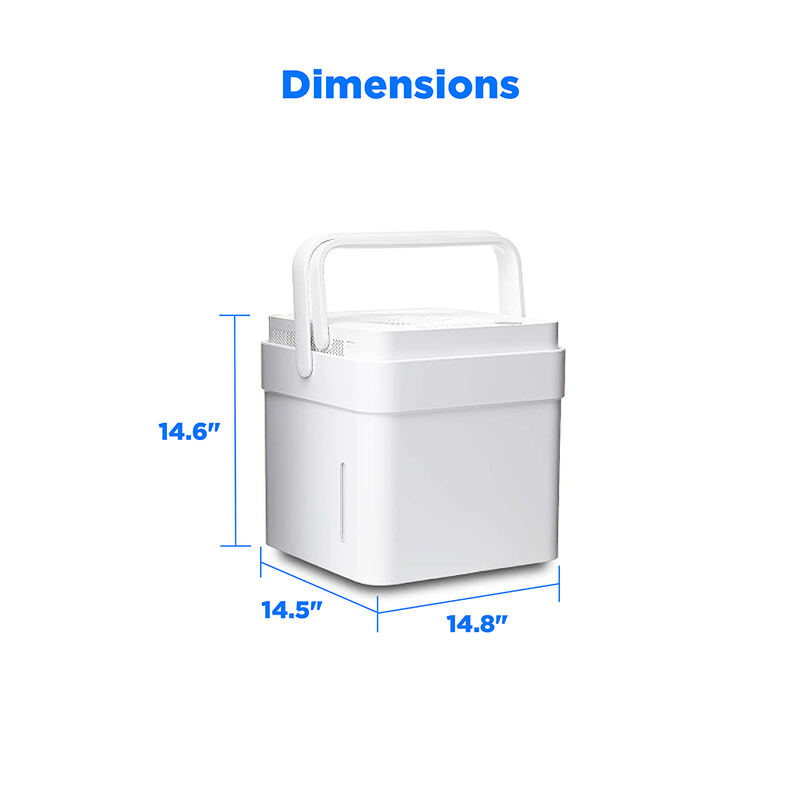
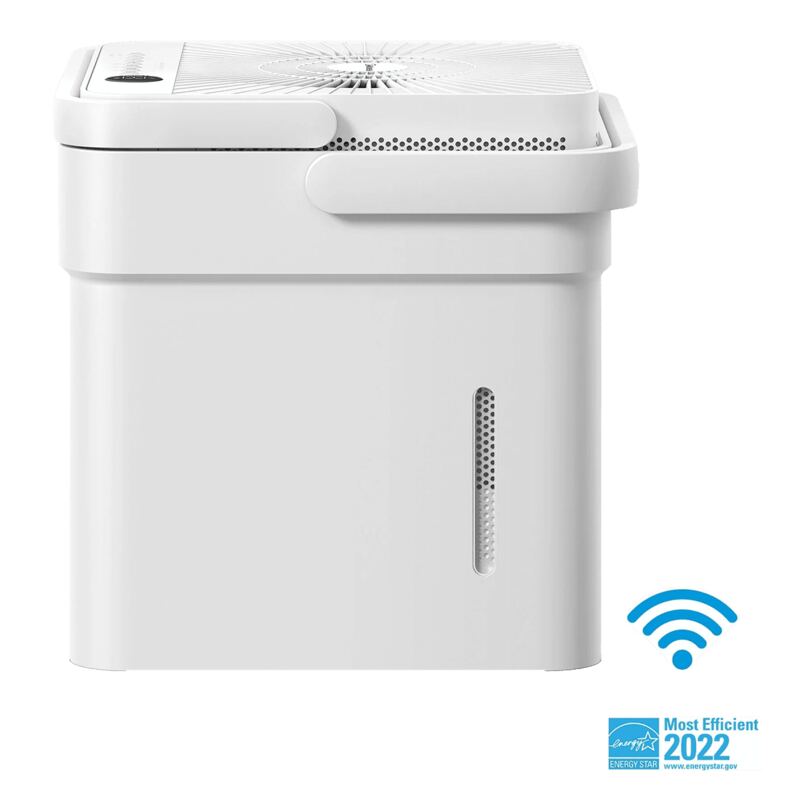
Dehumidifier Buyers Guide and HouseFresh both rank the Midea Cube as the best 50-pint dehumidifier they have ever tested. The collapsible cube-shaped chassis hides a 4.2-gallon tank and built-in pump, and it draws less power than every other 50-pint unit in the test set. Wi-Fi, Alexa, and a measured noise floor in the mid-60s on high keep it usable in open-concept living areas — though the lift-and-twist design is awkward for users who need to drag a full bucket up basement stairs.

Full review
Moisture Removal Performance
Dehumidifier Buyers Guide measured the MAD50S1QWT pulling a 50 sq ft test chamber from 90% RH down to 40% RH in 7 minutes and 39 seconds — the fastest result across 34 high-capacity units the team has run through the same protocol. HouseFresh's Danny Ashton saw a comparable 65% to 45% drop in roughly six minutes in his own living-room test, and noted the unit held the target through several months of continuous service without resetting. Those numbers translate to real-world coverage of about 4,500 square feet of open-concept space, which matches Midea's published AHAM rating rather than overstating it.
The performance edge comes from a higher-airflow fan paired with a larger-than-average evaporator coil. Dehumidifier Buyers Guide recorded 230 CFM at high speed, which is more than competing 50-pint units even after Midea backed off the compressor rpm to keep noise down. The practical result is that the Cube clears a damp basement after a summer thunderstorm in a single overnight cycle, where 22-pint compacts in the same room would still be chasing humidity the next afternoon.
Coverage and Room Size Fit
Midea rates the Cube for spaces up to 4,500 square feet, which is at the high end for any consumer-grade portable. HouseFresh confirmed the unit kept a 2,000 square foot basement at the target humidity continuously, and Consumer Reports gave the MAD50S1QWT the highest score in its 50-pint class for moisture removal. Buyers planning to drop one unit on a main floor of a two-story home can realistically expect it to keep most of the conditioned space comfortable, though doors and stair stacks will limit cross-floor circulation.
The flip side is that the 50-pint capacity is overkill for a single bedroom or 400-square-foot office. Buyers Guide pointed out that the lowest fan speed is still 65 dB, which is loud enough to be intrusive in a sleeping space. For anyone who only needs to dehumidify one room, the 35-pint or 20-pint Midea Cube siblings hit the sweet spot of size, noise, and price.
Setup and Drain Options
The MAD50S1QWT ships with a built-in pump that can push condensate up to 16 vertical feet, which is the headline feature for basement installations where the nearest drain is a utility sink halfway up the wall. HouseFresh praised the included drain hose for being long enough to reach across an unfinished basement without splicing. Gravity drain is also supported by removing a plug on the lower housing — useful for laundry rooms with a floor drain.
When the pump is not used, the 4.2-gallon tank holds about 34 pints, which is the largest in any consumer dehumidifier on the market and roughly three times the typical 12-pint bucket on a hOmeLabs or Frigidaire chassis. HouseFresh did flag that lifting a full bucket out of the unit takes some effort because the tank weighs about 40 pounds when topped off — the cube design is space-efficient but not the friendliest for users with limited upper-body strength.
Noise and Bedroom Friendliness
Dehumidifier Buyers Guide measured 65.4 dB on low and 66.4 dB on high at the unit, which is right in the middle of the 50-pint class. Most competing top-exhaust 50-pint dehumidifiers came in at 70 dB or higher, so the Midea is meaningfully quieter where it matters even though it never drops into whisper territory. MedGrade reported a much lower 42.5 to 49 dB reading at distance under sleep-mode programming — closer to a refrigerator hum than a window-AC unit.
In practical terms, the Cube is acceptable background noise in a finished basement or open living room, but it is loud enough to interrupt conversation if placed within 10 feet of a sofa. Users sensitive to fan noise in a bedroom should look at the dual-inverter LG PuriCare line or the smaller MAD20S1QWT, both of which test below 50 dB on low. Several Amazon reviewers also note a slight compressor hum that becomes noticeable in a quiet house at night.
Energy Use and Long-Term Cost
Dehumidifier Buyers Guide measured 512 watts at 50% relative humidity, the lowest power draw of any 50-pint unit in the test set — most competitors pull 600 watts or more under the same conditions. HouseFresh's published Energy Star efficiency number of 1.8 liters of water removed per kilowatt-hour ties the most-efficient compressor design currently certified, which is why the EPA tagged it as Energy Star Most Efficient. Over a humid summer running 12 hours a day at U.S. average electric rates, the difference works out to roughly $40 to $60 in lower bills versus a non-certified 50-pint unit.
The MAD50S1QWT is also the only 50-pint dehumidifier in this category with built-in pump and Wi-Fi at this price point — Frigidaire's pump models historically cost $50 to $80 more. Long-term cost of ownership is harder to call: HouseFresh flagged that the companion app has not received updates in over a year, which raises questions about smart-feature support five years out. The compressor itself carries an industry-standard one-year warranty that lags Honeywell's five-year sealed-system coverage.
Smart Features
The MideaAir SmartHome app handles scheduling, humidity setpoints, remote on/off, and a basic dashboard of historical readings. HouseFresh reported the initial Wi-Fi pairing process is fiddly — it asks for 2.4 GHz only and the app times out if the router takes too long to broadcast — but once paired the connection holds reliably. Alexa and Google Assistant integrations both work and respond within a second or two for setpoint changes, though there is no native HomeKit support.
The biggest smart-feature limitation is that there is no built-in scheduling tied to outdoor weather or local humidity forecasts, which a few competitors are now offering through their respective ecosystems. The Midea app is functional but feels frozen in 2022 vintage — basic graphs and toggles with no automations, scenes, or routines beyond the daily timer. Most reviewers conclude the smart features are nice-to-have rather than worth a premium over a non-Wi-Fi 50-pint unit.
What Reviewers Loved
Both Dehumidifier Buyers Guide and HouseFresh kept emphasizing the same three things: fastest moisture removal in class, lowest power draw in class, and a tank size so large you forget to check it for a week at a time. Consumer Reports' testers gave the MAD50S1QWT their highest score in the 50-pint category for energy efficiency, water removal, and convenience — a clean sweep that no other 50-pint dehumidifier achieved in their lab in 2026. Reddit threads in r/HVAC echo the same sentiment, with several professional installers using the Cube as their default recommendation for basement retrofits where a whole-home dehumidifier loop is not in the budget.
Where It Falls Short
The most consistent complaint is the lift-and-twist mechanism. To extend the cube for operation you twist the upper housing 90 degrees, and to nest it for storage you reverse the twist. HouseFresh and several Amazon reviewers described the action as sticky after a few weeks of dust accumulation, and at least one reviewer reported the latch wearing loose enough to slip while moving the unit. The 40-pound full bucket is also a known pain point for older users.
The one-year warranty is the other big asterisk. Honeywell offers five years on the sealed system, and Frigidaire offers two — Midea's one-year coverage is on the short side for a $350 appliance with moving parts. HouseFresh also noted that the MideaAir app stopped receiving feature updates in late 2024, which is concerning if you want the smart features to remain functional through the unit's expected eight-to-ten-year service life.
Who It's Best For
The MAD50S1QWT is the right pick for someone with 2,500 to 4,500 square feet of open or semi-open space who wants pump drainage and basic smart controls without paying premium dollar-per-pint pricing. It is a particularly strong fit for finished basements where the noise tradeoff is acceptable, the pump can lift water to a utility sink, and the large tank lets the homeowner ignore it for a week between checks. Anyone refinancing a finished walkout level should put this on the shortlist.
It is not the right pick for a single bedroom or quiet home office — the noise floor is too high. It is also not ideal for users who want a long warranty: Honeywell's TP50AWKN ships with five years on the sealed system at a similar street price, and its quieter operation makes it a better fit for living spaces where occupants are present. Owners of multi-floor homes should weigh whether one 50-pint or two 35-pint units serves them better — the Cube alone will not push dry air upstairs without help from existing HVAC ducting.
Strengths
- +Removed 90% to 40% RH in 7 minutes 39 seconds in dehumidifierbuyersguide testing
- +Built-in pump lifts condensate up to 16 feet to a sink or out a window
- +4.2-gallon water tank means 3x longer between empties than conventional units
- +Energy Star Most Efficient with measured 512 W draw at 50% RH
- +Wi-Fi app and Alexa voice control included at no extra subscription
Watch-outs
- −Lift-and-twist cube takes effort to carry when the bucket is full
- −Companion app no longer receives updates per HouseFresh testing
- −Only a one-year warranty against five years from Honeywell
- −Top-exhaust airflow blows warm air upward in low-ceilinged rooms
How it compares
The MAD50S1QWT is the clear performance and convenience pick over the gravity-drain Honeywell TP50AWKN and the manual-empty hOmeLabs HME020031N. Compared to the smaller MAD35S1QWT and MAD20S1QWT Cubes in this lineup, the 50-pint adds the integrated pump and roughly doubles the AHAM rating, but it gives up the lower noise floor and lighter footprint of those siblings.
Who this is for
At a glance: Whole-home owners with 2,500 to 4,500 sq ft of conditioned space who want a single workhorse with pump drainage and Alexa control rather than juggling two smaller units.
Why you’d buy the Midea Cube MAD50S1QWT 50-Pint Smart Dehumidifier with Pump
- Removed 90% to 40% RH in 7 minutes 39 seconds in dehumidifierbuyersguide testing.
- Built-in pump lifts condensate up to 16 feet to a sink or out a window.
- 4.2-gallon water tank means 3x longer between empties than conventional units.
Why you’d skip it
- Lift-and-twist cube takes effort to carry when the bucket is full.
- Companion app no longer receives updates per HouseFresh testing.
- Only a one-year warranty against five years from Honeywell.
Rating sources
“The best home dehumidifier for those who can't use an external drain which has plenty of design features that make it an easy device to live with.”
“A dehumidifier's job is to dehumidify and the Midea Cube simply dehumidifies faster and more efficiently than any other 50 pint dehumidifier we've tested.”
“Massive 34-pint water tank reduces emptying frequency by 3x and operates with highly quiet operation as low as 42.5 dB.”
Our 4.7 score is the average of these published ratings. More about methodology.