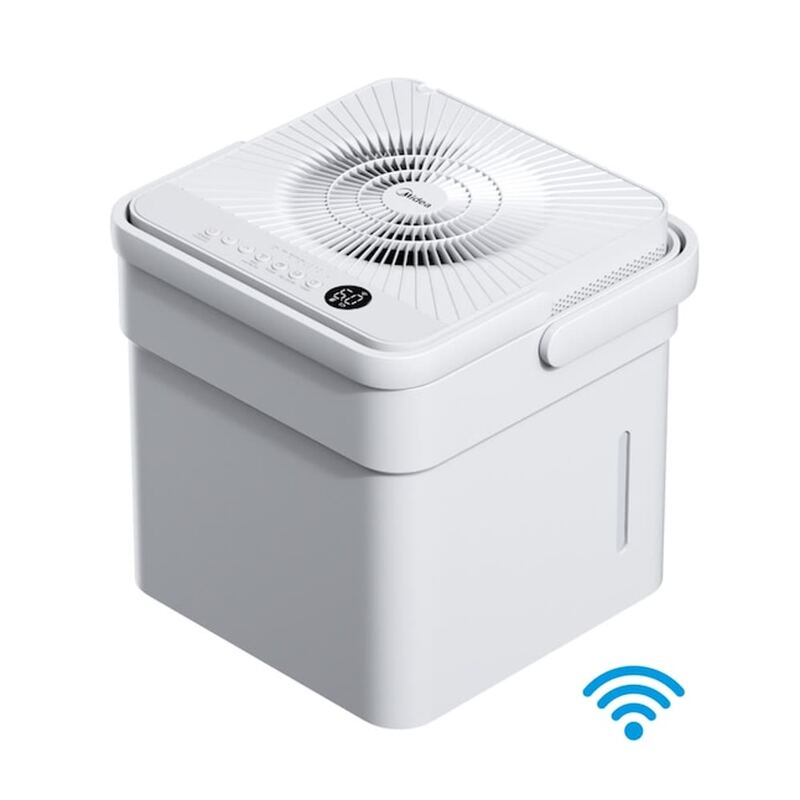
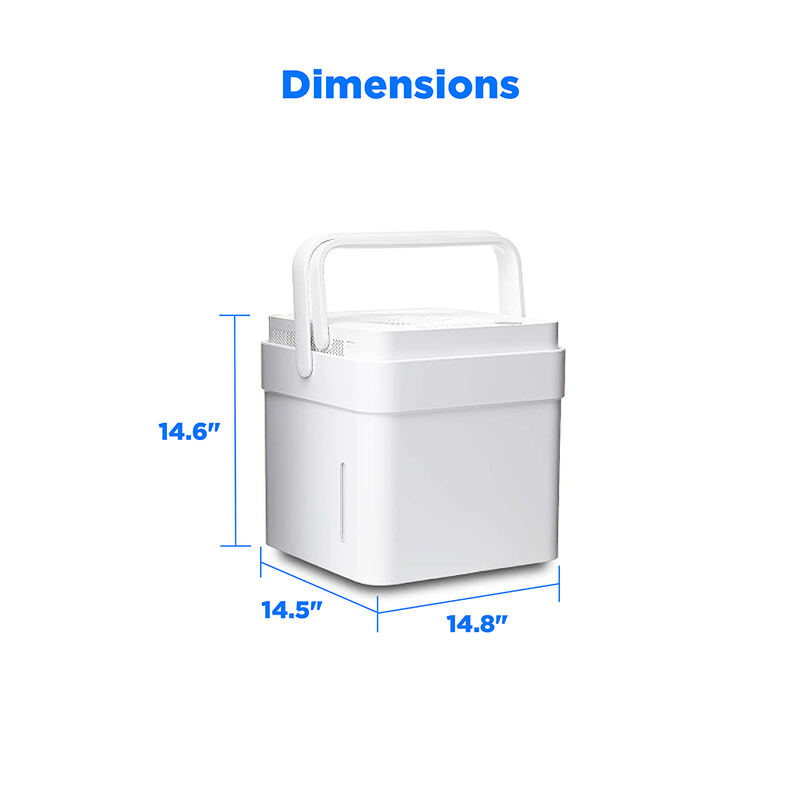
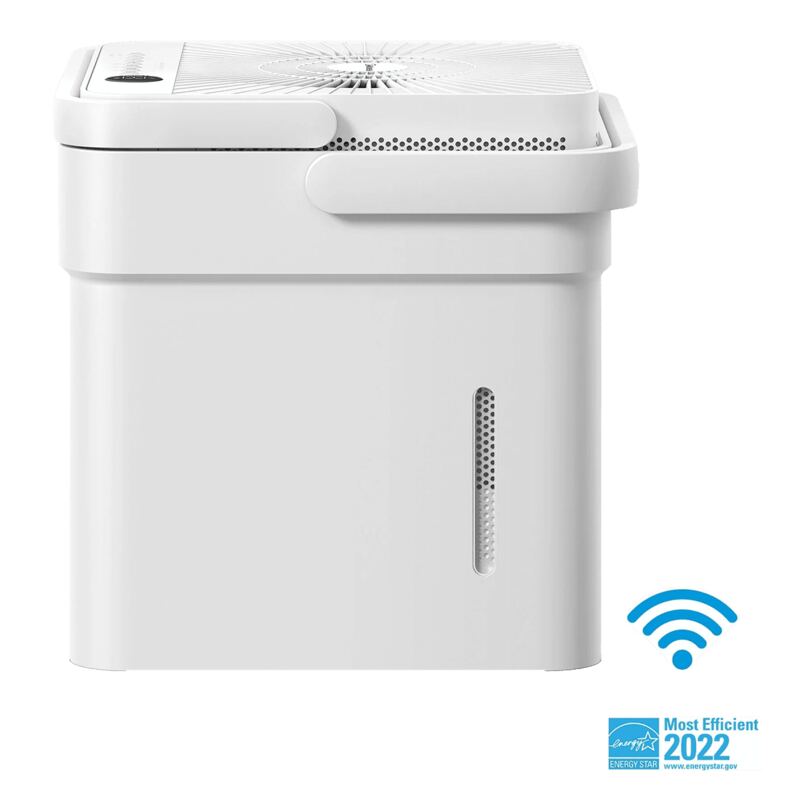
In the 50-pint workhorse class the HME020031N is the budget pick, typically $100 under the Midea Cube and other premium pump units, with energy-efficient performance and a long included drain hose that reaches most basement geometries. HouseFresh's longer-term testing exposed durability concerns with the optional pump add-on, though the base unit kept a 2,000 square foot basement under control through months of continuous service. Buy it when budget is the dominant constraint and smart controls are not needed.
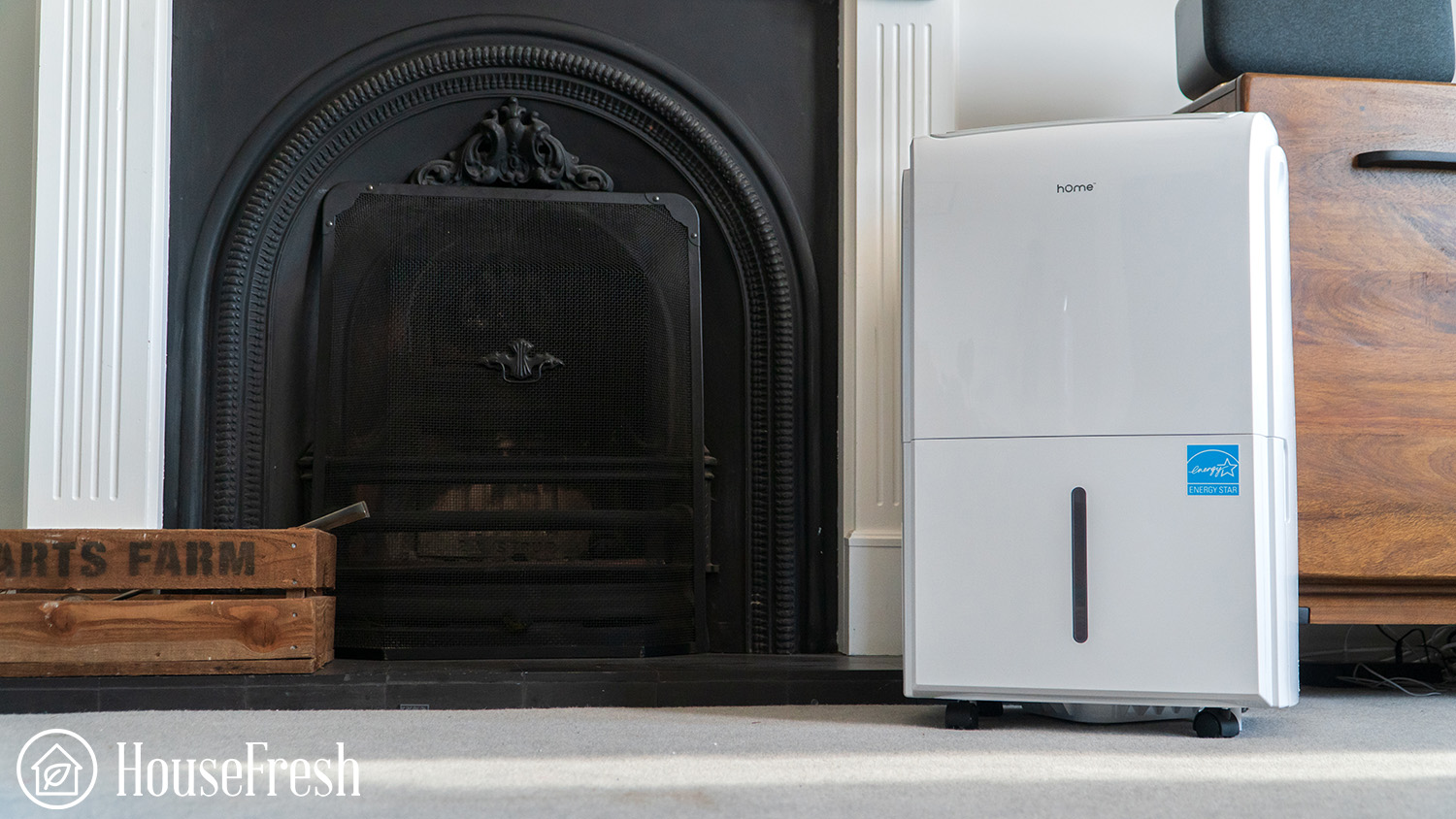
Full review
Reliable long term humidity control despite slower pull rate
Dehumidifier Buyers Guide measured the HME020031N pulling a test chamber from 90% RH down to 40% RH in 10 minutes and 3 seconds — slower than the 7:39 the Midea Cube posted, but well within the competitive range for the 50-pint workhorse class. HouseFresh's longer-running real-world test in a 2,000 square foot basement showed the unit holding 65% target humidity continuously through several months of October-to-January testing. That is the more meaningful number for buyers: it kept up over time rather than gasping during peak summer humidity.
Buyers Guide also clocked the comfort mode pull from 80% RH down to 50% RH in 5 minutes 33 seconds — third-best in their test set. The compressor cycles a touch slower than premium units, but power per pint removed is competitive. The trade-off becomes apparent only at the extremes: in a flooded basement scenario where you need maximum pull rate, the Cube and Frigidaire pump units finish faster.
Effective for moderate spaces but limited in high humidity
hOmeLabs rates the HME020031N for up to 4,000 square feet, which is realistic for moderately damp spaces like an unfinished basement plus an adjacent crawlspace. HouseFresh found it adequate for a 2,000 sq ft basement at continuous operation, and Buyers Guide concurred that buyers should not expect it to handle a 4,000 sq ft severely damp basement on its own without pairing it with bathroom and laundry exhaust fans.
For a typical 1,500 to 2,500 sq ft finished basement or open main-floor layout in a moderately humid climate, this unit will keep up. In a Gulf Coast or southern Florida home with high outdoor dew points, plan for it to run nearly continuously through the summer — that is true of every 50-pint portable, but the smaller tank on this unit becomes a real pain without the included gravity hose plumbed in.
Long drain hose compensates for small tank capacity
The HME020031N ships with a 16.4-foot drain hose, which Buyers Guide singled out as longer than what most competitors include in the box. That extra length covers most basement layouts where the nearest floor drain or utility sink is across the room, without needing a coupling or extension. Gravity drain only — there is no built-in pump option, so the drain destination has to be lower than the unit's outlet.
When run on the bucket, the 12.8-pint tank fills in roughly five to six hours under heavy humidity, which is on the small side for a 50-pint dehumidifier. HouseFresh flagged this as the unit's most annoying day-to-day flaw — empty trips are frequent enough that the gravity-hose setup is effectively mandatory rather than optional. The bucket itself has a handle and pours cleanly, but the small size shows hOmeLabs spent its bill of materials on the compressor rather than the tank.
Noise and Living-Space Friendliness
Dehumidifier Buyers Guide measured 58.6 dB on low and 59.3 dB on high at the unit — quieter than the Midea Cube's 65 dB floor by a meaningful margin. HouseFresh confirmed the unit is noticeably more livable in a living-space scenario than the louder workhorses in the same class. The compressor noise itself is the weak point: Buyers Guide noted it has an unpleasant whine that is not well-masked by the fan, so it draws attention even when the overall dB reading is moderate.
For a basement or laundry room, the noise is acceptable background. For a finished family room with people present, the compressor whine becomes the most-objectionable noise source after about thirty minutes. Light sleepers should not place this in a bedroom — the noise floor is acceptable, but the periodic compressor cycling is harder to tune out than steady fan noise.
Low upfront price offsets higher operating costs
Power draw of 520 watts maximum is one of the lower numbers in the 50-pint class. Buyers Guide measured 610 watts at the 50% RH setpoint in their controlled test, which puts the HME020031N just behind the Midea Cube on watts-per-pint efficiency. HouseFresh's calculation came out to roughly $528 annually, assuming a continuous draw at the unit's 520-watt maximum, according to the U.S. average rates — meaningful money over a decade-long service life, but in the same range as other Energy Star 50-pint competitors.
Sticker price is where this unit earns its keep. HouseFresh and Buyers Guide both note it consistently lands $80 to $120 below the Midea Cube and Honeywell TP50AWKN. Over the unit's expected service life, the operating-cost savings versus a non-Energy-Star competitor partially offset the lower build quality. The math works out if the buyer is comfortable accepting a higher probability of needing to replace it before the ten-year mark.
Manual controls with limited automation
There are none. The HME020031N is a fully manual unit with a front-panel digital display, mechanical buttons, and no Wi-Fi radio. No app, no Alexa, no Google Assistant — what you see on the panel is the entire user interface. For some buyers this is a feature rather than a bug: nothing to update, no privacy concerns, no app dependency for a long-lived appliance.
The Comfort mode auto-selects a target humidity based on the unit's onboard temperature sensor, which is the closest thing to smart behavior the unit offers. It works adequately for set-and-forget operation in a basement where the homeowner does not want to fiddle with setpoints. Buyers Guide noted the onboard hygrometer reads about 2 to 3 percentage points lower than actual, so the displayed humidity is not gospel.
Over 40,000 Amazon reviews averaging 4.7 stars
The unit's Amazon review history is what put hOmeLabs on the map — over 40,000 reviews averaging 4.7 stars before the product line consolidated. Buyers Guide notes the volume of positive feedback is consistent with the unit being a solid value pick that does what it promises. HouseFresh appreciated the long drain hose, the modern appearance, the dual carry handles, and the smooth-rolling wheels that make moving the unit between rooms genuinely easy. The Comfort mode and continuous operation rating both work as advertised for hands-off basement use.
Pump accessory failed and grew mold at 6 months
HouseFresh's most damning finding came at the six-month mark: the optional pump accessory failed and mold grew inside the included hose during continuous use. That is a yellow flag for anyone planning to plumb in the gravity hose and forget about it — the unit needs periodic hose inspection and replacement to stay sanitary. Buyers Guide's verdict was bluntly that the HME020031N "is built using lower quality parts and materials than that of the very best," which shows up in the LED display quality, the bucket molding, and the compressor whine.
The 12.8-pint tank is the other obvious shortcoming — it is dramatically smaller than the Midea Cube's 34-pint tank, which means more daily attention if the gravity hose is not plumbed in. The one-year warranty also lags Honeywell's five years on the sealed system, and the absence of any smart features means you cannot remotely monitor whether the basement unit has tripped or filled overnight.
$100 cheaper for moderate basement humidity
The HME020031N is the right pick for a homeowner who needs to handle moderate basement humidity in a 2,000 to 3,500 square foot space and wants to spend $100 less than the premium options. It is particularly well-suited to setups where the gravity hose can run to a nearby floor drain — that combination unlocks the unit's continuous-operation rating and sidesteps the tank-size complaint. Landlords and DIY remodelers who want a competent compressor without paying for smart features should put it on the shortlist.
It is not the right pick for someone who needs pump drainage to lift water up to a utility sink — there is no built-in pump and the optional accessory has reliability concerns. It is also not ideal for living-room placement where the compressor whine becomes objectionable, or for buyers who want a long warranty as insurance against premature failure. Owners in severe-humidity climates (Gulf Coast, Florida) should size up to the Midea Cube to get the larger tank and faster pull rate.
Strengths
- +Reduced 90% RH to 40% RH in 10 min 3 sec in dehumidifierbuyersguide testing
- +Energy Star certified at 520 W maximum draw, lower than most 50-pint competitors
- +16.4-foot included drain hose covers most basement layouts without splicing
- +Light 40-pound chassis with smooth-rolling casters and dual handles
- +Comfort mode auto-adjusts target humidity based on ambient temperature
Watch-outs
- −Small 12.8-pint water tank fills quickly without continuous drain
- −HouseFresh flagged a pump failure and mold growth inside the hose at six months
- −Build quality and LED display feel cheaper than premium competitors
- −No Wi-Fi, no app, no Alexa — fully manual front-panel controls only
How it compares
The HME020031N comes in roughly $100 under the Midea Cube MAD50S1QWT, with similar moisture-removal speed but a much smaller 12.8-pint tank versus the Cube's 34-pint cube tank. Compared to the Honeywell TP50AWKN, it sacrifices smart controls and the longer five-year sealed-system warranty for a meaningfully lower sticker price. Anyone who values build quality and warranty over price should skip this in favor of the Cube or the Honeywell.
Rating sources
“50 pints of water removed for $100 less than the competition. Uses only 520 watts versus 700 for comparable models.”
Our 3.5 score is the average of these published ratings. More about methodology.