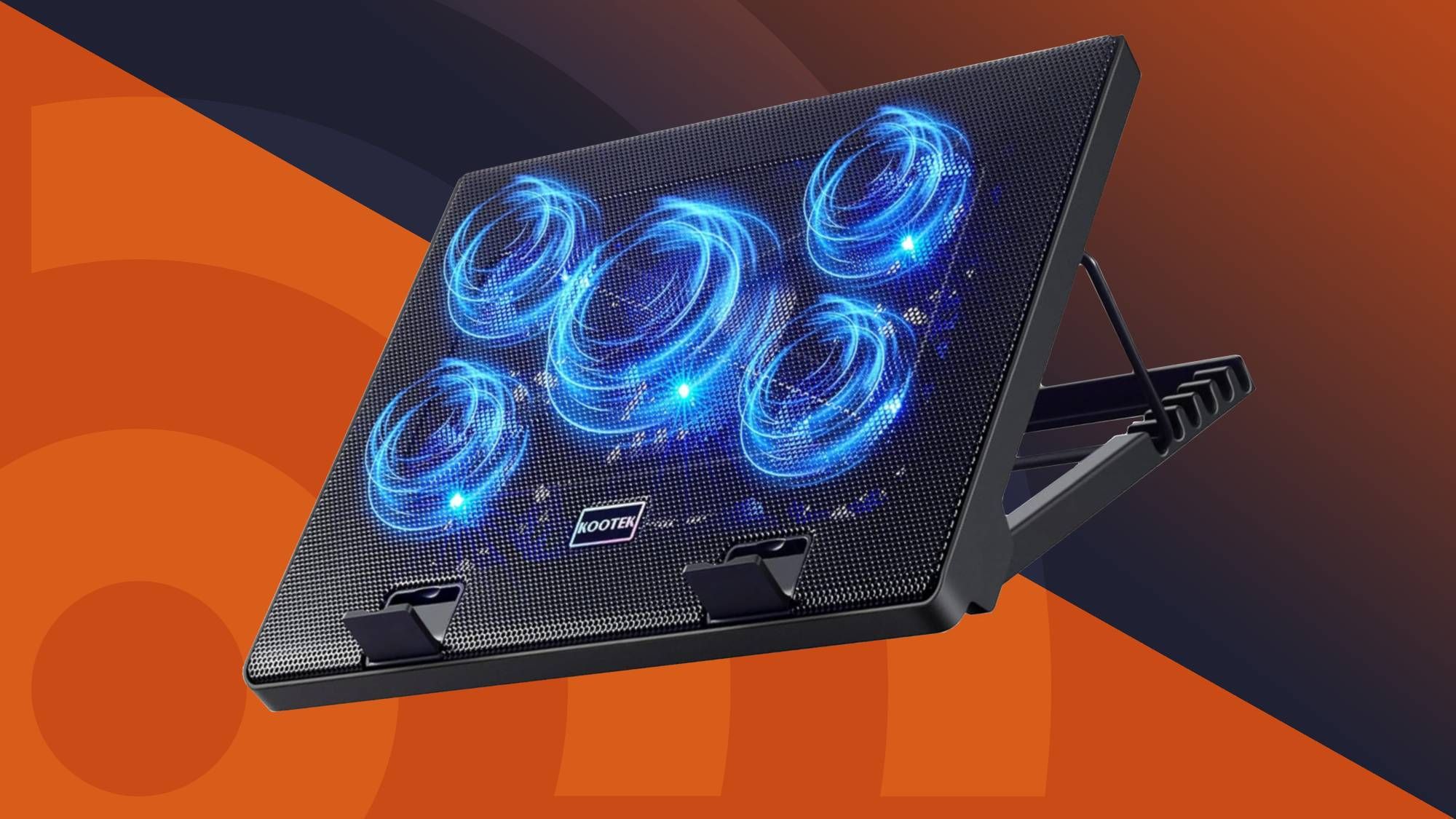
The Kootek Laptop Cooling Pad (model LCP04) is a USB-powered pad with one large and four small fans, six tilt positions and two USB 2.0 ports. Android Authority said it has more customization options than virtually any other laptop cooler, and in its tests the pad cut CPU temperature by 7C at idle and in a CPU stress test and prevented thermal throttling. Under a heavy game the CPU dropped only 3C, which the outlet called a below-average result, and it criticized the cheap-feeling plastic and fan lights that cannot be switched off while the fans run.
Full review
Fan switches and USB pass-through
Android Authority describes the LCP04 as a midrange cooler with a plastic frame and a metal grate on top. Two buttons on the back control the fans: one switches the centre fan and the other the four corner fans, so the pad can run all five, only the corners, or only the centre. There is no speed control, which the reviewer missed during heavy gaming.
Beside the buttons are two USB 2.0 ports. Because the pad is powered through its own attached USB cable, both ports stay free for a mouse or keyboard. Android Authority also noted that if the attached cable ever breaks, a USB-A to USB-A cable plugged into one of the ports keeps the pad running, a kind of redundancy it called rare.
Six tilt positions
The underside has six notches and a metal bar that moves between them: one flat position and five degrees of tilt. Android Authority said the system does not look amazing but is functional, and that the pad lifts a laptop higher than most competitors. It recommends adjusting the tilt with the laptop removed, since a heavy laptop can slide while the bar is being moved.
The reviewer's 17.3-inch ASUS ROG G731GW fit without much overhang, which Android Authority took as confirmation of Kootek's 17-inch claim.
Android Authority's temperature tests
With all five fans running, idle CPU temperature in Windows 10 fell from 45C to 38-41C. In a ten-minute Intel XTU stress test the CPU ran at 78C instead of 85C; without the pad the laptop thermal-throttled after 90 seconds, and with it no thermal throttling was detected and the throttled clock speed rose from 3.2GHz to 3.6-3.7GHz.
Gaming was weaker. In a match of Halo Wars 2 the CPU averaged 87C against 90C without the pad and the GPU 79C against 80C, though GPU spikes fell from 84C to 79C. Android Authority called the 3C CPU drop a below-average result, saying it considers 5C average, and cautioned heavy gamers specifically.
Build and lighting drawbacks
Android Authority found the design chunky and plain, with parts that feel a little cheap, though nothing broke during its tests. The fan lights, sold in blue or red, cannot be turned off without turning off the fans. The front plastic stoppers are tall enough that the reviewer warned they may sit higher than a MacBook or Ultrabook and catch the wrists while typing.
Strengths
- +Six tilt positions, more than nearly all competitors according to Android Authority
- +Centre fan and four corner fans switch separately, so one, four or five fans can run
- +Two usable USB 2.0 pass-through ports
- +7C lower CPU temperature at idle and in a CPU stress test in Android Authority's testing
Watch-outs
- −Only a 3C CPU drop during heavy gaming, a below-average result per Android Authority
- −Plastic design feels a little cheap and inelegant, Android Authority said
- −Fan lights cannot be turned off unless the fans are turned off
- −No fan speed control, and the tall front stoppers may bite into wrists on thinner laptops
How it compares
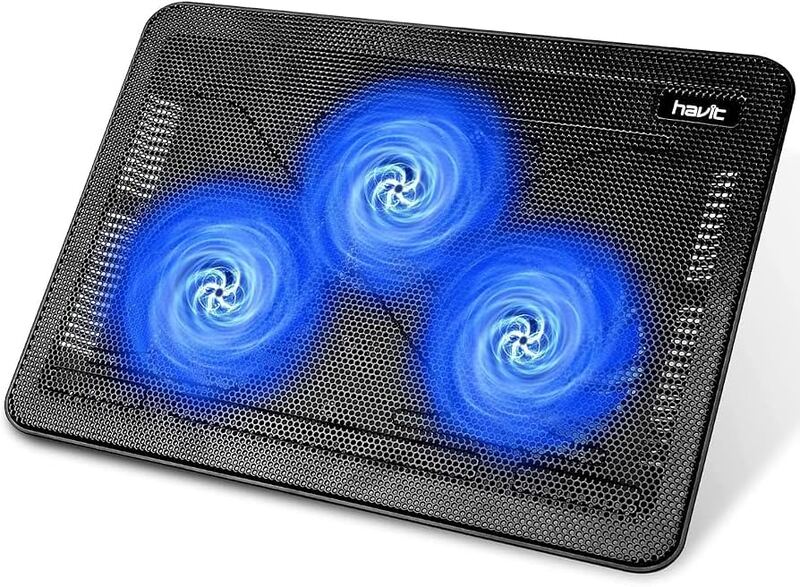
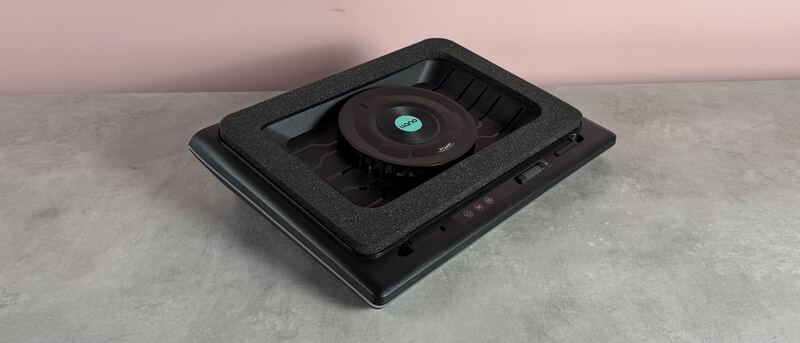
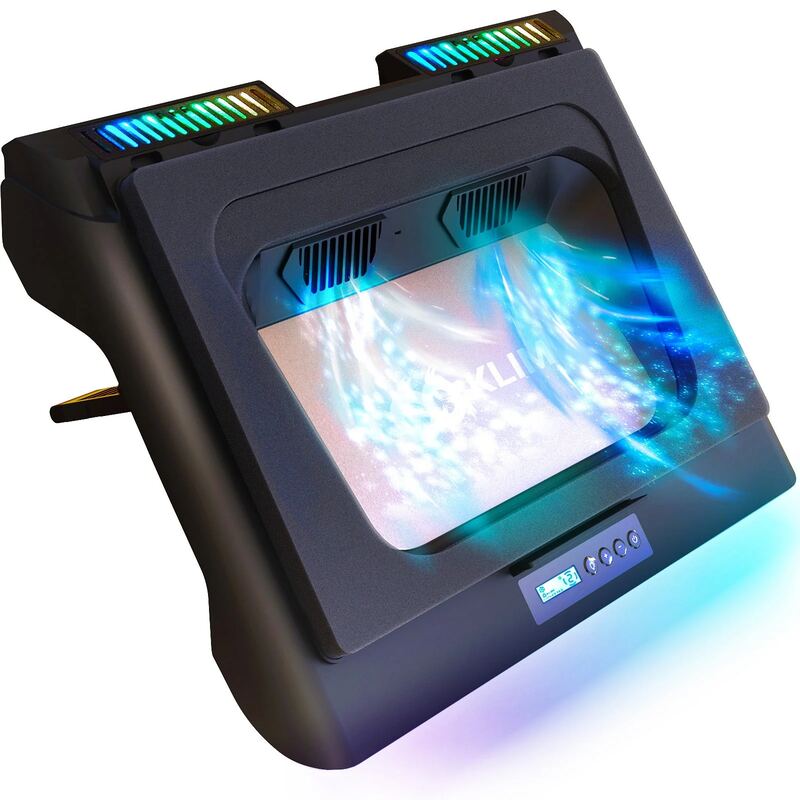
Like the Havit HV-F2056, the Kootek is USB-powered and has no fan speed control, but it carries five fans to the Havit's three and lets the centre fan and the four corner fans be switched separately. The KLIM Everest offers six fan speeds and the Llano V12 a single 5.5-inch, 2,800rpm fan that needs its own power adapter; the Kootek costs far less than either.
Price history At its lowest tracked price
16 daily reads from amazon.com since Oct 29, 2026. Lowest $24.68 (Nov 19), highest $25.99 (Oct 29), latest $24.68 (Nov 22).
Rating sources
Our 3.7 score is the average of these published ratings, each adjusted for how strictly its publisher scores. More about methodology.