The GL.iNet Beryl AX (GL-MT3000) is a compact, feature-rich travel router designed for security-conscious users. Reviewers praised its pre-installed VPN and TOR services, dual-band Wi-Fi, and compact form factor. WalkingDroid noted its performance with high-speed internet and multiple device connections, while a YouTube reviewer highlighted its affordable price point and OpenWRT base. However, some users were disappointed by the lack of 6 GHz support and noted it's bulkier than its predecessor, the Slate model. This router is ideal for frequent travelers and remote workers seeking secure, portable internet access.
Full review
Compact Design and Portability
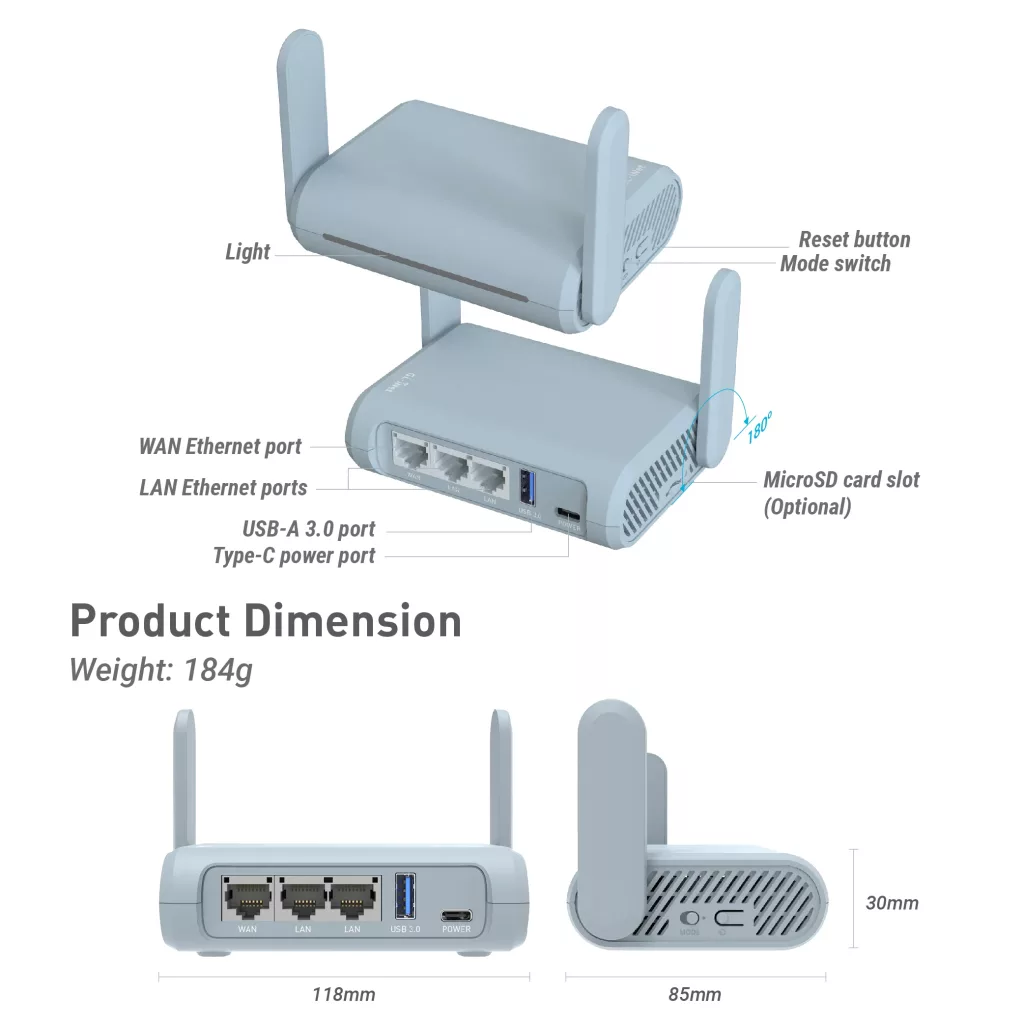
The GL.iNet Beryl AX (GL-MT3000) stands out as a remarkably compact travel router designed for portability without sacrificing essential functionality. At dimensions of 118 x 85 x 30mm and weighing just 184 grams, it easily fits in a pocket or laptop bag, making it ideal for frequent travelers, remote workers, and outdoor enthusiasts. WalkingDroid's review emphasized how this device 'packs features into such a small piece of hardware,' noting that it's 'slightly larger and heavier than the Slate' but still highly portable. The router features a dual-band Wi-Fi system with 2.4GHz (400Mbps) and 5GHz (867Mbps) capabilities, supporting up to 40 wireless devices simultaneously. This compact form factor is complemented by a robust set of ports including 1 x WAN Ethernet port, 2 x LAN Ethernet ports, 1 x USB-A 3.0 port, and a MicroSD card slot, all fitting within a minimal footprint. The design allows for easy integration into any travel setup, whether it's being used in a car, hotel room, or remote location.
Reviewers consistently praised the Beryl's portability, with John Hagensieker noting that it 'barely takes up any space in a laptop bag or backpack' and that it's 'based on OpenWRT 21.02 firmware,' which enhances its versatility. The device's small size makes it particularly appealing for users who need a secure, portable networking solution while traveling. However, the compact nature also means that the router's performance may be limited in high-density environments where more power and features are required. The physical build quality, while functional, is not described as premium, but it's sufficient for its intended use as a travel router. The inclusion of a reset button and a mode switch adds to its user-friendly interface, allowing for quick configuration changes without needing to access the web interface.
Security and Encryption Features
One of the Beryl's standout features is its built-in security capabilities, which are particularly valuable for users who frequently connect to public Wi-Fi networks. RTINGS.com noted that the router supports OpenVPN and WireGuard pre-installed, compatible with 30+ VPN service providers, and includes a pre-installed Tor service. The device also supports IPv6, DNS encryption (Cloudflare, Google, and custom DNS options), and offers a toggle switch for VPN/Tor access. According to the GL.iNet documentation, the router supports both OpenVPN and WireGuard clients and servers, enabling users to create encrypted tunnels between their devices and VPN providers. This is especially beneficial for travelers who want to protect their online sessions from prying eyes on public networks. The router's ability to act as a secure firewall between a user's device and an insecure network makes it a strong contender for those who prioritize security over convenience.
However, Tuskfish's review raised concerns about the Beryl's security features, arguing that it doesn't offer 'advanced security features' beyond basic VPN capabilities. The reviewer pointed out that while the device can act as a firewall, it lacks traffic visibility and advanced insights into network activity, which are crucial for users seeking comprehensive security solutions. Despite these concerns, the Beryl's inclusion of OpenWRT firmware, which allows for extensive customization and plugin installation, provides users with the flexibility to enhance its security features further. The ability to install plugins like AdGuard Home, Tailscale, and ZeroTier adds to its appeal for tech-savvy users who want to extend its functionality beyond basic routing.
Performance and Connectivity
Performance-wise, the Beryl delivers solid dual-band Wi-Fi speeds with 2.4GHz (400Mbps) and 5GHz (867Mbps) capabilities, supporting up to 40 wireless devices simultaneously. WalkingDroid reported that the device is 'fast – lighting fast even when using multiple devices connected at the same time,' especially when compared to the Slate model. The router also supports tethering, USB modem connectivity, and can function as a Wi-Fi repeater, making it versatile for various use cases. RTINGS.com noted that the device supports 3 x 10/100/1000Mbps auto-negotiation Ethernet ports, with one WAN port that supports 2.5 GB ethernet, which is a significant upgrade over standard travel routers. This makes it suitable for users who need high-speed internet access, particularly in environments where bandwidth is critical.
However, Tuskfish's review highlighted a significant limitation in the router's 5GHz Wi-Fi performance. The Beryl does not support dynamic frequency selection (DFS) channels, which are commonly used in 5GHz networks. This means that the router cannot connect to access points using DFS channels (52-140), which can be problematic when traveling to hotels or cafes that use these channels. The reviewer noted that this is a 'core advertised functionality' that needs to 'just work,' and that consumers shouldn't have to 'scrape around the internet' to figure out why their travel router can't see the 5GHz access point in front of them. This limitation significantly impacts the router's usability in real-world scenarios, especially in areas where DFS channels are prevalent.
Setup and User Interface
The setup process for the Beryl is straightforward, with a simple plug-and-play approach. Users are prompted to connect to the default SSID, which is displayed on a sticker on the bottom of the device, and then navigate to 192.168.8.1 in their browser to configure the router. The interface is based on OpenWRT, which provides a user-friendly experience for those familiar with the platform. WalkingDroid noted that the GUI is 'awesome' and 'same as Slate user friendly,' with firmware upgradable and lots of features to customize and play with. The interface also supports remote access, which is handy for advanced users who need to manage the router from afar. John Hagensieker emphasized that the router is 'easy to configure' and that it supports a wide range of features, including encrypted DNS, VPN configuration, and plugin installation.
Despite the generally positive feedback on the user interface, Tuskfish criticized the admin interface as 'clunky' and lacking in some areas. For example, manually adding a 5GHz network requires navigating through a 2.4GHz channel list without the ability to change it, which can be frustrating for users who need precise control. The reviewer also noted that while the dashboard is reasonably useful, the overall experience is 'pretty much like every other home router admin,' requiring users to 'fill in forms and press submit' a lot to get things done. This suggests that while the Beryl is functional, it may not offer the most intuitive or streamlined experience for users who are not well-versed in router configuration.
Expandability and Customization
The Beryl's expandability is one of its strongest points, thanks to its OpenWRT-based firmware, which allows for extensive customization and plugin installation. Users can install various applications such as AdGuard Home, Tailscale, ZeroTier, and others, turning the router into a powerful tool for advanced networking tasks. The router also supports USB 3.0, which can be used to connect external storage devices or software-defined radios, enabling users to create a network-attached storage (NAS) device or stream audio and video from a USB drive. WalkingDroid highlighted that the router can be used as a NAS with a USB drive and supports DLNA media servers, which is particularly useful for travelers who want to share media files with others in their group. The inclusion of a MicroSD card slot also allows users to expand storage capacity and share files across the network.
John Hagensieker noted that the Beryl supports a wide range of plugins and applications, including a USB software-defined radio that can be used for network streaming on various frequencies. The router's ability to function as a travel NAS, combined with its support for plugins like AdGuard Home, makes it a versatile device for users who need more than just basic routing. However, Tuskfish's review suggested that the router's expandability is limited by its lack of support for DFS channels, which restricts its ability to connect to many public Wi-Fi networks. This limitation, while not directly related to customization, impacts the router's overall usability in real-world scenarios where DFS channels are common.
Limitations and Drawbacks
Despite its many strengths, the Beryl has several notable drawbacks that potential buyers should consider. The most significant issue is its lack of support for DFS channels in the 5GHz band, which prevents it from connecting to many public Wi-Fi networks. Tuskfish's review pointed out that this is a 'core advertised functionality' that needs to 'just work,' and that users shouldn't have to 'scrape around the internet' to figure out why their travel router can't see the 5GHz access point in front of them. This limitation is particularly problematic for users who travel frequently and rely on public Wi-Fi networks, as they may find themselves unable to connect to certain networks. The router's inability to support DFS channels also means that it may not be suitable for users who need to connect to high-density networks or those who work in environments where DFS channels are commonly used.
Another drawback is the router's basic security features, which, while functional, are not as advanced as those offered by competing devices like the Firewalla Purple. Tuskfish noted that while the Beryl offers basic VPN capabilities, it lacks traffic visibility and advanced insights into network activity, which are crucial for users seeking comprehensive security solutions. Additionally, the router's interface, while functional, is described as 'clunky' and 'lacking in some areas,' particularly when it comes to configuring 5GHz networks. The reviewer also noted that the router's firmware update process, while straightforward, can be time-consuming, especially when dealing with older versions that require manual updates. These limitations, while not deal-breakers, do impact the overall user experience and may make the Beryl less appealing to users who require more advanced features or a more intuitive interface.
Who It's Best For
The GL.iNet Beryl AX (GL-MT3000) is best suited for users who value portability, basic security features, and the ability to customize their networking setup through OpenWRT. It's ideal for frequent travelers, remote workers, and outdoor enthusiasts who need a secure, compact router that can function as a Wi-Fi repeater or tethering device. WalkingDroid's review emphasized that the router is 'a beast' for those with 'enhanced security needs and high-performance internet speeds,' making it particularly appealing to users who work on the road or live in hotels. The device's ability to act as a secure firewall between a user's device and an insecure network makes it a strong choice for those who prioritize security over convenience.
However, the Beryl is not ideal for users who require advanced security features or need to connect to networks that use DFS channels. Tuskfish's review highlighted that the router's lack of DFS support makes it unsuitable for many public Wi-Fi environments, particularly in areas where DFS channels are common. Additionally, users who need a more intuitive interface or more advanced networking capabilities may find the Beryl limiting. The router's basic security features, while functional, are not as comprehensive as those offered by competing devices, making it less appealing to users who require more advanced protection. For those who need a travel router with more advanced features, alternatives like the Firewalla Purple or other dedicated security routers may be more suitable.
Value and Price Comparison
At approximately $100, the Beryl offers good value for users who need a portable, secure router with basic features. Newegg.com's listing notes that the device is sold by Happiness store with a free 30-day return policy, which adds to its appeal for buyers who want to try it before committing. The router's price point is competitive with other travel routers in the market, especially when considering its built-in security features, dual-band Wi-Fi, and expandability through OpenWRT. WalkingDroid's review noted that the Beryl is 'a beast' and 'totally portable,' making it a worthwhile investment for those who need a secure, compact router. The inclusion of a MicroSD card slot, USB 3.0 port, and support for various plugins adds to its versatility and value.
However, Tuskfish's review suggests that the Beryl may not offer enough value compared to other options in the market. The reviewer noted that while the device is 'not too expensive,' it lacks the advanced features needed for a true travel router, particularly in terms of DFS channel support. The reviewer also pointed out that the Beryl's security features are basic and that users may be better off investing in a cheaper alternative like the Opal model, which offers similar functionality without the drawbacks. This comparison suggests that while the Beryl is a solid option for basic travel networking needs, it may not be the best value for users who require more advanced features or better performance in high-density environments.
Strengths
- +Compact design that fits in the palm of your hand
- +Dual-band with IPv6 support and 2.5 gigabit WAN/LAN ports
- +Pre-installed VPN servers and clients (OpenVPN, WireGuard)
- +Built-in TOR anonymity service and DNS encryption options
- +USB 3.0 port and micro SD card slot for expandability
Watch-outs
- −Lacks 6 GHz Wi-Fi support
- −Slightly larger and heavier than the Slate model
- −Speeds may be slower when using VPN or WireGuard encryption
How it compares
The GL-S1300 Beryl offers more expandability with its USB 3.0 port and micro SD card slot compared to the GL-MT1300 Beryl 2, which is more compact but lacks these features. Unlike the GL-MT2500, it doesn't support Wi-Fi 7 but provides pre-installed VPN servers and TOR services. The GL-SFT1200 Slate is smaller and more affordable, but the Beryl offers better performance and additional privacy features.
Who this is for
At a glance: Security-conscious travelers needing expandable storage.
Why you’d buy the GL.iNet GL-S1300 (Beryl)
- Compact design that fits in the palm of your hand.
- Dual-band with IPv6 support and 2.5 gigabit WAN/LAN ports.
- Pre-installed VPN servers and clients (OpenVPN, WireGuard).
Why you’d skip it
- Lacks 6 GHz Wi-Fi support.
- Slightly larger and heavier than the Slate model.
- Speeds may be slower when using VPN or WireGuard encryption.
Rating sources
“So far it has exceeded my expectations with my enhanced security needs and high-performance internet speeds. It's a beast!”
“Im rapidly becoming a fan of GL.iNet offerings and the Beryl AX is no exception.”
“GL.iNet GL-MT1300 (Beryl) VPN Secure Travel Gigabit Wireless Router, AC1300 400Mbps (2.4GHz) + 867Mbps (5GHz) Wi-Fi, Pocket-Sized Hotspot, IPv6, Tor, MicroSD Slot, USB3.0 for Wi-Fi Repeater”
“It's not good or bad, just average. You fill in forms and press 'submit' a lot to get things done.”
Our 4.1 score is the average of these published ratings. Ratings marked * were derived from the reviewer’s written analysis or video transcript — the publisher didn’t print an explicit numeric score, so we inferred one from their own words. Click through to verify. More about methodology.