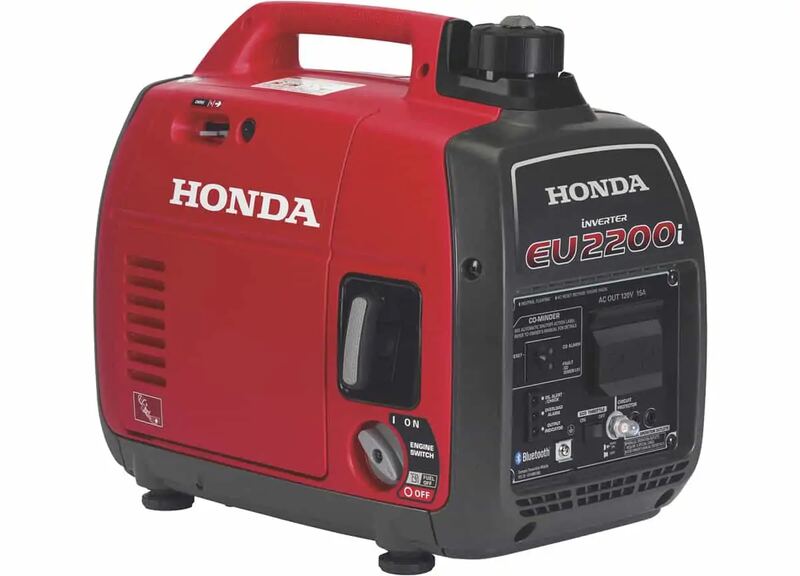
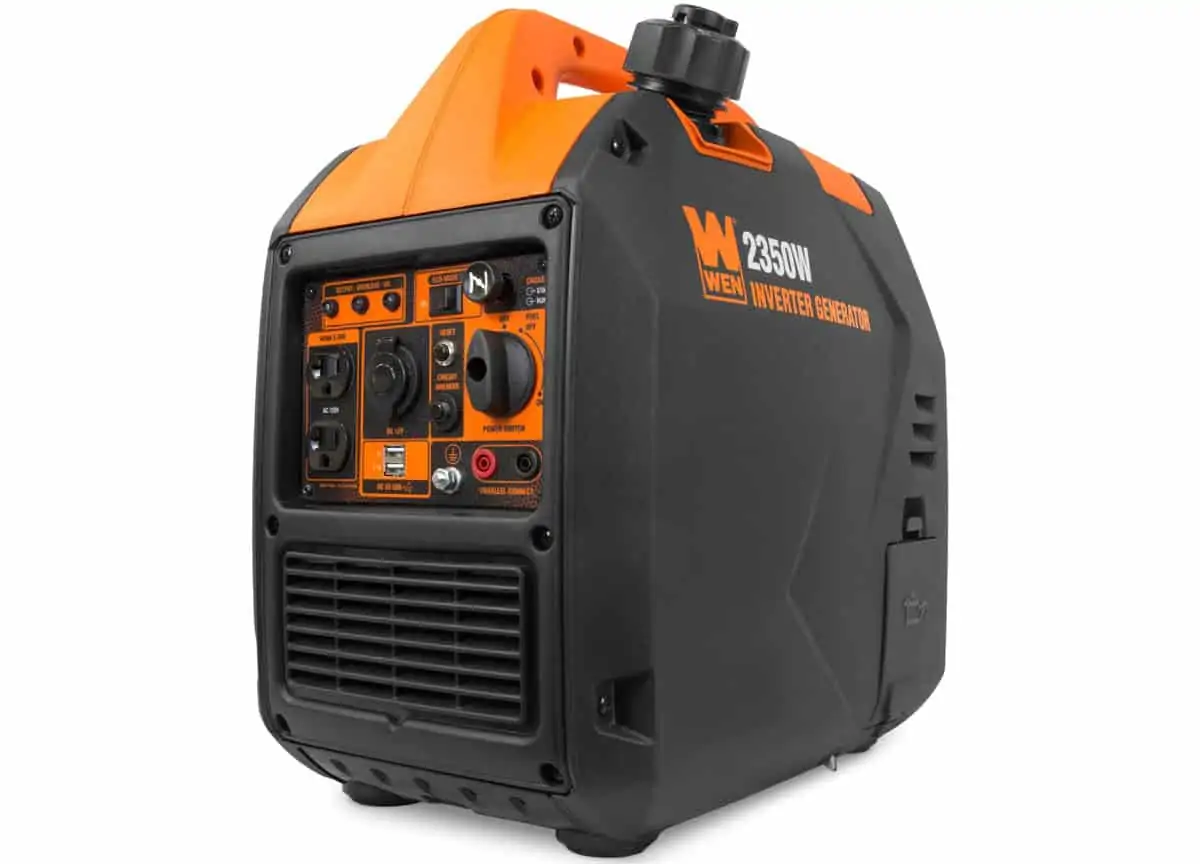
At 39 lbs, 51 dBA at quarter load and roughly $429 street price, the WEN 56235i is the ultra-portable budget pick. Its sine-wave power is cleaner than even the Honda EU2200i's (under 1.2% THD vs under 3%), and it runs 10.5 hours at 25% load on a single tank. A 2-year warranty and a lighter-duty engine are what you accept for paying a third of Honda's price.
Full review
Power Output and Real-World Use
The WEN 56235i delivers 1,900 running watts and 2,350 peak watts from a 79cc OHV four-stroke engine — slightly less running power than the Westinghouse iGen2800 (2,200W) and the Honda EU2200i is in the same class (1,800W). In practical RV terms, the 2,350-watt peak is enough to start most 13,500 BTU air conditioners but may struggle with the larger 15,000 BTU units that the Honda EU2200i Companion variant handles more reliably. For tent camping, tailgating, or running a small fridge and a few LED lights during a power outage, the 1,900-watt continuous rating is plenty.
Owner reports on RV and camping forums consistently mention the 56235i runs a small refrigerator, a few LED string lights, and a phone charger combined without breaking a sweat. The clean inverter output (less than 1.2% THD at full load per generator-bible's measurements) is actually a better spec than Honda's published under-3% THD, which means the WEN is genuinely safe for laptops, CPAP machines, and other sensitive electronics at any load condition.
Portability and Weight
At 39 pounds dry, the WEN 56235i is the lightest 2,000-watt-class inverter generator on the market — 8 pounds lighter than the Honda EU2200i and 7 pounds lighter than the Westinghouse iGen2800. For a single user lifting the generator into a truck bed, onto a tailgate, or up a steep campground path, those 8 pounds matter. The built-in carry handle is sturdy and balanced; reviewers consistently note it's the rare generator one person can carry one-handed across a parking lot without strain.
The compact 17.3 × 11.5 × 17.7-inch dimensions also make the unit easy to fit in the back of a hatchback or a car trunk for tailgating trips — Honda's EU2200i is about an inch longer and noticeably wider, which matters when packing a Subaru Outback or smaller crossover.
Noise Level and Neighborhood Use
WEN rates the 56235i at 51 dBA at quarter load and 23 feet — just 3 dBA above the Honda EU2200i's 48 dBA, which is the spec that costs $700 more on the Honda. In real-world terms, both units are quieter than a normal conversation and well within national park campground quiet-hour limits. At full load the WEN climbs to roughly 60 dBA, slightly louder than the Honda's full-load 57 dBA but still quieter than a window AC unit running indoors.
The eco-mode throttle response is reasonably quick — the engine idles down within a few seconds when loads drop, and spools back up smoothly when a refrigerator compressor cycles on. Some owners report a slight surging hunt at idle that the Honda doesn't exhibit, but it doesn't cause brownouts on connected devices.
Fuel Efficiency and Runtime
Runtime is one of the WEN's strongest specs. The 1.06-gallon tank lasts 10.5 hours at 25% load and roughly 5.7 hours at 50% load — longer than the Honda EU2200i's 8.1 hours at 25% load despite both units carrying similar tank capacities. The fuel shut-off feature is genuinely useful for storage: flip the switch and the engine runs the carburetor dry before stopping, which prevents the stale-gas gumming that kills cheap generators during 6-month-plus off-season storage. Anyone who only fires the unit up during hurricane season will appreciate this.
Low-oil and low-fuel automatic shutdown protect both the engine and connected electronics. The 12V 8A DC outlet on the front panel is useful for trickle-charging a deep-cycle battery during extended runs, a setup some boondocking RVers use to keep a house battery topped off without running the generator continuously.
1,000 to 2,000 hours before major engine work
The WEN 56235i's plastic clamshell housing and 79cc engine are typical for the price tier — sturdier than a Predator from Harbor Freight but not in the same durability class as the Honda's GXR120 commercial engine. Owner reports on generator and camping forums suggest 1,000-2,000 hours of service life before major engine work becomes necessary, versus Honda's 5,000+ hour ceiling. For occasional camping and storm-prep use (50-100 hours per year), the WEN will easily outlast its 2-year warranty several times over.
The plastic corners are the most common wear point — repeated transport in a truck bed can chip the housing within 2-3 years of regular use. The internal frame and engine mounts are steel and survive cosmetic damage; the unit keeps working even with a cracked corner panel. Replacement housings are available from WEN's parts catalog for around $40-60.
Harder to pull-start in freezing weather
The 2-year warranty is the most concrete limitation versus the Honda EU2200i's 3-year coverage and the Westinghouse iGen2800's 3-year residential warranty. WEN's service network is also smaller than Honda's — owners outside major metropolitan areas may need to ship the unit back for warranty repair rather than dropping it at a local dealer. For occasional users this rarely matters; for primary jobsite or RV use, it can mean a 2-3 week downtime if something fails.
Cold-start reliability is the second knock. Some owners report difficulty pull-starting the 56235i after long storage or in below-freezing weather, with multiple pulls required before the engine fires. Using ethanol-free gas and running the fuel shut-off feature before storage largely eliminates the issue, but the Honda EU2200i is more forgiving about poor storage habits.
A fit for casual campers, not daily use
The WEN 56235i is the right pick for tent campers, tailgaters, hunting-camp users, and storm-prep buyers who use the generator 30-80 hours per year and don't want to spend Honda money. At $429 street it's roughly a third the cost of the Honda EU2200i, and for buyers who match that usage profile, the 8-pound weight savings versus the Honda is genuinely meaningful when packing a small vehicle.
Anyone running a generator for primary RV camping (200+ hours per year), jobsite duty, or long-duration multi-day outage backup should step up to the Honda EU2200i or Westinghouse iGen2800. The WEN's lighter-duty engine reaches its service-life ceiling much faster under continuous use; for casual use it's the easiest budget recommendation in the category.
Runs 30% longer per tank than the Honda
At $429 the WEN 56235i is a near-impossible value to beat in the ultra-portable inverter category. It produces cleaner sine-wave power than the Honda EU2200i on paper, runs 30% longer per tank, weighs 8 lbs less, and costs a third as much. The trade-offs are real (shorter warranty, lighter-duty engine, smaller service network) but irrelevant for the casual-user profile that buys this unit. Anyone unsure whether they actually want to own a generator should start here — find out if you use it, and upgrade to the Honda if you do.
Strengths
- +39 lb dry weight is the lightest in the 2,000-watt-class inverter market — genuinely one-hand portable
- +51 dBA noise at quarter load is competitive with Honda's 48 dBA at less than half the price
- +Under 1.2% Total Harmonic Distortion is cleaner than the under-3% THD of competing budget inverters
- +Includes fuel shut-off feature that runs the carburetor dry to prevent stale-gas gumming during long storage
- +Two USB-A ports and a 12V DC outlet provide direct phone, tablet, and 12V camping-gear charging
Watch-outs
- −Two-year warranty is shorter than Honda's three years or Westinghouse's three-year residential coverage
- −Plastic clamshell housing wears at corners during repeated truck-bed transport per owner reports
- −Recoil start can be stiff on cold mornings — some users complain about hard starts after long storage
How it compares
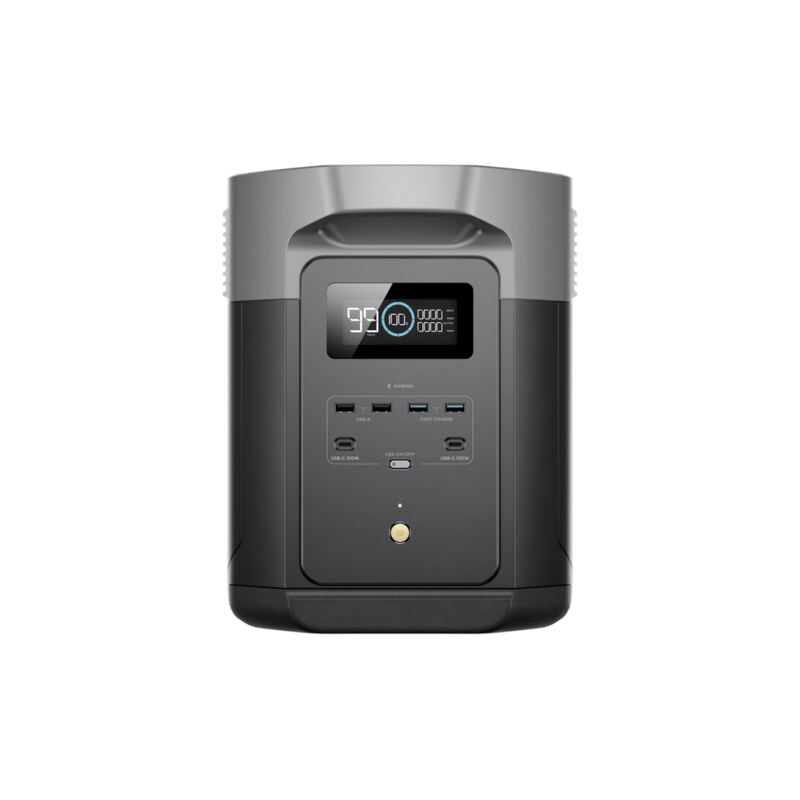
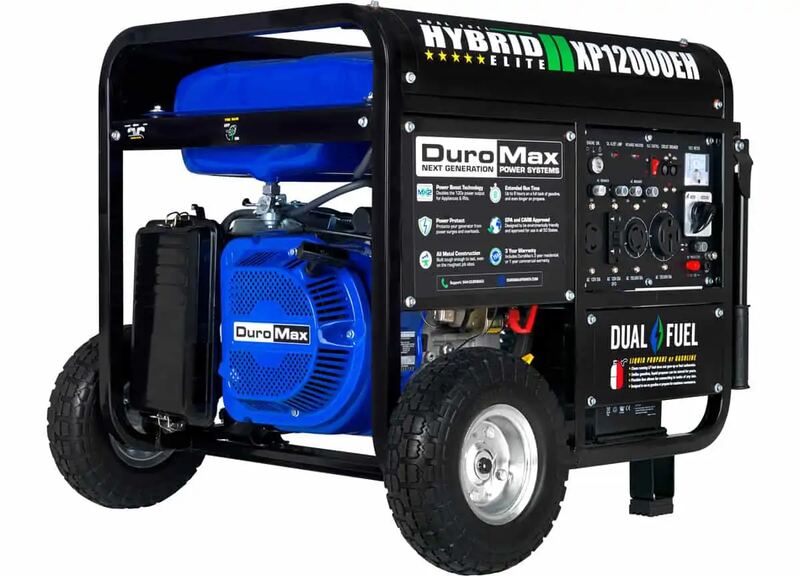
The lightest unit in this draft at 39 lbs versus the Honda EU2200i's 47.4 lbs and the Westinghouse iGen2800's 46.3 lbs. Cleaner THD spec than either Honda or Westinghouse but with a 2-year warranty versus their 3-year coverage. Different product class entirely from the DuroMax XP12000EH and the EcoFlow Delta 2 Max — those are whole-home solutions, this is a camping/tailgating featherweight.
Rating sources
“WEN offers comparable power output and runtime at a more affordable price point”
Our 4.5 score is the average of these published ratings. Ratings marked * were derived from the reviewer’s written analysis or video transcript — the publisher didn’t print an explicit numeric score, so we inferred one from their own words. Click through to verify. More about methodology.