The Tymate TM7 is the budget value pick for everyday cars, SUVs and light trailers, pairing four external sensors and a bright color LCD with quoted ±1.5 PSI accuracy at a fraction of RV-system prices. Reviewers call it accurate, convenient and genuinely plug-and-play. The trade-offs are a large dash unit, non-disablable alarms for empty sensor slots, and the need for a repeater on longer setups.
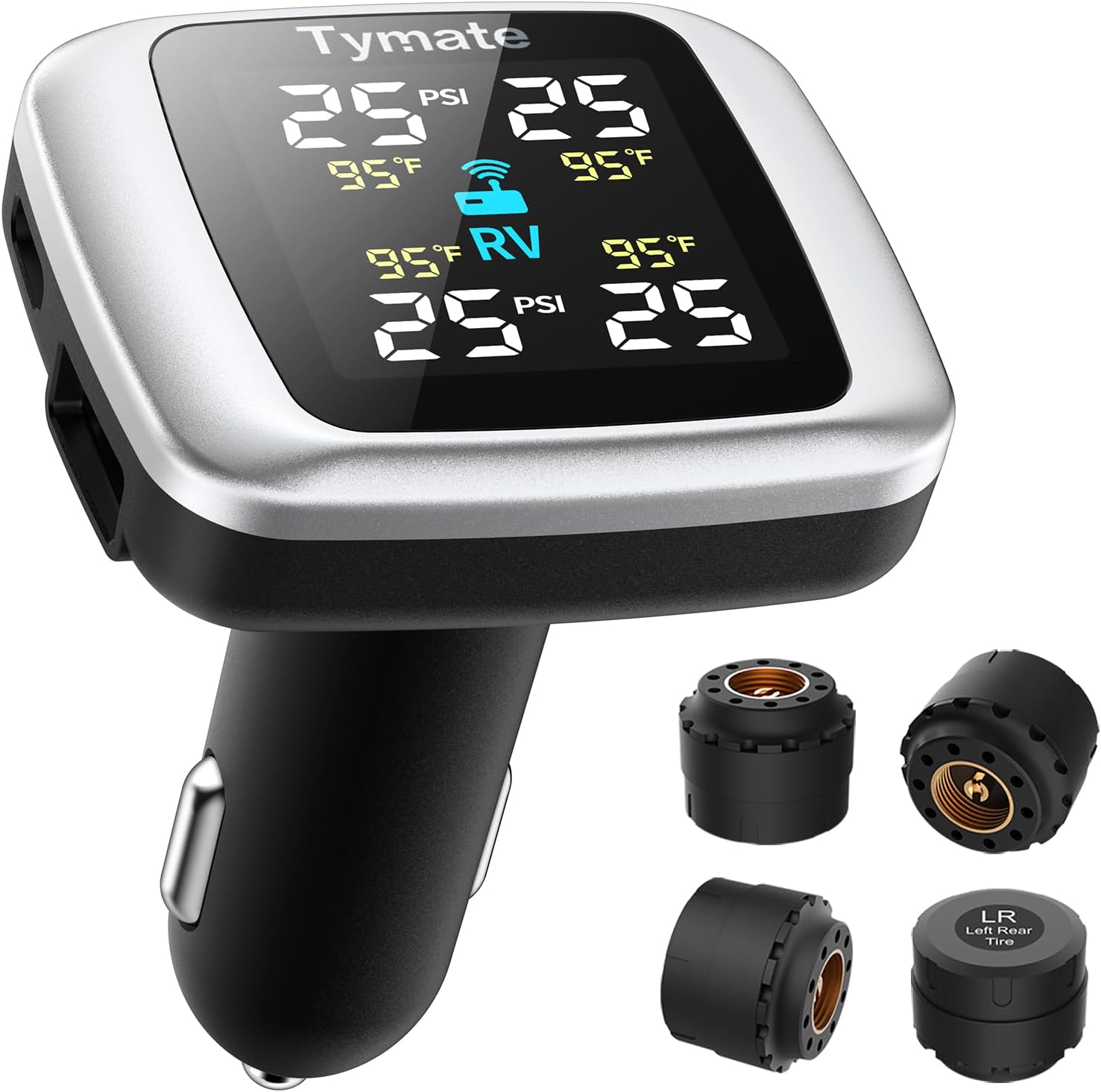
Full review
Accuracy
The Tymate TM7 is the budget standout for everyday vehicles. Flawless Car Guide measured it against a calibrated shop gauge under heavy highway use and found it provides accurate tire pressure readings within the quoted ±1.5 PSI, with NerdTechy calling it a reliable and affordable TPMS that is a great addition to any vehicle. Car Care Total likewise credited it with accurate real-time monitoring and a robust ±1.5 PSI accuracy figure for SUVs and sedans.
It supports four external sensors and a wide 0-144 PSI range, covering most passenger-car and light-truck tires, with six alarm modes for pressure and temperature. For a unit at a fraction of the price of the rugged RV systems, the day-to-day accuracy and reliability are the headline.
Display and Installation
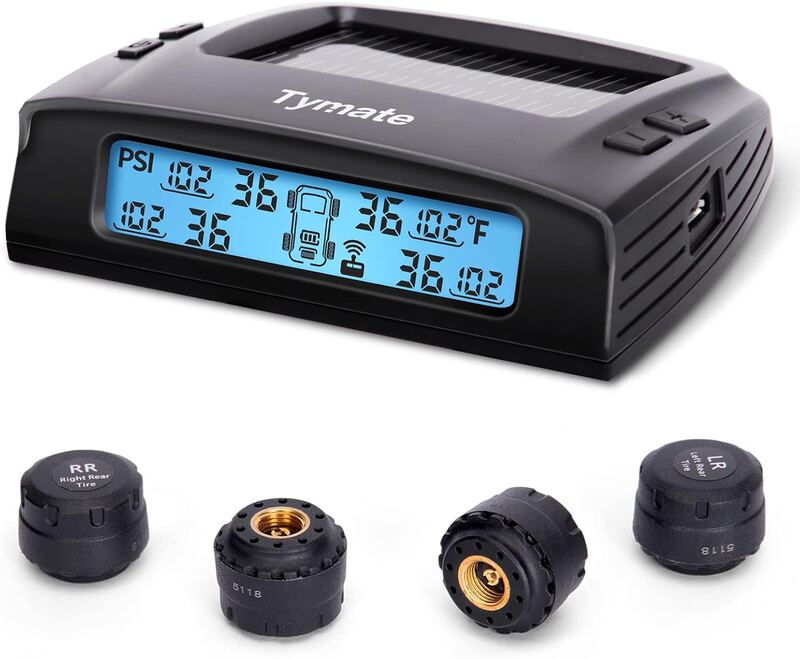
The TM7's bright color LCD with adjustable backlight is one of its strongest selling points at the price — reviewers found it easy to read across lighting conditions. It is the kind of clear, glanceable display that more expensive systems charge a premium for.
Installation is genuinely plug-and-play: the four sensors thread onto the valve stems and pair to the display with minimal fuss. Reviewers repeatedly cite the easy setup as a reason the TM7 punches above its price, making it approachable for owners who have never installed an aftermarket TPMS before.
Accuracy and Monitoring
Tymate quotes ±1.5 PSI and ±3°F accuracy, and independent testing largely bears that out for standard passenger and SUV applications. The system updates in real time and offers six alarm modes, so it flags slow leaks, sudden pressure drops and high temperatures.
Reviewers are honest that some users see readings off by a few PSI versus a calibrated gauge — acceptable for spotting leaks and tracking trends, which is the real job, but not lab-grade precision. For a car or light trailer, that level of accuracy is more than enough to catch the problems that actually cause blowouts.
Long-Term Ownership
The TM7 has a large, satisfied owner base — it carries a 4.4-star average across hundreds of reviews, reflecting consistent everyday reliability rather than one-off praise. For a budget unit, that track record matters: it suggests the sensors and display hold up over normal car-and-light-trailer use rather than failing after a season, which is the worry with the cheapest TPMS units.
The external screw-on sensors run on replaceable batteries and the display charges over USB, so ongoing maintenance is minimal. The two long-term annoyances owners cite are the non-disablable alarms for empty sensor slots and the display's size on the dash — both livable quirks rather than reliability problems. On a 433.92 MHz link with roughly car-length range, the TM7 is a dependable long-term companion within its intended scope, with the optional RP05 repeater available if you later add a longer trailer.
Can't silence alarms for unused sensor slots
The TM7's display unit is fairly large and takes up noticeable space on the dash, which some owners find awkward. A more frustrating quirk: alarms for sensor slots that are not in use can be annoying and, per reviewers, cannot be disabled — a software limitation that nags owners running fewer than the maximum sensors.
It is also a car-and-light-trailer tool, not a long-rig system. On combinations over roughly 36 feet you will likely need the supplemental RP05 repeater for reliable signal, and its tire capacity and range fall well short of the TST 507 or EEZTire 518C. Within its lane, though, the limitations are minor.
Brighter display than its sibling M7-3
Against the rugged RV systems — TST 507, EEZTire-TPMS Pro (518C) and TireMinder Smart TPMS — the Tymate TM7 is far cheaper but more limited in range, tire capacity and long-rig reliability. It is not trying to compete on ruggedness; it is the affordable everyday-vehicle option.
Compared to its sibling, the solar Tymate M7-3 (Solar), the TM7 offers a brighter color display and a wider 0-144 PSI range, while the M7-3 adds solar charging and a lower price. For a car or SUV owner who wants the clearest budget display, the TM7 is the better of the two Tymate units.
About $35.99 for four external sensors
At around $36 the Tymate TM7 is one of the strongest value buys in tire monitoring for a regular vehicle. Reviewers repeatedly note it punches above its price: you get a bright color display, four external sensors and quoted ±1.5 PSI accuracy for a fraction of what the rugged RV systems cost. Car Care Total and NerdTechy both frame it as a cost-effective alternative to replacing factory TPMS sensors.
The value holds as long as you stay within its lane. It is not built for long rigs, and the inability to disable alarms for unused sensor slots is a minor irritation. But for a car, SUV or light trailer, the TM7 delivers the core safety benefit — early warning of leaks and blowouts — at a price that makes the TST 507 or EEZTire 518C look like overkill. For everyday-vehicle duty it is the value sweet spot.
Installs and runs within minutes
The Tymate TM7 is for car, SUV and light-trailer owners who want an affordable, easy-to-install TPMS with a clear color display and solid everyday accuracy. If you drive a passenger vehicle and want cheap insurance against slow leaks and blowouts without the cost or complexity of an RV system, the TM7 is an easy recommendation, and its plug-and-play install means you can have it running in minutes.
It is not the right tool for long RVs or multi-trailer rigs — the TST 507 or EEZTire 518C handle those with the range and capacity the TM7 lacks. Stick to the TM7 for daily-driver duty, and budget for the RP05 repeater only if you tow something over roughly 36 feet.
Strengths
- +Affordable plug-and-play TPMS for cars, SUVs and light trailers
- +Bright color LCD with adjustable backlight, easy to read
- +Quoted ±1.5 PSI / ±3°F accuracy with six alarm modes
- +Four external screw-on sensors install in minutes
- +Wide 0-144 PSI range covers most passenger and light-truck tires
Watch-outs
- −Pressure readings can drift a few PSI versus a calibrated gauge
- −Display unit is fairly large on the dash
- −Alarms for unused sensor slots can't be disabled
- −Long rigs over ~36 ft may need the optional RP05 repeater
How it compares
The Tymate TM7 is a budget car-and-light-trailer alternative to the rugged RV systems, undercutting the TST 507, EEZTire-TPMS Pro (518C) and TireMinder Smart TPMS on price but lacking their range and capacity. It steps up from the solar Tymate M7-3 (Solar) with a brighter color display and wider 0-144 PSI range.
Rating sources
“The Tymate TM7 TPMS provides accurate tire pressure readings within +/-1.5 PSI.”
“Easy installation and a clear display make it a great addition to any vehicle.”
Our 4.4 score is the average of these published ratings. Ratings marked * were derived from the reviewer’s written analysis or video transcript — the publisher didn’t print an explicit numeric score, so we inferred one from their own words. Click through to verify. More about methodology.