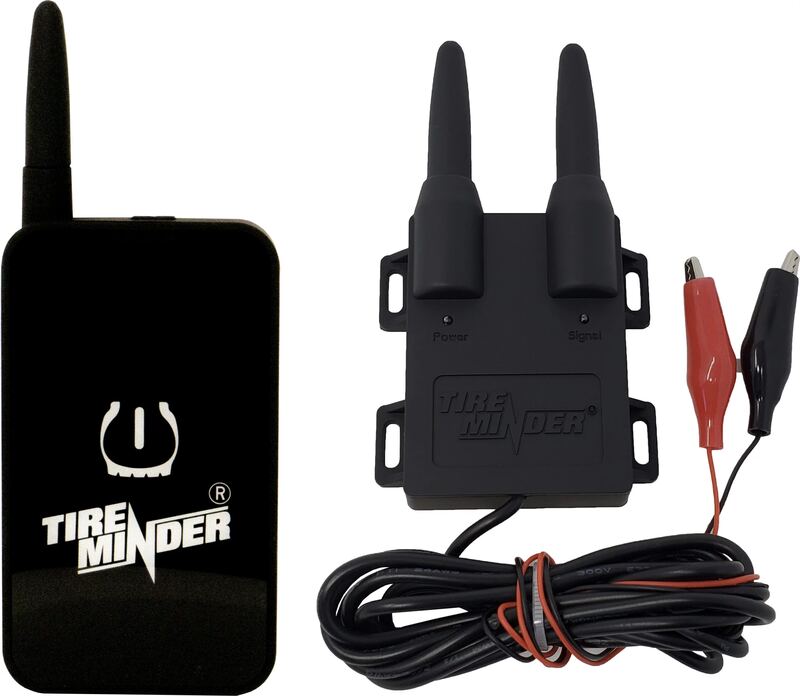
Verdict
The Best 5Reviewed by Mike Hun·May 19, 2026

Best Tire Pressure Monitoring Systems

Top 5 aftermarket tire pressure monitoring systems reviewed and ranked.

Quick answer

Tymate TM7 is our top pick for tire pressure monitoring systems — an averaged 4.6/5 across 1 published review at about $80. Runner-up: EEZTire-TPMS Pro (518C) (~$400).

At a glance

Tap any product for the full review
1Tymate TM7Top Score
(1 source)
$80Best for: everyday car drivers without OEM TPMS who want accurate four-tire monitoring at a reasonable price
$80 · Check Price on Amazon
(1 source)
$400Best for: RV and travel-trailer owners with multiple axles, dual rear tires, and a towed vehicle
$400 · Check Price on Amazon
(1 source)
$300Best for: RV owners who prioritize US-based support and a longer warranty over raw tire-count capacity
$300 · Check Price on Amazon
$130Best for: owners of small-to-medium RVs and dual-axle travel trailers who want RV-tier monitoring without the EEZTire 518C premium price
$130 · Check Price on Amazon
$50Best for: budget-conscious daily drivers who want a basic TPMS at the lowest possible price and don't need RV-tier features
$50 · Check Price on Amazon
Verdict is reader-supported. As an Amazon Associate we earn from qualifying purchases. Some links on this page are affiliate links — if you click through and buy, we may earn a small commission at no extra cost to you. Our ratings are sourced from independent publications, not sponsors.

The full ranking

How we rank →
Tymate TM7
#1 · Top Score
Best for: everyday car drivers without OEM TPMS who want accurate four-tire monitoring at a reasonable price
Tymate TM7
from 1 source$80

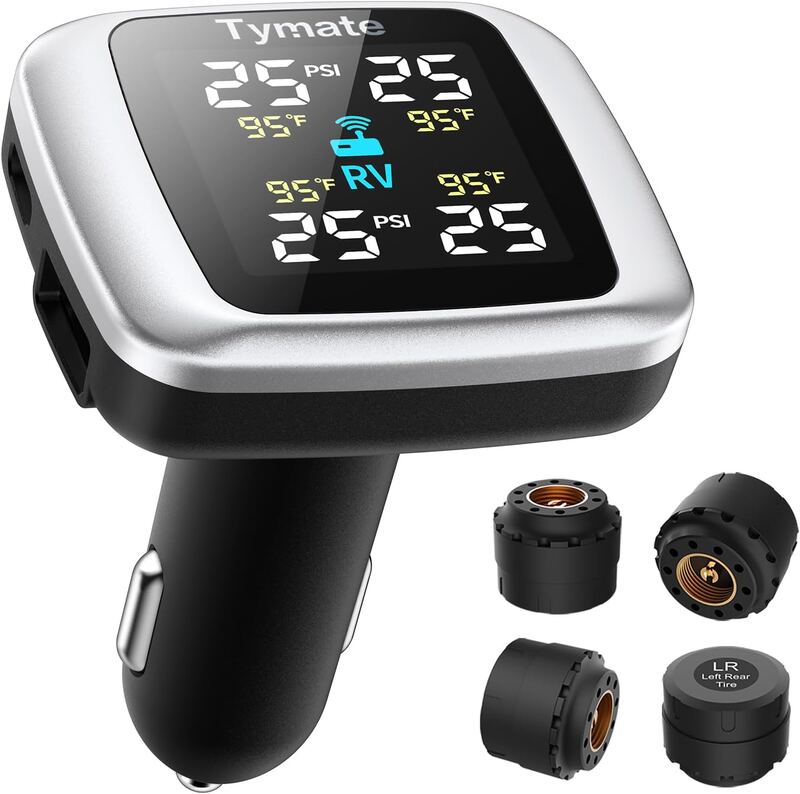
The TM7 is the consumer TPMS to beat — ±1.5 PSI accuracy, all six standard alarm modes, dual-USB lighter mount, and a clear color display, all at $80. Multiple 2026 review roundups put it at the top of consumer aftermarket TPMS. The external cap sensors are the obvious compromise — visible on valve stems, easy to install in 30 seconds per wheel. For most car drivers without OEM TPMS, this is the upgrade pick.

Strengths
  • ±1.5 PSI accuracy and ±3°F temperature precision — best-rated consumer accuracy
  • Six alarm modes (high/low pressure, fast leak, high temp, low sensor battery, signal loss)
Watch-outs
  • External cap sensors are visible on the valve stems — less stealth than OEM internal TPMS
  • Cigarette-lighter installation occupies one outlet permanently
EEZTire-TPMS Pro (518C)
#2
Best for: RV and travel-trailer owners with multiple axles, dual rear tires, and a towed vehicle
EEZTire-TPMS Pro (518C)
from 1 source$400

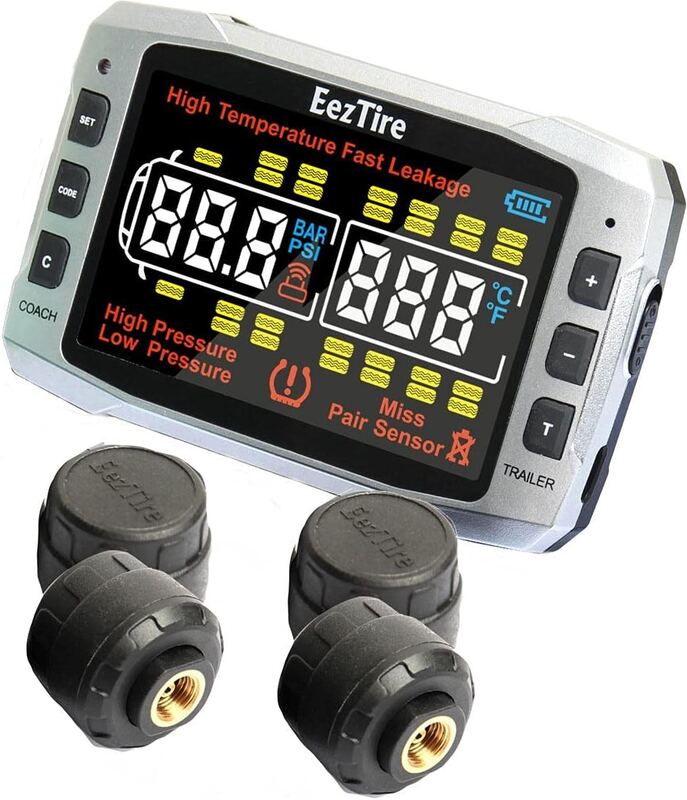
The 518C is the RV/heavy-duty pick. Up to 26 tires monitored, 210 PSI capacity (high enough for commercial-truck tires), and the longest track record of any consumer RV TPMS — EEZTire has been selling this product line since 2005. The 6-sensor base bundle is $400, but RV owners with dual rears and a towed vehicle quickly justify the price. Not the right pick for daily-driver cars; the Tymate TM7 covers that scenario at a fifth the cost.

Strengths
  • Monitors up to 26 tires — by far the most capacity in this round-up
  • Pressure range 0-210 PSI — covers heavy-duty truck and trailer pressures
Watch-outs
  • Most expensive pick here at $400 (6-sensor configuration)
  • Not compatible with EEZTire's previous T515, E518, E618 sensors — buyers of older systems need full replacement
TST 507 (4 Cap Sensors)
#3
Best for: RV owners who prioritize US-based support and a longer warranty over raw tire-count capacity
TST 507 (4 Cap Sensors)
from 1 source$300

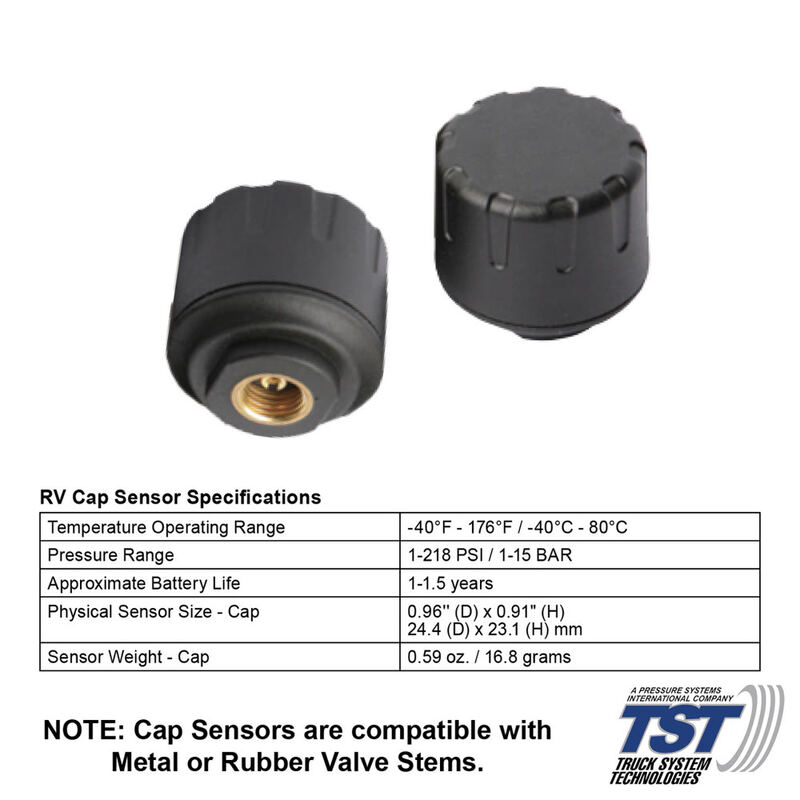
The TST 507 is the RV TPMS with the best brand support. Replaceable CR2032 batteries (no full-sensor replacement when batteries die), USA-based customer service, and a 3-year warranty are the differentiators against the cheaper Tymate options and the spec-sheet-leading EEZTire 518C. Expansion path goes to towing trucks plus 4 towables — useful for users who tow trailers frequently. The flow-through variant is the upgrade for users with metal valve stems.

Strengths
  • USA-based live customer support — best in this lineup
  • 3-year warranty — longest among picks here
Watch-outs
  • Pricier than the Tymate TM7 by nearly 4x for 4 sensors
  • RV/trailer-focused — overkill for daily drivers
Tymate TM12
#4
Best for: owners of small-to-medium RVs and dual-axle travel trailers who want RV-tier monitoring without the EEZTire 518C premium price
Tymate TM12
$130

The TM12 is the budget RV/medium-trailer pick. Up to 12 tires monitored with 6 sensors in the base kit, USB and solar charging, and a 100 ft range with the included repeater — all at $130. The trade-off is the 12-tire ceiling and 116 PSI pressure range, which exclude heavy-duty commercial truck use. For typical Class C RVs, dual-axle travel trailers, and SUV+small-trailer setups, it's the value RV pick.

Strengths
  • Monitors up to 12 tires — covers most consumer RVs and tow setups
  • USB AND solar charging on the display unit
Watch-outs
  • 12-tire ceiling is below the EEZTire 518C's 26-tire capacity
  • Pressure range tops out at 116 PSI — not enough for heavy commercial-truck tires
Tymate M7-3 (Solar)
#5
Best for: budget-conscious daily drivers who want a basic TPMS at the lowest possible price and don't need RV-tier features
Tymate M7-3 (Solar)
$50

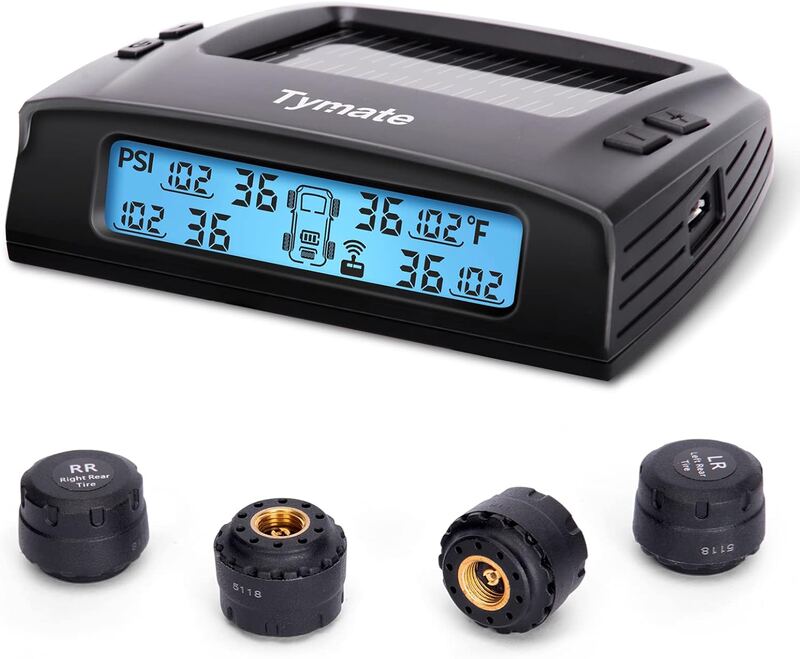
The M7-3 is the budget solar pick. At under $50 it's the cheapest TPMS in this lineup, with solar charging that frees the cigarette-lighter outlet — a real advantage in older cars without USB ports. The catches are real: 0-87 PSI range is barely enough for car tires, and accuracy isn't published. Best for users who want a basic TPMS warning system at a low price and don't need RV-tier capacity. The Tymate TM7 is the better-spec upgrade for $30 more.

Strengths
  • Cheapest pick in this round-up — under $50
  • Solar charger on the display means no permanent cigarette-lighter occupation
Watch-outs
  • 0-87 PSI pressure range is low — barely covers car tires, useless for RV tires
  • Five alarms vs the Tymate TM7's six (missing signal-loss alert)

Spec comparison

5 products
SpecTymate TM7EEZTire-TPMS Pro (518C)TST 507 (4 Cap Sensors)Tymate TM12Tymate M7-3 (Solar)
Tires Monitored4Up to 264 (expandable to truck + 4 towables)Up to 12 (6 sensors included)4
Sensor TypeExternal capCap (anti-theft or flow-through)Cap (flow-through variant available)External cap (IP67)External cap
Accuracy±1.5 PSI / ±3°F±3 PSI±3 PSI±3 PSI
Alarm Modes665
DisplayColor LCD3.5-inch color, motion-activatedColor LCD (4.6 in)Color LCDBacklit LCD
Pressure Range0-144 PSI0-210 PSI0-218 PSI0-116 PSI0-87 PSI
Signal Range36 ft (extendable with repeater)50 ft (100 ft with repeater)36 ft (extendable with repeater)
Warranty3-year3-year
ChargingUSB + SolarSolar

Frequently asked questions

What is the best tire pressure monitoring system?
Tymate TM7 is our top pick for tire pressure monitoring systems, with an averaged rating of 4.6/5 from 1 published reviews. The TM7 is the consumer TPMS to beat — ±1.5 PSI accuracy, all six standard alarm modes, dual-USB lighter mount, and a clear color display, all at $80. Multiple 2026 review roundups put it at the top of consumer aftermarket TPMS. The external cap sensors are the obvious compromise — visible on valve stems, easy to install in 30 seconds per wheel. For most car drivers without OEM TPMS, this is the upgrade pick.
Is there a cheaper alternative worth considering?
Tymate M7-3 (Solar) (around $50) rates 4.3/5 in our analysis. The M7-3 is the budget solar pick. At under $50 it's the cheapest TPMS in this lineup, with solar charging that frees the cigarette-lighter outlet — a real advantage in older cars without USB ports. The catches are real: 0-87 PSI range is barely enough for car tires, and accuracy isn't published. Best for users who want a basic TPMS warning system at a low price and don't need RV-tier capacity. The Tymate TM7 is the better-spec upgrade for $30 more.
How does Verdict rank these products?
Every rating on Verdict is the numerical average of scores published by independent review sites, YouTube reviewers, and Reddit buyer reports. No editor adjusts the order — the ranking is whatever the source data produces. See our methodology page for the full process.
When was this guide last updated?
This guide was last re-checked in May 2026. We re-run our research pipeline for each category on a rolling basis so prices and rankings reflect current market reality.

Related guides

Browse all →