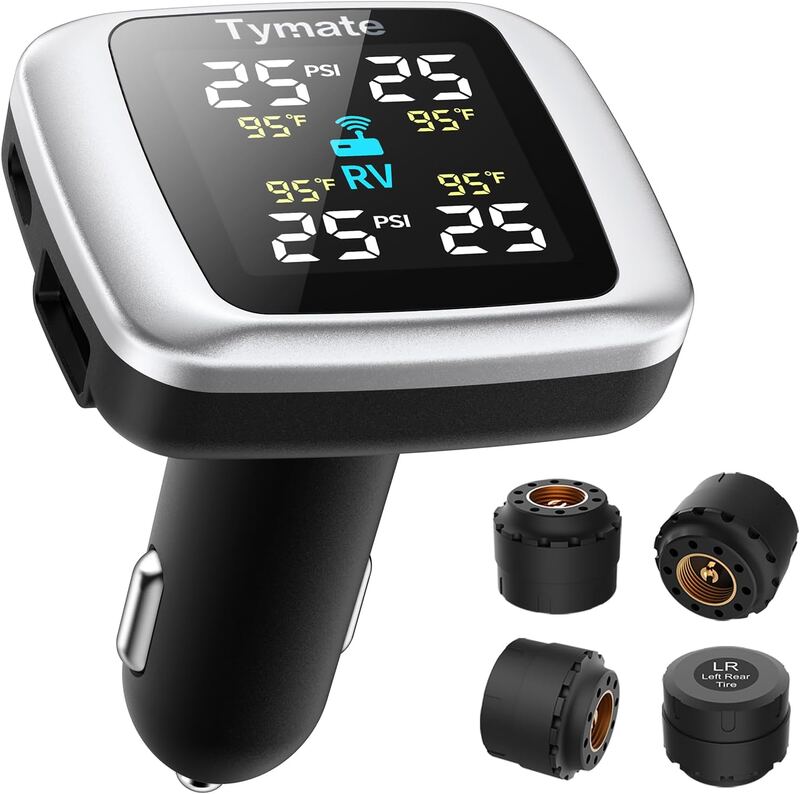
The Tymate M7-3 (Solar) is the budget-of-the-budget pick, a solar-charged external TPMS that reviewers call cheap insurance that has genuinely saved trips. It runs four sensors, charges off solar or USB-C, and earns an Editor's Choice nod from one buying guide. The compromises are real: a small LCD that washes out in sun or overheats on hot dashes, a few-PSI accuracy spread, and limited range.
Full review
Weighs just 9.6 ounces
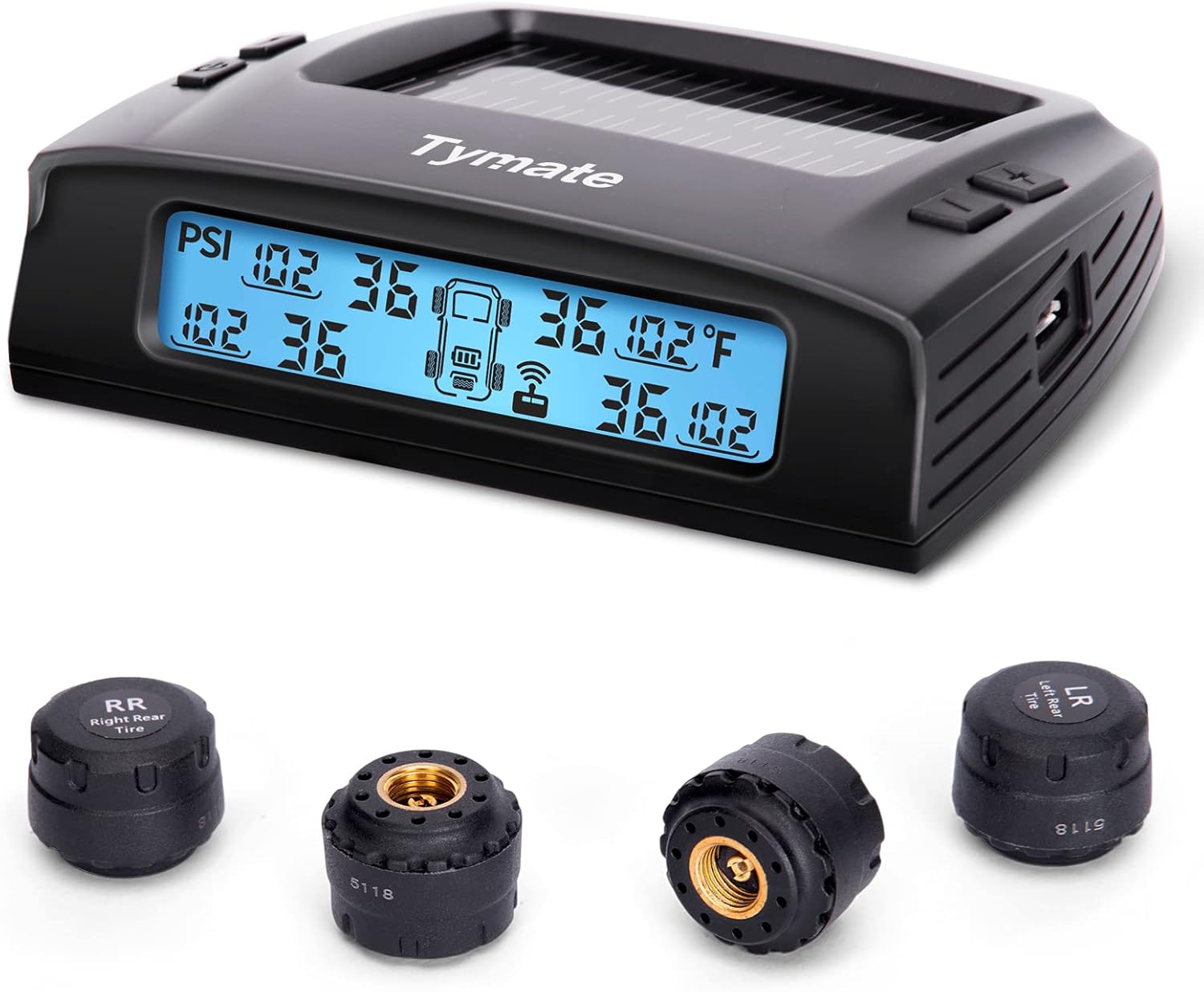
The Tymate M7-3 (Solar) is the entry point to tire monitoring, and reviewers treat it as cheap insurance that has genuinely saved trips for budget-conscious owners. RV Outfitting's review noted that many RVers credit this TPMS with catching slow leaks, damaged wheels, bulging sidewalls or punctures in time to pull off before total tire failure. The Tire Wiki named the M7-3 an Editor's Choice, citing its incredibly light 9.6-ounce build and compact dimensions.
It runs four external screw-on sensors (expandable to six with spares) monitoring a 0-87 PSI range, with five alarm modes. Owners commonly report pressures within a couple PSI of decent hand gauges and OEM TPMS — plenty for spotting leaks and tracking trends, which is exactly what a budget system needs to do.
Solar Charging and Daily Use
The headline feature is solar charging, backed up by USB-C. Many owners run for months on mostly solar power, and reviewers like the low-profile display that sits unobtrusively on the dash. An auto sleep/wake mode conserves power when the vehicle is parked, so the unit is largely maintenance-free in normal use.
The solar-charged display with five alarm modes and auto sleep is convenient and low-maintenance. For an off-grid RVer who does not want to think about charging another device, the solar panel is a genuinely useful touch that no other system here offers.
Sensors and Setup
Setup mirrors the other external systems: thread the four sensors onto the valve stems and pair them to the display. The light weight and compact size make the display easy to place, and the kit can grow to six sensors to cover a spare or a small trailer.
Range is around 36 feet, which is adequate for cars, smaller trailers and short motorhomes but tight for long combinations. For those, a repeater or a step up to one of the rugged RV systems is the better answer — the M7-3 is designed for simple, affordable coverage rather than long-rig reach.
Long-Term Ownership
Owner reports on the M7-3 are mixed but lean positive for its price class. The solar-plus-USB-C charging means many owners run for months without plugging in, and the auto sleep/wake mode preserves power when parked — both real conveniences for a low-maintenance budget unit. Accuracy stays within a couple PSI of decent hand gauges over time, which is plenty for trend monitoring and slow-leak detection.
The honest long-term caveats are environmental: reviewers note the LCD can wash out in bright sun or even go black on very hot dashboards, and a minority of owners report delayed updates or missed alarms on fast blowouts. The internal battery can also fade after a few years. These are the trade-offs of the lowest entry price in the category — for a buyer who understands them, the M7-3 delivers years of basic tire visibility, and the recurring saved-my-trip stories show it does the core job.
LCD can fade on a hot dashboard
The small LCD is the recurring complaint. RV Outfitting noted it is hard or impossible to read in bright sun for some drivers, and the LCD can fade or go black on very hot dashboards — a real issue for an RV parked in summer heat. The screen size that makes it low-profile also makes it harder to read at a glance while driving.
Accuracy runs a few PSI off a calibrated gauge, and a minority of owners report delayed updates or even missed alarms when a tire let go quickly. Combined with the ~36 ft range, these are the compromises you accept at this price. For trend monitoring and slow-leak detection it is fine; for instant catastrophic-failure alerts on a long rig it is not the tool.
Adds solar charging the TM7 lacks
Against its sibling the Tymate TM7, the M7-3 (Solar) is cheaper and adds solar charging, but the TM7 has a brighter color display and a wider 0-144 PSI range. Within the Tymate family the choice comes down to solar-and-price (M7-3) versus display-and-range (TM7).
Compared to the rugged systems — TST 507, EEZTire-TPMS Pro (518C) and TireMinder Smart TPMS — the M7-3 is far more basic in range, capacity and display quality, but also a fraction of the price. It is the budget floor of this lineup, suited to owners who want any tire visibility cheaply rather than the most capable system.
Cheapest system in this roundup
The M7-3 (Solar) is the cheapest system in this roundup, and reviewers frame it exactly as it should be judged: cheap insurance that has genuinely saved trips. The Tire Wiki named it an Editor's Choice, and RV Outfitting credits it with catching slow leaks, bulging sidewalls and punctures before total failure. At its price, even occasional saves represent enormous value relative to the cost of a blown tire or trailer damage.
The value is real precisely because the expectations are modest. You are not paying for a sun-readable display, long range, or instant blowout alerts — for those the TST 507 or EEZTire 518C are worth the upgrade. What you get is solar-charged, low-maintenance tire visibility at the lowest cost here, which is exactly the right value proposition for a budget buyer who wants any monitoring rather than the best monitoring.
Never needs a manual recharge thanks to solar
The Tymate M7-3 (Solar) is for budget-conscious RV, trailer and car owners who want solar-charged, low-maintenance tire visibility at the lowest possible cost. If you want cheap insurance against slow leaks and overheating, value not having to recharge another device, and can live with a small display, it delivers the essentials and the saved-my-trip stories are not rare.
It is the wrong pick for long-rig RVers or anyone who needs a large, sun-readable display and the longest range — the TST 507 or EEZTire 518C are worth the upgrade there. Buy the M7-3 when price and solar convenience outweigh display size and range, and accept the small screen and few-PSI accuracy spread as the cost of the lowest entry price in the category.
Strengths
- +Solar plus USB-C charging keeps the display topped up off-grid
- +Lowest price here; genuine cheap insurance against blowouts
- +Four external sensors, expandable to six with spares
- +Low-profile display sits unobtrusively on the dash
- +Five alarm modes with auto sleep/wake to save power
Watch-outs
- −Small LCD is hard to read in bright sun and can wash out
- −Display can go black on very hot dashboards
- −Accuracy runs a few PSI off a calibrated gauge
- −~36 ft range and occasional missed fast-blowout alerts
How it compares
The Tymate M7-3 (Solar) is the cheapest system here, adding solar charging that no other pick offers but trading away the brighter display and wider range of the Tymate TM7. It is far more basic than the rugged TST 507, EEZTire-TPMS Pro (518C) and TireMinder Smart TPMS, suiting budget buyers rather than long-rig RVers.
Rating sources
“Editor's Choice; an incredibly light 9.6-ounce build with compact dimensions.”
“Many RVers credit this TPMS with catching slow leaks in time to pull off.”
Our 4.3 score is the average of these published ratings. More about methodology.