The Sharge Shargeek 170 Power Bank distinguishes itself with a transparent prism design and an IP66 water-resistant rating, though YouTube reviewer Stefan Zanev cautioned that the all-plastic exterior might scratch over time. It delivers up to 170W of combined output across two USB-C ports and one USB-A port, supported by a smart display that How-To Geek highlighted for its utility in verifying charging throughput and monitoring battery status. While it offers rapid recharge capabilities via high-wattage input, the device is significantly heavier than standard power banks and carries a premium price point that may deter budget-conscious shoppers. This unit fits enthusiasts who value aesthetic uniqueness and high-speed performance, but those seeking lightweight, cost-effective backup power should look elsewhere.
Full review
Transparent prism design reveals internal circuitry
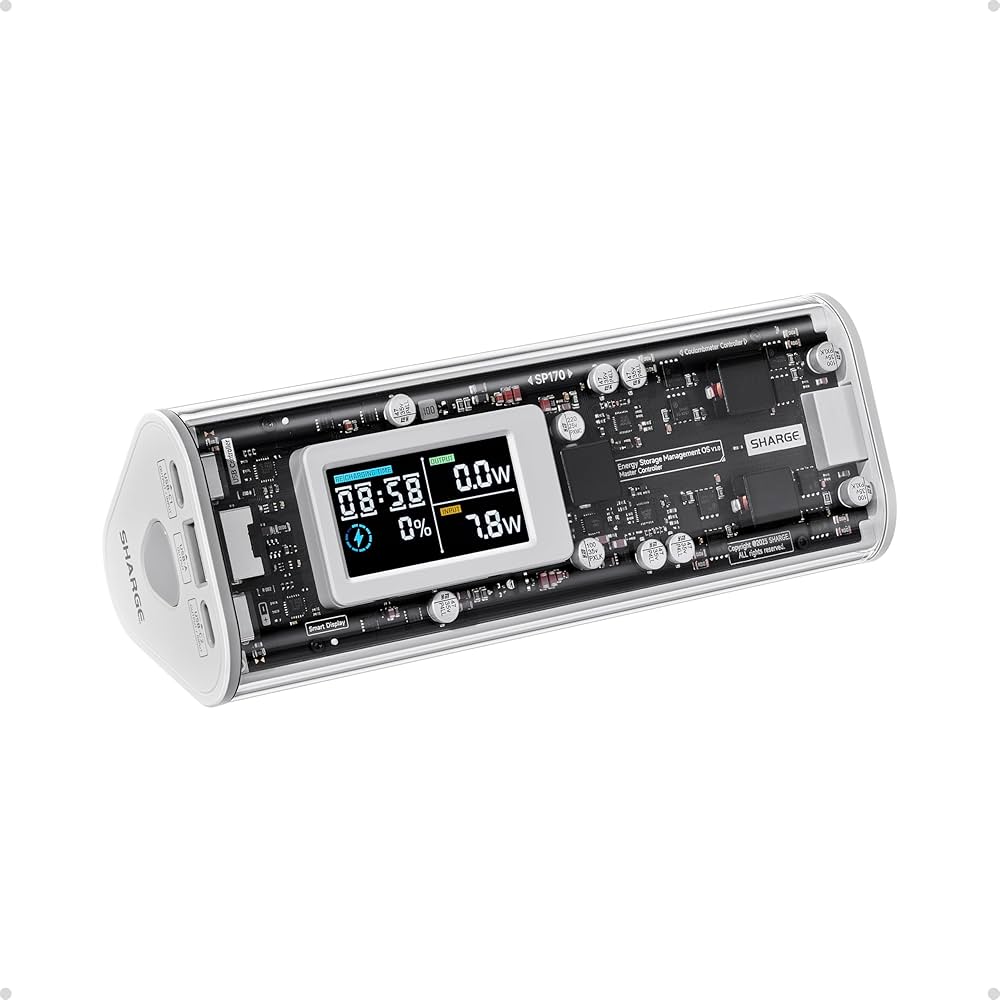
The Shargeek 170 abandons the standard rectangular block form factor in favor of a triangular prism shape that immediately distinguishes it from conventional portable chargers. The exterior is constructed from clear acrylic panels, offering an unobstructed view of the internal components including the motherboard and six cylindrical EV-grade battery cells housed on the rear side. This aesthetic choice evokes a retro-futuristic vibe that reviewers have compared to props from science fiction films or cyberpunk settings, appealing directly to users who enjoy seeing the mechanical and electronic guts of their gadgets.
While the visual appeal is widely praised as eye-catching and unique, the transparent plastic housing introduces practical durability concerns. YouTube reviewer Stefan Zanev cautioned that the all-plastic exterior might scratch over time. The inclusion of a fabric carrying pouch helps mitigate this risk by protecting the acrylic from direct contact with abrasive materials during transport.
The physical dimensions and weight reflect the substantial internal components required to house 24,000 mAh of capacity. The Gadgeteer weighed it on a kitchen scale at one pound, 8.3 ounces, enough to add noticeable bulk to any carry setup compared to lighter alternatives.
Smart display provides real-time charging metrics
A large LED screen dominates the front face of the prism, serving as a central feature that differentiates this unit from competitors. The Gadgeteer found the display to be exceptionally bright and easy to read even in direct sunlight or under studio lighting conditions, resolving a common complaint about dim screens on other power banks. The interface is color-coded to distinguish between input wattage flowing into the device and output wattage being delivered to connected gadgets.
The screen provides highly specific data points that help users diagnose charging efficiency. It displays the current battery percentage alongside an estimated time remaining until the power bank is fully depleted or, conversely, the time required to recharge itself based on the adapter currently in use. The Gadgeteer observed that using a weak 11-watt charger resulted in prohibitively long refill times, while switching to a high-power MacBook Pro brick delivered over 130 watts of input.
How-To Geek highlighted the practical utility of this data transparency, noting that seeing real-time wattage helps users verify whether their USB-C cables are supporting the necessary throughput for fast charging. The display also indicates when low-current mode is active, a specific setting required to properly charge small devices like smartwatches and earbuds without the power bank entering sleep mode prematurely.
170W combined output supports simultaneous laptop charging
The device is engineered around a high-wattage architecture, featuring two USB-C ports capable of up to 140 watts each and one USB-A port rated for 30 watts. When utilizing specific port combinations, such as pairing one USB-C output with the USB-A port, the unit achieves its maximum combined output of 170 watts. This configuration allows users to charge power-hungry devices like laptops alongside phones or tablets simultaneously without significant throttling.
Performance testing by The Gadgeteer demonstrated the practical application of these ports. Charging an iPad Pro from zero percent drew approximately 25 watts, taking just over two hours to reach full capacity while leaving 57% of the power bank's reserve intact. When a second iPad was connected, the total output effectively doubled, showcasing the unit's ability to handle multiple high-demand devices in tandem.
Charging a MacBook Pro revealed the dynamic nature of the power distribution. The Gadgeteer recorded that while the power bank could theoretically push higher numbers, it consistently hovered around 100 watts during actual laptop charging sessions rather than hitting the theoretical maximums constantly. This variance is typical as devices regulate their intake to protect battery health, but the sustained output remains sufficient for keeping modern laptops operational.
Rapid recharge capability reduces downtime
One of the most significant advantages of the Shargeek 170 is its ability to accept high-wattage input, allowing it to refill much faster than traditional power banks. The device supports up to 140 watts of input power via USB-C, enabling a recharge from zero to fifty percent in approximately twenty minutes and a full charge in roughly forty-five minutes when paired with a compatible high-output adapter.
The Verge highlighted the value proposition of this speed, noting that promotional pricing often drops the unit significantly below its retail price, making the rapid refill capability even more attractive for frequent travelers. This fast recharge time means users can top off the massive 24,000 mAh capacity during a short coffee break or while working at an airport gate, rather than leaving it plugged in overnight.
However, realizing these speeds requires specific hardware. Reviewers emphasized that using standard wall adapters will result in much slower charging times. The Gadgeteer found that dropping from a high-power adapter to a weaker one drastically increased the estimated time to full charge, proving that users must invest in appropriate 140-watt chargers to fully leverage this feature.
IP66 rating offers splash protection for outdoor use
The Shargeek 170 carries an IP66 water-resistant rating, a specification that is uncommon in portable battery packs of this size. This rating indicates the device can withstand high-pressure water jets and significant splashes without sustaining damage. Android Police noted that while it can handle accidental spills or poolside use, users should not submerge the unit directly in water.
This durability feature adds a layer of confidence for outdoor enthusiasts and travelers who might encounter unpredictable weather conditions. The transparent acrylic panels seal effectively against moisture ingress, ensuring that the internal electronics remain protected even if the device is caught in heavy rain or knocked over by a wave at the beach.
The ruggedness extends to its physical construction as well. Basic-tutorials reported flawless fit and finish with no visible gaps or sharp edges during their inspection. The robust build quality complements the water resistance, making it a durable option for users who need reliable power in harsh environments.
Airline compliance requires careful capacity management
Travelers will find this device compliant with most airline regulations regarding portable lithium batteries. The internal 24,000 mAh battery operates at a voltage that results in a total energy capacity of 86.4 watt-hours, which sits safely below the standard 100-watt-hour limit imposed by aviation authorities for carry-on luggage.
Despite being within legal limits, the unique appearance and large size can attract attention from security personnel. Basic-tutorials noted that the transparent design can draw curious glances, or possibly a conversation with security staff at the airport.
The prism shape also means the device takes up more volume in a backpack than a rectangular equivalent. Users planning long trips need to account for this physical footprint alongside the weight, ensuring they have adequate space and strength to carry such a substantial piece of hardware throughout their journey.
Premium pricing reflects specialized features
The Shargeek 170 commands a premium price point compared to standard power banks, with retail costs fluctuating between roughly $99 during sales events and over $187 at full list price. This cost disparity is driven by the complex transparent housing, high-wattage charging circuitry, and large capacity battery cells.
The Verge pointed out that while the sticker shock is real for basic power banks, frequent discounts make the unit more accessible to enthusiasts who value the specific combination of speed, capacity, and aesthetics. The pricing strategy positions it as a niche product rather than a mass-market commodity.
For users who prioritize raw charging speed and visual uniqueness over cost efficiency, the premium is justified by the feature set. However, budget-conscious shoppers looking for simple backup power may find better value in cheaper, non-transparent alternatives that lack the smart display and high-wattage input capabilities.
Strengths
- +Equipped with an IP66 water-resistant rating, allowing it to withstand high-pressure water jets and splashes without damage.
- +Includes a bright smart display showing real-time input/output wattage, remaining charge time, and battery percentage for all connected devices.
- +Delivers up to 170W combined output across two USB-C ports (up to 140W each) and one USB-A port (30W), supporting pass-through charging.
Watch-outs
- −Priced significantly higher than standard power banks, with costs ranging from $99 during sales to over $187 at full retail.
- −The translucent plastic housing might scratch over time, potentially degrading the aesthetic appeal.
How it compares
It supports pass-through charging, allowing users to charge devices while recharging the bank itself, a feature missing from the Anker A1383.
Rating sources
Counts as 3.89/5 in our score — this publisher's 10 scores on the site average 4.04, so its scores are adjusted up to compare fairly with other publishers.
Counts as 3.74/5 in our score — this publisher's 18 scores on the site average 3.86, so its scores are adjusted up to compare fairly with other publishers.
Our 3.8 score is the average of the 2 scored reviews above, each adjusted for how strictly its publisher scores; 4 more reviewed it without printing a score and are not in the average. More about methodology.