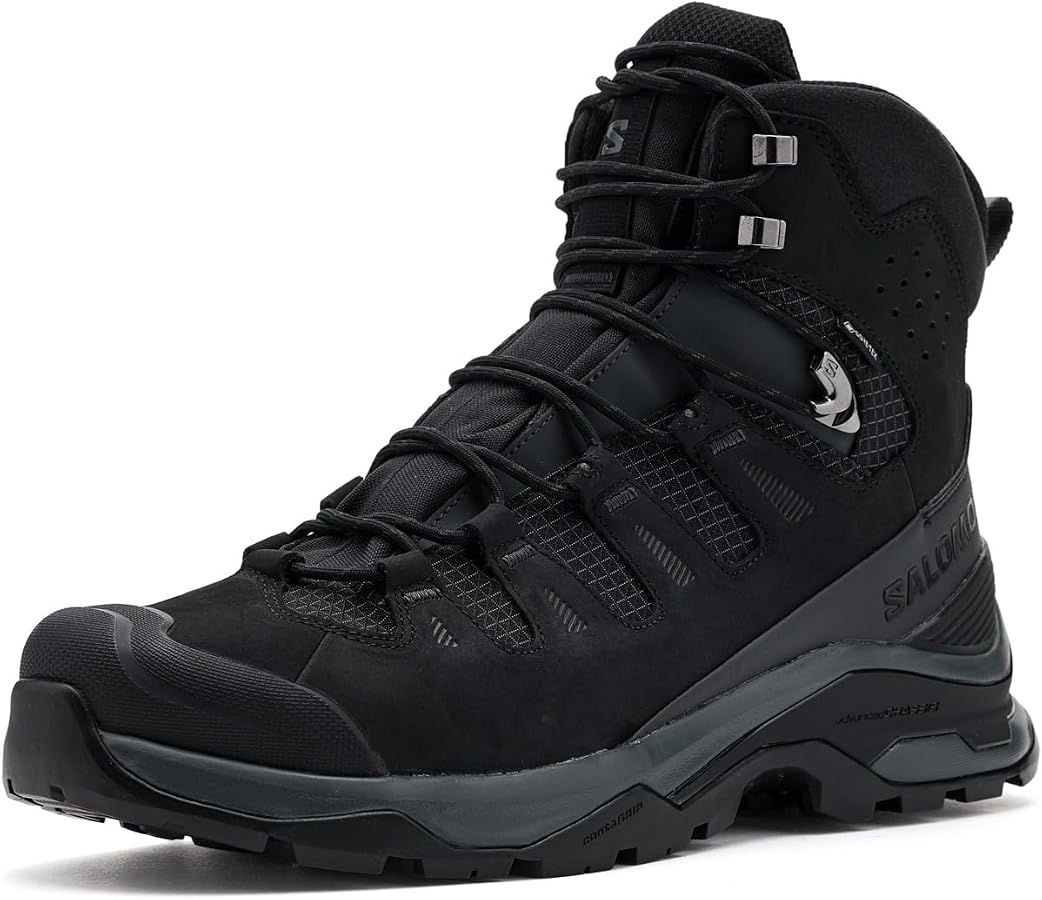
Better Trail and Outdoors Gear Lab both highlight the Salomon Quest 5 Gore-Tex as a premier choice for backpackers who prioritize stability over plush cushioning. Runrepeat notes that while it lacks high-end shock absorption, its firm EnergyCell midsole delivers predictable support under heavy loads. Hiking Feet praises the updated fit, noting the wider toe box resolves previous complaints about Salomon's narrow forefoot designs. This boot is best suited for hikers tackling rugged terrain with substantial packs; those seeking lightweight agility or hot-weather breathability should look elsewhere.
Full review
4D Advanced Chassis delivers heavy-load stability
The Salomon Quest 5 relies on its proprietary 4D Advanced Chassis to anchor the foot, creating a platform that outdoorgearlab describes as providing freakishly good ankle support and total foot stability. This plastic plate runs through the boot to cradle the heel while allowing the forefoot some natural flex, resulting in a predictable footbed that prevents rolling on uneven surfaces. bettertrail recorded an impressive 4.5 out of 5 score for this category, noting that the tall upper wraps fully around the ankle with a firm collar. When carrying loads exceeding 25 pounds over loose river cobble or steep descents, the chassis functions as a cohesive unit that keeps the foot secure without feeling overly rigid.
hikingfeet corroborates this structural integrity after logging over 1000 miles of backpacking in previous Quest iterations and testing the fifth version. The reviewer found that the moderately sturdy ankle collar combined with strong torsional rigidity provides more support than most standard hiking boots, making it a legitimate choice for serious backpacking rather than casual day use. outdoorgearlab awarded the boot an 82 overall score, ranking it third among eighteen tested models specifically because of this outstanding lateral stability on technical terrain.
Ortholite sockliner and wider midfoot improve comfort
Previous generations of the Quest were notorious for a narrow midfoot that compressed the arch, but mountaineerjourney notes that Salomon has significantly widened the boot's midsection and added an Ortholite sock liner to address this. The addition of a real, cushier insole improves step-in comfort and shock absorption compared to earlier models that lacked proper liners. During testing with a 40-pound pack on granite trails, mountaineerjourney found the impact absorption was noticeably better than before, allowing for more aggressive hiking without excessive foot fatigue.
gearjunkie also highlighted this roomier fit as a major improvement over the fourth generation, noting that the toe box provides ample space without compressive hot spots. This wider forefoot design means hikers who previously struggled with Salomon's typically narrow lasts will find the Quest 5 much more accommodating. While mountaineerjourney gave it an 8 out of 10 for comfort and praised the lack of toe slams on descents, they did note that the tongue could still use more padding to prevent digging into the top of the foot during steep downhill sections.
Contagrip TA lugs grip loose gravel but narrow heel slips
The outsole utilizes Salomon's proprietary All-Terrain Contagrip rubber, which mountaineerjourney rated at 8.5 out of 10 for traction. A key design change in this iteration is the addition of double lugs along both the medial and lateral sides of the entire outsole. This doubled-lug layout allows the boot to hold a better edge on uneven terrain, biting into loose gravel and rocky surfaces more effectively than previous versions. The heel features a reverse lug pattern that creates additional friction when climbing steep ascents or navigating slippery descents.
Despite these improvements, mountaineerjourney identified a specific limitation in the traction design: the heel width narrows slightly toward the bottom of the boot. This reduced surface area means less contact with the ground on loose surfaces, leading to occasional slips on wet limestone. outdoorgearlab recorded an 8.0 score for traction, acknowledging that while the grip is reliable across various terrains including snow and ice, the narrow heel profile prevents it from achieving a perfect rating in extreme conditions.
Waterproofing excels but limits breathability
The inclusion of a Gore-Tex membrane ensures that the Quest 5 remains completely waterproof, keeping feet dry during river crossings and wet snow travel. treelinereview praised this aspect heavily, noting that the boot maintains the series' reputation for top-notch waterproofing while protecting against debris via a gusseted tongue. bettertrail also awarded high marks for foot protection and water resistance, confirming that the tall cut and durable upper materials work together to keep external moisture at bay in demanding environments like Utah's canyon country.
However, this reliable waterproof barrier comes with a predictable trade-off regarding airflow. gearjunkie explicitly listed heat retention as a con, noting that the boot runs hot in warm weather conditions due to the lack of breathability inherent in the Gore-Tex lining. runrepeat measured the energy return at a below-average 47.5%, contributing to a dull underfoot feel that does not dissipate heat well during high-exertion activities. Shoppers hiking in summer temperatures will likely find their feet sweating significantly compared to mesh-based trail runners.
Weight and stiffness favor heavy packs over day hikes
gearjunkie measured their test pair at just under 2 pounds 9 ounces, confirming that it is lighter than many competitors but still substantial enough to feel cumbersome on short, casual trails.
bettertrail emphasized that while the boot feels surprisingly comfortable out of the box due to dense EVA cushioning, it remains far from the lightweight, flexible feel preferred by modern hikers. They found that lighter users weighing 150 pounds or less often perceive the stiffness as overkill, whereas heavier individuals benefit more from the added structure. hikingfeet advised that if your primary activity is day hiking rather than carrying a loaded pack, this boot may be too heavy and rigid, suggesting lighter alternatives for those specific use cases.
Fit runs true to size with roomier toe box
Sizing consistency remains strong across the Quest lineage. hikingfeet confirmed that the boot runs true to size, featuring a standard fit in the forefoot that is notably less narrow than most other Salomon models. This wider toe box allows toes to spread naturally, which mountaineerjourney found eliminated the annoying toe-slamming sensation common on long descents with heavy loads. gearjunkie noted that while it fits true to size, some users might consider sizing down if they are between sizes due to the roomier internal volume.
Despite these improvements, fit nuances still apply. hikingfeet reported experiencing medial rubbing near the rubber mudguard on their right foot, suggesting that individual foot shapes may still encounter pressure points. bettertrail observed a consistent trend where hikers with larger frames find the boot more comfortable than those with smaller builds, likely due to how the stiff chassis interacts with different body weights. The boot is not available in wide widths, so those requiring extra volume should test them carefully before committing.
Strengths
- +4D Advanced Chassis provides exceptional lateral stability and ankle support, making it ideal for heavy loads on technical terrain.
- +Gore-Tex membrane ensures reliable waterproofing across wet environments like river crossings and snow.
- +Reinforced rubber toe bumper and nubuck/ripstop upper offer robust protection against rocks and debris.
- +Wider midfoot and added Ortholite sockliner significantly improve step-in comfort compared to previous Quest iterations.
Watch-outs
- −Stiff, structured build feels overkill for casual day hiking or lighter packs.
- −Limited breathability causes feet to run hot in warm weather conditions due to waterproof lining.
- −Heel narrows slightly towards the bottom of the boot, which some reviewers noted reduced traction on loose surfaces.
How it compares
The Salomon Quest 5 Gore-Tex delivers exceptional lateral stability via its 4D Advanced Chassis, making it ideal for heavy loads where the Arc'teryx Kopec Mid's soft upper provides limited support. While it features a wider toe box than previous Salomon iterations, it remains stiffer and heavier than the Hoka Kaha 3 GTX, prioritizing predictable support under pack weight over plush cushioning.
Rating sources
Counts as 4.17/5 in our score — this publisher's 11 scores on the site average 4.50, so its scores are adjusted down to compare fairly with other publishers.
Counts as 4.56/5 in our score — this publisher's 149 scores on the site average 3.69, so its scores are adjusted up to compare fairly with other publishers.
Counts as 4.62/5 in our score — this publisher's 45 scores on the site average 4.03, so its scores are adjusted up to compare fairly with other publishers.
“Salomon hadn't updated the world's best backpacking boot in 5 years—and I've been backpacking in other boots I don't like as well.”
Not in the average — we derived this score from the review's words, and a publisher printed a score for this product, so the printed number counts instead.
Our 4.5 score is the average of 3 of the scored reviews above, each adjusted for how strictly its publisher scores; 5 more reviewed it without printing a score and are not in the average. 1 derived score above is not in the average because a publisher printed a score for this product. Ratings marked * were derived from the reviewer’s written analysis or video transcript — the publisher didn’t print an explicit numeric score, so we inferred one from their own words. Click through to verify. More about methodology.