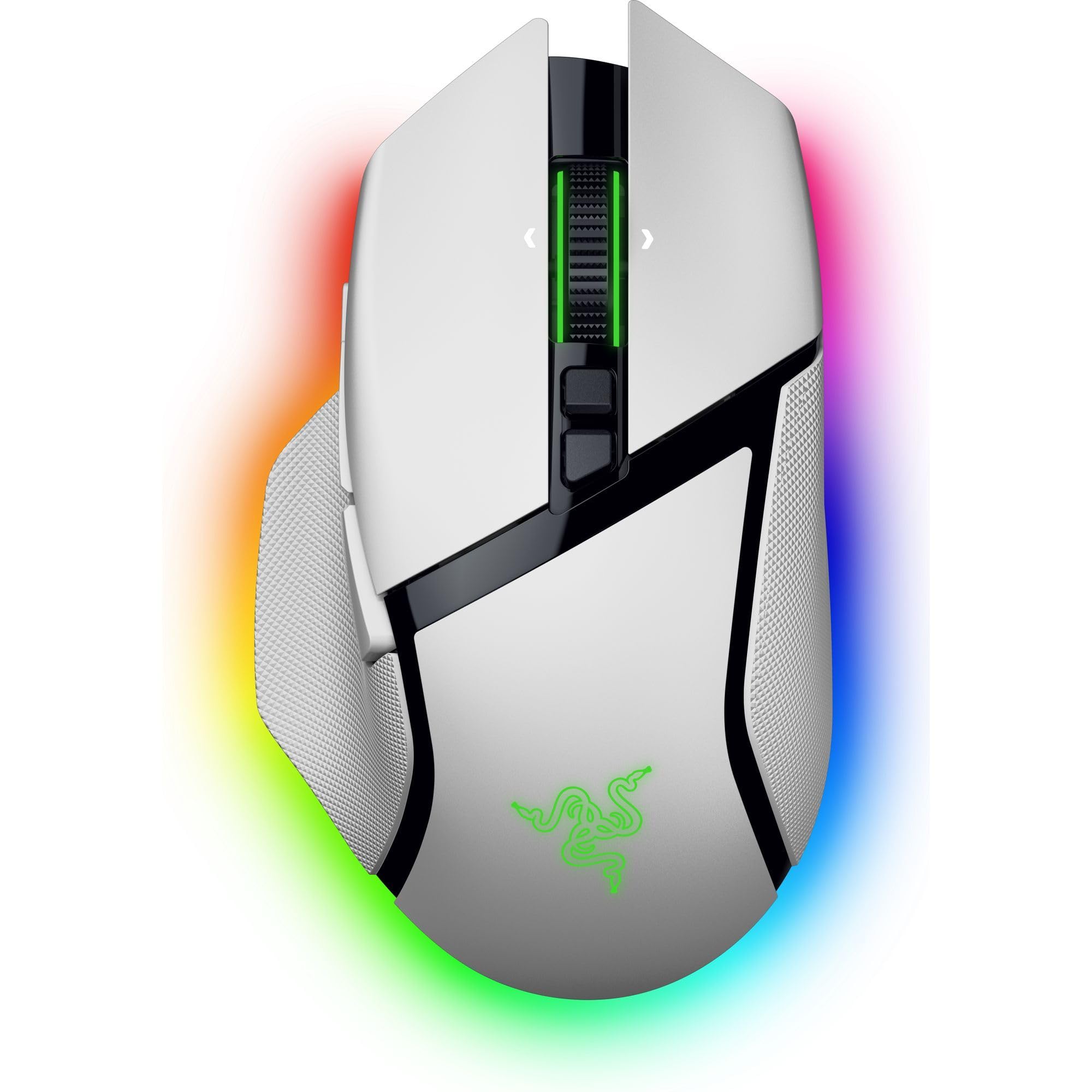
The Razer Basilisk V3 Pro features an ergonomic right-handed shape that accommodates medium to large hands comfortably, though its 112-gram weight makes it significantly heavier than modern lightweight esports mice. IGN noted the HyperScroll wheel’s dual modes are responsive but occasionally gimmicky in practice. The device supports tri-connectivity via Bluetooth, USB-C wired, and a 2.4 GHz dongle, offering versatile usage for both gaming and office tasks. This mouse fits right-handed users with larger hands who prioritize ergonomics over minimal mass, while lefties and those seeking ultra-lightweight options should look elsewhere.
Full review
Ergonomic shape and thumb rest accommodate medium to large hands
The Razer Basilisk V3 Pro maintains the iconic angular silhouette of its predecessors, delivering a mid-width profile that IGN found comfortable across virtually every grip style. The design features a textured matte finish paired with rubberized sides to enhance friction and control during extended sessions. While the body feels somewhat narrow in the palm area, the inclusion of a wide thumb rest prevents any dragging or discomfort for users with larger hands. Jaredheinrichs.substack.com noted that people with larger hands feel right at home with this device, while those with smaller hands might find it slightly less accommodating compared to more compact alternatives.
The trigger button sits in an easily reachable position along the left flank, complementing the thumb rest's rubberized finish. This layout makes it difficult for the thumb to slip off during intense gaming moments or rapid movements. However, the specific curvature and width mean the mouse is strictly designed for right-handed users, leaving lefties without a viable option within this ergonomic family.
HyperScroll wheel toggles between tactile clicks and free-spinning glide
A defining feature of the Basilisk V3 Pro is its HyperScroll tilt wheel, which allows users to switch instantly between a traditional notched mode for precise clicking and a smooth free-spinning mode for rapid document scrolling. IGN described this mechanism as feeling somewhat gimmicky in practice, noting that it rarely worked in a meaningful way during their review. Despite the skepticism from some reviewers regarding its utility, the physical actuation remains highly responsive. The wheel can be tilted left or right to trigger additional programmable actions, which users can customize through Razer Synapse software for functions like volume adjustment.
Focus Pro sensor tracks accurately up to 30,000 DPI with glass support
The mouse utilizes the Focus+ optical sensor capable of reaching an impressive maximum sensitivity of 30,000 dots-per-inch. IGN pointed out that while achieving such extreme levels of programmable sensitivity is technically remarkable, it offers little practical utility in real-world gaming scenarios where users rarely exceed standard ranges like 15,000 DPI. The polling rate supports multiple configurations including 125, 500, 1000, 2000, and 4000 Hz updates.
Tri-connectivity options include Bluetooth for extended battery life
Connectivity flexibility is handled through three distinct methods: standard Bluetooth, the Razer HyperSpeed 2.4 GHz wireless dongle, and a USB-C wired connection. Jaredheinrichs.substack.com emphasized that utilizing Bluetooth connectivity is one of the most effective ways to maximize battery life for office or casual use where high-speed responsiveness is less critical. The 2.4 GHz dongle can be stashed in a dedicated hideaway compartment underneath the mouse, preventing loss and keeping desk space tidy. This tri-connectivity setup ensures the device adapts seamlessly whether it is sitting on a charging dock or being carried in a backpack.
13-zone Chroma RGB lighting creates an underbelly halo effect
Lighting customization spans 13 zones across the device, with specific illumination located on the scroll wheel, the palm rest logo, and a strip wrapping around the bottom edge. IGN admitted that even as an RGB skeptic, they found the aesthetic appealing, comparing the underbelly glow to the StreetGlow modifications seen on customized vehicles in pop culture.
112-gram weight and bulky dimensions limit appeal for lightweight enthusiasts
At 112 grams, the Basilisk V3 Pro sits firmly on the heavier end of the spectrum compared to modern esports-focused mice that prioritize minimal mass. While no sane user would operate a mouse past 17,000 DPI for general tasks or gaming, the physical heft remains a defining characteristic that distinguishes it from ultra-lightweight competitors.
Qi wireless charging puck adds cost to an already premium package
The mouse supports Qi wireless charging via a receiver puck that slides into the bottom compartment, allowing for cable-free power replenishment. Jaredheinrichs.substack.com noted that while any standard Qi charger will technically work for charging, opting for the official pedestal enhances both functionality and aesthetics by syncing with Chroma software to display a high-tech visual on the dock.
Strengths
- +Ergonomic right-handed shape with a wide thumb rest that accommodates medium to large hands comfortably.
- +HyperScroll tilt wheel allows on-the-fly switching between tactile notched scrolling and smooth free-spin mode.
- +Focus Pro sensor provides accurate tracking up to 30,000 DPI with glass-tracking capability.
- +Supports tri-connectivity via Bluetooth, USB-C wired, and Razer HyperSpeed wireless dongle for versatile usage.
Watch-outs
- −At 112 grams, it is significantly heavier than modern esports-focused lightweight mice.
- −Not suitable for left-handed users or those with very small hands due to its specific ergonomic design.
How it compares
The Razer Basilisk V3 Pro features a Focus Pro sensor accurate up to 30,000 DPI and supports tri-connectivity including USB-C wired, offering more versatile connectivity options than the Bluetooth-only Logitech Lift Vertical Ergonomic Mouse. However, it is significantly heavier at 3.95 oz compared to the MCHOSE L7 Ultra's 1.62 oz, making it less ideal for users seeking ultra-lightweight performance.
Rating sources
Counts as 4.48/5 in our score — this publisher's 87 scores on the site average 3.98, so its scores are adjusted up to compare fairly with other publishers.
Counts as 4.18/5 in our score — this publisher's 95 scores on the site average 3.98, so its scores are adjusted up to compare fairly with other publishers.
Counts as 4.03/5 in our score — this publisher's 15 scores on the site average 4.13, so its scores are adjusted up to compare fairly with other publishers.
Our 4.2 score is the average of the 3 scored reviews above, each adjusted for how strictly its publisher scores; 3 more reviewed it without printing a score and are not in the average. More about methodology.