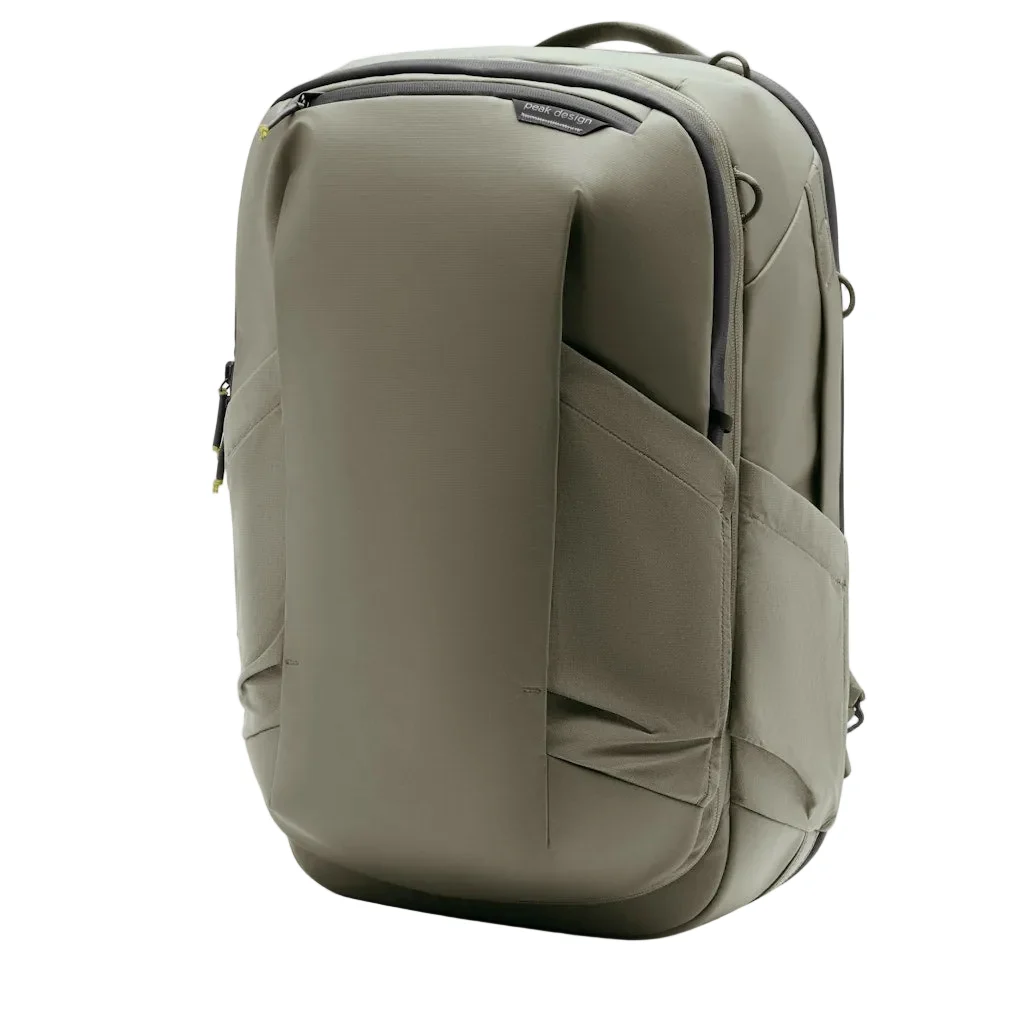
The Peak Design Travel 2-in-1 combines a base pack and daypack via a wraparound zipper that reviewers prefer over other split-system designs. Pack Hacker found the UltraZip hardware highly resilient under heavy loads, while Gear Patrol praised the magnetic strap storage for tidy overhead bin placement. However, combining the bags reduces usable capacity to approximately 40 liters due to structural overlap, and the removable hip belt adds bulk without significant comfort support. Amateur Photographer noted that accessing camera gear requires opening the entire back clamshell panel, hindering quick retrieval on the move. This system fits travelers who prioritize aesthetic cohesion and standalone versatility over maximum volume or rapid equipment access.
Full review
Capacity loss when bags are zipped together
The defining feature of the Peak Design Travel Backpack 2-in-1 is its ability to function as a single large travel pack or two separate smaller packs. The 34-liter base pack and 16-liter daypack do not add up to 50 liters when joined, however: the structural overlap caused by the connecting zipper reduces the usable volume significantly. Pack Hacker noted that Peak Design estimates the combined capacity at roughly 42 liters, a figure they agreed with after extensive use.
Nomads Nation provided real-world packing data that aligns with this reduction in space. During their testing, they found the larger base pack felt closer to a 30-to-33-liter range rather than its rated capacity when fully packed out. Similarly, the smaller daypack carried closer to 10 or 12 liters of actual usable gear rather than the theoretical maximum. This discrepancy means travelers who rely on strict volume calculations for one-bag travel will find they have less room than the sum of the individual parts suggests.
The loss of capacity is a direct consequence of the wraparound zipper system that binds the two units. When separated, the bags can flex and swell outward into their own distinct shapes, accommodating more bulky items like sweaters or shoes. However, when zipped together, the daypack sits flush against the front of the main pack, restricting expansion and compressing the internal volume. This trade-off is necessary for the bag's aesthetic cohesion but requires users to pack more efficiently than they might with a traditional single-chamber backpack.
UltraZip durability under heavy loads
The mechanical integrity of the 2-in-1 system relies entirely on the quality of its zippers, which are Peak Design's proprietary UltraZips manufactured in partnership with Zoom. Pack Hacker tested these components extensively during a seven-night Caribbean cruise, deliberately overstuffing the main compartment to see if the hardware would fail under stress. They reported that the No. 10 weather-resistant zippers performed admirably, never binding or bursting even when squeezed around tightly packed packing cubes and travel shoes.
Gear Patrol highlighted the robust nature of these components as a key differentiator from lesser travel bags. The heavy-duty construction ensures that the connection between the base pack and daypack remains secure during transit. Unlike standard coil zippers that can pop open or separate at the teeth when overloaded, these UltraZips maintain their seal reliably. This durability is critical for a bag that claims to merge two distinct containers into one structural unit.
Beyond the main compartment, the zipper pulls feature Hypalon-style loops rather than traditional heat-shrink cords. Pack Hacker noted a preference for these durable tabs because they are easier to grip and manipulate, especially when wearing gloves or dealing with wet conditions. The ability to lock the main compartment zippers by looping them together provides an additional layer of security for checked luggage, preventing accidental openings during rough handling by baggage handlers.
Bulky hip belt adds volume without support
The harness system on the Travel Backpack 2-in-1 includes a removable hip belt that reviewers found to be excessively bulky and largely unnecessary for comfort. Pack Hacker observed that while the bag remained comfortable even when fully loaded, the addition of the hip belt did not provide meaningful support for their body type. Instead, it added significant volume and weight to the lower back area, creating an awkward profile when navigating airports or tight seating arrangements.
The process of removing the hip belt is straightforward, involving a simple push-and-pull mechanism that releases the strap from its mounting points inside the bag. However, reattaching it proved difficult for reviewers who wanted to experiment with different carrying configurations. The tight fit and lack of magnetic assistance make installation cumbersome, leading many users to leave it detached permanently. Nomads Nation noted that while hip belts can be useful for heavy loads, this specific design felt more like an obstacle than a benefit.
For travelers who prefer not to use a hip belt, the absence of one does not compromise the structural integrity of the pack. The shoulder straps and back panel provide sufficient support on their own, distributing weight effectively across the upper body. Removing the hip belt also opens up space for attaching other accessories or simply reduces the overall bulk of the bag when stowing it in overhead compartments or under airplane seats.
Magnetic strap storage simplifies packing
One of the most praised features of the Travel Backpack 2-in-1 is the integration of magnets within the shoulder straps and back panel. Gear Patrol described this as a clever solution to a common problem: storing loose straps when the bag is not in use. Instead of fumbling with buckles or tucking flaps, the straps snap securely against the back pad, keeping them tidy and preventing them from flopping around during transit.
This magnetic system also aids in overhead bin storage. Pack Hacker reported that the magnets helped keep the harness compact when sliding the bag into tight spaces on Delta Airlines flights. The straps stayed flat against the back panel, reducing the overall footprint of the pack and making it easier to fit alongside other carry-on items. This attention to detail enhances the bag's usability in crowded airports where every inch of space counts.
The magnets are strong enough to hold the straps firmly in place but do not interfere with the comfort of wearing the bag. When the shoulder straps are deployed, they sit naturally on the shoulders without any magnetic pull or resistance. This seamless integration allows users to switch between carrying modes quickly and efficiently, a significant improvement over older designs that required manual adjustment and tucking of loose hardware.
Camera access requires full back panel opening
For photographers using the Photo Bundle with interchangeable camera cubes, accessing gear presents a notable limitation. Amateur Photographer found that there is no way to retrieve a camera or lens without unzipping the entire clamshell back panel of the base pack. This design choice prioritizes security and organization over quick access, ensuring that all equipment remains safely contained within the main compartment.
This lack of side or top access means that photographers cannot easily grab their gear while on the move or in crowded environments like city streets or public transportation. To change lenses or switch cameras, users must remove the bag from their back and open it fully, which can be cumbersome during fast-paced shooting scenarios. The daypack section is not designed for camera storage either, lacking internal padding and dedicated compartments.
The trade-off here is between security and convenience. While the full clamshell opening makes packing and organizing gear straightforward, it hinders rapid access to equipment. Travelers who need to switch lenses frequently or shoot spontaneously may find this layout restrictive compared to backpacks with side-access panels or quick-grab top openings.
Standalone daypack utility for city travel
When separated from the main pack, the 16-liter daypack functions as a fully independent unit suitable for daily excursions. It features its own adjustable shoulder straps, external pockets, and a quick-grab handle on top. Nomads Nation noted that this smaller bag is ideal for carrying essentials like a laptop, water bottle, and light jacket while exploring a city or attending meetings.
The daypack's slim profile makes it less bulky than the main travel pack, allowing users to navigate tight spaces more easily. It includes stretchy side pockets that can hold water bottles or umbrellas, as well as hidden AirTag holders for tracking purposes. The top quick-access pocket provides a convenient spot for storing items like boarding passes or smartphones without needing to open the main compartment.
Using the daypack separately allows travelers to leave their heavy luggage in hotel rooms while carrying only what is necessary for the day. This flexibility reduces fatigue and increases mobility, making it easier to engage in spontaneous activities or navigate public transit. The ability to detach the daypack seamlessly transforms a single large backpack into two versatile bags capable of handling different travel scenarios.
Material durability withstands airport abuse
The Travel Backpack 2-in-1 is constructed from weather-resistant recycled 330D nylon canvas, with a thicker 900D material reinforcing the bottom of the main pack. Pack Hacker reported that these materials held up well during their cruise, showing only minor scuffs on the front after being tossed around by airport staff and checked as luggage for the return flight.
The use of durable fabrics ensures that the bag can withstand the rigors of frequent travel without tearing or wearing out prematurely. The 900D bottom provides extra protection against abrasion when setting the bag down on rough surfaces, while the DWR coating helps repel light rain and moisture. Gear Patrol praised the high-quality materials as a hallmark of Peak Design's commitment to longevity.
While the materials are robust, reviewers noted that the back panel can show signs of wear in specific spots due to friction against other surfaces or clothing. Despite this minor issue, the overall construction remains solid, with reinforced stitching and sturdy hardware contributing to the bag's reputation for durability.
Strengths
- +Both the base pack and daypack function as fully standalone units with their own compartments, straps, and pockets when separated.
- +Shoulder straps feature integrated magnets that snap against the back panel for tidy storage in overhead bins or under seats.
- +The main compartment utilizes durable UltraZip zippers made with Zoom that reviewers found to be highly resilient even when overstuffed.
Watch-outs
- −Combining the bags reduces total usable capacity from a theoretical 50L down to approximately 40-42L due to structural overlap.
- −Accessing camera gear requires opening the entire back clamshell panel, making it difficult to retrieve items quickly while on the move.
How it compares
Its full clamshell access is slower for quick gear retrieval compared to the dual-side access of the Wandrd Stratus Photo 18L or the top-access design of the Vanguard Alta Sky 42.
Rating sources
Counts as 4.35/5 in our score — this publisher's 10 scores on the site average 3.95, so its scores are adjusted up to compare fairly with other publishers.
Counts as 4.22/5 in our score — this publisher's 16 scores on the site average 4.53, so its scores are adjusted down to compare fairly with other publishers.
Not in the average — we derived this score from the review's words, and a publisher printed a score for this product, so the printed number counts instead.
“And while they’re all absolutely outstanding (as is par for the course, at this point), there’s one that stands out as a shining example of the brand’s prowess and dedication to its craft: the Peak Design Travel Backpack 2-in-1 .”
Our 4.3 score is the average of 2 of the scored reviews above, each adjusted for how strictly its publisher scores; 2 more reviewed it without printing a score and are not in the average. 1 derived score above is not in the average because a publisher printed a score for this product. Ratings marked * were derived from the reviewer’s written analysis or video transcript — the publisher didn’t print an explicit numeric score, so we inferred one from their own words. Click through to verify. More about methodology.