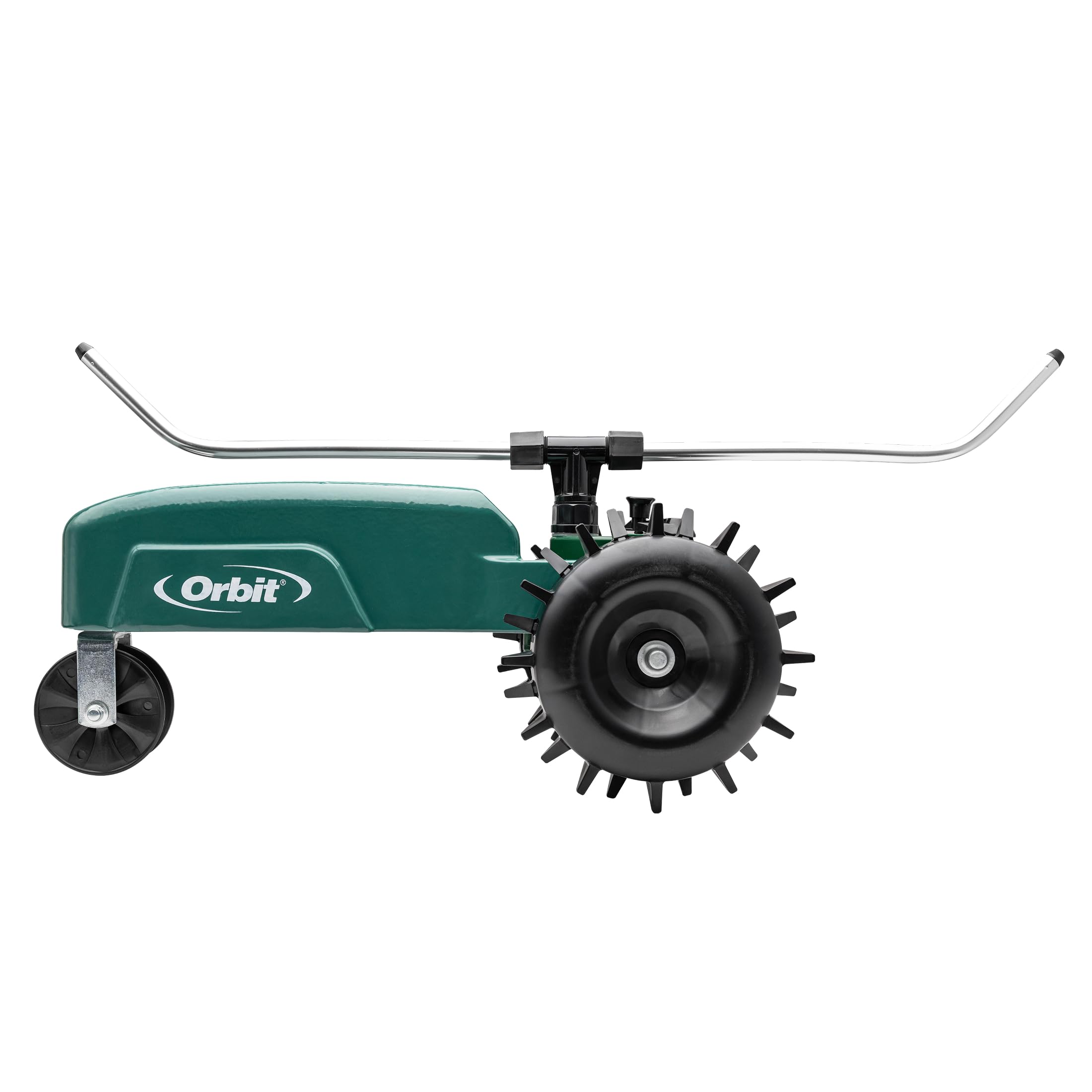
The Orbit Traveling Tractor Water Sprinkler features a durable 18.8-pound cast iron body that Reviewed found anchors the unit effectively against minor lawn obstacles while navigating gradual hose bends. Its hydraulic transmission converts water pressure into movement, with Home.howstuffworks.com explaining how internal gears drive the wheels at speeds up to 37 feet per hour on the highest setting. The device automatically shuts off when the front wheel engages a stopper ramp, depressing a plunger to cut water flow and halt motion without manual intervention. However, Reviewed noted that this movement is remarkably slow even on fast settings, making it inefficient for large areas, while its forceful spray pattern is unsuitable for watering new seed. This sprinkler fits homeowners with established lawns who prioritize deep hydration and durability over speed, but those needing to germinate new grass or cover vast spaces quickly should look elsewhere.
Full review
Cast iron weight and gradual hose bends
The Orbit Traveling Tractor Water Sprinkler is built almost entirely of cast iron, a material choice that gives the unit an 18.8-pound heft Reviewed found. This substantial mass serves two critical functions in outdoor use: it anchors the sprinkler against bumps or small obstacles on uneven terrain, and it signals to homeowners that the device is engineered for long-term durability rather than seasonal disposability. The dense construction ensures the machine stays grounded even when navigating minor irregularities in a typical suburban yard.
While the weight provides stability, the mechanical design requires specific track preparation to function correctly. Reviewed noted that the sprinkler moves around bends and turns easily, but these curves must be gradual rather than sharp. If the hose is laid with tight angles, the front wheel risks jumping off the track entirely. Homeowners should plan their watering layout carefully, ensuring that any directional changes in the garden hose path are smooth enough to allow the heavy cast iron body to roll over without derailing.
The sheer mass of the Orbit Traveling Tractor Water Sprinkler also dictates how it interacts with foreign objects on a lawn. During setup or operation, minor debris like a rake lying across the path can be pushed aside by the machine. Reviewed observed that the sprinkler continued to push such an obstacle for approximately 10 minutes before clearing it completely. While this demonstrates impressive torque and weight distribution, reviewers still advise clearing larger items from the track beforehand to prevent unnecessary strain on the drive gears.
Water pressure drives transmission gears
The internal mechanics of the Orbit Traveling Tractor Water Sprinkler rely entirely on hydraulic force rather than electricity or gasoline. Home.howstuffworks.com explained that incoming water pressure, typically between 40 to 60 psi in residential systems, flows through a pipe inside the unit and exits through two bent sprinkler arms. This exit creates an equal and opposite reaction force that generates torque, spinning the arms much like a merry-go-round powered by water rockets.
This rotational energy is transferred internally via a plastic worm gear located within the tractor body. The spinning arms rotate this worm gear, which then engages a transmission gear train connected to the drive axle. This simple mechanical linkage converts the high-speed rotation of the spray arms into the slow, deliberate forward motion of the back wheels. The entire system operates as a self-contained hydraulic engine that requires no external power source beyond standard household water pressure.
The transmission mechanism includes three distinct settings that alter how this torque is applied to movement. Home.howstuffworks.com detailed that these gears allow users to switch between high speed, low speed, and neutral. Disengaging the gear train completely puts the sprinkler in a stationary mode for localized watering, while switching between different sized gears changes the rotation speed of the axle. This mechanical simplicity is what allows the device to operate reliably without complex electronics or batteries that could fail over time.
Spray radius spans 15 to 50 feet
The watering capability of the Orbit Traveling Tractor Water Sprinkler is defined by a spray diameter that ranges from 15 feet up to 50 feet depending on water pressure and nozzle configuration. This wide variance means the machine can adapt to different lawn sizes, but it also introduces limitations regarding specific gardening tasks. The maximum reach allows the sprinkler to cover expansive areas without needing constant repositioning, making it suitable for mature lawns that simply need consistent hydration.
However, the 50-foot spray limit presents a significant drawback for homeowners attempting to establish new grass from seed. Reviewed explicitly categorized this limitation by noting the device is not ideal for new seed because the wide, forceful spray can easily wash away loose seeds or prevent them from settling into the soil properly. The high-velocity water distribution designed for established turf creates too much disturbance in bare earth where germination requires gentle, consistent moisture.
The operating pressure required to achieve these coverage metrics is rated between 15 and 65 PSI according to the product specifications. This broad acceptable range ensures compatibility with most standard residential spigots, but users must understand that lower end pressures will result in a significantly reduced spray radius. Achieving the full 50-foot diameter requires robust water pressure at the source, meaning homes with naturally low municipal pressure may only utilize the lower end of the coverage spectrum.
Speed settings measure up to 37 feet per hour
The forward movement speed of the Orbit Traveling Tractor Water Sprinkler is remarkably slow, even when set to its highest available setting. Reviewed clocked the maximum travel rate at just 37 feet per hour on the high gear, while the low gear moves at a crawl of only 15 feet per hour. This deliberate pace ensures that water penetrates deeply into the soil rather than running off the surface, but it also means watering large lawns requires significant time investment.
The sluggish speed is so imperceptible to casual observation that Reviewed spent approximately 15 minutes trying to determine if the machine was actually moving before realizing it was progressing forward. This near-stationary movement on the high setting highlights a design philosophy prioritizing thorough hydration over rapid coverage. Homeowners with very large yards should calculate their watering time carefully, as covering even moderate distances will take many hours of continuous operation.
This slow pace is directly tied to the mechanical gear ratios discussed by Home.howstuffworks.com. The transmission is designed to trade rotational speed for torque and distance control, ensuring the heavy cast iron body moves steadily without slipping or jumping over obstacles. While this guarantees consistent water distribution across the track length, it also means the sprinkler cannot be used as a quick-fix solution for spot watering; it must be left running for extended periods to complete its assigned path.
Automatic shut off uses ramp and plunger
The self-propelled nature of the Orbit Traveling Tractor Water Sprinkler is managed by a simple but effective automatic shutoff mechanism. Reviewed explained that users must attach an included stopper ramp to the end of their garden hose track where they want the watering cycle to conclude. This ramp does not require any electrical wiring or complex sensors; it relies purely on physical interaction between the sprinkler's wheels and the ground.
When the front wheel of the tractor encounters this ramp, it climbs over the obstacle while the back wheels pass around either side. As the body rises over the incline, a spring-loaded plunger located on the bottom of the unit is depressed by the track geometry. This mechanical action closes an internal valve that simultaneously cuts water flow to both spray arms and stops the drive gears from turning. The result is a complete shutdown of all functions exactly when the machine reaches the end of its designated path.
Proper placement of this shutoff ramp is critical for the mechanism to function correctly. Reviewed found that if the stopper ramp is placed on a curved section of the hose rather than a straight segment, the sprinkler will fall off before it can engage the plunger. The physical alignment requires a linear approach so the front wheel can cleanly climb the incline and trigger the valve. Homeowners must ensure their track layout includes a straight final stretch to guarantee reliable automatic shutoff.
Setup takes less than five minutes
Installing the Orbit Traveling Tractor Water Sprinkler is designed to be an immediate process that requires minimal tools or technical knowledge. Reviewed noted that setup involves expanding the unit to its full length, laying out a garden hose in a pattern that covers the desired lawn area, and connecting the back coupler to the water supply. The entire preparation phase can be completed in less than five minutes for an average-sized yard.
Once the hose is positioned with gradual bends and the stopper ramp is secured at the end of the track, the user simply places the front wheel on the hose approximately four feet from the beginning. Attaching the garden hose to the rear coupler completes the physical setup. Turning on the water supply immediately activates both the spray arms and the drive gears, launching the machine into its automatic watering cycle without any further intervention.
The simplicity of this process eliminates the need for timers or manual monitoring during operation. Because the device shuts itself off when it reaches the end ramp, homeowners can set it up and leave the area entirely. Reviewed emphasized that while you do not need to watch the sprinkler constantly, it is still advisable to check on it periodically from a distance to ensure it remains on track and has not encountered any unexpected obstacles that might derail its path.
Strengths
- +Simple set up that takes less than five minutes to lay out the hose and connect the unit
- +Automatic shut off mechanism stops water flow when the sprinkler reaches the end ramp
- +Durable construction featuring a heavy cast iron body for longevity
- +Moves effectively around gradual bends in the garden hose track
Watch-outs
- −Sprays up to 50 feet, which is insufficient for watering new seed or large areas
- −Movement speed is remarkably slow even on its highest setting
How it compares
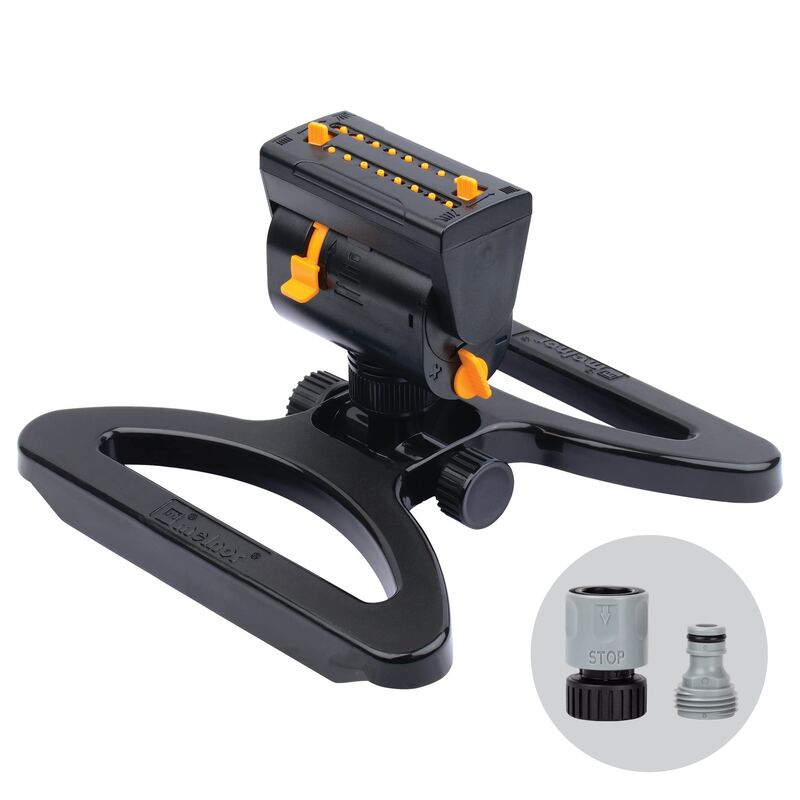
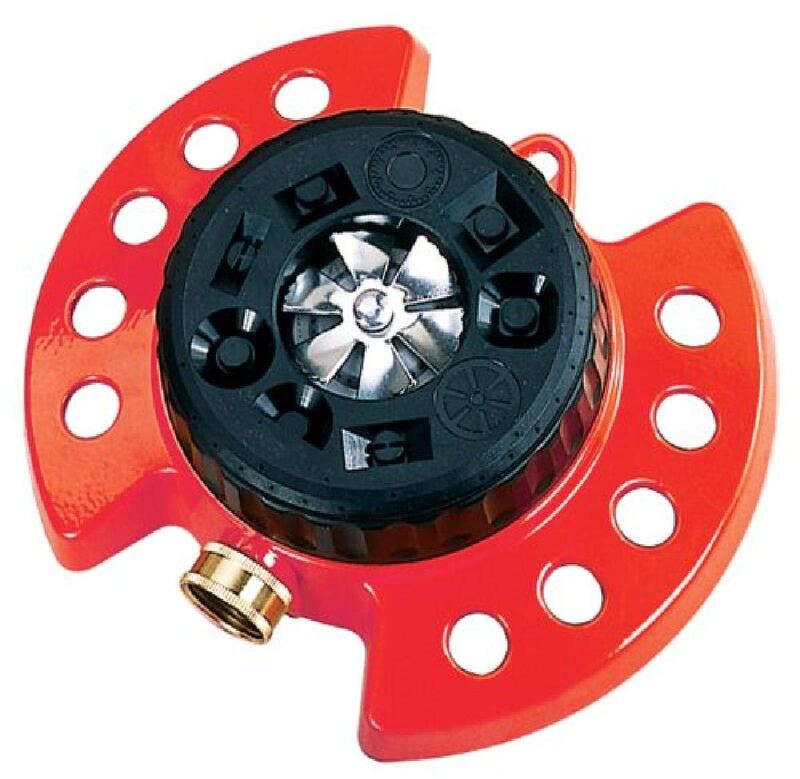
This self-propelled unit moves automatically along a hose track, eliminating the need for manual repositioning required by the stationary Dramm and Melnor sprinklers. Its heavy cast iron body anchors effectively against obstacles, whereas the lightweight plastic sled base of the Melnor MiniMax Turbo is prone to shifting under pressure.
Rating sources
“Short of a fully automatic sprinkler system, this is the best way that I’ve found to water a lawn.”
Our 4.5 score is the average of the 1 scored review above; 4 more reviewed it without printing a score and are not in the average. Ratings marked * were derived from the reviewer’s written analysis or video transcript — the publisher didn’t print an explicit numeric score, so we inferred one from their own words. Click through to verify. More about methodology.