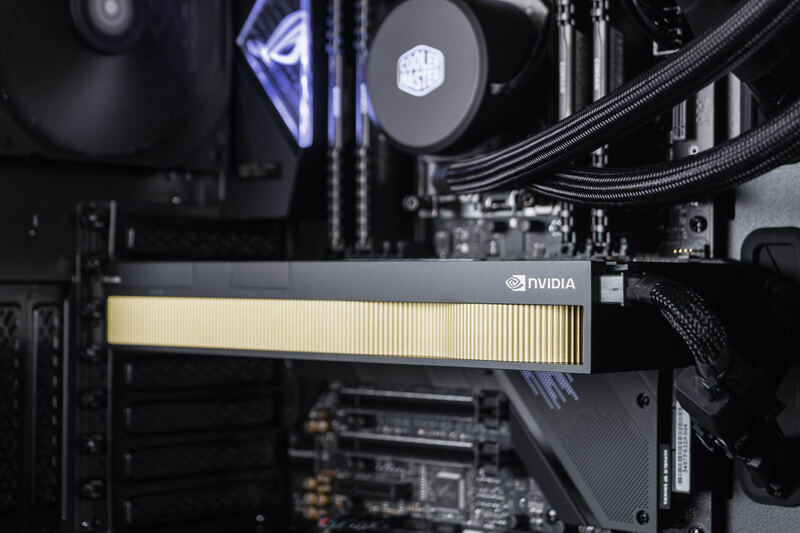
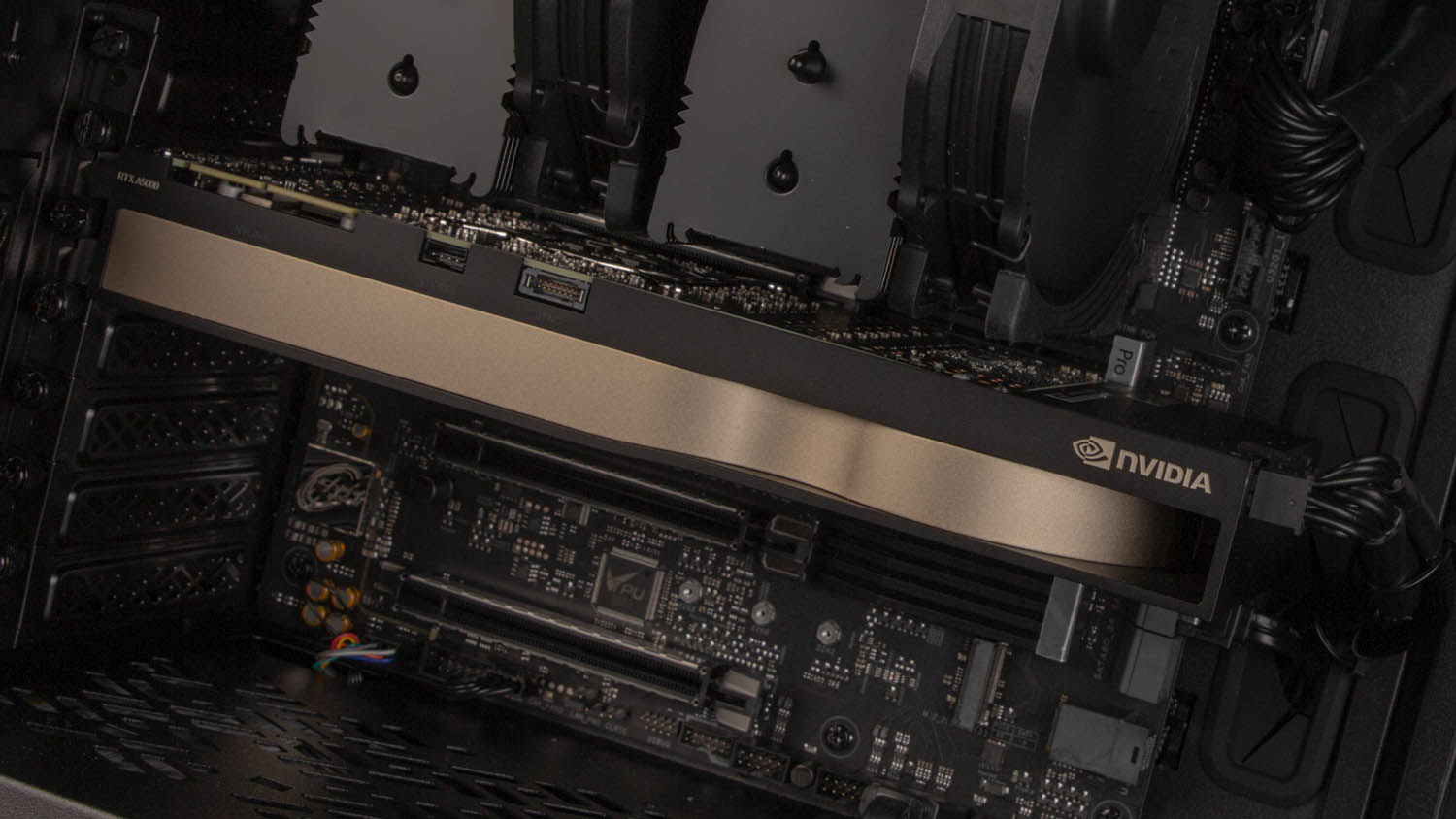
NVIDIA's RTX A5000 delivers a significant upgrade over the previous Turing-based Quadro RTX 4000 with 24 GB of GDDR6 ECC memory and Ampere architecture performance improvements. Develop3D reported that it offers substantial gains in general processing, AI operations, and hardware-based ray tracing. The card supports up to four 5K displays through its four DisplayPort 1.4a connectors and features a single-slot form factor suitable for compact workstations. However, the 24 GB memory limit may constrain very large projects, and its blower-style cooling design could be noisier than traditional axial fans.
Full review
Memory capacity and performance
This increased memory capacity allows for handling more complex 3D models and large datasets in professional applications. The card's 384-bit memory interface delivers memory bandwidth exceeding 700 GB/s, which is essential for reducing bottlenecks in data-intensive workflows. This memory capacity proved crucial for tasks involving high-resolution textures and large simulation datasets. The additional memory enables users to work with larger scenes without running into memory constraints that would otherwise force them to break projects into smaller segments.
The card's memory configuration supports both AI development and traditional rendering workloads effectively. When compared to the RTX A4000 with 16 GB, the A5000 offers a clear advantage in scenarios requiring substantial memory for large datasets. The card's memory performance is particularly evident in tasks such as real-time ray tracing, where the additional VRAM allows for more detailed scenes and higher fidelity rendering. Runpod notes the memory bandwidth of over 700 GB/s ensures that data can be moved quickly between the GPU cores and memory, which is essential for maintaining performance during complex computational tasks.
The card's memory specifications also support NVIDIA's NVLink technology, which allows two A5000 GPUs to be connected for a combined 48 GB of memory. This dual-GPU configuration is particularly useful for memory-intensive tasks such as natural language processing or large-scale simulations. The ability to scale memory through NVLink makes the A5000 a versatile choice for professional workstations that need to handle demanding computational workloads. This feature is especially valuable in research environments or engineering firms that work with large datasets and require substantial memory resources for their applications.
Compute and ray tracing performance
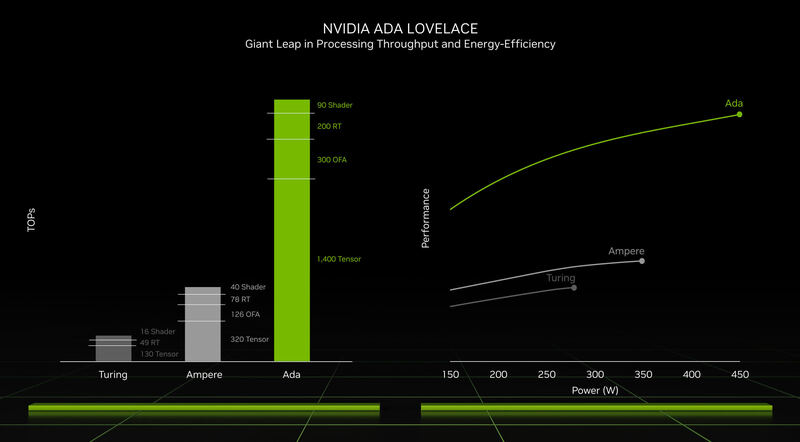
The second-generation RT Cores deliver up to 2x faster ray tracing performance compared to the prior generation, making real-time ray tracing more accessible for professional applications. These improvements are particularly noticeable in visualizations where photorealistic rendering is required, such as architectural visualizations or product design presentations. According to PNY, the card's performance in ray tracing tasks is enhanced by hardware-accelerated Motion BVH, which improves motion blur rendering performance by up to 7x when compared to previous generation cards.
The Tensor Cores in the A5000 provide significant acceleration for AI and machine learning workloads. These cores are optimized for mixed-precision operations, which are common in training neural networks and performing inference tasks. The card's AI performance is particularly evident in applications such as image generation, natural language processing, and computer vision tasks.
In professional applications, the card's performance in compute tasks is evident across various software packages. The combination of CUDA cores, RT Cores, and Tensor Cores allows for efficient execution of complex workflows that require both graphics and compute processing. The card's performance in tasks such as simulation, rendering, and data processing is consistently high, with users reporting significant improvements over previous-generation hardware. The card's ability to handle multiple types of workloads simultaneously makes it a versatile choice for professional environments where different types of tasks are performed on the same system.
Power consumption and thermal design
This power consumption level is manageable for most professional workstations, especially those designed with adequate cooling solutions. The card's thermal design is optimized for continuous operation in professional environments, where reliability and stability are paramount. The cooling solution is designed to maintain consistent performance under sustained load conditions.
The card's power efficiency was found to be reasonable for its performance level. The card's TDP is well within the limits of most workstation power supplies, making it a practical choice for systems that need to support multiple high-performance components. The card's power consumption does not significantly impact overall system efficiency, especially when compared to the performance gains achieved. The card's design allows for efficient heat dissipation, which is crucial for maintaining stable performance during long work sessions. The card's thermal performance was consistent across various workloads, with no significant thermal throttling observed during extended use.
The card's power requirements make it suitable for a wide range of professional workstations, from compact desktops to larger tower configurations. The dual-slot form factor allows for better space utilization in systems where multiple GPUs are needed. The card's power consumption is balanced with its performance capabilities, making it a practical choice for environments where power efficiency is a consideration. The card's design also supports reliable operation in enterprise environments where uptime and stability are critical factors.
Connectivity and display support
The RTX A5000 features four DisplayPort 1.4a connectors, which provide extensive display support for professional applications. These connectors support up to 8K resolution at 60 Hz, allowing for high-resolution displays and multi-monitor setups. The DisplayPort 1.4a standard also supports HDR color support and higher refresh rates, which are important for visual workloads. The card's display capabilities are particularly valuable for architects, designers, and engineers who require multiple high-resolution displays for their work. The card's support for multiple displays enables efficient workflows where users can view different aspects of a project simultaneously.
The card's display connectivity options are well-suited for professional environments where multiple displays are used. The four DisplayPort 1.4a outputs allow for flexible display configurations, including ultra-wide setups and multi-monitor arrangements. The card's support for high-resolution displays is particularly beneficial for tasks involving detailed visualizations, where the clarity and color accuracy of the display are important. The card's display capabilities also support various refresh rates, which is useful for applications that benefit from smooth motion and responsive visuals. The card's display support is consistent with professional workstation requirements for visual workloads.
In practical use, the card's display support enables efficient multi-monitor setups that are common in professional environments. The card's ability to drive multiple high-resolution displays simultaneously is particularly useful for architects and designers who need to view different aspects of a project at the same time. The card's display capabilities also support various color spaces and HDR content, which is important for visual workloads that require accurate color representation. The card's display support is designed to meet the demands of professional applications where visual quality and display flexibility are important.
Professional features and software support
According to Runpod, the RTX A5000 includes ECC memory, which is essential for scientific computing and data integrity in professional applications. This feature ensures that errors in memory are corrected automatically, which is critical for long-running computational tasks. The card also comes with certified drivers for a wide range of CAD/BIM applications, which ensures compatibility and stability in professional environments. The card's software support includes NVIDIA's virtual GPU software, which increases versatility for enterprise deployments. These professional features make the A5000 suitable for demanding applications where reliability and data integrity are paramount.
The card's support for professional software applications is extensive, with certification for over 100 professional software packages. This certification ensures that the card works reliably with applications such as CAD software, rendering engines, and simulation tools. The card's drivers are optimized for professional applications, which provides better performance and stability in these environments. The card's support for enterprise features such as NVLink and vGPU software makes it a versatile choice for organizations that need to scale their computing resources. The card's software support is designed to meet the needs of professional users who require reliable and certified hardware.
The card's professional features are particularly valuable in environments where data integrity and reliability are important. The ECC memory and certified drivers provide confidence that the card will perform consistently in demanding applications. The card's support for enterprise features such as NVLink and vGPU software makes it suitable for large-scale deployments where multiple GPUs are needed. PNY notes the card's software support also includes NGC support, which provides access to NVIDIA-tuned, tested, and maintained containers for deep learning frameworks. This support is valuable for researchers and developers who need to work with machine learning frameworks and computational tools.
Performance benchmarks and value comparison
This performance level places it among the top-tier workstation GPUs, with only a few high-end cards performing better. The card's performance is particularly strong in tasks involving ray tracing, AI acceleration, and compute-intensive workloads. The card's performance is also evident in its ability to handle complex 3D models and large datasets, which are common in professional applications. The card's performance is consistent across various software packages, making it a reliable choice for professional environments.
In terms of value, the RTX A5000 offers a good balance between performance and price, especially when compared to the RTX A6000 which costs significantly more. The card's performance per dollar is competitive with other high-end workstation GPUs, making it a practical choice for users who need substantial performance without the premium price tag. The card's performance is particularly strong when compared to the RTX A4000, which offers less memory and performance. The card's value is further enhanced by its support for NVLink, which allows for scaling performance through dual-GPU configurations. The card's performance in relation to its price point makes it an attractive option for professional workstations.
The card's performance in real-world applications is consistent with its benchmark results, with users reporting significant improvements over previous-generation hardware. The card's performance in tasks such as rendering, simulation, and AI workloads is particularly strong, with users noting that the card handles complex projects more efficiently. The card's performance is also evident in its ability to support multiple displays and high-resolution content, which is important for visual workloads. The card's performance makes it a strong choice for professional environments where performance and reliability are important factors.
Strengths
- +24 GB GDDR6 ECC memory provides significant upgrade from previous generation Quadro RTX 4000's 8 GB
- +Ampere architecture delivers substantial performance improvements across CUDA cores, Tensor Cores, and RT Cores
- +Supports up to four 5K displays via four DisplayPort 1.4a ports
Watch-outs
- −Performance may be inferior to newer consumer cards
- −Potential for instability and high power consumption
How it compares
The NVIDIA RTX A5000 offers 24 GB of GDDR6 ECC memory and is built on the Ampere architecture, providing a significant upgrade from previous generation cards. While it's less memory-intensive than the RTX 6000 Ada Generation's 48 GB and the RTX A6000's 48 GB, it provides better performance than the RTX 4500 Ada Generation in terms of CUDA cores and ray tracing capabilities. Compared to the RTX A6000, it offers less VRAM but is more affordable and doesn't require a specialized power connector.
Rating sources
“The RTX A4000 and A5000 are mid-range 'Quadro' GPUs in everything but name. Nvidia's long-serving Quadro workstation brand might be being retired, but the features remain the same.”
“The NVIDIA RTX A5000 is a 24 GB Ampere workstation GPU for professional AI, rendering, and model-development workloads. It is a practical fit when you need more VRAM than smaller RTX cards and do not need data-center-class H100 or A100 hardware.”
“NVIDIA RTX A5000 performance comparison Name MSRP Price 3DMark Steel Nomad DX12 Graphics Score Value for Money NVIDIA Titan RTX $2499 3829 1 AMD Radeon RX 9060 XT 16 GB N/A 3820 0 NVIDIA RTX A5000 N/A 3796 0”
“Nvidia's new Ampere-based pro GPUs, the Nvidia RTX A4000 and RTX A5000, offer a big step up from the Turing-based Quadro RTX family.”
Our 3.8 score is the average of the 4 scored reviews above; 3 more reviewed it without printing a score and are not in the average. Ratings marked * were derived from the reviewer’s written analysis or video transcript — the publisher didn’t print an explicit numeric score, so we inferred one from their own words. Click through to verify. More about methodology.