The AMD Radeon Pro W6800 is a workstation-class GPU featuring 32 GB of VRAM and hardware-based ray tracing capabilities. It's designed for demanding architectural visualization workflows and supports professional applications like Solidworks Visualize, Autodesk Maya, and Unreal Engine. While it offers significant memory capacity and viewport boost technology, it's not optimized for FP64 workloads and has limited ray tracing support compared to Nvidia's offerings. This card targets visualization professionals who need substantial memory and ray tracing performance.
Full review
Memory capacity and architecture
The Radeon Pro W6800 stands out primarily due to its 32 GB of GDDR6 memory, a figure that surpasses even the 48 GB model from Nvidia's RTX A6000 line. This massive memory capacity positions the card as a serious contender for high-end visualization workloads. The memory is connected to the GPU through a 256-bit interface operating at 2,300 MHz, delivering peak memory bandwidth of 512 GB/s. This configuration allows the card to handle extremely large datasets, such as city-scale models with immense detail or projects with hyper-realistic textures and vegetation. The card's design also incorporates 128 MB of Infinity Cache, which significantly boosts effective bandwidth in certain scenarios. The memory architecture is further enhanced by ECC support, which is crucial for enterprise environments where data integrity is paramount.
Ray tracing capabilities and software support
The card introduces hardware-based ray tracing through enhanced Compute Units with dedicated Ray Accelerators, marking AMD's first professional GPU with this capability. While the number of applications that can leverage these accelerators is still limited, the list includes those supporting DirectX Raytracing (DXR), such as Unreal Engine, and applications featuring Radeon ProRender 2.0, including Solidworks Visualize, Autodesk Inventor, Rhino, Autodesk Maya, and Blender. AEC Magazine notes the card is not optimized for Nvidia RTX-enabled applications like Luxion KeyShot or Chaos V-ray, which limits its compatibility in certain workflows. Future support is expected for Vulkan Ray tracing, including developments from Solidworks, Autodesk, and Enscape. The card's ray tracing performance is designed to work with applications that are heavily dependent on GPU processing power, particularly those in the visualization domain.
Viewport boost and performance optimization
AMD's Radeon Pro Viewport Boost feature is designed to reduce latency and boost viewport navigation performance by automatically dropping resolution in specific areas when a 3D model is moving quickly, then restoring full resolution when movement stops. This technology is particularly effective in GPU-limited workflows and works best at higher resolutions (4K and above) with larger models. The feature is currently supported in Revit, 3ds Max, Twinmotion, and Unreal Engine (for packaged projects only). According to AMD, this can increase frames per second dramatically without impacting visual experience. The technology is especially beneficial for visualization-focused applications like Twinmotion and Unreal Engine, which can consume all available GPU processing power. The feature works best when the GPU is the bottleneck, which is typical in CAD/BIM applications.
Display output and multi-monitor support
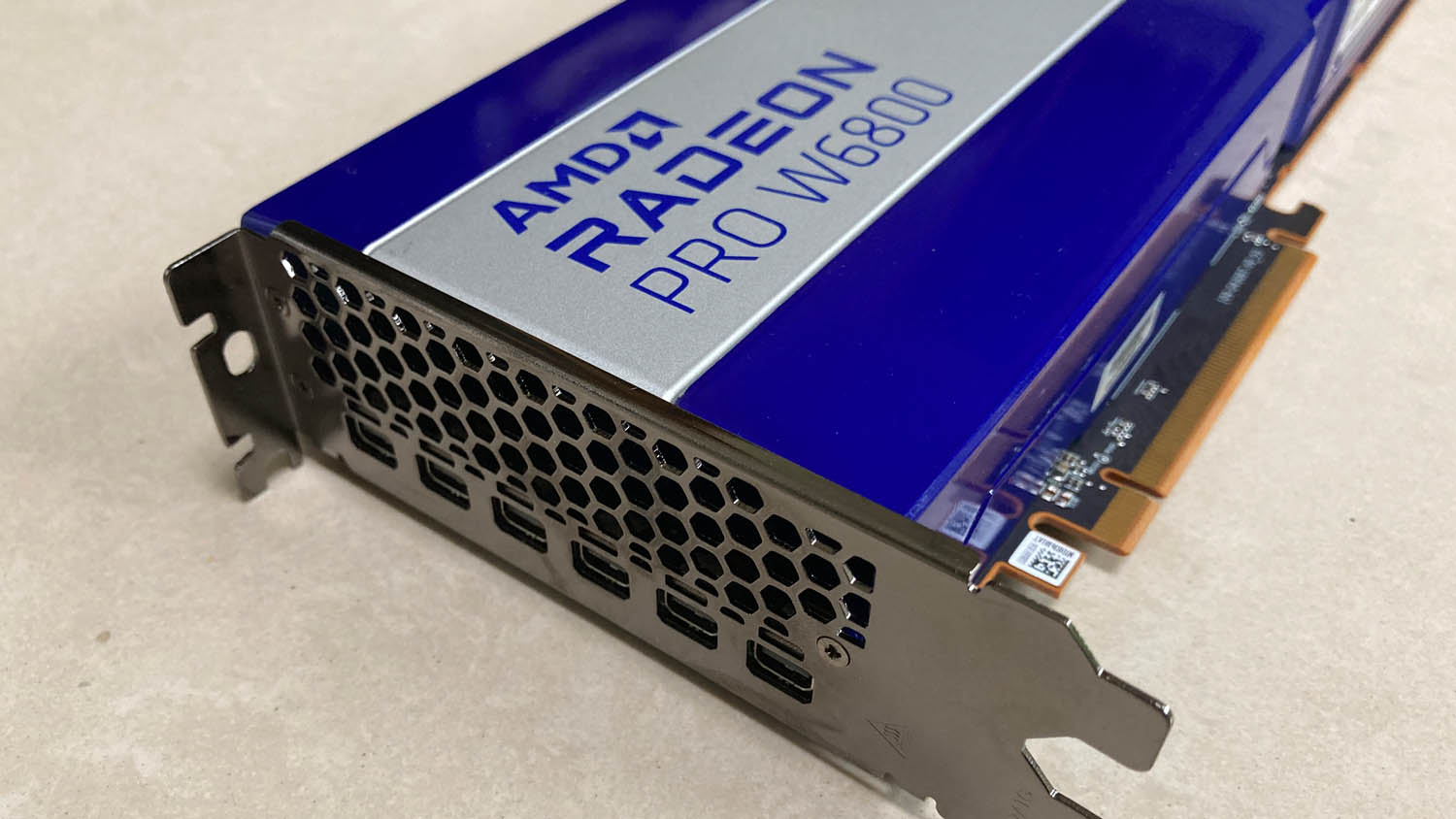
According to Techgage, the card supports up to six displays through its six mini-DisplayPort connectors, which can drive up to six 4K or 5K monitors or two 8K displays. This level of multi-monitor support is particularly valuable for powerwall setups and large-scale visualization projects. DEVELOP3D notes the card's design includes a single 'blower' fan that draws cool air from the top and pushes it out the rear, which is beneficial in multi-GPU workstations where airflow management is critical. The card is a full-height, double-slot PCIe 4.0 graphics card with a peak power consumption of 250W. It requires both a 6-pin and an 8-pin power connector, making it compatible with most mid-sized tower chassis. The card's ability to support multiple high-resolution displays makes it ideal for professionals working with large datasets or requiring extensive visual monitoring.
Performance benchmarks and comparison
According to AEC Magazine, the Radeon Pro W6800 sits somewhere between AMD's consumer Radeon RX 6800 and RX 6800 XT in terms of raw performance. The card's performance is particularly strong in visualization tasks, where its large memory capacity and ray tracing capabilities shine. However, it is not optimized for FP64 (Double Precision) code, making it less suitable for engineering simulation workloads, which are better served by the AMD Radeon Pro VII. The card's performance is also notable in applications like Twinmotion and Unreal Engine, where its ability to handle large datasets and its viewport boost feature provide significant advantages.
Application certification and enterprise use
The Radeon Pro W6800 is certified for a wide range of professional applications, including major CAD and BIM tools, which is especially significant for enterprise customers. This certification ensures compatibility and stability in demanding professional environments. The card's design includes features that make it suitable for enterprise use, such as ECC memory support, which protects against crashes, and the ability to support up to six displays, which is important for powerwall setups. The card's support for Error Correcting Code (ECC) memory, which is not available in previous-generation Radeon Pro models, is a significant improvement. This certification and feature set make the card an attractive option for businesses that require reliable, high-performance visualization capabilities.
Strengths
- +Features 32 GB of on-board GDDR6 memory, double that of consumer counterparts
- +Includes hardware-based ray tracing with dedicated Ray Accelerators
- +Supports up to six displays and Error Correcting Code (ECC) memory
- +Designed for professional applications including CAD, BIM, and visualization tools
- +Includes Radeon Pro Viewport Boost for improved viewport navigation performance
Watch-outs
- −Not optimized for FP64 (Double Precision) code used in engineering simulation
- −Limited ray tracing acceleration support compared to Nvidia RTX GPUs
How it compares
The AMD Radeon Pro W6800 provides 32 GB of GDDR6 memory and dedicated Ray Accelerators, making it suitable for CAD, BIM, and visualization tools. While it offers more memory than the RTX A5000's 16 GB, it's less memory-intensive than the RTX 6000 Ada Generation's 48 GB and the RTX A6000's 48 GB. Unlike the NVIDIA cards, it's not optimized for FP64 workloads and has limited ray tracing acceleration support compared to the RTX 6000 Ada Generation.
Rating sources
“With a whopping 32 GB of on board memory its designed for the most demanding architectural visualisation workflows”
“With RDNA2, AMD delivers performance to allow it to be competitive at the top-end of the market, and adds support for valuable features like resizable BAR, variable rate shading, and hardware ray tracing all of which can be great for both working and gaming.”
“32 GB is a huge amount of memory for a GPU, surpassed only by the 48 GB Nvidia RTX A6000 which costs twice as much. It means the Radeon Pro W6800 can handle some seriously demanding visualisation datasets.”
Our 4.5 score is the average of the 4 scored reviews above; 3 more reviewed it without printing a score and are not in the average. Ratings marked * were derived from the reviewer’s written analysis or video transcript — the publisher didn’t print an explicit numeric score, so we inferred one from their own words. Click through to verify. More about methodology.