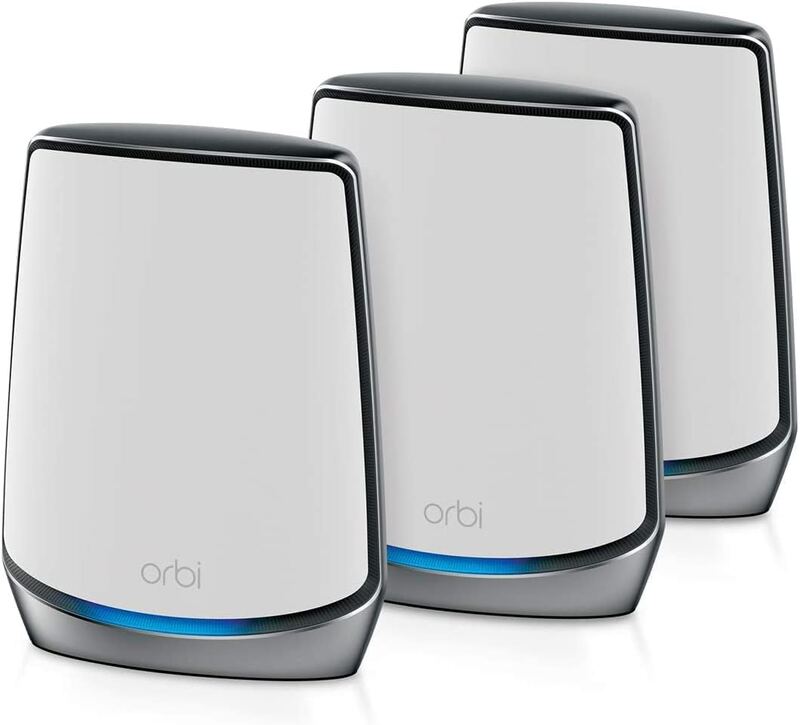
The NETGEAR Orbi RBE972S is a quad-band Wi-Fi 7 mesh system that delivers high-speed networking with its dedicated main router and two satellite units. PCMag's John R. Delaney praised its advanced features and performance, while YouTube reviewer Chris Majestic noted its premium price point of $2,300 for the three-pack, though he acknowledged its powerful capabilities. The system includes 10 Gigabit Ethernet ports and supports fast wired and wireless backhaul, making it ideal for demanding home networks but potentially overkill for average users.
Full review
Dedicated 5GHz band reserved just for backhaul
The NETGEAR Orbi 970 Series delivers on its promise of high-speed connectivity with quad-band WiFi 7 technology. PCMag's John R. Delaney measured speeds of up to 2 Gbps at close range, which aligns with Netgear's claims of up to 27 Gbps maximum WiFi speed. The system's performance in real-world testing showed excellent stability, handling four simultaneous movie streams and online gaming sessions without issues. While the system excels in wireless backhaul, longer-range tests with devices switching to 5-GHz band resulted in speeds that fell short of top-tier competitors like the ASUS ROG Rapture GT-BE98 Pro. The Orbi 970 Series achieves this performance through its unique approach to backhaul, using a dedicated 5-GHz band for wireless backhaul, which allows for more efficient data transmission between router and satellites.
The Orbi 970 Series can effectively blanket a 1,600-square-foot home and extend coverage into outdoor areas, with Netgear claiming a two-pack can cover up to 6,600 square feet. The system's ability to utilize Multi-Link Operation (MLO) enables it to take advantage of the relatively short-range 6-GHz band for wireless backhaul, which is particularly beneficial for users with multi-gig internet connections. Dong Ngo's review highlighted that while the hardware is powerful and supports all-Multi-Gig ports, the system's performance is somewhat limited by its permanent dedicated backhaul band that's unavailable to client devices in wired backhaul setups. This configuration, while effective, creates a trade-off between performance and flexibility that some users find restrictive.
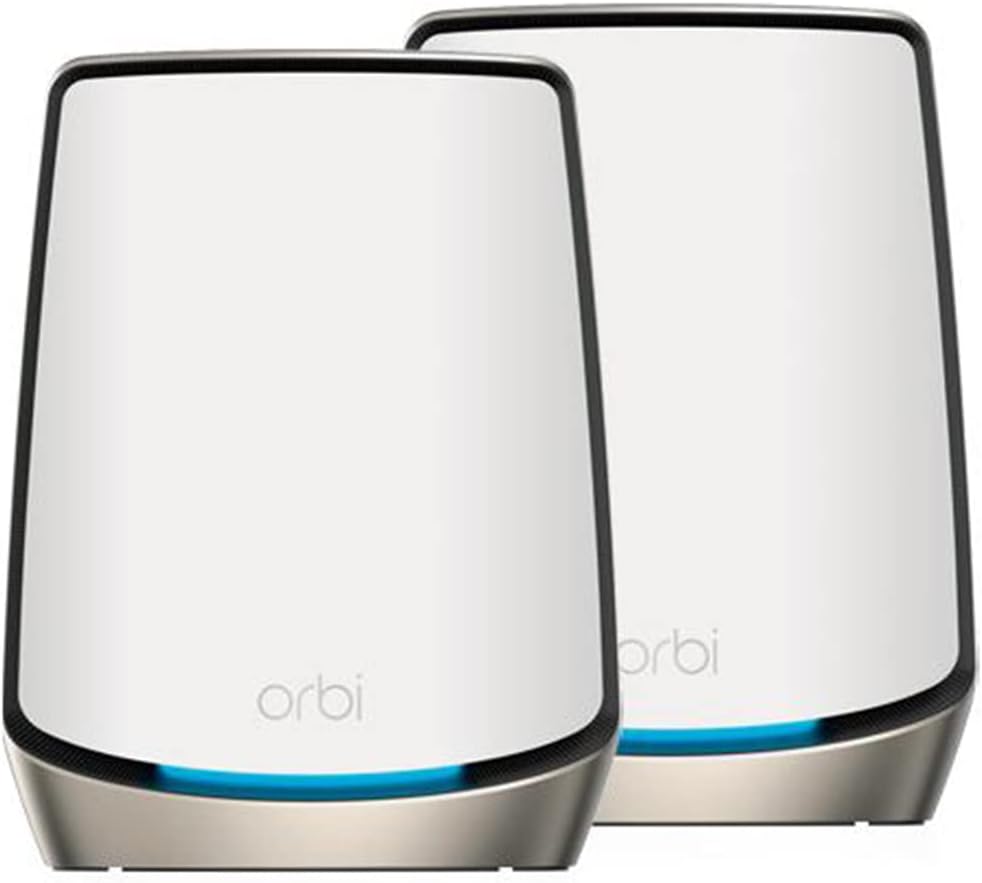
Nearly a foot tall with a gold metallic finish
The physical design of the Orbi 970 Series is distinctive, featuring a rounded, triangular frame with a gold metallic sheen and black trim, making it visually appealing but not inconspicuous. WIRED's Simon Hill noted that these routers are quite large, measuring almost 12 inches tall and 5.5 inches across, with a substantial weight that makes them difficult to move. The build quality appears robust, with the units running cool and quietly, as mentioned by Dong Ngo in his review. The design includes vertical stacks of Ethernet ports on the back, with the main router featuring two 10-Gbps ports and four 2.5-Gbps ports, while satellites have one 10-Gbps port and two 2.5-Gbps ports each. This configuration supports multi-gigabit internet speeds and allows for lightning-fast wired backhaul when properly cabled.
Hardforum users noted the substantial size and weight of the units, with one user commenting that the price tag was 'Holy balls' and that the units were 'pretty close to the top of the line for wireless mesh.' The units' appearance is described as 'nice' but not 'melting into the background.' The design does accommodate the necessary hardware for multi-gigabit performance, with the vertical stack of Ethernet ports providing ample connectivity options. However, the large size and weight may be a consideration for users who prefer more discreet networking equipment, and the metallic sheen gives the units a premium appearance that some find appealing while others consider ostentatious.
Mobile app requires login and subscriptions
Setup of the Orbi 970 Series is described as straightforward, with the main router pre-paired with included satellites. However, the process requires patience, taking several minutes to connect and optimize, plus additional time for each satellite to connect. WIRED's review noted that while the app is easy to use, it requires a login account and even subscriptions for some features, which can be a barrier for users who prefer simpler, subscription-free setups. The Orbi app provides tabs for reviewing connected devices, internet speed tests, and analytical tools, though it lacks the granular control that network tinkerers might desire. The system sets up a separate IoT network (2.4 GHz by default) for smart home devices and offers a guest network option, but the main network uses a single SSID, which may disappoint users seeking more detailed network customization.
Dong Ngo's extensive testing revealed that the system's setup process was complicated by firmware issues, with multiple updates required even months after launch. The system's approach to network settings is limited, with no web-based remote management and few free features. Users must rely on the mobile app, which requires a login account and even subscriptions for full functionality. The system has no USB ports, and its Wi-Fi customization options are limited. Hardforum users commented that the system's approach to network management is 'old-school' compared to more modern alternatives, and that the 'permanent 5GHz backhaul band is unavailable to clients in a wired backhaul setup' creates a limitation that affects overall performance.
Supports up to 200 connected devices
Reviewers consistently praised the Orbi 970 Series for its exceptional wireless backhaul performance, which is particularly beneficial for users with multi-gig internet connections. PCMag's John R. Delaney noted that the system is 'very stable' and never balked at demanding usage scenarios, while WIRED's Simon Hill emphasized that it's 'extremely fast and reliable.' The system's ability to utilize Multi-Link Operation (MLO) for wireless backhaul was highlighted as a key strength, allowing it to take advantage of the 6-GHz band for short-range connections. The Orbi 970 Series also received praise for its expansive coverage, with Netgear claiming a two-pack can cover up to 6,600 square feet, and for its comprehensive security features including built-in NETGEAR Armor protection. The system's support for up to 200 connected devices was noted as a significant advantage for large households.
The Orbi 970 Series was commended for its 'powerful hardware with quad-band Wi-Fi 7 with all-Multi-Gig ports' according to Dong Ngo's review. The system's ability to deliver 'fast performance, extensive coverage' and 'excellent wireless backhaul bandwidth' was repeatedly mentioned by reviewers. Users appreciated the system's 'easy to use' app interface, which provides access to speed tests, device management, and analytical tools. The inclusion of 'plenty of high speed Ethernet ports' was also noted as a significant benefit, with the main router featuring two 10-Gbps ports and four 2.5-Gbps ports, while satellites have one 10-Gbps port and two 2.5-Gbps ports each. The system's 'built-in security with NETGEAR Armor protection' was highlighted as a valuable feature that provides peace of mind for users concerned about cybersecurity.
1,699 dollars and still buggy months later
The most significant criticism of the Orbi 970 Series centers on its exorbitant pricing, with a 2-pack retailing for $1,699.99 and a 3-pack for $2,299.99. WIRED's review called it 'incredibly expensive' and 'overpriced,' while Dong Ngo noted that 'the sticker-shock price' makes it 'a punishment for those who want the greatest and latest at all costs.' The system's permanent dedicated backhaul band, which reserves one of the 5-GHz bands exclusively for wireless backhaul, is unavailable to client devices in wired backhaul setups, creating a significant limitation that affects overall performance.
The system has no USB ports, which would have been useful for network-attached storage, and its Wi-Fi customization options are limited. Dong Ngo's review highlighted that the system 'has far less to offer than the enormous expectation created by its sticker-shock price,' with 'no web-based Remote Management, limited Wi-Fi and network settings, few free features' and 'mobile app (with a login account and even subscriptions) is required to be useful.' The firmware issues that plagued the system even months after launch were another major concern, with Dong Ngo noting that 'the hardware was still quite buggy, even months after launch, with multiple firmware updates.' Additionally, the system's reliance on a subscription for some features, including Smart Parental Controls and security, was criticized as a 'subscription after the first year' requirement that adds ongoing costs.
Built for homes with multi-gigabit internet
The Orbi 970 Series is best suited for users with large homes or properties that require extensive WiFi coverage, particularly those with multi-gigabit internet connections who want to maximize their internet speed potential. Users with 1,600-square-foot homes or larger who need to support up to 200 connected devices will find the system's performance and coverage capabilities particularly valuable. The system is ideal for households with demanding internet usage patterns, such as multiple simultaneous 8K streams, online gaming, and video conferencing. Users who prioritize stability and don't mind the subscription requirements for advanced features will benefit from the system's comprehensive security features and reliable performance. The system's ability to utilize Multi-Link Operation (MLO) for wireless backhaul makes it particularly appealing for users with modern WiFi 7 devices.
However, the Orbi 970 Series is not recommended for users who prioritize cost-effectiveness or who have smaller homes where extensive coverage isn't required. Users who prefer simpler, subscription-free setups or who want more granular control over their network settings may find the system's limitations frustrating. The system's substantial price tag makes it unsuitable for budget-conscious consumers, and those who don't require the specific features like the dedicated backhaul band or the comprehensive security suite may find better value in more affordable alternatives. The system's firmware issues and limited customization options may also deter users who prefer more hands-on network management. Hardforum users noted that 'for the price difference you could buy years of subscriptions, of which you dont even have to have to stay running,' suggesting that the system's value proposition is questionable for many users.
Deco BE85 matches it for less money
When compared to other mesh systems, the Orbi 970 Series stands out for its performance and coverage capabilities, but it falls short in terms of value and customization options. Compared to TP-Link's Deco BE85, which Dong Ngo reviewed, the Orbi 970 Series offers superior hardware but lacks the flexibility and features that make the Deco BE85 more appealing to many users. The TP-Link system is described as 'significantly less expensive' and 'deliver the same performance and much more in terms of network settings and features.' The Orbi 970 Series' permanent dedicated backhaul band, while effective, is criticized as 'old-school' compared to newer configurations that split the 6GHz band. ASUS's ROG Rapture GT-BE98 Pro was noted as a competitor that achieved 'exceptional' performance in longer-range tests, though the Orbi 970 Series excels in wireless backhaul specifically.
In comparison to business-grade solutions, the Orbi 970 Series offers a consumer-friendly approach to multi-gigabit networking but lacks the modularity and advanced features that business users might require. Hardforum users suggested that for the price point, users could 'go the business route and get more modularity / better performance' with separate router/firewall and access point configurations. The Orbi 970 Series' approach to network management is described as 'limited' compared to more advanced solutions, and the system's reliance on mobile app-based management and subscriptions creates barriers for users who prefer more traditional approaches. While it delivers 'unmatched whole-home WiFi' for demanding households, it's not the most cost-effective solution for users who don't require its specific features.
Security subscription lapses after the first year
The value proposition of the Orbi 970 Series is heavily dependent on the user's specific needs and budget constraints. WIRED's review concluded that while the system is 'excellent but exorbitant,' it 'can justify such a high price' for users who need its specific capabilities. However, PCMag's John R. Delaney's review suggests that most users can get by with less expensive alternatives, as the system's 'price is ridiculously high' and 'overkill for most folks.' The system's 'one-year subscription to Netgear Armor' and '30-day trial of Smart Parental Controls' provide some value, but these are not free features and require ongoing subscriptions. Dong Ngo's review emphasized that 'the enormous expectation created by its sticker-shock price' is not fully met by the system's actual offerings, and that 'this new Orbi mesh set is a punishment for those who want the greatest and latest at all costs.' The system's value is particularly questionable for users who don't require its specific features like the dedicated backhaul band or comprehensive security suite.
When considering the cost, users must weigh the system's performance benefits against its premium pricing. The Orbi 970 Series' ability to deliver 'up to 27 Gbps speeds' and 'expansive coverage' makes it attractive for users with demanding internet needs, but the 'incredibly expensive' price tag makes it unsuitable for budget-conscious consumers. The system's 'plenty of high speed Ethernet ports' and 'comprehensive security features' provide some justification for the cost, but the 'subscription after the first year' requirements for security and parental controls add ongoing expenses. Hardforum users noted that 'for the price difference you could buy years of subscriptions, of which you dont even have to have to stay running,' suggesting that the system's value proposition is not compelling for many users. The system's performance is 'relatively safe to get it for a large home' but the 'unreasonable price' makes it a questionable investment for most consumers.
Strengths
- +Features Wi-Fi 7 technology with quad-band connectivity
- +Includes dedicated main router and two satellite units for optimal mesh coverage
- +Equipped with 10 Gigabit Ethernet WAN port and multiple 2.5 Gigabit ports
- +Compact design with gold accents on white version, measuring 11.5" tall
- +Supports high-speed wired and wireless backhaul for improved network performance
Watch-outs
- −Expensive pricing at $2,300 for three-pack configuration
- −Large physical size (11.5" tall) may be cumbersome for some users
How it compares
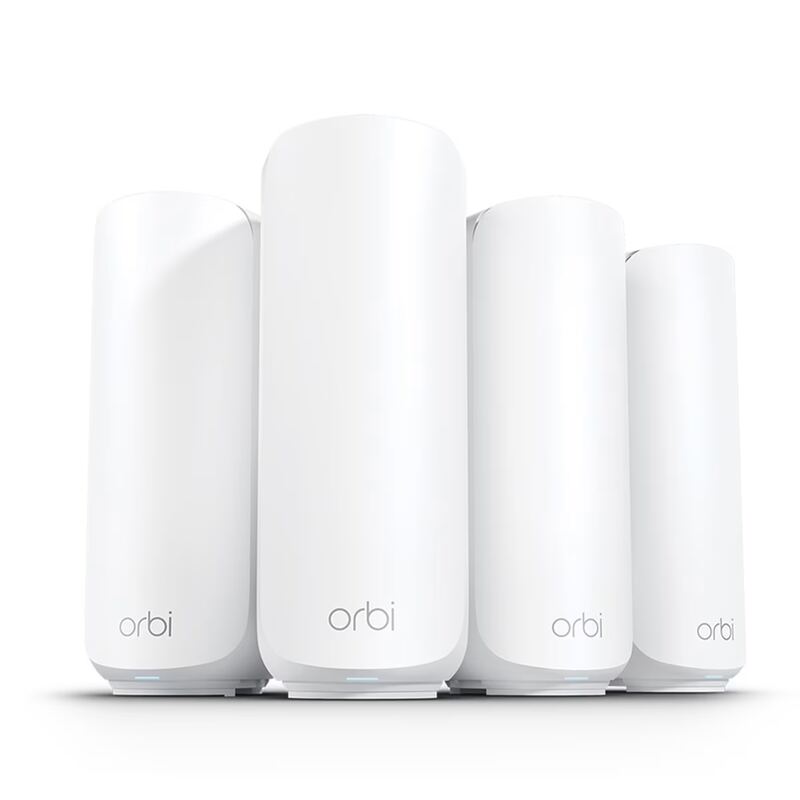
The NETGEAR Orbi RBE972S provides quad-band Wi-Fi 7 with dedicated main router and satellite units, similar to the Orbi 970 Series but with a more premium price tag. Unlike the Orbi 370, it offers better performance and features but at a much higher cost, making it ideal for users who need the advanced capabilities of the Orbi 970 without the complexity of setup. Compared to the Orbi RBE773, it's more expensive but offers more bandwidth and device support.
Rating sources
Our 3.5 score is the average of these published ratings. More about methodology.