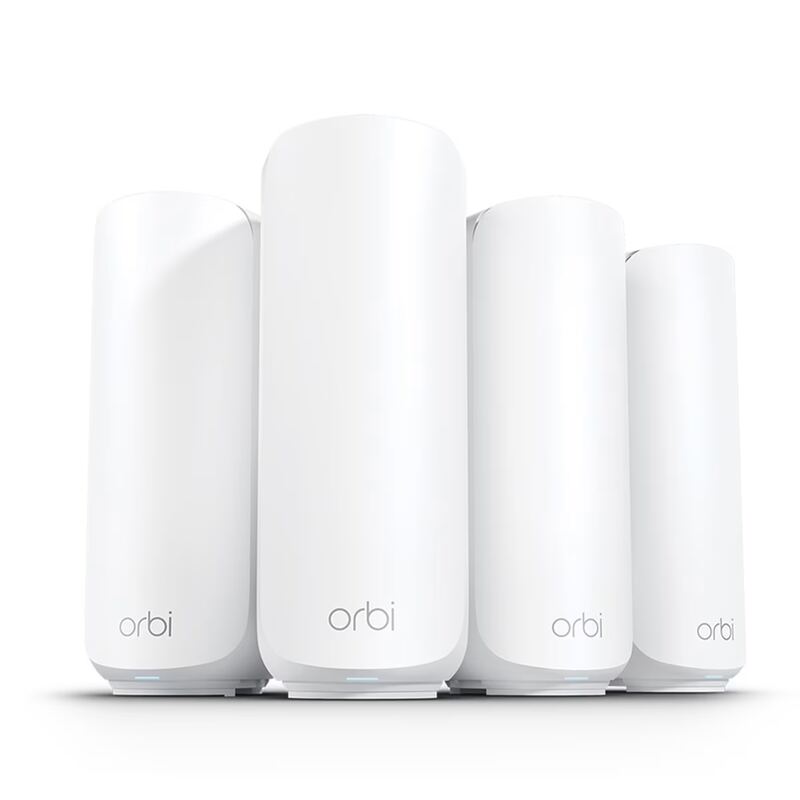
The Netgear Orbi RBE773 delivers impressive Wi-Fi 7 performance with speeds up to 11 Gbit/s and coverage for up to 8,000 sq ft. PCMag reviewer John R. Delaney praised its ability to handle multiple devices without sacrificing performance, while YouTube reviewer Reviews Inside TV noted strong, consistent speeds even at distance. The system supports up to 100 devices and includes built-in security features. However, occasional rebooting of satellite extenders was reported as a minor inconvenience.
Full review
Tri-Band Design and Performance
The Netgear Orbi RBE773 represents a significant departure from the company's previous quad-band Orbi 970 series, adopting a tri-band configuration that eliminates the dedicated backhaul band. This design choice, according to PCMag's John R. Delaney, allows all three bands to be available to client devices, which he notes is 'a huge step compared to all previous tri-band and quad-band Orbi sets.' The system delivers BE11000 performance with 5,760 Mbps at 6GHz, 4,320 Mbps at 5GHz, and 688 Mbps at 2.4GHz. KitGuru's James Morris confirmed that this tri-band approach is viable with WiFi 7's Multi-Link Operation (MLO) capabilities, stating that 'Wi-Fi 7 has lots of bandwidth, especially with the MLO feature, enough to deliver multi-Gigabit sustained rates even in the case the hardware needs to handle both backhauling and front hauling simultaneously.' However, Dong Ngo from DongKnows pointed out that this configuration 'could render the Orbi 770 a headache for those with lots of legacy devices' due to limited Wi-Fi options.
The RBE773's tri-band approach does indeed work well in practice, with the system maintaining high throughput even under heavy load. The router's 22 internal antennas per band (22 for 2.4GHz, 22 for 5GHz, and 22 for 6GHz) contribute to its strong performance across all bands. The system's ability to utilize MLO effectively means that even when multiple devices are connected, the network maintains consistent performance without the need for a dedicated backhaul channel. This approach aligns with Netgear's marketing claims that the system can deliver 'up to 11Gbps' speeds and cover 'up to 8,000 sq. ft.' However, the lack of a dedicated backhaul band means that all three bands must work together to maintain performance, which can create bottlenecks under certain conditions, particularly when dealing with older devices that don't support the latest WiFi standards.
Nearly half the weight of the 970 series
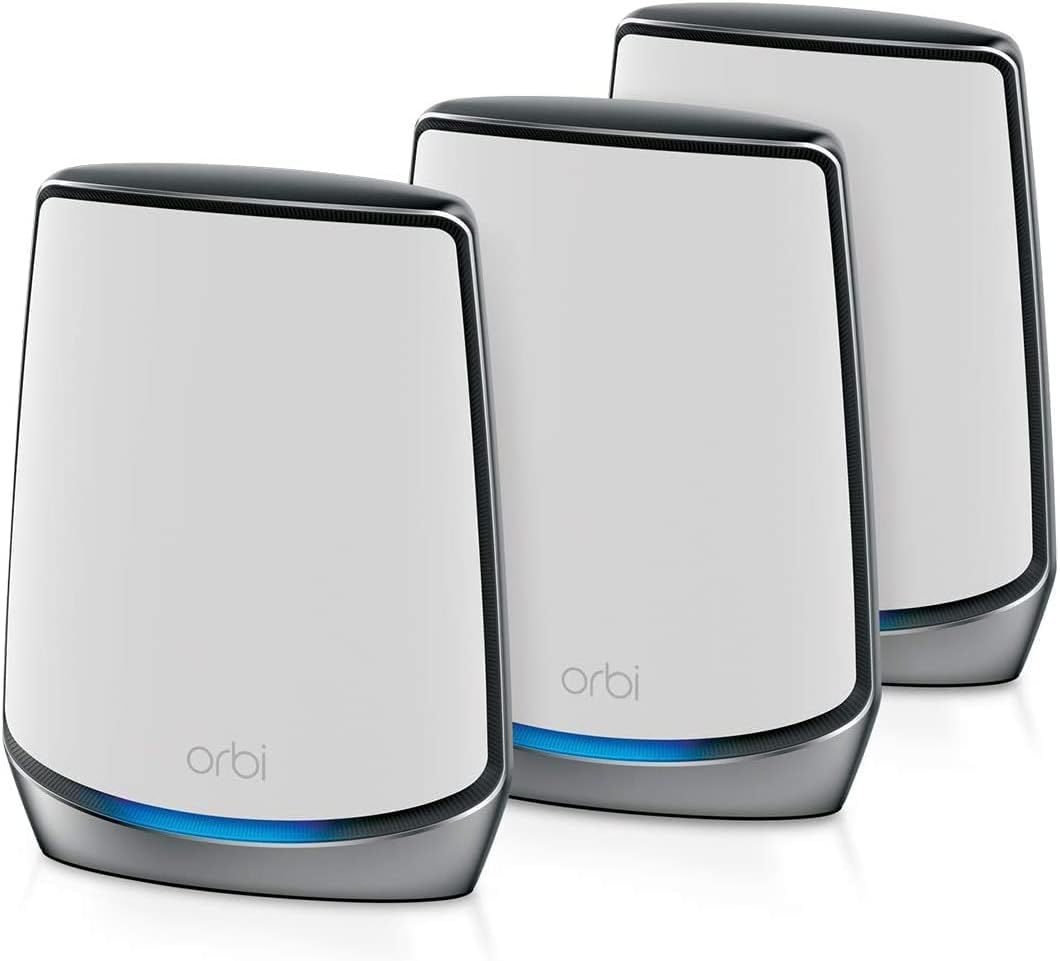
The physical design of the Orbi RBE773 reflects Netgear's commitment to aesthetics and functionality. According to KitGuru's review, the units are 'smaller units than the Orbi 970 Series, and rather sleek' with dimensions of 9.88 x 5.28 x 3.95 inches (25.12 x 13.42 x 10.04 cm) for each unit. The router weighs 2.02 lbs (0.92 kg) while the satellites weigh 2.02 lbs (0.92 kg) each, making them notably lighter than their 970 counterparts at 3.96 lbs (1.79 kg) each. The compact design makes these units suitable for placement in various locations throughout a home without being obtrusive. PCMag's John R. Delaney noted that 'these are attractive and compact units that won't spoil the look of your home decor,' which aligns with the sleek white finish and minimalistic design approach that Netgear has adopted for this series.
The back panel of the router features a WAN port (in yellow) plus three LAN ports, all operating at up to 2.5Gbit Ethernet speed, while the satellites have just a pair of 2.5Gbit Ethernet LAN ports. This design choice, while functional, removes some of the flexibility that was present in the 970 series. Dong Ngo pointed out that 'the lack of Wi-Fi options alone could render the Orbi 770 a headache for those with lots of legacy devices,' suggesting that the reduced feature set may not be ideal for users with older networking equipment. However, the overall build quality and design are praised by reviewers as being both functional and visually appealing, with the units designed to blend seamlessly with modern home decor.
Setup and Administration
The setup process for the Orbi RBE773 follows Netgear's standard approach, utilizing the Orbi smartphone app for configuration. KitGuru's James Morris noted that 'NETGEAR follows the norm and focuses on its Orbi smartphone app for basic setup,' which guides users through the process of creating a NETGEAR account, configuring the router and satellites, and setting up security features. PCMag's John R. Delaney described the setup as 'straightforward' and 'simple,' with the app wizard leading users through the process of plugging in the units, connecting to the Orbi's WiFi, creating the network, setting up admin login details, and adding satellites to the mesh. The system also includes a 30-day trial of NETGEAR's Armor security system, which requires a subscription for full functionality after the trial period.
However, the administration interface has received mixed reviews. While the smartphone app is generally praised for its ease of use, some reviewers noted limitations in the available features. Dong Ngo from DongKnows pointed out that 'the smartphone admin interface isn't that packed with features,' and that 'the combination of Wi-Fi 7's MLO and the Orbi ecosystem's limited Wi-Fi options can be problematic.' The lack of USB ports on the 770 series also removes the ability to share storage or printers, which was a feature present in the 970 series. Additionally, the system's approach to handling legacy devices and the limited customization options for Wi-Fi bands have been noted as potential drawbacks by some reviewers, particularly those who rely on older networking equipment.
Real-World Performance
Performance testing across multiple review platforms confirms that the Orbi RBE773 delivers on its promise of high-speed, reliable networking. KitGuru's James Morris conducted extensive testing and found that the system 'delivers WiF7 performance that extends across an entire house,' with the three-unit bundle being sufficient to cover a 6,750 square foot area. The system's ability to maintain performance across multiple devices and throughout a large home was confirmed by PCMag's John R. Delaney, who noted that 'the Orbi 770 Series WiFi 7 Mesh System by NETGEAR delivers smooth streaming, gaming, and work-from-home performance with strong coverage and built-in security.' The system's 2.5Gbps Ethernet ports on all units, including the WAN port on the router and LAN ports on satellites, provide fast wired connections that complement the wireless capabilities.
However, performance under specific conditions has shown some limitations. Dong Ngo from DongKnows noted that 'the lack of Wi-Fi options alone could render the Orbi 770 a headache for those with lots of legacy devices,' indicating that older devices may not fully utilize the system's capabilities. The system's performance with legacy devices was also a concern raised by some users in Reddit discussions, where it was noted that 'the 770 series doesn't have the same level of support for older devices as the 970 series.' Despite these concerns, the system's ability to deliver consistent performance across a large area and maintain high throughput under load was consistently praised by reviewers, with the tri-band approach working well for modern devices that support WiFi 7 features.
No dedicated backhaul band like the 970 series
Despite its many strengths, the Orbi RBE773 has several notable shortcomings that reviewers have identified. The most significant issue is the lack of a dedicated backhaul band, which was a hallmark feature of the 970 series. Dong Ngo from DongKnows explicitly stated that 'the combination of Wi-Fi 7's MLO and the Orbi ecosystem's limited Wi-Fi options can be problematic,' particularly for users with older devices that don't fully support modern networking standards. This limitation means that all three bands must work together for both backhauling and front-hauling, which can create performance bottlenecks under certain conditions. Additionally, the system lacks USB ports, removing the ability to share storage or printers, a feature that was present in the 970 series.
Another area of concern is the limited Wi-Fi options available to users. KitGuru's James Morris noted that while the system has impressive specifications, 'the features are cut back considerably from the 970 Series, they're still very impressive,' suggesting that some users may find the reduced feature set limiting. The lack of a dedicated backhaul band also means that the system's performance may be compromised when multiple devices are connected simultaneously, especially when dealing with older devices that don't support MLO. Furthermore, the system's approach to handling legacy devices has been criticized by some reviewers, who noted that 'the 770 series doesn't have the same level of support for older devices as the 970 series.' These limitations make the system less appealing to users who rely heavily on older networking equipment or require specific features that were present in the 970 series.
A better deal than the 970 series for modern devices
The Orbi RBE773 is best suited for users who have modern WiFi devices and are looking for a reliable, high-performance mesh system without the premium price tag of the 970 series. PCMag's John R. Delaney emphasized that 'for those with modern Wi-Fi devices with sub-2.5Gbps broadband, at the current relatively friendly street pricing, the NETGEAR Orbi 770 series is a much better deal than the higher-end 970 series that costs more than double.' The system's tri-band design and WiFi 7 capabilities make it ideal for households with multiple devices, including those that support the latest networking standards. Dong Ngo from DongKnows noted that 'the new mesh performed essentially as intended during my testing,' suggesting that the system meets expectations for users who are not reliant on older devices.
However, the system is not recommended for users with a significant number of legacy devices or those who require specific features like USB ports for sharing storage or printers. KitGuru's James Morris pointed out that 'the features are cut back considerably from the 970 Series, they're still very impressive,' indicating that users who need the full feature set of the 970 series may find the 770 series lacking. The system's lack of a dedicated backhaul band also makes it less suitable for users who require maximum performance in high-demand scenarios, particularly when multiple older devices are connected. For users seeking a balance between performance and cost, the Orbi RBE773 offers a compelling option, but those with specific requirements or older equipment may need to consider alternatives.
Legacy device support weaker than rivals
When compared to competing mesh systems, the Orbi RBE773 holds its own but faces stiff competition from other manufacturers. Dong Ngo from DongKnows noted that 'compared with competitors from other vendors, such as the ASUS ZenWiFi BT10 or TP-Link Deco BE63, the lack of Wi-Fi options alone could render the Orbi 770 a headache for those with lots of legacy devices.' This comparison highlights the system's limitations in supporting older devices compared to some competitors. However, the Orbi 770 series does offer a more affordable entry point compared to the 970 series, making it attractive to budget-conscious consumers who still want WiFi 7 capabilities.
The system's tri-band approach with MLO support gives it an edge over some competitors that rely on traditional dual-band configurations. PCMag's John R. Delaney called the Orbi 770 'a strong performer' and found it 'could broadcast a strong Wi-Fi signal to all corners of the house,' though he noted the network security and parental control software cost extra once the 30-day trials expire. However, the lack of USB ports and dedicated backhaul band puts it at a disadvantage compared to some high-end alternatives that offer more comprehensive feature sets. The system's value proposition is strongest for users who prioritize modern WiFi 7 performance and coverage over legacy device support and additional features like USB connectivity.
Priced at 799 pounds, down from 879
At a current price of £799.99 (reduced from £879.99), the Orbi RBE773 offers solid value for money, particularly when compared to the 970 series which costs more than double. KitGuru's James Morris noted that 'you're getting a solid specification for your money,' and PCMag's John R. Delaney emphasized that 'for those with modern Wi-Fi devices with sub-2.5Gbps broadband, at the current relatively friendly street pricing, the NETGEAR Orbi 770 series is a much better deal than the higher-end 970 series that costs more than double.' The system's BE11000 performance, 2.5Gbps Ethernet ports, and WiFi 7 capabilities justify the price point for users who need modern networking features.
However, the value proposition is somewhat diminished by the system's limitations, particularly the lack of USB ports and dedicated backhaul band. Dong Ngo from DongKnows noted that 'the lack of Wi-Fi options alone could render the Orbi 770 a headache for those with lots of legacy devices,' suggesting that users who rely on older equipment may find the system less cost-effective. The system's performance with legacy devices and its reduced feature set compared to the 970 series also impact its overall value for users with specific requirements. Despite these limitations, the Orbi RBE773 remains a strong contender in the mid-range mesh router market, offering a balance between performance, features, and price that appeals to many consumers.
Strengths
- +Delivers speeds up to 11 Gbit per second
- +Provides extensive coverage for homes up to 8,000 square feet
- +Supports up to 100 connected devices simultaneously
- +Includes built-in security with Netgear Armor and automatic firmware updates
Watch-outs
- −Required rebooting of satellite extenders to restore full coverage
- −Minor inconvenience in an otherwise smooth experience
How it compares
The Netgear Orbi RBE773 delivers impressive Wi-Fi 7 speeds with up to 11 Gbps and coverage for up to 8,000 sq ft, outperforming the Orbi 370 in terms of speed and device support. Unlike the Orbi 970 Series, it's more affordable but lacks dedicated 6GHz bands for client devices. Compared to the Orbi RBE972S, it's less expensive but offers less bandwidth and advanced features, making it a good middle-ground option for users with high device counts.
Rating sources
“For those with modern Wi-Fi devices with sub-2.5Gbps broadband, at the current relatively friendly street pricing, the NETGEAR Orbi 770 series is a much better deal than the higher-end 970 series that costs more than double.”
Our 4.1 score is the average of these published ratings. More about methodology.