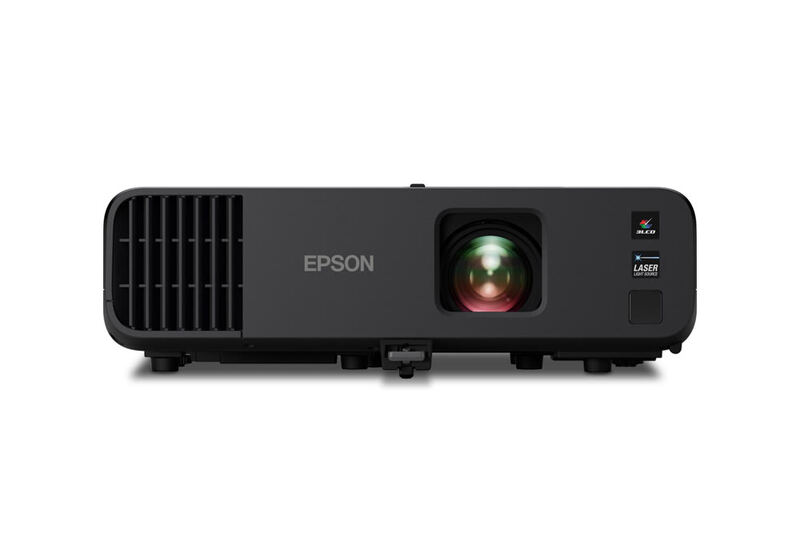
Aimed at custom installations and home theater enthusiasts, the Epson QS100 is a premium 4K PRO-UHD ultra-short-throw laser projector. PCMag's M. David Stone singled out the brightness and the dynamic HDR tone mapping, and Projector Reviews credited the 4500 lumens output and the 32-bit QZX Picture Processor for picture quality. It doesn't hit true 4K resolution and there's no Dolby Vision support, which limits it for anyone chasing the highest-end cinematic result. Discerning buyers and professional installations are the market, not mainstream consumers.
Full review
20,000-hour laser life, no built-in speakers
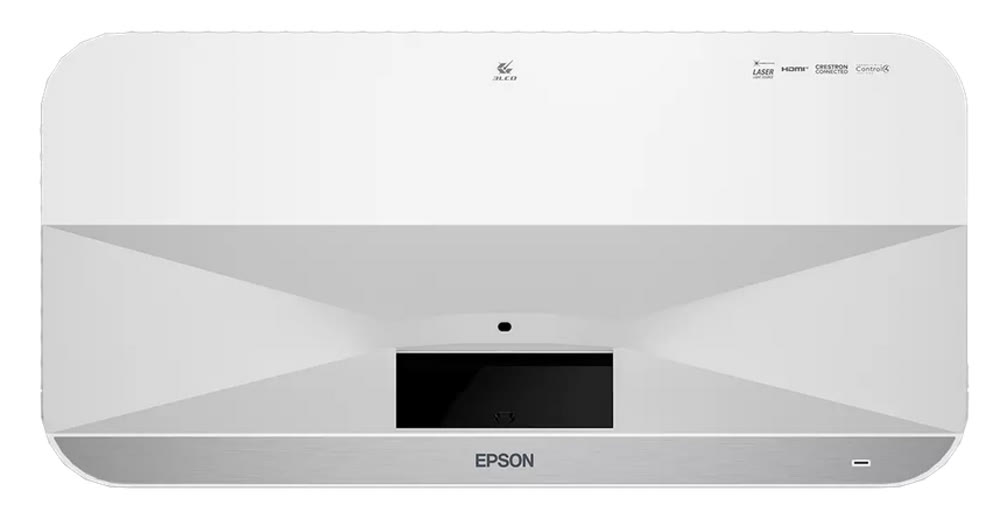
The Epson QS100B arrives as a premium ultra-short-throw projector designed for custom integrators and discerning home theater enthusiasts. Reviewers from ProjectorReviews.com noted that while the QS100 and LS800 share a similar external appearance, the QS100 is built with a more professional target in mind. It features a sleek black finish and a robust construction that reflects its intended use in high-end installations. ProjectorCentral.com's Sammie Prescott Jr. emphasized the QS100's solid-state laser light source, which not only contributes to its impressive brightness but also ensures a lifespan of up to 20,000 hours with minimal maintenance. The design philosophy prioritizes functionality over consumer-friendly features, with no built-in speakers or smart OS, aligning with its target market of users who already have sophisticated audio setups.
Professional reviewers also highlighted the projector's connectivity options, which include two HDMI 2.0 inputs with eARC on HDMI 2. The QS100 supports Auto Low Latency Mode (ALLM), a feature crucial for gaming performance. According to ProjectorCentral.com, the QS100's design separates it from the LS800, which had known HDMI control quirks that Epson claims to have resolved. The absence of a built-in Android TV system allows for seamless integration with external streaming devices and high-end audio systems, as noted by ProjectorReviews.com. The QS100 also includes ISF Certified Calibration Controls, which provide installers and enthusiasts with precise adjustments for room-specific optimization, something the LS800 lacked.
Brightness and Image Quality
Epson QS100B delivers a rated brightness of 4,500 lumens for color and white light output, a 500-lumen improvement over the LS800. ProjectorCentral.com's testing confirmed this claim, measuring 4,479 ANSI lumens in Dynamic picture mode—just 1% below the stated specification. The projector's 3-chip 3LCD technology ensures consistently high brightness and vivid color reproduction. The native contrast ratio is approximately 1,800:1, which can be boosted to between 8,000:1 and 250,000:1 when dynamic contrast is enabled. The 32-bit QZX Picture Processor enables dynamic HDR tone mapping, which ProjectorReviews.com noted contributes to excellent picture quality for both movies and gaming. PCMag's M. David Stone emphasized the projector's ability to maintain color accuracy and brightness even in ambient light conditions, making it suitable for great rooms or spaces where lighting cannot be fully controlled.
Despite its impressive brightness, the QS100B uses native 1080P 3LCD panels, which means it doesn't deliver true 4K resolution. This limitation was noted by ProjectorReviews.com, which stated that while the 4K UHD Pro technology doubles the onscreen resolution from 2.2 million to 4.4 million pixels, it still falls short of true 4K. However, the lack of 4K/120Hz support and Dolby Vision compatibility, as noted by ProjectorCentral.com, may disappoint users seeking the latest HDR standards. The projector's color reproduction is praised for its vibrancy, though some reviewers noted that its gamut coverage is limited compared to more advanced projectors in its class. The QS100B's dynamic tone mapping and high brightness make it a strong contender for home theater setups where ambient light is a concern.
Performance in Real-World Use
The Epson QS100B excels in environments where high brightness and accurate color reproduction are essential. ProjectorCentral.com's Sammie Prescott Jr. tested the projector in a variety of lighting conditions and found that its 4,500 lumens output allowed for clear, vibrant images even in moderately lit rooms. The projector's dynamic HDR tone mapping was particularly effective in enhancing contrast and detail in both dark and bright scenes. The 32-bit QZX Picture Processor was praised for its ability to handle HDR content with minimal artifacts, though some users noted that the lack of Dolby Vision support limits its compatibility with certain HDR formats. The projector's ultra-short throw distance allows it to project large images from just a few inches away, making it ideal for spaces where ceiling mounting is impractical.
The QS100B's performance in gaming scenarios was also evaluated by ProjectorCentral.com, where it supported Auto Low Latency Mode (ALLM) and measured 28ms of input lag at 4K/60Hz and 22ms at 1080p/120Hz, which suits casual rather than competitive gaming. However, the lack of 4K/120Hz support may limit its appeal to users who demand the highest resolution and refresh rate capabilities. The projector's ISF Certified Calibration Controls were also tested by professional installers, who found them to be comprehensive and precise, allowing for fine-tuning of picture quality based on specific room environments. The absence of built-in smart features like Android TV was seen as a trade-off by some reviewers, but it was appreciated by those who prefer to use external streaming devices and high-end audio systems.
Calibration and Control Features
One of the standout features of the Epson QS100B is its ISF Certified Calibration Controls, which provide professional installers and advanced users with precise adjustments for optimizing picture quality. ProjectorReviews.com emphasized that this capability is absent in the LS800, making the QS100 a more suitable choice for users who require fine-tuned performance. The projector offers a range of image adjustments, including gamma, grayscale, and CMS adjustments, which are typically found on traditional Epson Home Cinema projectors. These features allow for extensive customization based on room lighting, screen type, and personal preferences. The inclusion of panel alignment and control system capabilities further enhances its appeal to custom integrators, as noted by ProjectorCentral.com.
The QS100B also supports IP control, which allows for integration with home automation systems and professional control environments. This feature was particularly praised by reviewers who work in custom installation settings, where centralized control of multiple devices is essential. The projector's Web UI for setup and panel alignment was highlighted as a user-friendly tool for configuring the device, especially for those who are comfortable with technical interfaces. However, some reviewers noted that the lack of an intuitive smart OS might be a barrier for casual users who are accustomed to built-in streaming platforms. The absence of 3D support and HDR10+ compatibility, as mentioned by ProjectorCentral.com, limits its appeal to users seeking the latest video processing technologies.
160-inch images from an ultra-short throw
Reviewers across multiple platforms consistently praised the Epson QS100B for its exceptional brightness and color reproduction, particularly in challenging lighting conditions. PCMag's M. David Stone highlighted the projector's ability to deliver vivid images with excellent contrast, even when ambient light is present. The 4,500 lumens output was frequently cited as a major advantage, especially for users who want to avoid the need for complete darkness in their home theater setups. ProjectorCentral.com's Sammie Prescott Jr. noted the projector's long-lasting solid-state laser light source, which provides up to 20,000 hours of nearly maintenance-free operation. The dynamic tone mapping and high brightness make the QS100B an excellent choice for environments where lighting cannot be fully controlled.
The projector's support for Auto Low Latency Mode (ALLM) was another feature that received widespread praise, particularly among gaming enthusiasts. ProjectorCentral.com's review emphasized that the QS100B's gaming performance is enhanced by its low input lag, making it a strong contender for users who prioritize responsive gameplay. The ISF Certified Calibration Controls were also appreciated by professional installers, who found them to be comprehensive and precise for optimizing picture quality in various room conditions. The projector's ability to support up to a 160-inch image size, along with its ultra-short throw distance, was seen as a significant advantage for users with limited space or unconventional room layouts.
No Dolby Vision, HDR10+, or 3D support
Despite its many strengths, the Epson QS100B has several limitations that may deter certain users. The most significant drawback is its use of native 1080P 3LCD panels, which means it doesn't deliver true 4K resolution. ProjectorReviews.com noted that while the 4K UHD Pro technology doubles the onscreen resolution, it still falls short of true 4K, which may disappoint users seeking the highest resolution capabilities. The lack of 4K/120Hz support and Dolby Vision compatibility, as mentioned by ProjectorCentral.com, limits its appeal to users who demand the latest HDR standards. Additionally, the absence of built-in smart features like Android TV was seen as a trade-off by some reviewers, though it was appreciated by those who prefer external streaming devices and high-end audio systems.
Another limitation noted by reviewers is the projector's limited gamut coverage, which may not satisfy users seeking the most accurate color reproduction. The lack of HDR10+ support and 3D capabilities further reduces its versatility in the current HDR landscape. The QS100B's price point of $4,999 also makes it a premium option, which may be prohibitive for budget-conscious consumers. Some reviewers noted that the absence of a smart OS and built-in speakers means users must invest in additional equipment to create a complete entertainment system. The lack of 3D support and HDR10+ compatibility, as highlighted by ProjectorCentral.com, may also be a dealbreaker for users who rely on these features for their viewing experience.
ISF calibration aimed at professional installers
The Epson QS100B is best suited for professional custom integrators and home theater enthusiasts who require high brightness, precise calibration controls, and seamless integration with existing audio systems. ProjectorReviews.com emphasized that the projector's design philosophy separates it from the LS800, which was aimed at mainstream consumers seeking a smart TV replacement. The QS100B's lack of built-in speakers and smart OS makes it ideal for users who already have sophisticated audio setups and prefer to use external streaming devices. Its ISF Certified Calibration Controls are particularly valuable for installers who need to fine-tune performance based on room conditions.
The projector is also an excellent choice for users who want to create a cinematic experience in spaces where traditional ceiling-mounted projectors are impractical. Its ultra-short throw distance allows it to project large images from just a few inches away, making it suitable for great rooms or unconventional layouts. Gamers who value low input lag will appreciate the Auto Low Latency Mode (ALLM) support, which ensures smooth gameplay performance. However, casual users who rely on built-in smart features or 3D and HDR10+ support may find the QS100B's lack of these features to be a limitation. The projector's high price point of $4,999 also makes it a premium option that may not be suitable for budget-conscious consumers.
More calibration control than the Android TV LS800
The Epson QS100B competes with other high-end ultra-short-throw projectors in the market, particularly the Epson LS800, which it was designed to complement rather than replace. ProjectorReviews.com noted that while the two models share similar physical dimensions and throw distances, the QS100B offers enhanced brightness, improved video processing, and more advanced calibration features. The LS800, with its built-in Android TV and Yamaha 2.1 sound system, is better suited for mainstream consumers seeking a plug-and-play solution. However, the QS100B's lack of smart features and built-in speakers makes it more appealing to users who prefer to integrate external components. The QS100B's support for ISF calibration and IP control sets it apart from the LS800, which lacks these professional-grade features.
Compared to other 4K projectors in its class, the QS100B's 4,500 lumens output and 32-bit QZX Picture Processor provide strong performance in terms of brightness and HDR handling. However, its native 1080P resolution and lack of Dolby Vision support may limit its competitiveness with newer models that offer true 4K and advanced HDR formats. ProjectorCentral.com's review noted that while the QS100B delivers excellent brightness and color reproduction, its feature set is more limited compared to some of its competitors in the premium segment. The projector's focus on professional customization and integration makes it a strong choice for custom installers, but it may not appeal to casual users who prioritize smart features and ease of use.
Strengths
- +Delivers 4500 lumens of brightness for color and white light output
- +Features 4K PRO-UHD technology with 2-way pixel-shifting to double onscreen resolution
- +Includes dynamic HDR tone mapping via Epson’s 32-bit QZX Picture Processor
- +Designed for custom integrators with extensive picture adjustment tools
Watch-outs
- −Native resolution is 1080P, not true 4K
- −No Dolby Vision support
How it compares
The Epson QS100B (the black QS100) provides 4,500 lumens with 4K PRO-UHD technology and 2-way pixel-shifting, offering better resolution than the Hisense L9Q's native 1080P. However, it lacks Dolby Vision support, unlike the Hisense L9Q.
Rating sources
Counts as 4.16/5 in our score — this publisher's 181 scores on the site average 4.00, so its scores are adjusted up to compare fairly with other publishers.
Counts as 4.61/5 in our score — this publisher's 9 scores on the site average 4.00, so its scores are adjusted up to compare fairly with other publishers.
“The QS100 can deliver 4500 lumens of brightness and has a dynamic contrast ratio of 5,0000,000:1.”
Not in the average — we derived this score from the review's words, and a publisher printed a score for this product, so the printed number counts instead.
Our 4.4 score is the average of 2 of the scored reviews above, each adjusted for how strictly its publisher scores. 1 derived score above is not in the average because a publisher printed a score for this product. Ratings marked * were derived from the reviewer’s written analysis or video transcript — the publisher didn’t print an explicit numeric score, so we inferred one from their own words. Click through to verify. More about methodology.