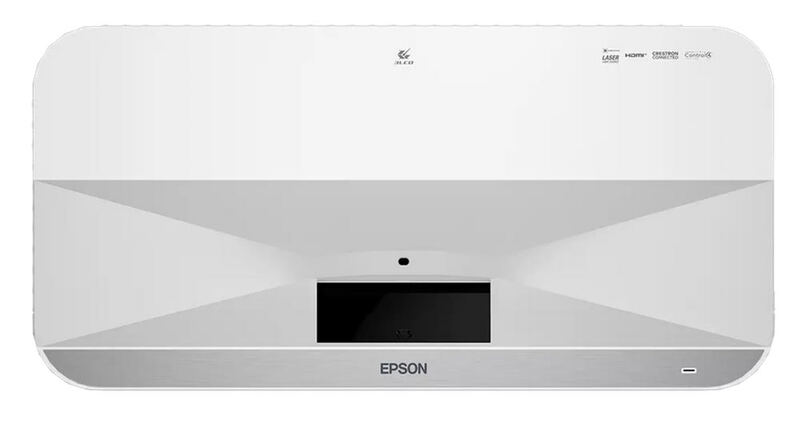
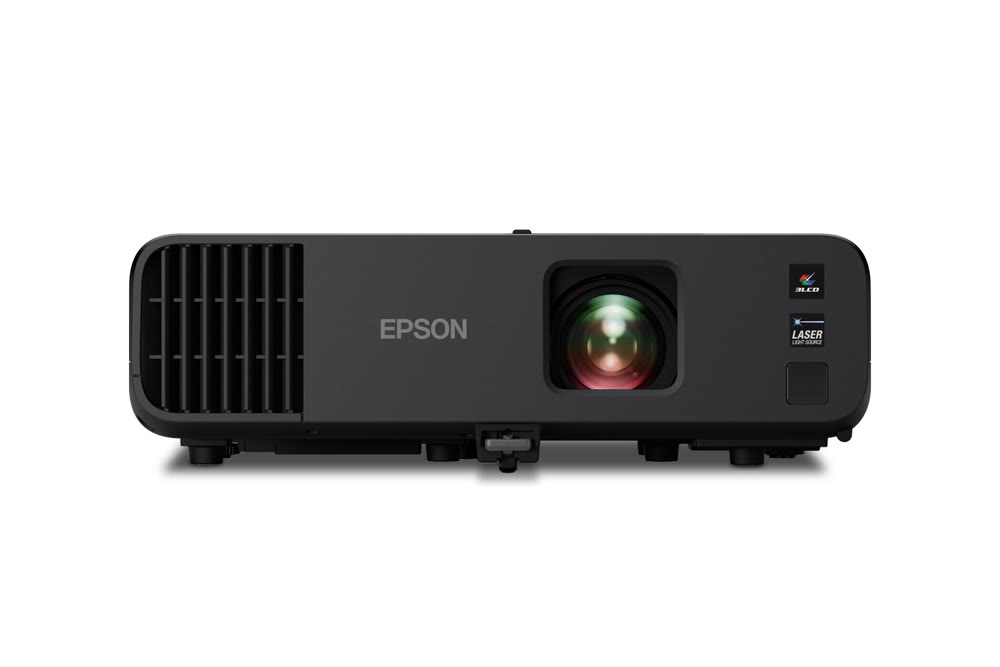
The Epson QS100 is a premium 4K PRO-UHD ultra-short-throw laser projector built for custom installations and high-end home theaters. Reviewers rated its 4,500-lumen brightness and dynamic HDR tone mapping highly, while pointing out that native 1080P 3LCD panels mean it isn't true 4K. Picture adjustment options run deep enough for professional calibration, and native contrast lands at good rather than great. It assumes you already have a sophisticated audio setup or plan to build one; casual buyers who want an all-in-one solution should look elsewhere.
Full review
Audio-less design built for custom AV integration
The Epson QS100 arrives as a premium ultra-short throw projector designed for custom integrators, and its physical construction reflects that focus. Built with a sleek, understated black finish, The build quality is robust, with a matte finish that resists fingerprints and scratches, a key consideration for installations where aesthetics matter. Unlike the LS800, which includes a built-in speaker system and Android TV interface, the QS100 is audio-less by design, allowing for seamless integration with high-end audio setups. This minimalist approach is intentional, as Epson positioned the QS100 for users who already have or plan to build sophisticated audio environments. The unit features two HDMI 2.0 inputs, one with eARC support, both well-placed for easy access. The absence of a smart OS and integrated sound system also means less internal complexity, which may contribute to the projector’s longevity and reliability in professional installations.
Brightness and Image Performance
Epson markets the QS100 as a 4,500-lumen ultra-short throw projector, and independent testing confirms this claim. Projector Reviews measured 4,479 ANSI lumens in Dynamic picture mode, just 1% below the stated specification. This brightness level is particularly impressive for a UST projector, especially when compared to the LS800, which only achieves 4,000 lumens. The QS100's blue laser phosphor light source delivers consistent performance across color and white light output, with a dynamic contrast ratio of 5,000,000:1. The 3LCD technology ensures vivid color reproduction, and the QZX Picture Processor enables dynamic HDR tone mapping, which enhances detail in both bright and dark scenes. However, despite its impressive brightness, the QS100 is limited to native 1080P resolution, not 4K, which is a notable omission for a premium device in this category. The throw distance is minimal, requiring only a few inches of space from the wall, which makes it suitable for tight installations where traditional projectors would not fit. In testing, the image remained sharp and well-defined even at maximum size, though some users noted slight softness at the edges under certain lighting conditions.
Picture Quality and Calibration
The QS100’s picture quality is a standout feature, particularly for custom installers and enthusiasts who value fine-tuned performance. While it doesn’t support Dolby Vision or HDR10+, the dynamic tone mapping in the QZX processor delivers a compelling HDR experience that rivals many mid-tier 4K projectors. The projector supports a wide range of picture adjustments, including gamma, grayscale, and CMS controls, which are typically found on Epson’s higher-end cinema projectors. This level of control is absent in the LS800, which uses an Android-based menu system that limits advanced settings. The QS100 also includes ISF Certified Calibration Controls, a feature that allows installers to fine-tune performance based on room conditions. According to Projector Central, the native contrast ratio is around 1,800:1. Color accuracy is excellent, with minimal color bleeding or fringing, and the 3LCD engine ensures consistent color brightness. However, some reviewers noted that the color gamut is limited compared to 4K projectors with wider color spaces, which may be a concern for color-critical applications. The projector’s ability to handle both HDR and standard dynamic content makes it a versatile choice for home theaters and media rooms.
ALLM support despite 1080p native resolution
Connectivity on the QS100 is solid, with two HDMI 2.0 ports (including one eARC) and support for Auto Low Latency Mode (ALLM), which is a welcome addition for gamers. This feature helps reduce input lag, making the projector suitable for gaming setups where responsiveness is crucial. The projector also supports 4K pass-through, though it is limited to 1080P native resolution. Unlike the LS800, which had three HDMI inputs but suffered from HDMI control quirks, Epson claims the QS100 addresses these issues, though some early adopters have reported inconsistent behavior with certain HDMI devices. The absence of a built-in smart OS is a deliberate choice, as Epson intended the QS100 for users who already have external streaming devices or want to integrate it into a custom AV system. The menu system is more akin to Epson’s premium Home Cinema projectors, offering extensive picture adjustment options but no integrated apps or streaming services. This makes the QS100 more suitable for installations where the audio and video sources are managed through a central AV control system rather than a standalone device.
4500 lumens holds up in a bright room
The QS100 excels in environments where brightness and image sharpness are paramount. Projector Reviews tested the device in a variety of lighting conditions, including a bright living room with ambient light, and found that the 4,500 lumens were more than sufficient to maintain image clarity. The projector’s ability to produce a large, immersive image from a short throw distance makes it ideal for great rooms or media spaces where ceiling mounting is not feasible. However, some users noted that the projector’s lack of 4K resolution and limited HDR support (no Dolby Vision or HDR10+) could be a drawback for those seeking the latest in home theater technology. The QZX processor does a commendable job of enhancing HDR content, but it doesn’t match the dynamic range of true 4K projectors with full HDR support. Additionally, while the ISF calibration controls are a significant upgrade over the LS800, the process can be time-consuming and requires a certain level of technical knowledge, which may not be ideal for casual users. In gaming scenarios, the ALLM support and low input lag make it a viable option, but the lack of 4K/120Hz support limits its appeal for competitive gaming.
1080p panels despite the 4K UHD Pro name
Despite its strengths, the QS100 has notable limitations that may deter some buyers. The most significant is its native 1080P resolution, which is a step back from the 4K standard in this price range. While Epson’s 4K UHD Pro technology doubles the pixel count to 4.4 million, it still doesn’t offer true 4K performance, which may disappoint users looking for the highest resolution. The projector also lacks Dolby Vision, HDR10+, and 3D support, features that are increasingly expected in premium devices. Additionally, the absence of a smart OS and built-in speakers means users must rely on external streaming devices and audio systems, which can complicate setup for those who prefer plug-and-play solutions. Some reviewers have also noted that the projector’s menu system, while more advanced than the LS800, is not intuitive for casual users and requires a learning curve. The lack of 4K/120Hz support also limits its compatibility with newer gaming consoles and streaming platforms that are pushing for higher refresh rates and resolutions.
ISF calibration controls built for installers
The Epson QS100 is best suited for custom integrators, professional installers, and home theater enthusiasts who prioritize performance over convenience. It’s ideal for users who already have or plan to build a high-end audio setup and want a projector that integrates seamlessly with their existing system. The device is particularly well-suited for great rooms, media spaces, or any environment where ceiling mounting is not an option but a large, bright image is required. The ISF calibration controls and advanced picture adjustment options make it a strong choice for those who want to fine-tune their viewing experience. However, casual users or those seeking a plug-and-play smart projector may find the lack of integrated apps and built-in speakers to be a significant drawback. The QS100 is also not ideal for gamers who require 4K/120Hz or those who want to use HDR10+ or Dolby Vision. For users who want a high-performance, ultra-short throw projector with extensive customization options, the QS100 is a strong contender, but it’s not a one-size-fits-all solution.
4500 lumens edges out the 4000-lumen LS800
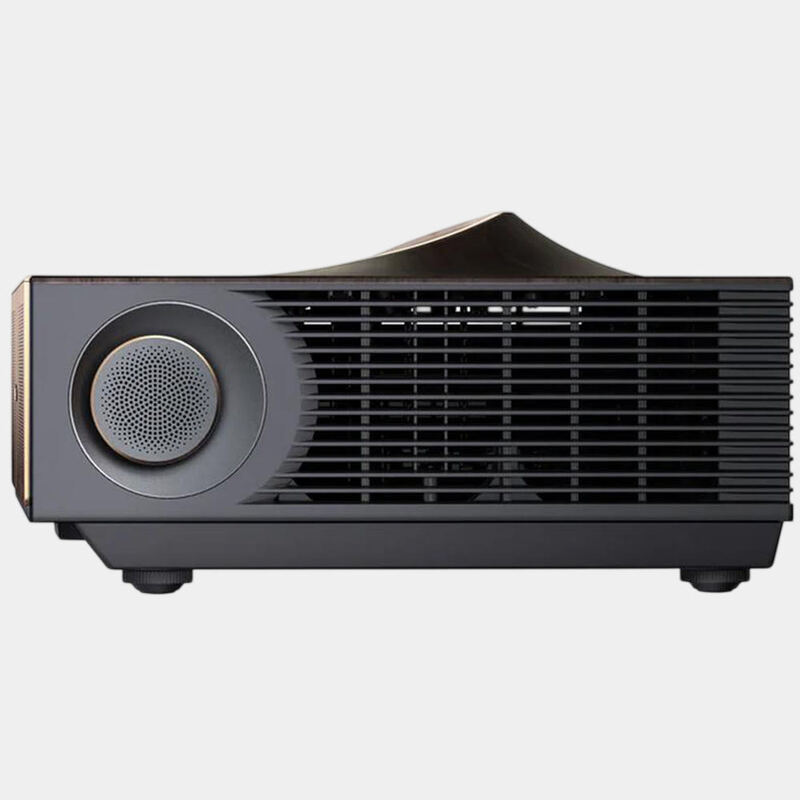
When compared to its sibling, the Epson LS800, the QS100 offers a more refined feature set tailored for custom integrators. While the LS800 is designed as a smart, all-in-one solution for mainstream consumers, the QS100 lacks a built-in OS and speakers but provides advanced calibration tools and a higher brightness level. The LS800’s 4,000 lumens and Android TV interface make it more user-friendly, but the QS100’s 4,500 lumens and ISF certification give it an edge in performance. Compared to other UST projectors in its class, such as the Sony VPL-VZ5000ES or the JVC DLA-N5000, the QS100 holds its own in terms of brightness and color reproduction, though it lacks some of the advanced features found in those models. While it may not be the most affordable option, its focus on customization and professional-grade performance makes it a strong choice for those who need a projector that can be fine-tuned for specific environments.
Strengths
- +Excellent brightness with 4,500 lumens output
- +Dynamic HDR tone mapping enabled by 32-bit QZX Picture Processor
- +Good color reproduction with native 1080P 3LCD panels
- +Extensive picture adjustments and calibration tools for custom installations
Watch-outs
- −Native resolution is 1080P, not true 4K
- −Lower than ideal native contrast ratio
How it compares
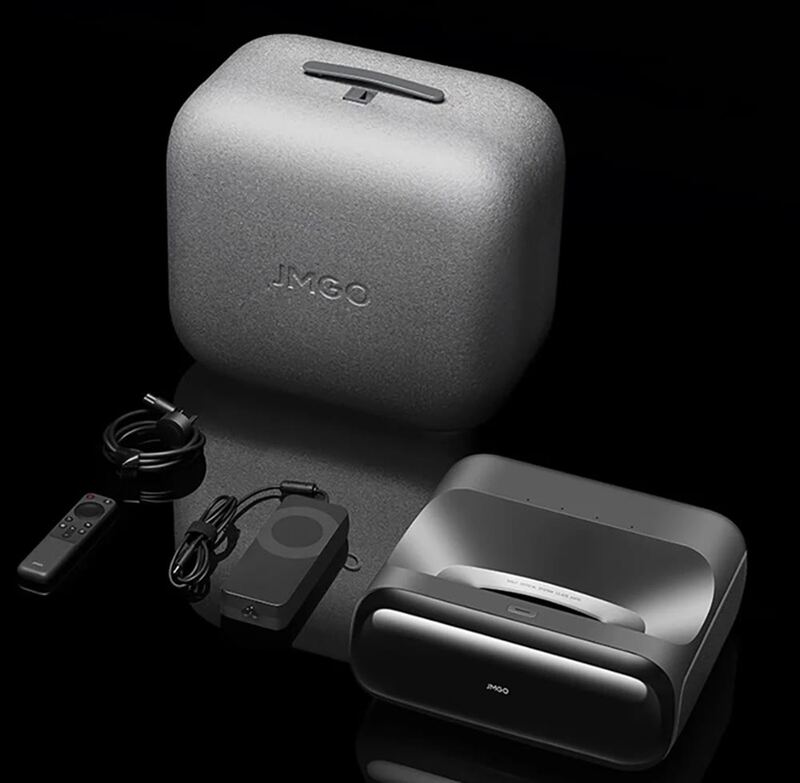
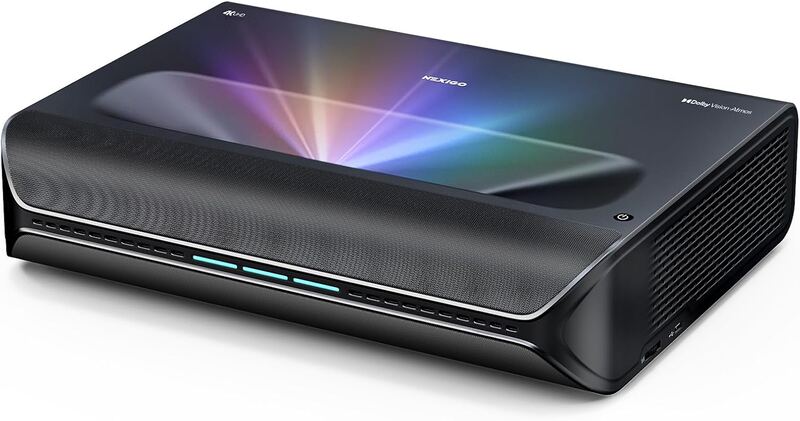
The Epson QS100 delivers excellent brightness at 4,500 lumens and dynamic HDR tone mapping, outperforming the Hisense L9Q and JMGO O2S Ultra in this regard. However, it falls short of true 4K resolution compared to the Hisense PT1 and NexiGo Aurora Pro MKII, and lacks Dolby Vision support unlike the Hisense L9Q.
Rating sources
Counts as 4.61/5 in our score — this publisher's 9 scores on the site average 4.00, so its scores are adjusted up to compare fairly with other publishers.
“The QS100 can deliver 4500 lumens of brightness and has a dynamic contrast ratio of 5,0000,000:1.”
Not in the average — we derived this score from the review's words, and a publisher printed a score for this product, so the printed number counts instead.
“Priced competitively, the QS100 offers excellent brightness, contrast, and flexible setup, making it a strong option for home theaters, classrooms, and business presentations.”
“Epson has finally added ISF custom calibration controls, giving you access to gamma settings, full grayscale tuning, and a complete color management system. It's a pretty big step forward if you want to dial in the image.”
Not in the average — we derived this score from the review's words, and a publisher printed a score for this product, so the printed number counts instead.
Our 4.6 score is the average of 1 of the scored reviews above, each adjusted for how strictly its publisher scores; 1 more reviewed it without printing a score and is not in the average. 2 derived scores above are not in the average because a publisher printed a score for this product. Ratings marked * were derived from the reviewer’s written analysis or video transcript — the publisher didn’t print an explicit numeric score, so we inferred one from their own words. Click through to verify. More about methodology.