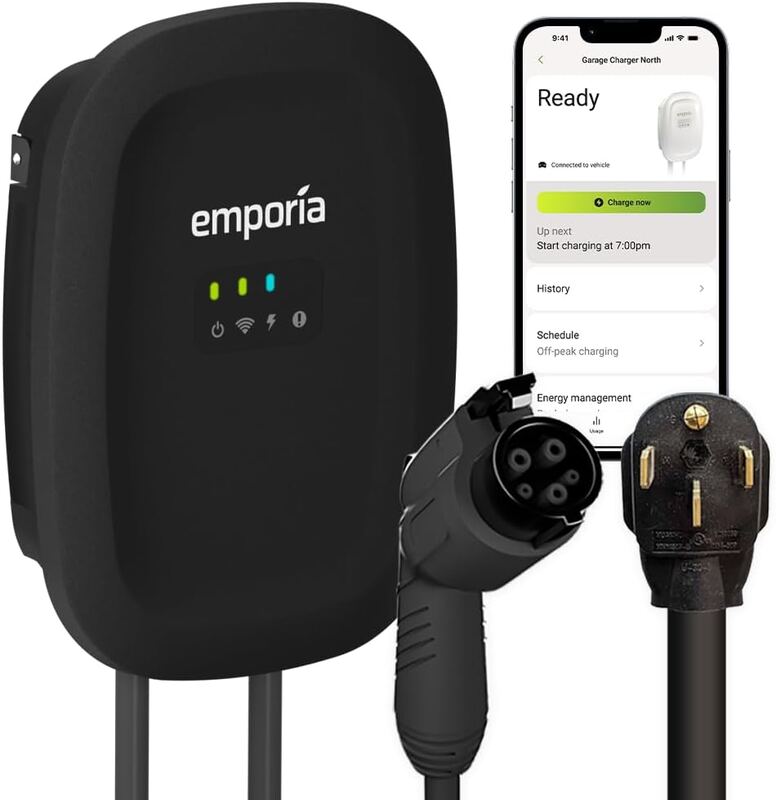
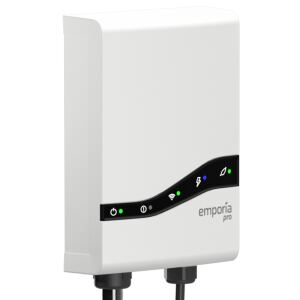
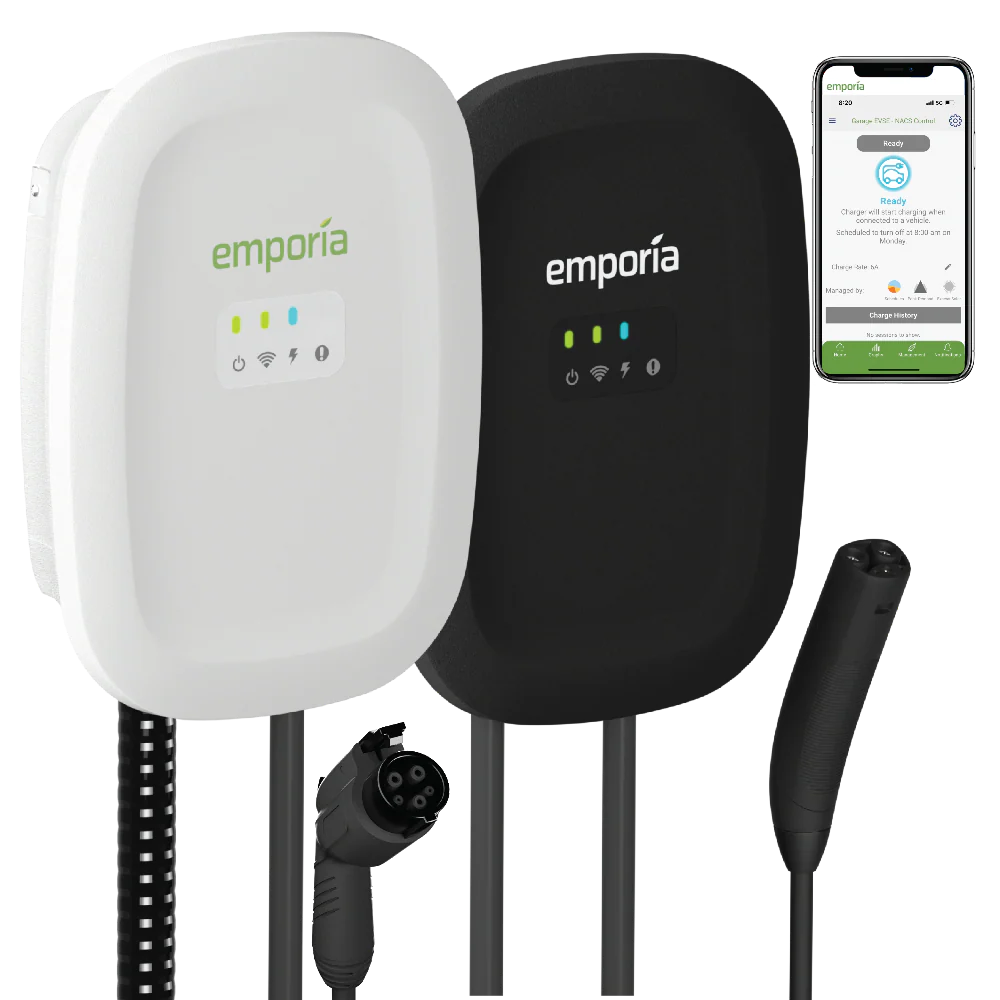
The Emporia Level 2 is a second-generation EV charging station that builds on its predecessor's value proposition with enhanced features like intelligent load balancing. Tom Moloughney of EVChargingStations.com praised its PowerSmart technology and smart app functionality, though he noted the lack of a physical power limit switch as a drawback. The unit comes with a 3-year warranty and includes an energy monitor, with installation requiring professional help. While it currently lacks a NACS connector, Emporia plans to release one in Q4 2025. This charger is ideal for homeowners seeking smart, reliable Level 2 charging with energy monitoring but may not suit those needing immediate NACS compatibility.
Full review
Smart Load Management
The Emporia Pro's PowerSmart feature represents a significant advancement in home EV charging technology, allowing users to install high-powered chargers without requiring expensive electrical service upgrades. According to Tom Moloughney's ChargerRater testing, the system effectively monitors home electrical load and dynamically adjusts charging power to prevent overloading circuits. This capability was particularly valuable during his 30-hour deep freeze test, where the unit maintained functionality even when exposed to -12°F temperatures. The system's ability to reduce draw when HVAC systems or other high-power appliances activate prevents breaker trips that commonly occur with traditional chargers. EnergySage's review noted that this intelligent load management eliminates the need for costly electrical panel upgrades, making it attractive to homeowners who previously couldn't install 48-amp chargers due to capacity constraints.
Installation and Build Quality
Emporia's installation process follows standard industry practices with a wall-mounted bracket system that's similar to competitors like Lectron's V-Box. The unit arrives well-packaged with all components securely fastened, though some reviewers noted the cardboard insert was overly protective, making it difficult to remove items from the box. The charger's NEMA 4 rating allows for both indoor and outdoor installation, with the black model being particularly susceptible to fingerprint smudges. The 25-foot J1772 charging cable is notably thick and less flexible than many competitors, but this design choice provides better cold-weather performance. The separate connector holster is a marked improvement over the previous model's built-in design, though some users still prefer more angled mounting options to reduce protrusion from the wall.
App and Smart Features
The Emporia app provides comprehensive control over charging sessions, including scheduling, cost tracking, and solar integration capabilities. Tom Moloughney's testing revealed that the app's interface, while functional, has an outdated design that could benefit from modernization. However, the charging history calendar provides detailed breakdowns of energy usage, charging sessions, and cost estimates, which users find particularly valuable. The system's ability to integrate with the included Emporia Vue 3 Home Energy Monitor enables real-time energy tracking and automatic adjustment of charging power based on home consumption patterns. Users can set utility rate plans for more accurate cost calculations, and the app supports Alexa integration for voice control. The charging current can be adjusted from 12 to 48 amps through the app, though the lack of physical dip switches has been a point of criticism among users who prefer manual control options.
Performance and Reliability
Over two years of testing, including the 30-hour deep freeze test conducted by Tom Moloughney, demonstrated the Emporia Pro's consistent performance in various conditions. The unit passed cold-weather testing with frost forming on the cable but maintaining functionality, with the connector withstanding five drops from waist height onto concrete without damage. The charging cable's thick construction proved durable in extreme cold, unlike many competitors whose cables become brittle and difficult to manage. The PowerSmart technology effectively prevented overloads during high-consumption periods, with users reporting no breaker trips or power issues during normal operation. The included Emporia Vue 3 Home Energy Monitor successfully tracked home energy usage and adjusted charging power accordingly, maintaining stable performance even when multiple appliances were operating simultaneously.
What Reviewers Loved
Multiple reviewers praised the Emporia Pro's intelligent load management and solar integration capabilities, with Tom Moloughney awarding it an 87/100 on ChargerRater and calling it one of the best chargers of 2025. The bundled Emporia Vue 3 Home Energy Monitor was particularly appreciated, as it provides real-time energy tracking and automatic adjustment of charging power. Users highlighted the charger's reliability, with one reviewer noting two years of trouble-free operation. The app's charging history and cost tracking features were consistently praised for their detail and usefulness. The NEMA 4 rating and weatherproof construction were valued by outdoor installation users, while the separate connector holster received positive feedback as an improvement over previous models. The ability to schedule charging sessions and integrate with off-peak electricity rates was seen as a significant value-add for cost-conscious users.
Where It Falls Short
Several reviewers identified significant drawbacks, with the lack of physical dip switches for manual current limiting being a major complaint. Tom Moloughney specifically criticized the absence of internal dip switches, preferring systems that can't be incorrectly configured through software. The connector holster, while improved from the previous model, was still considered below average by some users who preferred more angled mounting options. The app's outdated interface was noted as a design weakness, though functional. The NACS connector option is not yet available, requiring adapters for newer EVs, with Emporia promising a Q4 2025 release. Additionally, the $599 price point puts it in the premium category despite its Indian manufacturing, creating a disconnect between cost and value perception for budget-conscious buyers.
Who It's Best For
The Emporia Pro is ideal for homeowners who need intelligent load management and solar integration capabilities, particularly those with electrical panels that can't support a full 48-amp charger without costly upgrades. It's best suited for users who value smart features, detailed cost tracking, and the ability to optimize charging based on solar production. The system appeals to those who want to avoid breaker trips during high-consumption periods and need a reliable, weatherproof installation option. However, it's not recommended for users who prefer physical controls or are on tight budgets, as the $599 price point exceeds many competitors. The system is also less ideal for those who require immediate NACS connector compatibility, as this feature is not yet available. Users who prioritize app-based control over manual switches will find the system more appealing than those who prefer traditional hardware controls.
How It Compares to Alternatives
The Emporia Pro competes directly with premium chargers like the Wallbox Pulsar Plus and Enphase HCS-50, though it offers unique advantages in load management and solar integration. While the Wallbox Pulsar Plus offers superior compactness and a more premium connector design, the Emporia Pro's PowerSmart technology provides functionality that competitors lack. Compared to Enphase's HCS-50, which costs approximately $700, the Emporia Pro offers similar features at a $100 price advantage while including the Vue 3 Home Energy Monitor at no additional cost. The Emporia Pro's bundled energy monitoring system sets it apart from most competitors, though its lack of physical dip switches and outdated app interface differentiate it from more premium offerings. The price difference between the Emporia Pro and competitors like the Lectron V-Box is minimal, but the Emporia system's smart features provide additional value that justifies the premium cost for users requiring load management capabilities.
Strengths
- +Intelligent load management (PowerSmart feature) allows installation even with limited electrical service
- +Smart charging capabilities via Emporia app with remote access, scheduling, and solar integration options
- +Includes Emporia Vue 3 Home Energy Monitor with two 200a CT sensors for energy tracking
- +Durable NEMA-4 enclosure protects against weather conditions for indoor/outdoor use
Watch-outs
- −No physical power limit switch; all adjustments must be made through the app
- −Currently only comes with J1772 connector; NACS connector option pending release in Q4 2025
How it compares
The Emporia Level 2 model offers more advanced smart features than the Classic version, including app integration and energy monitoring with the Emporia Vue monitor. While the Classic focuses on basic reliability, the Level 2 model provides PowerSmart load balancing and automated charging schedules, making it better suited for energy-conscious users but similar to the Pro model in terms of smart capabilities.
Who this is for
At a glance: smart home users wanting energy monitoring.
Why you’d buy the Emporia Level 2
- Intelligent load management (PowerSmart feature) allows installation even with limited electrical service.
- Smart charging capabilities via Emporia app with remote access, scheduling, and solar integration options.
- Includes Emporia Vue 3 Home Energy Monitor with two 200a CT sensors for energy tracking.
Why you’d skip it
- No physical power limit switch; all adjustments must be made through the app.
- Currently only comes with J1772 connector; NACS connector option pending release in Q4 2025.
Rating sources
“After going hands-on with the Emporia charger, Im starting to believe its more of the latter than the former. For its price, I expected some major annoyances with the Emporia EV charger. To my surprise, I found very minor ones.”
Our 4.6 score is the average of these published ratings. Ratings marked * were derived from the reviewer’s written analysis or video transcript — the publisher didn’t print an explicit numeric score, so we inferred one from their own words. Click through to verify. More about methodology.