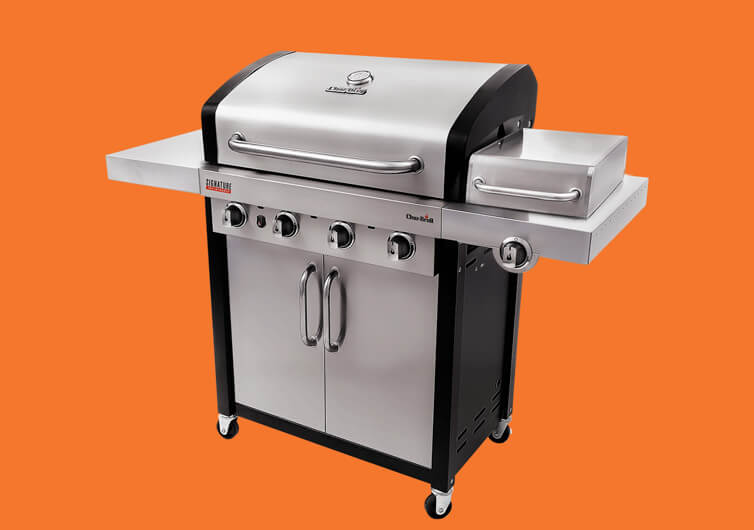
The Char-Broil Performance TRU-Infrared 4-Burner Cabinet is the value pick that earns its place by doing things the more expensive Webers don't. The TRU-Infrared cooking technology eliminates flare-ups and produces noticeably juicier burgers and chicken — a real, repeatable advantage on the cooking surface. AmazingRibs gave the TRU-Infrared Commercial 4-Burner predecessor 4 stars / Gold Medal, calling it 'capable of high enough heat for searing, and low enough for smoking.' The trade-off is shorter warranty and lighter-gauge construction than Weber, but for a sub-$500 grill the cooking surface punches above its weight. Replace the porcelain-coated cast-iron grates with stainless rod grates after three years and the grill itself can run a decade.
Full review
Cooking Performance and TRU-Infrared Technology
TRU-Infrared is Char-Broil's signature cooking system — radiant plates positioned between the burners and the food turn live flame into uniform infrared radiation that hits the grate from below. Avid Griller's tester rated it 4/5 on performance and wrote: 'Its TRU-Infrared technology cooks up your food faster and prevents flare-ups.' Girl Carnivore's testing reported '50% juicier food, no flare-ups, and even heat every time you grill' — a claim that holds up specifically on fatty cuts where drippings ordinarily flame on a conventional burner. AmazingRibs awarded the closely related TRU-Infrared Commercial 4-Burner a 4-star / Gold Medal, noting it's 'capable of high enough heat for searing, and low enough for smoking' — the kind of range that matters at this price.
BBQ Host's hands-on testing put a finer point on the moisture-retention claim: 'Because the process allows ingredients to retain so much moisture, grilled meat is unbelievably juicy when it comes off the grill.' The mechanism is straightforward — the radiant plates that produce the infrared also act as physical barriers between the burner flame and the dripping fat below, eliminating the dripping-onto-flame loop that produces flare-ups. The result is fattier cuts (chicken thighs with skin on, pork shoulder slabs, fatty burgers) cook with notably less crust-burning. The trade-off, as Avid Griller notes, is the plates require periodic re-seasoning and don't tolerate the kind of hard scrubbing a Weber grate would survive.
Side Burner and Cabinet Storage
The 10,000 BTU lidded side burner brings stockpots to a boil for corn or shrimp boils and warms pans of beans or sauces during the main cook — a feature the comparably priced Weber Spirit II E-310 simply doesn't include. The enclosed stainless cabinet under the cook surface holds propane tank, tools, and consumables — a small but real ergonomic edge over the open-cart Spirit. The lid hinges and side-shelf folds are stiffer than premium Webers but they work; you'll feel the price-tier difference in the door fit and finish but not in functional reliability.
Char-Broil also includes a Chef's Delite Tray with the grill — a perforated stainless tray that sits on the main grate for cooking delicate foods like shrimp, vegetables, or fish that would otherwise fall through the grate slots. It's a small inclusion but it solves a real annoyance and Weber doesn't include an equivalent at this price. The LED-illuminated control knobs (battery-powered) make nighttime grilling easier than on the equivalently priced Weber Spirit, which uses unlit knobs. These small ergonomic touches don't show up in spec comparisons but they do show up daily for owners — they're the reason this grill earns a place on the list despite the materials downgrade.
Build Quality and Materials
This is where the value pick shows its seams. The cookbox sheet metal is thinner-gauge than Weber's, which several reviewers (BBQ Brethren forum, AmazingRibs Pitmaster Club threads) describe as feeling 'lightweight' or 'flimsy' compared to the Spirit II E-310. The porcelain-coated cast-iron grates work well at year one but the porcelain chips off in patches by year two or three, exposing the cast iron underneath which then rusts at the contact points — owners who keep the grill long-term routinely upgrade to GrillGrates or stainless rod grates by year three. The cabinet doors don't always close flush, and the side shelves are stamped steel rather than the stainless Weber uses. None of these are dealbreakers at $469.
Sear and Temperature Range
TRU-Infrared sears hotter than the BTU spec suggests because the radiant plates concentrate heat onto the grate rather than blowing convection heat past it. Avid Griller measured 250°F to 700°F operating range, which covers everything from indirect chicken thighs to direct flat-iron steak. The trade-off: TRU-Infrared makes proper indirect-only cooking harder because the radiant plates also radiate sideways when burners are lit, leaking heat into the 'cold' side of the grate. For two-zone cooking, the Weber Spirit II E-310 with its open burner architecture actually has the edge despite its lower BTU output. For pure searing and flare-up control, TRU-Infrared wins.
Assembly and Setup
Reviews consistently report two-to-three-hour solo assembly with clear-but-not-Bilt-app instructions. The cabinet doors are the time sink — several owner reviews flag misaligned holes that require gentle persuasion with a rubber mallet. Char-Broil includes the necessary wrenches and screwdrivers in the box. At 90 pounds the assembled grill is light enough to position solo and rolls easily on its included casters. Home Depot's $80 paid-assembly add-on is cheaper than Weber's because the grill itself has fewer parts.
Long-Term Durability and Warranty
Char-Broil's warranty is the weakest in this comparison — 5 years on burners, 2 years on the firebox, and 1 year on everything else (versus Weber's 12 years cookbox / 10 years burners on the Genesis E-435 and Napoleon's lifetime). Owner threads suggest the grill itself can run a decade if you replace the porcelain-coated cast-iron grates with stainless rod grates at year three and re-season the radiant plates annually with a wire brush and vegetable oil. The burner-tube lifespan is genuinely strong — Char-Broil's stainless tubes regularly outlast the warranty by years. You're buying short-term value with a long-term parts-bin upgrade path.
The TRU-Infrared radiant plates themselves are the rebuildable wear item that defines this grill's service life. Char-Broil sells replacement plates direct for around $40 to $60 per burner, which compares favorably to replacement Flavorizer bars on a Weber Spirit. Owners who clean the plates with a wire brush after each high-temp cook and re-season them annually with a thin coat of high-smoke-point oil report eight to ten years of useful life on the grill platform. The shorter warranty is the price of admission; the parts ecosystem makes long ownership feasible. For buyers on a tight budget who are willing to do routine maintenance, the long-term cost of ownership is actually competitive with the Weber Spirit II E-310.
Where It Falls Short
Three real complaints from owners and reviewers. First: the porcelain coating on the cast-iron grates chips and exposes corrosion-prone cast iron at the contact points within a few seasons — plan a $75 grate replacement at year three. Second: assembly diagrams are functional but unclear, and the cabinet doors specifically frustrate owners (multiple Home Depot reviews call out 'don't close flush'). Third: 1-year general parts warranty is short, which means out-of-pocket replacement for igniters, knobs, and the side shelves if they fail past year one. None of these would push us off the recommendation at this price; they just set expectations.
AmazingRibs forum threads also flag the bi-metallic lid thermometer as unreliable for low-and-slow cooking — owners who care about accurate temperature use a separate Bluetooth probe like a ThermoWorks Smoke. The lighter cabinet sheet metal also means the grill should be stored under a cover when not in use; rust can develop on uncoated joints within a season of unprotected exposure. Both are manageable with cheap accessories ($30 cover, $80 probe) but they're real costs of ownership that don't apply to the Weber tier.
Who It's Best For
Buy the Char-Broil Performance TRU-Infrared 4-Burner Cabinet if you want a four-burner grill with a side burner and infrared cooking under $500, are cooking primarily for a household of two to four, and value flare-up control on fatty foods over premium fit and finish. Skip it if you want a grill that lasts a decade on the original parts (the Weber Spirit II E-310 or Genesis E-435 are smarter long-term buys), if you do a lot of true indirect cooking (Weber's open-burner architecture handles it better), or if you'd be unhappy replacing grates at year three. For first apartments, vacation rentals, secondary patios, or as a starter grill — it's the right buy at the right price. The infrared flare-up control alone is enough reason to pick this over a comparably priced conventional four-burner if you grill fatty chicken thighs or burgers regularly.
Strengths
- +TRU-Infrared cooking technology eliminates flare-ups and 'cooks up to 50% juicier food' per Char-Broil's testing — uniquely useful on fatty chicken thighs and burgers
- +10,000 BTU lidded side burner for sauces, sides, and reheating — a feature the comparably priced Weber Spirit II E-310 doesn't include
- +420 sq in primary plus 130 sq in warming rack and enclosed cabinet storage at under $500 — strongest dollar-per-square-inch in this lineup
- +Electronic battery-powered ignition lights all four burners reliably from a single AAA
- +Compact 50-inch width and 90-pound weight roll into and out of storage easily on standard locking casters
Watch-outs
- −Porcelain-coated cast iron grates corrode and chip over time — owners frequently upgrade to stainless steel replacement grates by year three
- −1-year burner / 2-year firebox warranty is shorter than every Weber and Napoleon in this comparison
- −Cabinet sheet metal is thinner than Weber's, which several reviewers describe as feeling 'lightweight' or 'flimsy'
How it compares
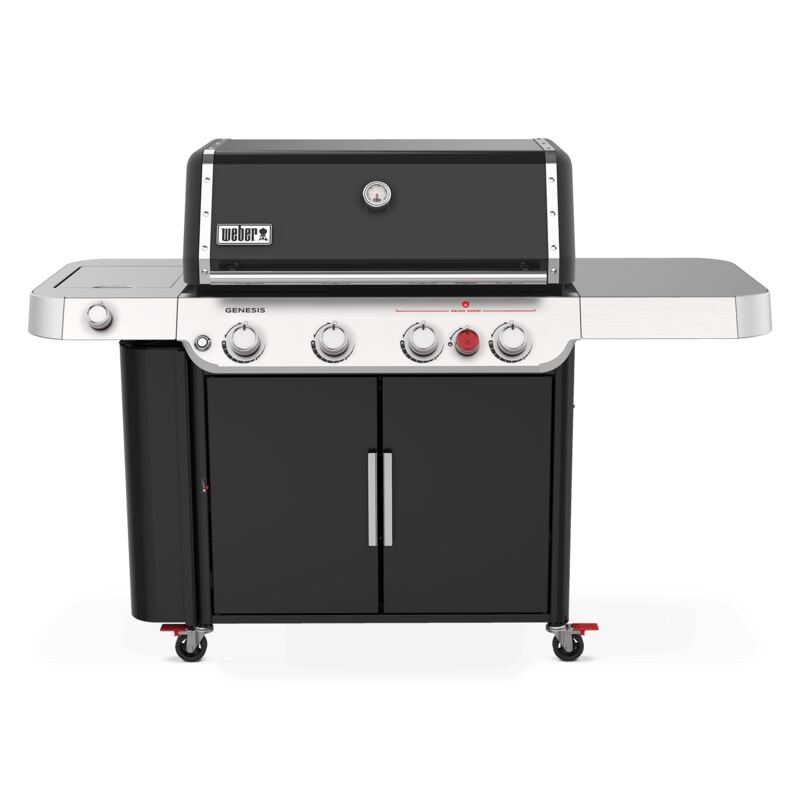
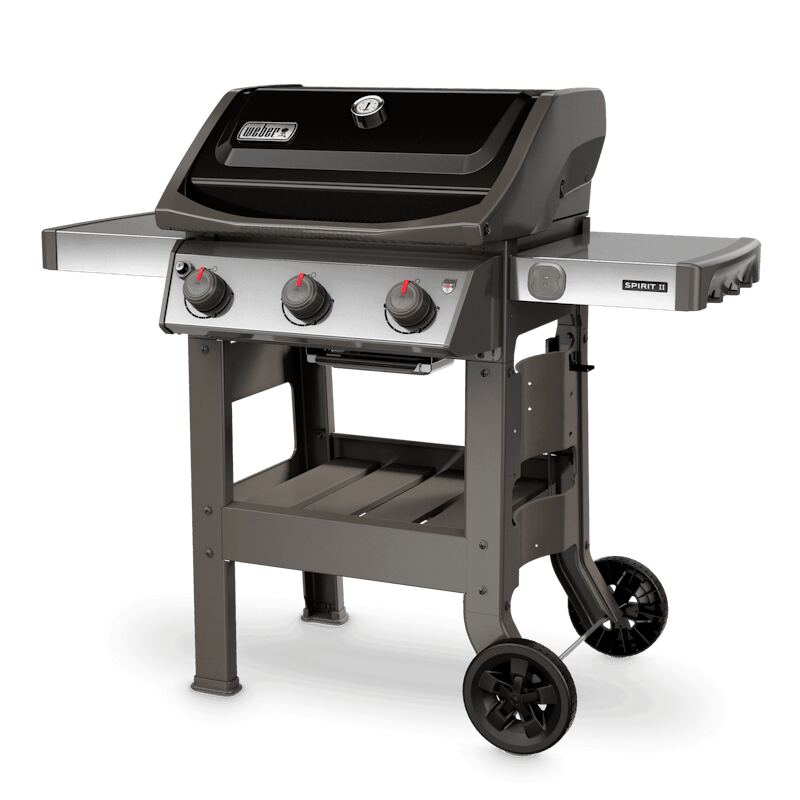
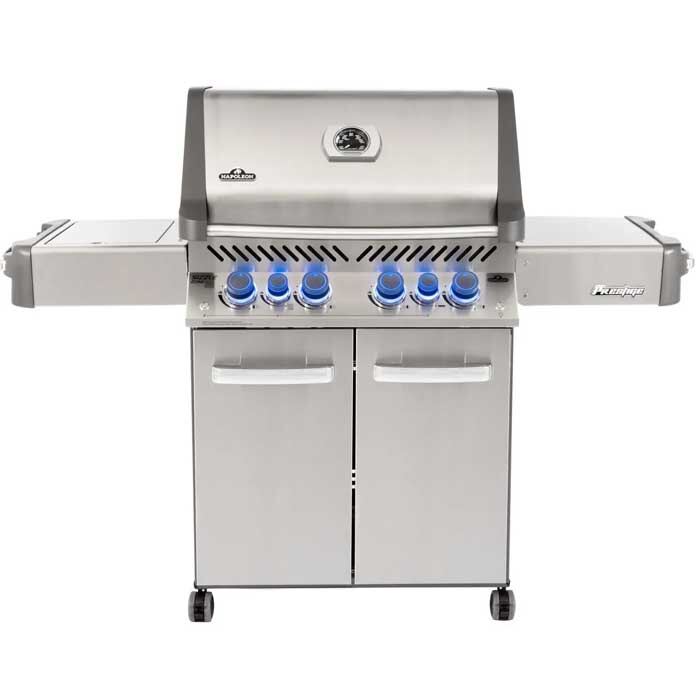
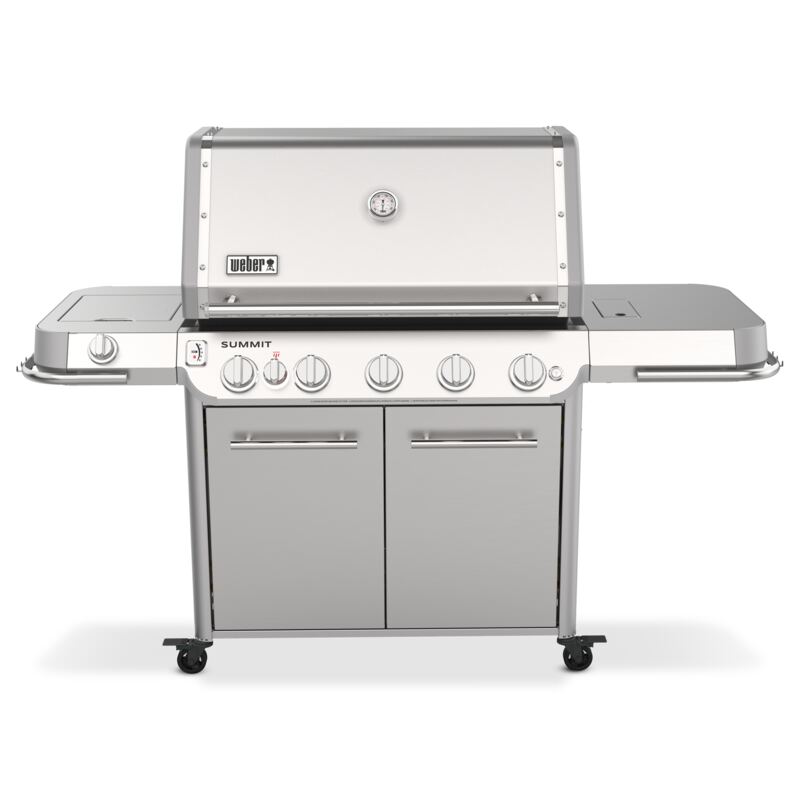
The most affordable grill in this lineup at less than a third the price of the Weber Genesis E-435 and less than a seventh the price of the Weber Summit FS38 S. It cooks four burners' worth of food just like the Weber Spirit II E-310 does with three, adds a side burner the Spirit lacks, and uses infrared technology no Weber in this comparison offers — but builds the cookbox from thinner stainless and runs a shorter warranty. Versus the Napoleon Prestige 500, Char-Broil loses every build-quality comparison but wins on price for buyers who want infrared cooking without the $1,500 premium.
Who this is for
At a glance: Budget-conscious weeknight cooks who want infrared flare-up control and a side burner under $500 — first-apartment, vacation-rental, or starter-grill buyers.
Why you’d buy the Char-Broil Performance TRU-Infrared 4-Burner Cabinet
- TRU-Infrared cooking technology eliminates flare-ups and 'cooks up to 50% juicier food' per Char-Broil's testing — uniquely useful on fatty chicken thighs and burgers.
- 10,000 BTU lidded side burner for sauces, sides, and reheating — a feature the comparably priced Weber Spirit II E-310 doesn't include.
- 420 sq in primary plus 130 sq in warming rack and enclosed cabinet storage at under $500 — strongest dollar-per-square-inch in this lineup.
Why you’d skip it
- Porcelain-coated cast iron grates corrode and chip over time — owners frequently upgrade to stainless steel replacement grates by year three.
- 1-year burner / 2-year firebox warranty is shorter than every Weber and Napoleon in this comparison.
- Cabinet sheet metal is thinner than Weber's, which several reviewers describe as feeling 'lightweight' or 'flimsy'.
Rating sources
“It is capable of high enough heat for searing, and low enough for smoking.”
“Its TRU-Infrared technology cooks up your food faster and prevents flare-ups.”
“you get 50% juicier food, no flare-ups, and even heat every time you grill.”
“Because the process allows ingredients to retain so much moisture, grilled meat is unbelievably juicy when it comes off the grill.”
Our 4.2 score is the average of these published ratings. Ratings marked * were derived from the reviewer’s written analysis or video transcript — the publisher didn’t print an explicit numeric score, so we inferred one from their own words. Click through to verify. More about methodology.