Verdict Research
Can't go wrong, or minefield? We measured the shopping risk in 370 product categories.
By Mike Hunter · July 30, 2026 · Methodology at the bottom
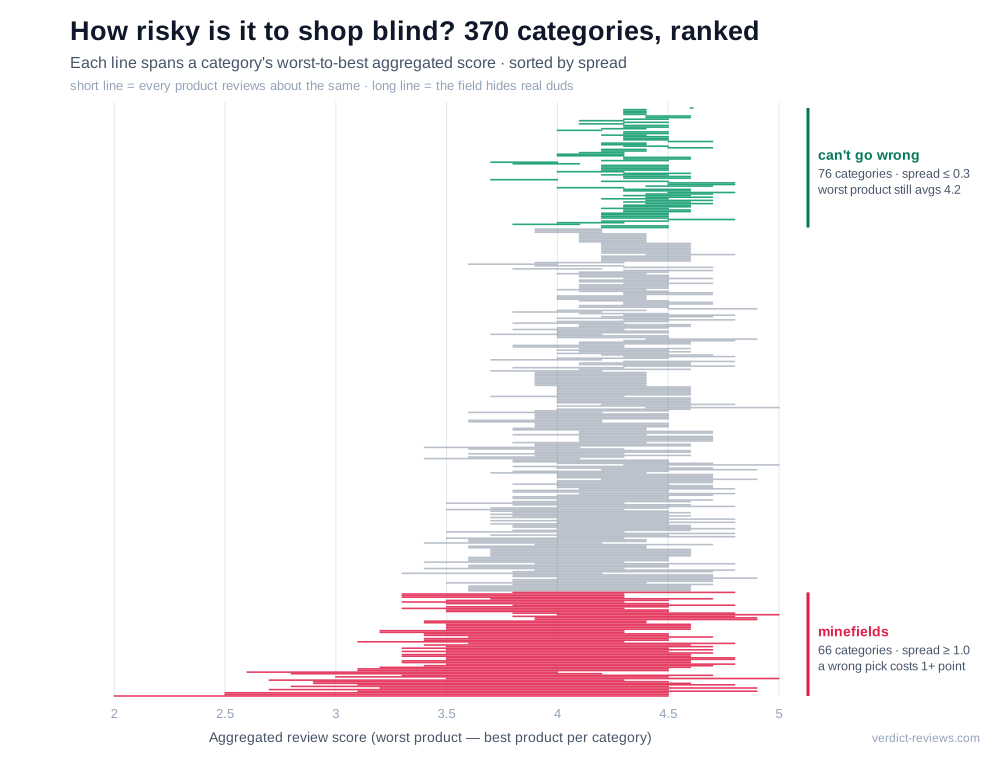
Some purchases barely need research: nearly everything on the shelf is good. Others punish a casual click with a product that reviews a full point worse than the best pick at the same price. We measured which is which. For every category in our database with at least four rated products, we took the gap between the best and worst aggregated expert score — the category's spread. Across 370 categories and 1,874 products, the split is stark: in 76 categories (1 in 5) every product lands within 0.3 points, while in 66 categories (1 in 5) the field spans a full point or more.
Where you genuinely can't go wrong
In the 76 tight categories, the products reviewers shortlist have converged so completely that the ranking is nearly a coin flip. The lowest-scoring product in these categories still averages 4.24 / 5. The extreme case: every sous vide circulator we track scores an identical 4.6 — the “worst” one is a Breville Joule. A few hand-checked examples, with the lowest-ranked product shown — the floor, not the winner:
| Category | Spread | The worst pick is still… |
|---|---|---|
| Sous vide circulators | 0.0 pts | Breville Joule Turbo · 4.6/5 |
| Hybrid mattresses | 0.1 pts | Leesa Sapira Chill Hybrid · 4.3/5 |
| Weighted blankets | 0.2 pts | Luxome Cooling Weighted Blanket · 4.4/5 |
| Ultrawide monitors | 0.2 pts | ASUS ROG Swift PG349Q · 4.3/5 |
| Smart thermostats | 0.2 pts | Ecobee Smart Thermostat Essential · 4.1/5 |
| Air fryers under $200 | 0.2 pts | Ninja AF101 4-Qt · 4.3/5 |
The minefields
The 66 wide categories are a different sport. The average floor score there is 3.31 — and these aren't obscure products; they sit in the same search results and the same sale flyers as the winners. The same shelf holds a 4.9-rated pick and a 3.1-rated one at comparable prices:
| Category | Best pick | The trap |
|---|---|---|
| Portable jump starters | NOCO Boost X GBX55 · 4.9/5 | GOOLOO GP2000 · 3.1/5 |
| Battery chainsaws | Milwaukee M18 Fuel Telescoping · 4.9/5 | Greenworks Commercial 82V · 3.2/5 |
| Bread machines | Zojirushi Home Bakery Virtuoso Plus · 4.8/5 | Briskind 19-in-1 Compact · 3.1/5 |
| Cable modems (DOCSIS 3.1) | Netgear CM1000 · 4.5/5 | Motorola MB8611 · 2.7/5 |
| Gaming laptops under $1,500 | ASUS TUF Gaming A15 · 4.3/5 | Acer Nitro V 16 · 2.7/5 |
| Dog harnesses | Ruffwear Front Range · 5/5 | Rabbitgoo Dog Harness · 3.5/5 |
Why some categories converge and others don't
The tight categories are mostly mature ones: the engineering is solved, the field has consolidated, and anything genuinely bad stopped getting shelf space (and reviewer attention) years ago. Mattresses, air fryers, weighted blankets — the survivors all work. The minefields cluster where two things collide: spec-sheet parity (a $99 jump starter lists the same peak amps as a $150 one; the difference shows up in testing, not the listing) and low barriers to entry that flood the category with lookalike products. That's why battery tools, modems, and budget laptops punish blind buying while bedding basically doesn't.
The doorbuster test
- In a tight category, take the deal. If every product scores within 0.3 points, the discounted one is fine — the research is already priced in.
- In a minefield, never buy unranked. A deep discount on a 3.1-rated jump starter is not a deal; it's a discounted mistake. Check what independent reviewers concluded first.
- You can't tell which is which from the shelf. Both kinds of category look identical in a search-results grid — that's the point of measuring it.
The aggregated rankings behind these numbers are free to browse in the category index.
Methodology & data
Figures come from Verdict's database as of July 2026: 370 categories with four or more products carrying an aggregated expert review score (1,874 products; scores normalized to a 5-point scale and averaged across publications — see our earlier study on per-outlet grading bias for why averaging matters). A category's spread is its best minus worst aggregated score. “Can't go wrong” = spread ≤ 0.3; “minefield” = spread ≥ 1.0; median spread across all 370 is 0.60. “Trap” products score ≥ 1.0 below their category's best. One caveat cuts both ways: our database covers products that earn professional review coverage at all, so true junk is underrepresented — real-world spreads are, if anything, wider. Named examples were individually re-checked; unrecognizable white-label brands were excluded from the tables. Full ranking methodology: Verdict methodology. Questions or want the underlying numbers? Get in touch.