The Wilderness Systems Atak 120 delivers exceptional stand-up stability thanks to its pontoon-style hull and wide beam, creating a secure platform for anglers who prioritize safety over speed. happinesswithout found that the AirPro MAX seat dries almost instantly and offers three positions, while the wind-shedding open deck ensures excellent tracking in breezy conditions without requiring a rudder. However, the 86-pound weight makes solo transport physically demanding, and the front hatch is not watertight with limited usable space for gear storage. Additionally, plastic foot braces feel flimsy compared to metal alternatives on competitor models. This kayak fits anglers who value a stable fishing station and extensive customization via FlexPod OS and SlideTrax, but those needing easy solo transport or dry storage should look elsewhere.
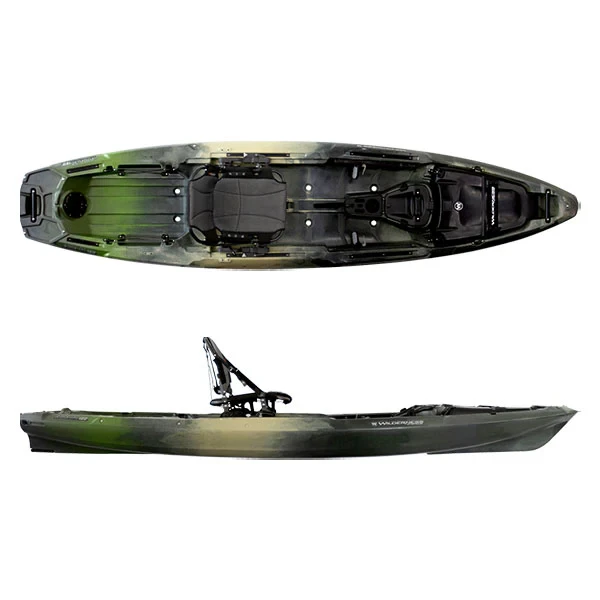
Full review
Pontoon hull delivers exceptional stand-up stability
The defining characteristic of the Wilderness Systems ATAK 120 is its remarkable primary stability, a feature that stems directly from its pontoon-style hull design. Unlike traditional V-shaped kayaks that feel tippy when weight shifts to one side, this platform utilizes wide beams and flat sections along the bottom to create an incredibly solid foundation for standing anglers. A reviewer on billdunnkayakfishing.wordpress noted that despite being a compact 12-foot vessel, it feels equally as stable as its larger 140 counterpart when casting or moving around the cockpit. This stability is not just theoretical; paddler3014728 confirmed this trait in a Paddling.com review, describing the kayak as very stable and easy to paddle even when equipped with an electric motor for Louisiana marsh fishing.
The wide 35-inch beam allows anglers to move freely without feeling at risk of flipping. A YouTube reviewer emphasized that they can stand up and move around the pontoon design without ever feeling unstable, a crucial feature for kayak anglers who need to cast in multiple directions or manage fish near the gunwales. The low-profile deck further lowers the center of gravity, enhancing this sense of security. This stability makes the ATAK 120 an ideal platform for larger paddlers or those who prioritize a secure standing position over raw speed, transforming what could be a restrictive sit-on-top into a highly mobile fishing station.
AirPro MAX seat dries instantly with three-position adjustability
Comfort on the water is heavily influenced by the AirPro MAX seat, which features honeycomb-vented fabric designed to dry almost instantly after getting wet. This quick-drying property prevents the clammy, uncomfortable feeling that often plagues long days on the river or lake. A reviewer from happinesswithout highlighted this specific benefit, noting that while many seats stay wet and itchy, the AirPro MAX dries rapidly, making it highly suitable for extended fishing trips. The seat also offers three distinct positions: high, low, and reclined, allowing paddlers to adjust their posture based on whether they are paddling vigorously or sitting still to fish.
However, adjusting these positions requires removing the entire seat from its mounting tracks rather than sliding it fore and aft while seated. A YouTube reviewer expressed frustration with this mechanism, noting that a quick-release cam lever for on-the-fly adjustment would be preferable, especially when needing to shift weight distribution between paddling efficiency and fishing comfort. Despite the hassle of physically lifting the seat out to change positions, reviewers consistently praised its breathability and wide profile, which accommodates larger body types and provides significant support for those with back pain.
Wind-shedding deck ensures tracking without a rudder
The open deck layout of the ATAK 120 is engineered to shed wind, providing excellent directional stability even in challenging conditions. A reviewer from happinesswithout was particularly impressed by this trait, stating that the kayak keeps its course without needing a rudder, even when facing 15-20 mph winds. This tracking ability means anglers do not have to constantly correct their heading with paddle strokes or pedal drives, conserving energy and allowing for more precise casting. The design allows the boat to cut through crosswinds that would typically blow a standard flat-bottom kayak off course.
This wind-shedding capability is complemented by the hull's S.M.A.R.T. technology, which balances stability with tracking performance. While it may not reach the top speeds of longer touring kayaks, the ATAK 120 glides efficiently and maintains a straight line with minimal effort. Paddler3014728 observed that the kayak offers a fairly dry ride even when motored at six miles per hour, further indicating how well the hull sheds water and wind resistance. This makes the boat particularly well-suited for open lakes or wide rivers where wind is a constant factor.
Heavy 86-pound weight complicates solo transport
The robust construction that provides stability and durability comes at the cost of significant weight, with the ATAK 120 tipping the scales at approximately 86 pounds. This mass makes solo car-topping and dragging the kayak to the water a physically demanding task for many users. A reviewer from happinesswithout explicitly warned that skinny or smaller-framed individuals will struggle to load this boat onto an SUV without assistance, recommending the use of a heavy-duty kayak cart to make transport feasible. The weight also means that portaging over rough terrain or carrying it long distances can be exhausting.
A YouTube reviewer echoed these sentiments, noting that dragging the 86-pound hull is difficult and takes on water if left sitting outside, which adds even more mass when lifting. While some users like paddler3014728 found they could load and unload it by themselves with ease due to strong carry handles, the general consensus is that this weight class requires physical strength or auxiliary equipment. For anglers who frequently launch from steep banks or long carries, the 86-pound figure is a major logistical hurdle compared to lighter recreational alternatives.
Front hatch lacks watertight sealing for wet storage
Storage on the ATAK 120 is versatile but has notable limitations regarding water protection. The large front hatch, while convenient for accessing gear, is not fully watertight and offers limited usable space when the kayak is underway. A reviewer from happinesswithout pointed out that this hatch does not go deep into the hull effectively, making it difficult to store tackle or electronics securely while floating. Consequently, anglers tend to reserve this compartment for long-term storage rather than frequent access during a fishing session.
A YouTube reviewer shared similar frustrations, describing the front hatch as rinky-dink plastic that does not provide dry storage suitable for keeping gear protected from splashes or rain. They noted that while they appreciated the buckles inside for strapping down items, the lack of a true dry box experience means sensitive electronics or extra clothing must be kept in separate dry bags if placed there. The rear tank well offers more accessible space but also lacks full enclosure, requiring anglers to use bungees and straps to secure coolers and gear against wind and wave action.
Plastic foot braces feel flimsy compared to metal alternatives
The cockpit outfitting includes adjustable foot braces, but their construction quality has drawn criticism from several users. A reviewer from happinesswithout described the plastic footpegs as kind of flimsy, contrasting them with the sturdier metal footpegs found on competitor kayaks like the Bonafide SS127. The concern is that stepping hard on these plastic braces or dropping heavy gear on them could lead to breakage over time, especially given the high loads placed on the feet during paddling.
A YouTube reviewer reinforced this observation, calling the foot pedals cheesy plastic that feels subject to breaking if mishandled. While they acknowledged that the braces are adjustable and functional for basic positioning, the lack of robust metal construction makes them feel like a cost-cutting measure in an otherwise premium package. For anglers who rely on firm footing for leverage during long paddling sessions or when fighting large fish, these flimsy plastic components may require early replacement or aftermarket upgrades.
Rear tank well accommodates heavy coolers but shifts center of gravity
The rear tank well is one of the most praised storage features, offering ample space for large gear such as a full-size Yeti cooler or a crate pack. A reviewer from billdunnkayakfishing.wordpress highlighted that this area can comfortably hold substantial loads, making it ideal for day floats or camping trips where food and drink capacity matters. The open design allows for easy access to items without needing to crawl into the cockpit.
However, loading heavy coolers like a full-size Yeti into the stern significantly shifts the center of gravity backward, which can make maneuvering in moving water difficult. A YouTube reviewer explained that while they loved the space initially, they stopped using large hard-sided coolers because hitting shoals or navigating currents with such weight at the back became a nightmare. Instead, they switched to lighter soft coolers around twenty quarts, finding this balance more manageable for active fishing environments where agility is preferred over massive storage capacity.
FlexPod OS and SlideTrax enable extensive customization
The ATAK 120 serves as a highly customizable platform, anchored by the FlexPod OS electronics console system. This removable pod allows anglers to easily install fish finders, batteries, and transducers without permanent modifications to the hull. A reviewer from outdoorsportswire noted that the inclusion of two additional hatches alongside the FlexPod provides ample room for electronics integration or Helix MD Motor Drive installation, catering to both traditional paddlers and those seeking motorized propulsion.
The SlideTrax accessory rails further enhance this modularity, allowing users to mount rod holders, cameras, and other gear anywhere along the deck. A reviewer from kayakcity emphasized that these tracks let anglers fish their way by customizing the layout to match their specific needs. This flexibility means the boat can be adapted for fly fishing, bass angling, or general recreation, making it a versatile choice for anglers who like to experiment with different setups rather than committing to a fixed configuration.
Strengths
- +Exceptional stand-up stability due to pontoon-style hull design and wide beam, allowing anglers to move around safely.
- +AirPro MAX seat features honeycomb-vented fabric that dries almost instantly and offers three positions (high, low, reclined).
- +Wind-shedding open deck layout provides excellent tracking and performance in windy conditions without a rudder.
- +Highly customizable platform with FlexPod OS electronics console and SlideTrax accessory rails for gear integration.
Watch-outs
- −Heavy weight (86 lbs) makes solo transport, car-topping, and dragging difficult without assistance or a cart.
- −Front hatch is not watertight and offers limited usable storage space while underway on the water.
- −Plastic foot braces are described as flimsy compared to metal alternatives found on competitor kayaks.
How it compares
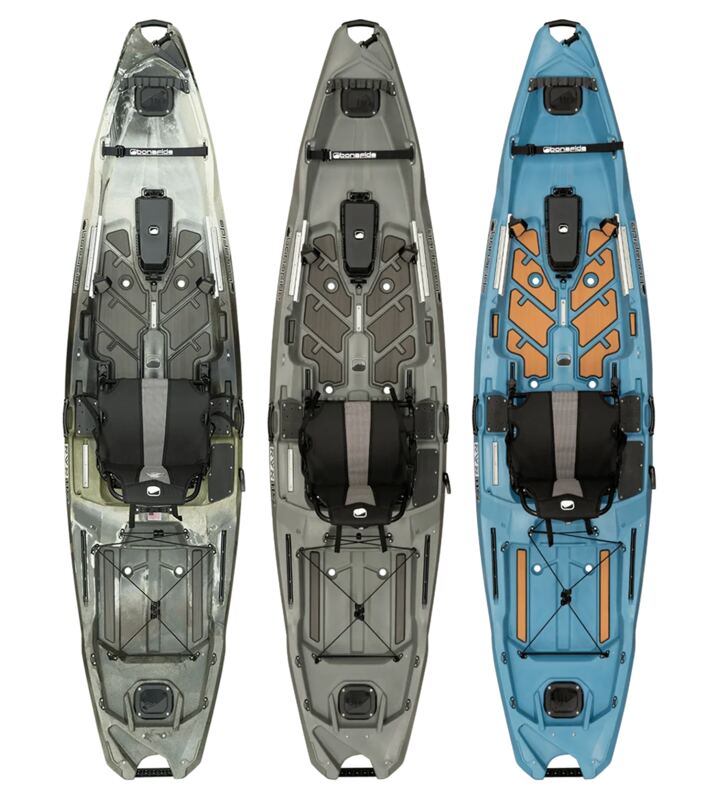
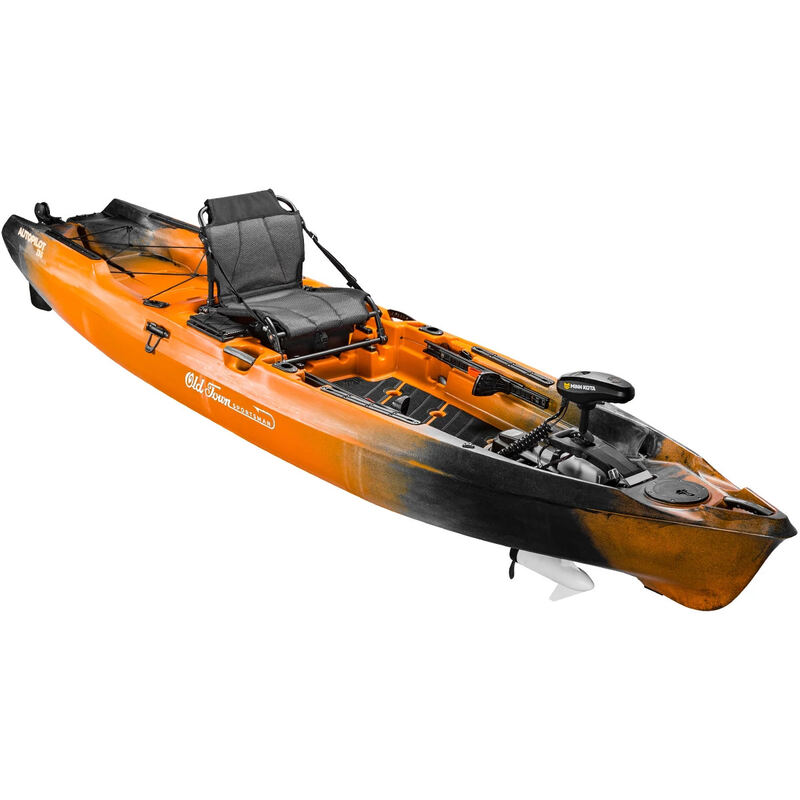
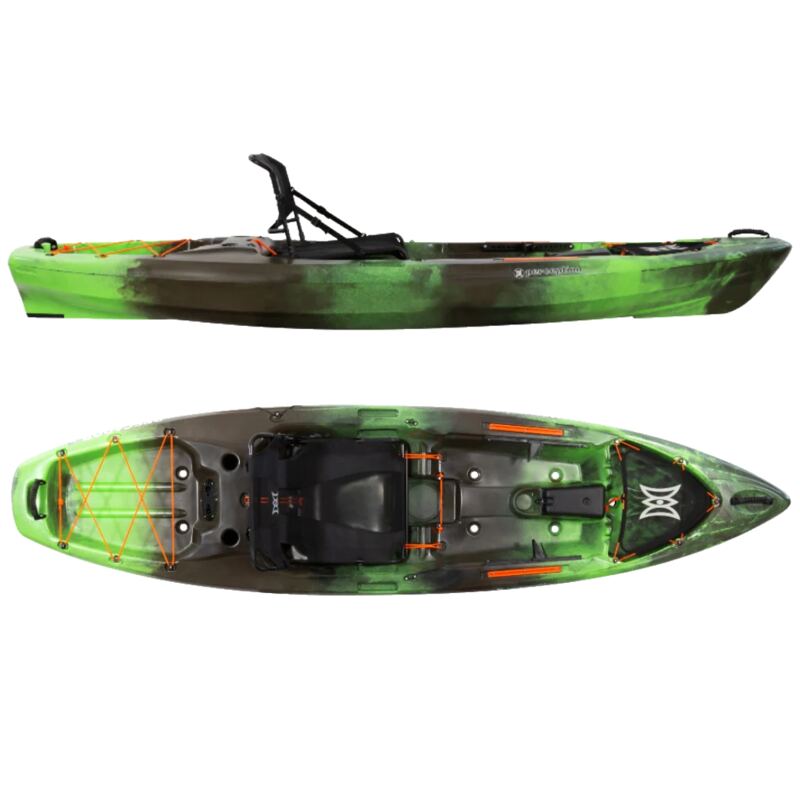
The Wilderness Systems Atak 120 features an AirPro MAX seat with honeycomb-vented fabric that dries almost instantly, a significant upgrade over the standard seats on the Bonafide RVR and Perception Pescador Pro 10. While its pontoon-style hull offers exceptional stand-up stability similar to the Old Town Sportsman AutoPilot 120, it lacks the integrated motor technology and weighs slightly less at 86 lbs.
Rating sources
“For calm water, and even fast-moving rivers, I’d get the ATAK 120 without thinking twice.”
“Looking at it from a value standpoint, the Pungo 120 is tough to beat—that’s why we picked it as one of the best kayaks .”
Our 4.7 score is the average of the 3 scored reviews above; 3 more reviewed it without printing a score and are not in the average. Ratings marked * were derived from the reviewer’s written analysis or video transcript — the publisher didn’t print an explicit numeric score, so we inferred one from their own words. Click through to verify. More about methodology.