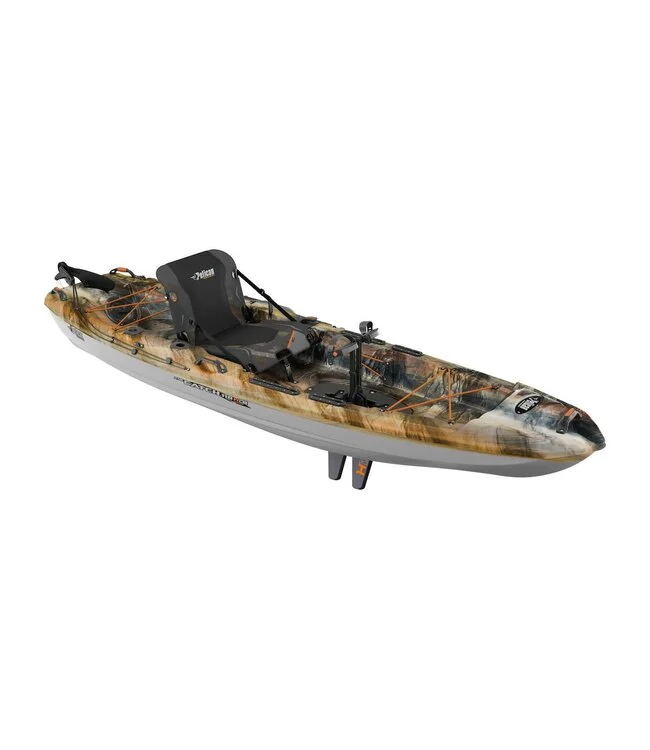
Kayak Angler found that the Pelican Catch Kicker 110 HDII successfully merges standup paddleboard convenience with kayak fishability, offering a lightweight hybrid platform for under $1,000. greatoutthere.online highlighted its thermoformed polyethylene hull as a major advantage, noting that it allows anglers to easily transport and cartop the boat without a trailer. While paddling.com reviews noted that the HyDryve II pedal system lacks the crisp feel of premium competitors, they praised its shallow-water capability due to folding fins. This model is best suited for beginner anglers or those seeking an affordable grab-and-go vessel for sheltered waters rather than serious offshore expeditions.
Full review
Thermoformed Hull Weight and Repairability
The Pelican Catch Kicker 110 HDII utilizes a thermoformed construction method, which involves molding two separate sheets of polyethylene plastic before welding them together. This manufacturing process results in a significantly lighter vessel compared to traditional rotomolded fishing kayaks that often exceed 90 pounds. Kayak Angler recorded the weight at just 59 pounds, noting that this substantial reduction allows for easy solo cartopping and storage propped on its side in a yard or garage. The lightweight nature of the hull makes it highly portable for anglers who lack heavy-duty trailers or multiple helpers.
Despite the advantages in portability, the thermoformed plastic construction presents a notable durability trade-off regarding long-term maintenance. Kayak Angler pointed out that while these boats are abrasion-resistant and built to last, they are not as easy to repair as rotomolded alternatives if they sustain significant impact damage. The structural integrity of welded thermoformed hulls does not tolerate the same level of DIY patching or welding by average users compared to single-piece rotomolded designs, meaning owners must be more cautious about striking submerged rocks or hard surfaces.
The combination of a lightweight frame and rigid construction creates a vessel that is highly responsive but demands careful handling. This portability is a primary driver for buyers who want to launch frequently without logistical hurdles, though the hull stiffness also means it can handle Class 1 whitewater conditions when the pedal drive is removed.
Hybrid Stability and Catamaran Hull Design
The Catch Kicker 110 HDII bridges the gap between a fishing kayak and a standup paddleboard through its wide, flat deck supported by a catamaran-style hull. This design maximizes stability, providing a secure platform for both seated angling and standing up to cast or scan for fish. The broad 33-inch beam offers ample space to adjust position without feeling tippy, addressing the common instability issues found in shorter paddleboards. Kayak Angler emphasized that this wide stern allows users to fish effectively from any angle while maintaining a low center of gravity when seated.
When the Ergocast G2 seat is folded down, it exposes a full-length standing platform that transforms the kayak into a functional SUP hybrid. This configuration retains enough primary stability to support an average adult angler standing and casting, making it ideal for shallow-water fishing where visibility and stealth are crucial. The design effectively solves the paradox of wanting a small, transportable boat without sacrificing the performance characteristics usually reserved for larger vessels.
The hull's sharp bow is engineered to cut through water and ride over small waves, enhancing comfort in slightly choppy conditions. While the wide beam provides excellent initial stability, it does come with hydrodynamic trade-offs regarding speed and tracking compared to longer, narrower touring kayaks. However, for sheltered lakes, slow-moving rivers, and coastal flats, the catamaran hull delivers a steady ride that prioritizes fishing utility over high-speed performance.
HyDryve II Pedal Drive Performance
Propulsion is handled by the HyDryve II pedal system, which uses two fins that flap back and forth in a motion similar to a stepper machine. This fin drive system allows for hands-free pedaling while steering with a hand-controlled rudder tiller, enabling anglers to troll, reel in lines, or tie on baits without stopping. The system is designed to be efficient, with users reporting the ability to reach speeds of approximately 5 mph during short bursts of faster pedaling. This efficiency significantly reduces upper body fatigue compared to traditional paddle propulsion.
A key advantage of the fin-based drive over propeller systems is its shallow-water capability. When entering waters too shallow for the fins or navigating around aquatic plants, anglers can simply push one pedal forward to fold the fins flat against the hull. Alternatively, the entire drive unit can be quickly removed from the boat to facilitate beach landings or transport on trails. This modularity adds versatility that fixed-propeller systems cannot match.
However, the driving experience does not perfectly mirror high-end competitor systems. A reviewer on paddling.com noted that while the HyDryve II is a beefed-up version of its predecessor and holds up well over time, it lacks the crisp steering response found in the Hobie Mirage Drive. The pedal mechanism feels slightly less precise, which may be noticeable to anglers transitioning from premium brands. Despite this difference in feel, the system remains highly effective for covering water efficiently without exhausting the user's arms.
Rudder Steering and Handling Dynamics
Steering is managed via a hand-controlled rudder tiller located near the seat, allowing anglers to maintain pedaling momentum while adjusting course. The system requires one hand for occasional steering adjustments, freeing the other hand for fishing tasks. Users have described the steering as light and easy to use, making it straightforward to navigate into wind or away from snags without interrupting the pedal rhythm.
The rudder system does exhibit some mechanical play even after initial setup and adjustment. A paddler on paddling.com reported that while assembling the rudder took about 30 minutes, there is a considerable amount of slack in the steering mechanism out of the box. This play can affect precise maneuvering in tight spots or strong currents, requiring anglers to be more proactive with their steering inputs compared to direct-drive systems.
For transport and storage, the rudder tiller can be flipped up and secured with a bungee cord to prevent bouncing during car travel. The design allows for quick deployment when entering the water, but users must remember to lower it before pedaling. The integration of the rudder with the pedal drive creates a cohesive propulsion system that prioritizes ease of use over high-precision tracking, making it ideal for casual anglers and beginners.
Storage Configuration and Accessory Tracks
The deck layout is designed to maximize open space while providing dedicated storage zones. An elevated area behind the seat features a molded shape specifically for holding a 13-by-13-inch gear crate, secured with complimentary bungees. This setup keeps tackle and essentials organized and accessible without cluttering the standing platform or footwells. Additional tie-downs in the bow allow for securing dry bags or nets using bungee cords.
Accessory mounting is facilitated by rigging tracks located on both sides of the seat and along the deck edges. These tracks accommodate a variety of aftermarket accessories, including rod holders, cup holders, and electronic mounts. Users have noted that the standard flush-mount rod holders included with the boat are compact and sit low enough to avoid catching fishing lines when casting forward. The small footprint of these holders is particularly useful for installing forward-facing rod holders without interfering with leg movement.
Some anglers choose to modify the track layout to better suit their preferences. A YouTube reviewer demonstrated relocating the paddle keeper from its default position in the handle cutout to a side-mounted position using stainless steel screws. This modification frees up the handle tracks for other accessories while keeping paddles secured nearby. The inclusion of multiple cup holders on either side of the seat adds convenience for storing drinks or small tools within easy reach.
Suitability for Beginners and Casual Anglers
The Catch Kicker 110 HDII is particularly well-suited for beginner anglers looking to enter kayak fishing without a massive financial investment or logistical burden. The combination of a low price point, lightweight design, and easy-to-use pedal drive lowers the barrier to entry significantly. Kayak Angler described it as a perfect fit for those intending to fish sheltered waters with limited tackle, offering a practical grab-and-go option that encourages frequent use.
For experienced anglers, this kayak serves as an excellent secondary vessel or travel companion. Its light weight allows it to be easily transported on smaller vehicles like trucks or SUVs without the need for heavy-duty trailers. This makes it ideal for vacation fishing trips or accessing remote lakes where launching a 90-pound rotomolded kayak would be impractical. The ability to paddle with a standard SUP paddle when the drive is removed adds to its versatility as a leisure craft.
The boat's stability and comfort features, such as the breathable mesh seat with lumbar support, make it suitable for longer days on the water. However, those seeking high-speed touring capabilities or advanced tracking in open ocean conditions may find the short hull length limiting. The Catch Kicker excels in calm to moderately choppy environments where its stability and shallow-water draft provide distinct advantages over traditional fishing kayaks.
Strengths
- +Thermoformed construction makes it significantly lighter (59 lbs) than traditional rotomolded kayaks, allowing for easy solo cartopping and storage.
- +Hybrid design features a wide catamaran hull that provides high stability suitable for both seated fishing and standing up on the deck.
- +Includes an efficient HyDryve II fin pedal drive system paired with a hand-controlled rudder for hands-free propulsion and maneuvering.
- +Versatile Ergocast G2 seat folds down to expose a full-length standing platform, bridging the gap between kayak and SUP.
Watch-outs
- −Thermoformed plastic hulls are more difficult to repair than rotomolded alternatives if they sustain significant impact damage.
- −The pedal drive system is not as crisp or precise in steering response compared to higher-end competitor systems like the Hobie Mirage Drive.
Rating sources
“The MOST affordable and versatile pedal and PADDLE kayak you can buy!”
Our 4.5 score is the average of the 1 scored review above; 4 more reviewed it without printing a score and are not in the average. Ratings marked * were derived from the reviewer’s written analysis or video transcript — the publisher didn’t print an explicit numeric score, so we inferred one from their own words. Click through to verify. More about methodology.