The Valentine One V1 Gen2 radar detector features patented electronics and LNA technology that deliver significant range superiority, particularly on Ka band. Vortex Radar testing showed it can match or exceed the Uniden R7 in long-distance detection. The device includes K-Verifier to filter unwanted K-band alerts and boasts a hundred-fold increase in scan-rate processing. However, it lacks GPS and some users have reported quality issues such as power failures and display problems. This detector is best suited for drivers seeking maximum radar detection range and stealth, though those wanting GPS functionality should look elsewhere.
Full review
Range Superiority Confirmed
Professional testing confirms the Valentine One V1 Gen2 delivers on its promise of exceptional radar detection range, particularly on Ka band frequencies. Vortex Radar's comprehensive testing showed the V1 Gen2 consistently outperforming competitors like the Uniden R7 and Escort Max 360c. On 34.7 mph, it matched the R7's performance and even surpassed it in several instances. Most impressively, at 35.5 mph, the V1 Gen2 demonstrated detection capabilities that exceeded the R7 across all tests. The detector's Surface-Acoustic-Wave Dispersive-Delay-Line technology, combined with LNA (Low Noise Amplifier) technology, enabled the V1 Gen2 to detect signals at distances approaching 2.5 miles, according to Popular Mechanics testing. Car and Driver magazine specifically named the V1 Gen2 as the 'Most Vigilant' detector due to its exceptional long-range sensitivity, while Road & Track awarded it the 'Longest Range' title, noting it detected radar signals at 2.1 miles, the farthest of any detector tested.
The V1 Gen2's range superiority is particularly notable in its Ka band performance, where it outperforms the Uniden R7 and Escort Redline EX. Vortex Radar's testing revealed that the V1 Gen2's sensitivity on Ka band is so advanced that it can detect signals from nearly twice the distance compared to other top-tier detectors. The detector's ability to handle multiple radar threats simultaneously without losing detection capability was also highlighted in testing, with the V1 Gen2's processing rate jumping over a hundredfold compared to previous models. This enhanced processing power allows the device to quickly sort speed-trap radar signals from the numerous lane-change and crash-prevention radars that now populate roadways, making it a significant improvement over earlier models and competitors like the Radenso Pro M, which showed shorter detection distances in the same tests.
Design and Interface Evolution
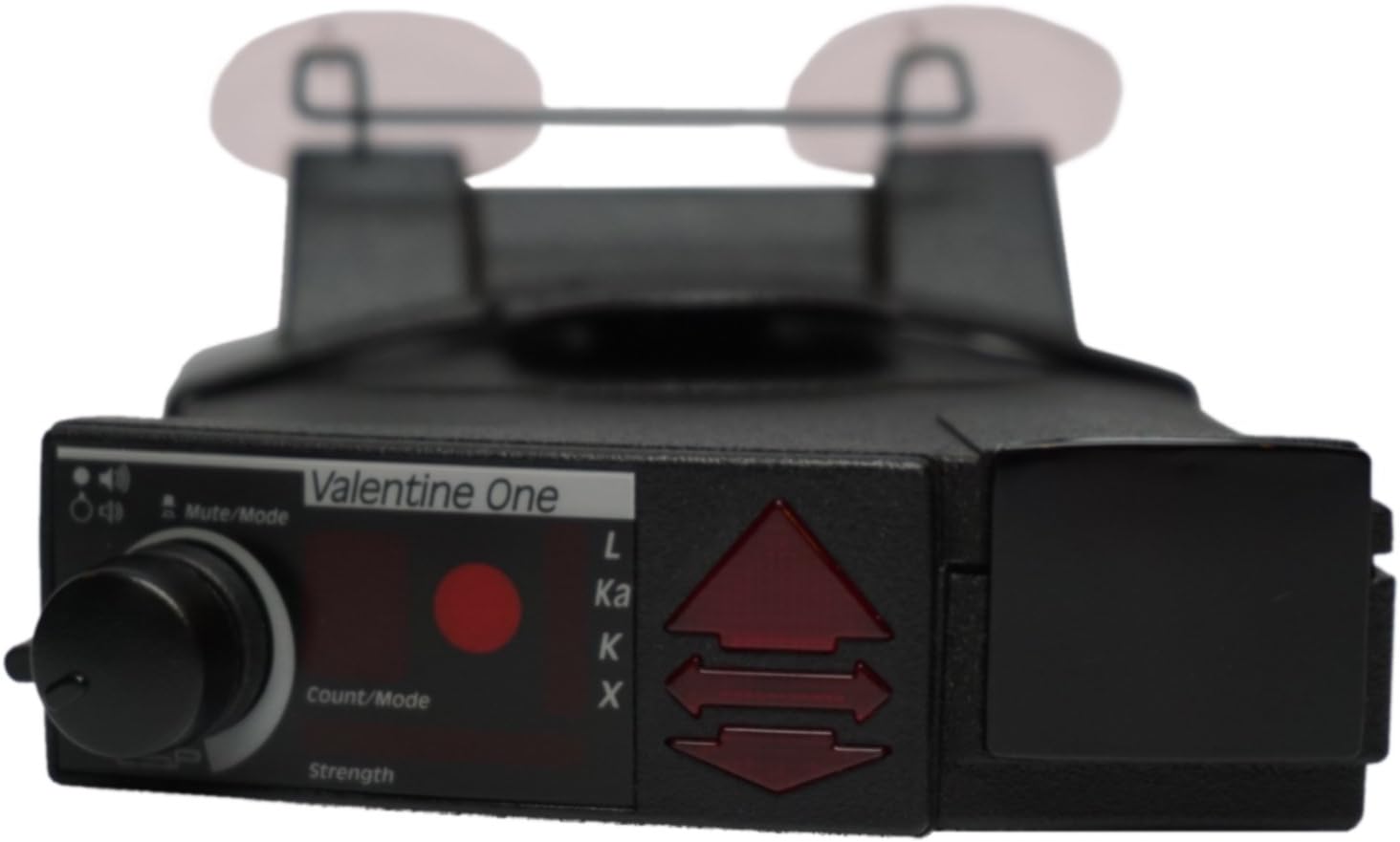
The Valentine One V1 Gen2 introduces a sleeker, more modern design compared to its predecessor, featuring a thinner profile and updated aesthetics based on customer feedback over the past three decades. The new interface replaces the dual volume control knobs with a single power/mute button and separate volume buttons positioned on top of the unit. This change was implemented to address user confusion with the previous design, where many users were unsure about the function of the outer volume lever. The new design also improves usability for motorcycle riders who wear gloves, as noted by Vortex Radar's testing. However, some users have expressed disappointment with the removal of the dedicated muting volume controls, which were preferred by those who frequently adjusted volume settings during operation.
LED indicators have been upgraded with a special diffusing film that creates a smoother, more evenly lit appearance. The band indicators now use larger red LED letters for better readability, particularly at night, compared to the previous white text with red LED dots. While the V1 Gen2 maintains the classic arrow LED display that indicates threat direction, the new design eliminates the use of modern multi-color OLED displays, a decision made to ensure better visibility in direct sunlight and to avoid potential burn-in issues that affect OLED technology over time. The display's reliability is further enhanced by the choice of LED technology, which is more durable for long-term use compared to OLED alternatives.
False Alert Management
The V1 Gen2's false alert filtering capabilities represent a significant improvement over previous models, particularly with the introduction of K-Verifier technology that blocks nearly all K-band alarms from lane-change and crash-prevention radars. Vortex Radar's testing showed that the V1 Gen2's filtering performance is most effective when using the BSM filters (now called K Verifier) enabled, which prevents the detector from becoming a false alert machine. However, this filtering system does come with limitations, as the V1 Gen2 cannot be adjusted to the same sensitivity levels as the Uniden R7 when K-band filtering is disabled. The device offers three logic modes: All Bogies mode (A mode), Logic mode (L mode), and Advanced Logic mode (L mode), each designed to reduce false alerts while maintaining detection sensitivity. The Advanced Logic mode specifically helps filter out unwanted signals from various sources including satellite radio interference, cell phone interference, and other automotive electronics.
Despite these improvements, some users have reported issues with false alerts, particularly with Ka-band signals. Reddit user sccues experienced continuous false alerts from the rear of the vehicle, which persisted even after multiple repairs. The device's inability to be updated via computer, unlike Escort detectors, has been cited as a significant drawback by users who have encountered problems. The V1 Gen2's filtering system is effective but requires careful adjustment to avoid over-filtering or under-filtering, which can either miss real threats or generate excessive false alarms. The K-Verifier feature, while helpful, may not be sufficient to eliminate all false alerts from modern vehicle systems, particularly those with integrated radar systems.
Reliability Concerns and Quality Issues
Despite its impressive performance specifications, the V1 Gen2 has faced significant reliability issues that have disappointed many users. Reddit user sccues reported having to send the device back to Valentine for repair twice, with the first repair being ineffective as the device returned in the same condition. The second repair also failed to resolve the issue, leaving the user with a device that would continuously flash directional arrows and count bogies without any actual radar threat present. This problem was not isolated, as other users in the rdforum.org thread reported similar experiences with intermittent operation and erratic behavior. The device's tendency to malfunction after extended use has led some users to question the overall quality control of the Gen2 model.
Multiple quality issues have been documented by users and reviewers, including power off failures, display bleed, display covers peeling off, and mute button sticking. Vortex Radar's review noted that while many early units have been plagued with poor reliability and various hardware failures, even repaired detectors continue to fail. The device's susceptibility to electrical problems in vehicles with certain accessories was also reported, with users experiencing false alerts when using vehicle accessories, turn signals, or brakes. The lack of computer update capabilities, unlike Escort models, has been cited as a major drawback, particularly for users who encounter problems that might be resolved through software updates. These reliability concerns have significantly impacted user confidence in the V1 Gen2, with some users considering alternative models like the Escort Redline 360C.
Bluetooth Integration and App Support
The V1 Gen2 features integrated Bluetooth connectivity, a significant upgrade from previous models that allows for smartphone app integration and advanced threat analysis. The device supports third-party applications like V1Driver and JBV1, which enhance functionality and provide additional features not available in the base unit. Vortex Radar's review highlighted the importance of this feature, noting that the integrated Bluetooth with support for fantastic cell phone apps makes the V1 Gen2 particularly appealing to tech-savvy enthusiasts. The ability to connect to smartphones via Bluetooth enables users to access advanced threat analysis, easy programming, and instant upgrades, which were previously unavailable with the V1 Gen1 model.
The V1 Gen2's Bluetooth integration also allows for firmware updates through the V1 app, which is a significant improvement over previous models that required physical updates or computer-based programming. This feature enables users to maintain their device's performance and security without needing to send it in for service. The device's compatibility with smartphone applications enhances its functionality by providing real-time threat analysis, historical data logging, and advanced configuration options. However, the lack of computer update capabilities, which some users have criticized, is somewhat offset by the mobile app functionality. The app support is comprehensive and provides users with additional control over their device's performance and settings.
Performance Against Competitors
In direct comparison with leading radar detectors, the V1 Gen2 demonstrates clear superiority in long-range detection capabilities, particularly on Ka band frequencies. Vortex Radar's comprehensive testing against the Escort Max 360c, Uniden R7, Escort Redline EX, and Radenso Pro M showed the V1 Gen2 consistently outperforming these competitors in detection range. The V1 Gen2's ability to match and exceed the Uniden R7's performance, which is considered the king of long-distance range, represents a significant achievement for Valentine Research. Road & Track's testing confirmed the V1 Gen2's range superiority, noting it detected radar signals at 2.1 miles, the farthest of any detector in their group. Car and Driver magazine's recognition of the V1 Gen2 as the 'Most Vigilant' detector further validates its performance claims.
However, the V1 Gen2's performance is not without limitations. While it excels in range detection, the device's K-band performance is more complex due to various filtering options that can affect sensitivity. The V1 Gen2's sensitivity on K band is roughly equivalent to the R7 set to 40% sensitivity when using BSM filters, but users cannot increase the V1's sensitivity to match the R7's maximum levels. Additionally, the device's false alert filtering, while improved, still requires careful adjustment to avoid either missing real threats or generating excessive false alarms. The V1 Gen2's performance in real-world conditions has been mixed, with some users reporting issues with reliability and intermittent operation, which affects its overall competitiveness against more stable alternatives like the Escort Redline EX.
Who It's Best For
The Valentine One V1 Gen2 is best suited for drivers who prioritize maximum radar detection range and are willing to accept potential reliability issues. Tech-savvy users who value smartphone integration and app support will find the device appealing, particularly due to its Bluetooth connectivity and third-party app compatibility. The detector's exceptional Ka band performance makes it ideal for drivers who frequently encounter speed traps and need early warning of radar threats. Users who drive in areas with high concentrations of radar detection equipment will benefit most from the V1 Gen2's superior range capabilities, which can provide detection distances approaching 2.5 miles. The device is particularly attractive to those who want a detector with advanced threat tracking capabilities and directional arrow indicators that clearly show the direction of detected threats.
However, the V1 Gen2 is not recommended for users who prioritize reliability and consistent performance over range superiority. Drivers who have experienced the V1 Gen1's dependability may find the Gen2's reliability issues disappointing, particularly given the need for multiple repairs in some cases. Users who require frequent software updates or computer-based programming will be frustrated by the device's lack of computer update capabilities, which limits troubleshooting options. The device is also not ideal for those who frequently encounter false alerts, as the filtering system, while improved, still requires careful adjustment and may not completely eliminate false alarms from modern vehicle systems. Those who value a simple, straightforward device without complex features may find the V1 Gen2's advanced functionality overwhelming.
Value and Price Considerations
At $499, the Valentine One V1 Gen2 represents a premium price point that reflects its advanced features and performance capabilities. The device's price is justified by its exceptional range performance, particularly on Ka band frequencies, where it outperforms competitors like the Uniden R7 and Escort Max 360c. Vortex Radar's testing confirmed that the V1 Gen2's range superiority makes it a strong contender despite its higher cost. The device's integrated Bluetooth connectivity, smartphone app support, and advanced threat analysis features add significant value for tech-savvy users who want enhanced functionality beyond basic radar detection. The ability to upgrade firmware through mobile apps and the inclusion of features like K-Verifier and LNA technology further justify the premium price.
However, the V1 Gen2's value proposition is somewhat diminished by its reliability issues and the lack of computer update capabilities. Users who have experienced the need for multiple repairs or who require frequent software updates may find the price point less attractive when considering long-term ownership costs. The device's performance advantages are significant, but the reliability concerns have led some users to consider alternative models like the Escort Redline 360C, which offers similar performance with better reliability and update capabilities. The V1 Gen2's value is most apparent for users who prioritize range over reliability and are willing to accept the potential for hardware issues in exchange for superior detection capabilities.
Strengths
- +Patented Surface-Acoustic-Wave Dispersive-Delay-Line technology provides range superiority
- +LNA technology boosts range and improves stealth by acting as a one-way valve
- +K-Verifier blocks nearly all K-band alarms from lane-change and crash-prevention radars
- +New scanning rate jumps the processing rate more than a hundred times for quick signal sorting
Watch-outs
- −No GPS functionality included
- −Some users report quality and reliability issues including power off failures and display bleed
How it compares
The Valentine One V1 Gen2 matches the Uniden R7 in long-range performance, particularly on Ka band, but lacks the GPS functionality and Auto Mute Memory that the R7 provides. While it offers superior LNA technology and K-Verifier filtering, the R7's dual antenna system and built-in GPS make it more practical for drivers seeking comprehensive urban and highway detection.
Who this is for
At a glance: Range-focused drivers wanting stealth features.
Why you’d buy the Valentine One V1 Gen 2 Radar Detector
- Patented Surface-Acoustic-Wave Dispersive-Delay-Line technology provides range superiority.
- LNA technology boosts range and improves stealth by acting as a one-way valve.
- K-Verifier blocks nearly all K-band alarms from lane-change and crash-prevention radars.
Why you’d skip it
- No GPS functionality included.
- Some users report quality and reliability issues including power off failures and display bleed.
Rating sources
“Not a huge difference between detectors. The R7 got the longest distance alerts, followed by the V1 Gen2, and everyone else clustered together.”
“V1 Gen2 brings new detection tools New LNA technology: The only way to extend range is to detect ever weaker signals. Think of LNA as a signal magnifier.”
“I’ve lost confidence in this unit after all the trouble I’ve been through.”
“V1 Gen2 is an entirely new security instrument that outperforms by a clear margin even the most highly-evolved version of V1.”
Our 3.9 score is the average of these published ratings. Ratings marked * were derived from the reviewer’s written analysis or video transcript — the publisher didn’t print an explicit numeric score, so we inferred one from their own words. Click through to verify. More about methodology.