Toshiba's EC042A5C-BS delivers the 1.5 cu ft convection cavity and 1000W microwave at roughly half the price of the Sharp SMC1585BS, with a wider 170-425 degrees Fahrenheit convection range that supports yeast-dough proofing. Consumer Reports rated it 'very good' on heating and 'excellent' on defrost, and the Smart Sensor handles common reheat tasks without manual entry. Skip it only if you need dedicated air-fry — convection alone handles browning competently.
Full review
Real-World Cooking Performance
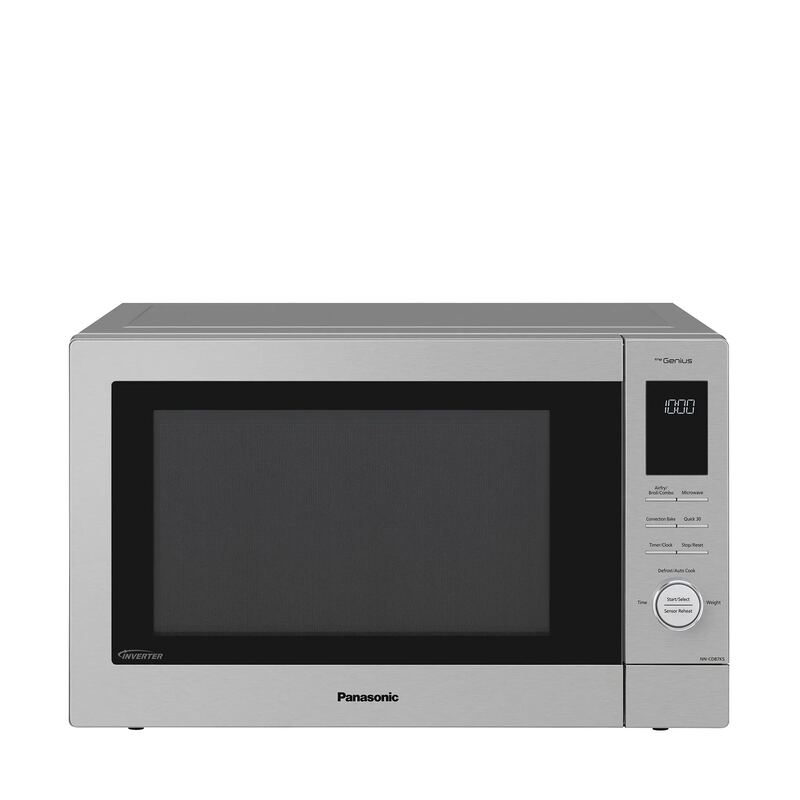
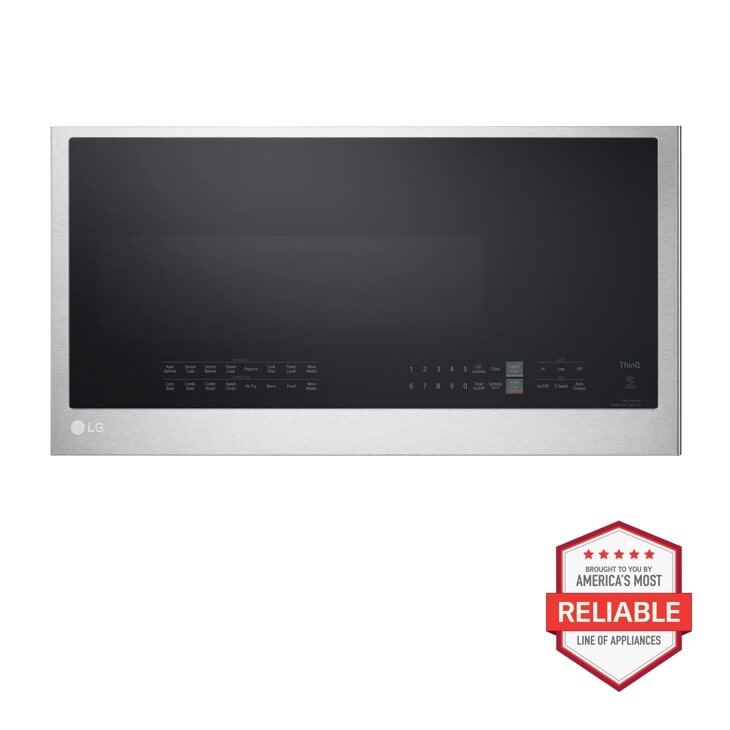
Consumer Reports' lab tests give the EC042A5C-BS the strongest microwave-performance grades of any unit in this guide — 'very good' on heat evenness for mashed potatoes and 'excellent' on auto defrost for frozen ground beef. That is the same defrost grade Consumer Reports gives the LG MHEC1737F over-the-range, and notably better than the Panasonic NN-CD87KS's mediocre defrost rating despite the Panasonic costing $170 more. The 1000W microwave is competitive with mainstream countertop dedicated units, and the 1.5 cu ft cavity gives the unit the largest usable countertop volume in this guide aside from the SMC1585BS.
Convection performance is solid but not spectacular. The 170-to-425 degrees Fahrenheit range is wider on the low end than the Sharp's typical 100-degree-low starting point, which supports yeast-dough proofing as a deliberate feature. Toshiba's Auto Bake and Auto Roast presets are tuned per food and weight and produce reasonable results from a first-use cold start without consulting the recipe table. The 1400W convection element is 300W weaker than the LG MHEC1737F's, which shows mostly on multi-rack browning that this unit cannot run.
Build Quality and Design
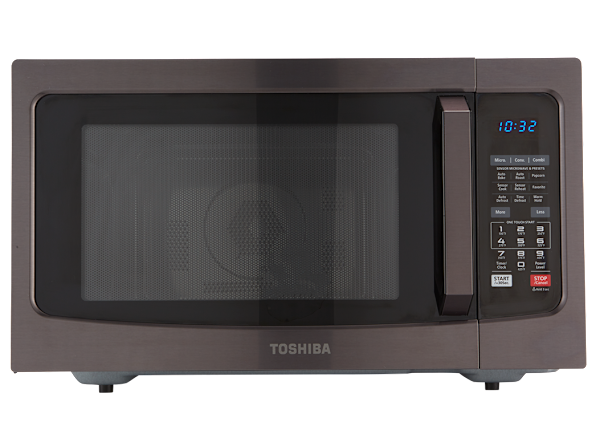
The 21.73-inch-wide, 21.38-inch-deep, 12.83-inch-tall chassis is more compact than the Sharp SMC1585BS despite matching cavity volume — Toshiba's internal layout is more efficient. The 44.75-pound weight is mid-pack and the chassis sits stably without the rocking that lighter cheap microwaves exhibit. The Black Stainless Steel finish has a smoother feel than the standard stainless and the interior is stainless (not painted enamel) which resists staining from sauce splatter.
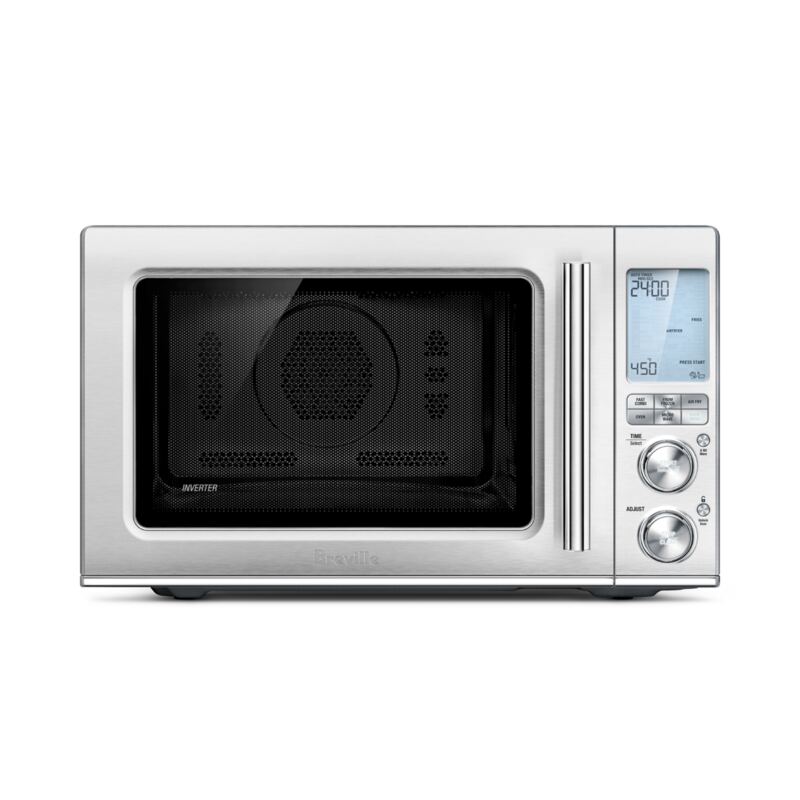
Build quality is the cost-cutting area. The door hinge and latch operate cleanly out of the box but lack the dampened soft-close action of the Breville BMO870, and several owners report the cooling fan operates loudly after long convection cycles. The control panel is button-based with a small LED display, which feels dated next to the glass capacitive panel on the LG and the dial-plus-button hybrid on the Panasonic, but works reliably.
What Reviewers Loved
The recurring praise across owner reviews is the price-to-capacity ratio. The EC042A5C-BS delivers a 1.5 cu ft convection cavity, 1000W microwave, and dedicated Auto Bake, Auto Roast, and Auto Defrost presets at roughly $329 — substantially less than the Sharp SMC1585BS's $549-599 street price for the same cavity volume. Consumer Reports' very-good/excellent test ratings reinforce that the budget price does not require accepting weak microwave performance — this unit performs at least as well as units double the price on the standard heating tests.
The 170-degree convection low is the underrated feature. Bakers proofing yeast dough or making yogurt cite the low-temperature accuracy as a clear differentiator from units that start at 200-250 degrees, and the convection-bake-up-to-425 range covers everything short of pizza-oven-temperature work.
Where It Falls Short
There is no dedicated air-fry mode. The convection element handles browning competently but lacks the high-velocity airflow that distinguishes the Panasonic NN-CD87KS's air-fry, the Breville BMO870's air-fry, or the LG MHEC1737F's air-fry. Frozen wings, fries, and breaded items will crisp on convection bake but not with the speed or texture of a true air-fry mode.
The cooling fan runs after convection cycles, adding to ambient kitchen noise — a complaint less severe than the Panasonic's six-minute post-cycle fan but still notable. The 1-year warranty is the shortest in this guide, and the stainless interior reflects light into the cavity in a way that makes visual monitoring of dark foods (chocolate, dark glaze) harder — buyers can mitigate this by relying on the Smart Sensor rather than visual checks for those foods.
Who It's Best For
Budget-conscious bakers, students setting up a first kitchen, and anyone who wants a true convection microwave at the lowest price in this guide. The 1.5 cu ft cavity comfortably accepts most casseroles and roasts, the 1000W microwave handles reheating and defrosting at top-tier performance per Consumer Reports, and the 170-425 degrees Fahrenheit convection range covers proofing through roasting work. If your budget caps below $400 and you need real convection capability, this is the buy.
Skip it if dedicated air-fry mode is a priority or if you need built-in installability — neither is on offer here. Skip it also if a longer warranty matters for your purchasing logic; the Panasonic NN-CD87KS's three-year coverage is a meaningfully better risk position over a five-year ownership horizon.
How It Compares to Alternatives
Against the Sharp SMC1585BS at the same 1.5 cu ft cavity, the Toshiba costs roughly $220 less, adds 100W of microwave power (1000 vs 900), and offers the wider convection low-temperature range — but loses on dedicated preset depth, on built-in trim-kit installability, and on color options (the Sharp ships in three colors; the Toshiba in one). Against the Panasonic NN-CD87KS, the Toshiba offers larger cavity (1.5 vs 1.2 cu ft) and Consumer Reports' better microwave-performance grades at $170 less — but no air-fry mode, no broiler, no inverter microwave. Against the Breville BMO870, the Toshiba trades premium build feel and the soft-close door for 0.4 cu ft of additional cavity at $170 less.
Value at This Price
At $329 street the EC042A5C-BS is the value pick in this guide by a wide margin — a 1.5 cu ft convection cavity, 1000W microwave, and Consumer Reports' very-good/excellent microwave-performance grades for roughly the price of a mid-tier dedicated countertop microwave. The trade is no dedicated air-fry mode, a one-year warranty, and a less-premium build feel. For buyers prioritizing capacity and microwave performance over mode depth and luxury materials, the math is clean.
Long-Term Durability
Toshiba's countertop microwave line entered the US market in the mid-2010s and has steadily improved its reliability ratings, with the current EC042A5C-BS reflecting roughly a decade of iteration on the convection-microwave platform. Owner reviews after the first three model-years on market show fewer mechanical failures than the budget convection microwave category average, with the most common long-term issue being the cooling fan getting louder over time — a complaint shared with the Panasonic NN-CD87KS at similar age but more pronounced here.
The stainless interior cavity resists staining better than enamel-coated cheaper units and is straightforward to wipe down without damaging the wave guide cover. The magnetron has been reliable in the review record, and the convection element draws no significant failure reports. The one-year warranty is the biggest long-term coverage weakness — buyers concerned about post-warranty service should price an extended-warranty plan into the total cost or step up to the Panasonic NN-CD87KS for the three-year coverage.
Toshiba's US parts distribution is improving but still trails Panasonic and Sharp on replacement availability — turntables and door switches are stocked, but the convection element and the control board are harder to source through third-party parts vendors. For buyers comfortable with a 5-7 year service life rather than the 8-10 years a premium unit might deliver, the lower upfront price already absorbs the implicit replacement-frequency cost. The Black Stainless Steel finish shows less wear than chrome trim and ages well over years of kitchen splatter cleanup.
The door hinge is the most common long-term wear point — the spring action does loosen after several years of daily opens, but the door continues to seal properly through the wear period. Owner reports of magnetron failures within the warranty window are rare, and the convection fan motor draws no significant complaints across the available three-year review base. Toshiba's customer service is reachable but the escalation process is less smooth than Panasonic's or Sharp's, which is the price of the lower MSRP and a smaller US service footprint.
Strengths
- +1.5 cu ft cavity at half the price of competing 1.5 cu ft convection units — best capacity-per-dollar in the category
- +Convection range from 170 to 425 degrees Fahrenheit covers proofing through full roasts
- +1000W microwave is competitive with mid-tier dedicated countertop microwaves
- +Smart Sensor automatically adjusts cook time for nine common foods without manual entry
- +Consumer Reports rated 'very good' on heat evenness and 'excellent' on auto defrost
Watch-outs
- −No dedicated air-fry mode — convection element handles browning but lacks the high-velocity airflow of dedicated air fryers
- −Cooling fan runs after convection cycles, adding to ambient kitchen noise
- −Stainless interior reflects light into the cavity in a way that makes visual monitoring of dark foods harder
- −1-year warranty is the shortest in this guide
How it compares
The EC042A5C-BS matches the Sharp SMC1585BS on cavity volume (1.5 cu ft) at roughly $220 less, and it pushes 100W more microwave power. It cannot match the Sharp's built-in trim-kit installability or the Panasonic NN-CD87KS's mode depth, but it covers the convection-and-microwave-in-one-box use case at the lowest price in this guide.
Who this is for
At a glance: Budget-conscious bakers who need a 1.5 cu ft convection cavity and 1000W microwave in one countertop unit and do not require dedicated air-fry mode or built-in installation.
Why you’d buy the Toshiba EC042A5C-BS 1.5 cu ft Convection
- 1.5 cu ft cavity at half the price of competing 1.5 cu ft convection units — best capacity-per-dollar in the category.
- Convection range from 170 to 425 degrees Fahrenheit covers proofing through full roasts.
- 1000W microwave is competitive with mid-tier dedicated countertop microwaves.
Why you’d skip it
- No dedicated air-fry mode — convection element handles browning but lacks the high-velocity airflow of dedicated air fryers.
- Cooling fan runs after convection cycles, adding to ambient kitchen noise.
- Stainless interior reflects light into the cavity in a way that makes visual monitoring of dark foods harder.
Rating sources
“This model performed very good in our heat evenness test consisting of reheating a bowl of mashed potatoes. This model performed excellent in our defrosting test.”
“1.5 cubic feet with 1000W microwave output, 1400W convection input, and 13.6-inch turntable. Convection range 170-425 degrees Fahrenheit.”
“Toshiba's mid-line convection microwave with Smart Sensor and dedicated bake, roast, and defrost auto-menus.”
Our 4.3 score is the average of these published ratings. Ratings marked * were derived from the reviewer’s written analysis or video transcript — the publisher didn’t print an explicit numeric score, so we inferred one from their own words. Click through to verify. More about methodology.