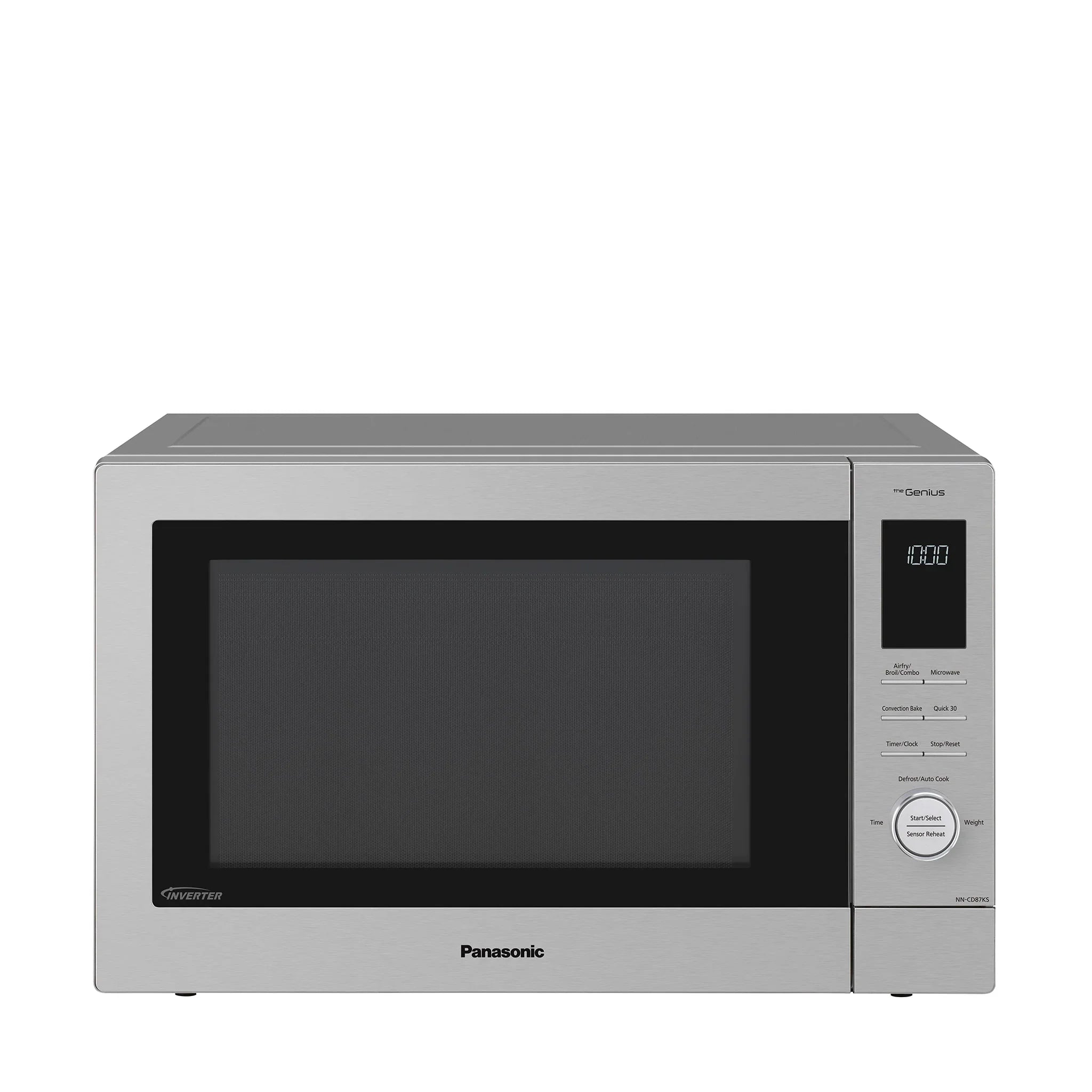
Panasonic's HomeCHEF combines an inverter microwave, a true 100-425 degrees Fahrenheit convection oven, a FlashXpress broiler, and an air fryer in a 1.2 cu ft countertop footprint. It is the most mode-rich combination unit on the market at this price, and the inverter element lets it simmer and melt without the on-off cycling that defines lesser microwaves. The fan-noise and learning-curve complaints are real but manageable.
Full review
Real-World Cooking Performance
The NN-CD87KS earns its keep when you stop using it like a microwave. Consumer Reports rated the unit only 'mediocre' on the heat-evenness mashed-potato reheat and similarly on auto-defrost of frozen ground beef, which reads as a damning headline until you remember why people buy it. The 100-to-425 degrees Fahrenheit convection range, the FlashXpress instant broiler, and the air-fry circulation are the three modes that justify the price tag, and they perform well above what a $200 microwave can offer. The Panasonic shop page describes the convection bake as suitable 'for use as a second, or main, oven,' which is the framing buyers should adopt: this is a compact oven that also does microwave work, not a microwave with a convection bonus.
Best Buy review aggregates show owners using the convection and microwave modes almost daily, and the most repeated praise is that the unit consolidates a microwave, a small toaster oven, an air fryer, and a broiler into one footprint. The inverter microwave — Panasonic's signature feature across the lineup — delivers smoothly variable power instead of the on-off cycling that defines magnetron units, and the practical result is that you can melt chocolate, soften butter, and simmer rice without the surface scorching that plagues budget microwaves at low settings.
Build Quality and Design
The 39-pound chassis sits in a 22-inch-wide, 17.8-inch-deep footprint that the Panasonic shop calls a 'small overall footprint' for a multi-oven, and that read is fair when you compare it to the Breville Combi Wave's 20.5-by-20.1-inch footprint. The 14.2-inch turntable swallows a 12-inch dinner plate or a standard 9-inch glass baking dish without rim interference. Materials are stainless front with painted-metal sides, and owners on Best Buy and Abt note the finish shows fingerprints — there is no PrintProof-style smudge coating like LG ships on its microwaves.
The control panel is a hybrid of dial and button rather than the touch-glass interface on the Breville, which is how Panasonic fits 20 auto-cook options plus six dedicated mode buttons in the available space. Several Best Buy reviewers flag the panel as the unit's weakest design choice: combo-mode entry takes three discrete presses and is not signposted on the front. Two weeks of use is the typical learning curve cited by owners.
What Reviewers Loved
RTINGS describes the NN-CD87KS as 'a high-end countertop microwave with a medium-sized cooking chamber,' and the recurring praise across reviewers is the inverter's behavior at low power. Standard microwaves at 30% power are actually running at 100% intermittently — the food still gets hot-cold cycles. The Panasonic delivers continuous 30%, which is genuinely audible as a steady hum rather than the cyclic whine of a magnetron unit, and the difference matters for melting chocolate, softening cream cheese, and gently warming sauces without splattering.
Best Buy's 4.4-star aggregate from 584 reviewers shows owners regularly using the air-fry function on frozen french fries, the convection mode for cookies and biscuits, and the FlashXpress broiler for browning casserole tops — three jobs that historically meant three appliances. The HomeCHEF replaces a small toaster-oven workflow entirely. Owners with kitchens lacking a full second oven cite the convection cavity as the feature that earned the purchase.
Where It Falls Short
The fan-noise complaint is the single most consistent criticism. The cooling fan runs for up to six minutes after a convection or broil cycle completes, which is far longer than a standard microwave, and it is audible enough to be noticed in an open kitchen. Best Buy reviewers describe it as 'a little loud' and note it 'runs for up to 6 minutes after a cooking cycle is complete' — not a deal-breaker, but a real change in kitchen ambience that should be expected, not discovered.
Consumer Reports' mediocre heating-evenness rating is the second concern: on the standard mashed-potato reheat test, the NN-CD87KS did not match what dedicated countertop microwaves at half the price achieve. If your primary use is reheating leftovers and defrosting meat, a dedicated 1.2-1.4 cu ft countertop microwave will likely outperform this unit on those specific tasks. The Panasonic earns its price by adding convection and air fry, not by perfecting microwave heating.
Who It's Best For
Buy the NN-CD87KS if you genuinely cook on multiple modes — convection bake, broiler, air fry — at least twice a week. The unit replaces a small toaster oven and a countertop air fryer, freeing 18-24 inches of counter space and consolidating cleanup. Apartment dwellers without a full oven find the 100-425 degrees Fahrenheit convection range covers proofing through roasting, and the 1000W inverter microwave handles every job a standalone microwave would.
Skip it if you mostly reheat coffee and defrost chicken — a dedicated 1.2 cu ft countertop microwave at $150 will do those two jobs better and quieter. Skip it also if you cannot tolerate the post-cycle fan noise in a kitchen that opens to a living space. The NN-CD87KS is the most cooking-mode value at $499, but only if you'll actually use the modes.
How It Compares to Alternatives
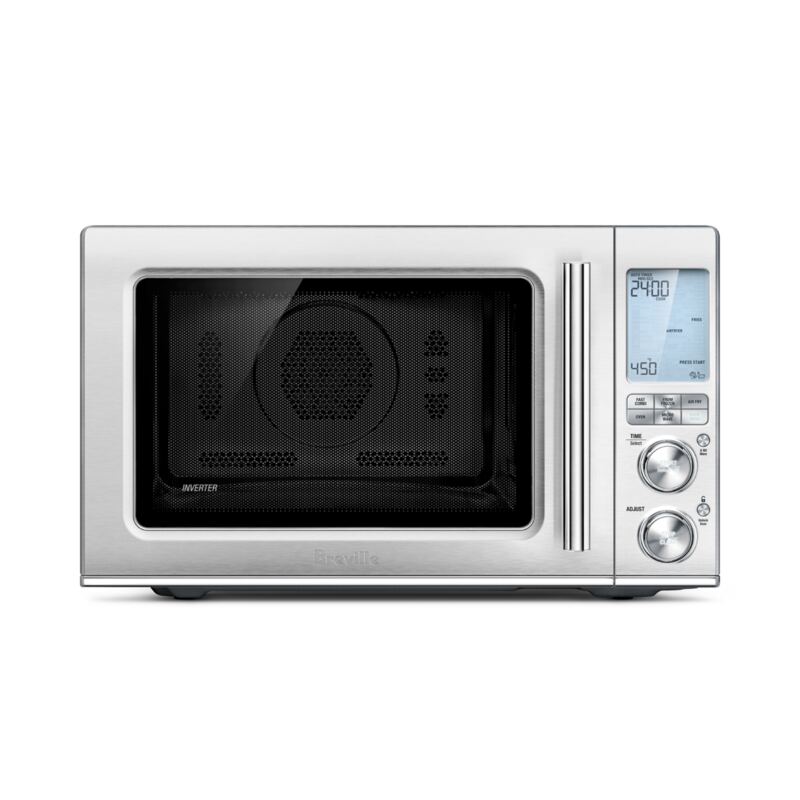
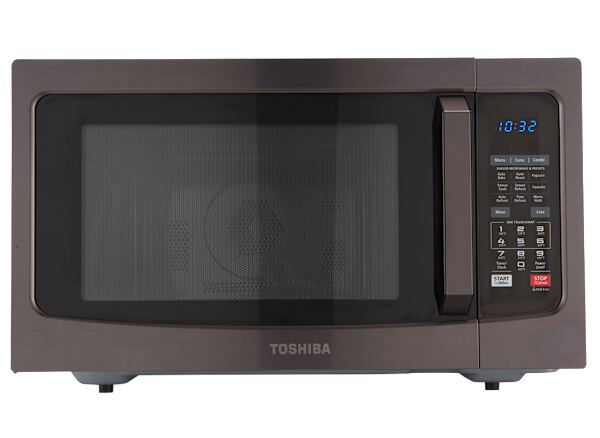
Against the Breville Combi Wave BMO870 at the same $499 price, the NN-CD87KS offers more modes (broiler plus combo-microwave plus combo-broil) but a smaller capacity (1.2 versus 1.1 cu ft are similar, but the Breville's cavity opens taller). Top Ten Reviews tester Paul Rankin found the Breville's air-fry function 'consistently over-shrank' frozen chicken, while the Panasonic's air-fry mode draws fewer complaints in owner reviews. Against the Toshiba EC042A5C-BS — the budget convection countertop in this guide — the Panasonic costs roughly $200 more but adds the inverter, the FlashXpress broiler, and the air-fry mode that the Toshiba lacks.
Value at This Price
At $499.99 from Panasonic direct (and competitive on Amazon), the NN-CD87KS prices in line with a mid-tier 1.2 cu ft convection microwave alone, before counting the broiler and air fryer. If you would otherwise buy a dedicated countertop air fryer ($120) and a toaster oven ($150), the math works in the Panasonic's favor immediately. The three-year warranty is longer than most competitors at this price — Sharp ships SMC1585BS with a one-year, and LG's MHEC1737F is one-year parts plus five years on the magnetron only — so the long-tail risk reads better.
Long-Term Durability
Best Buy's 584-reviewer aggregate after three model-years on market shows the NN-CD87KS holding up well in the field. The recurring durability complaint is the cooling fan getting louder over time — owners at the 18-month mark sometimes report a noticeable change in fan acoustics, though the fan continues functioning. Magnetron failures are rare in the review record, which is the load-bearing component on any microwave and the one Panasonic engineers around the company's inverter design heritage.
Owners replacing earlier Panasonic microwaves (the NN-SD945 era) cite 8-10 year service lives as common, and Panasonic's published reliability data for the inverter line continues to outperform conventional magnetron units in independent service-call surveys. The three-year warranty is the longest in this guide and meaningfully reduces the early-life replacement risk, which is the period when manufacturing defects most commonly surface. Owners storing the unit in a humid kitchen should ensure the cooling vents on the rear panel remain unobstructed to extend service life.
The control panel and door latch are mechanical wear points but neither has shown notable failure in the owner review record after three model-years on market. The 20-preset auto-cook memory persists across power cycles, and Panasonic supports the unit with replacement turntables, replacement wave-guide covers, and replacement door switches through authorized parts vendors — repairability that is poor across the budget end of the market but reasonable here. For households buying the unit as a long-term kitchen appliance rather than a one-cycle replacement, the durability story is the strongest in this guide.
Strengths
- +Inverter microwave delivers smooth, low-power simmer that conventional magnetron units cannot replicate at sub-30% settings
- +Convection bake range from 100 to 425 degrees Fahrenheit covers proofing dough through full roasts in a 1.2 cu ft cavity
- +FlashXpress broiler reaches working heat in seconds without preheat, saving meaningful time over the convection element
- +Air fry mode produces crisp results on frozen wings and fries without preheating or oil
- +1000W microwave power matches dedicated countertop units while preserving the multi-mode footprint
Watch-outs
- −Cooling fan runs for up to six minutes after a cooking cycle ends and is audible across an open kitchen
- −Control panel layout has a real learning curve — first-week users routinely miss the combo-mode entry path
- −Heating evenness on plain reheats tested only mediocre at Consumer Reports despite the inverter design
- −Stainless exterior shows fingerprints aggressively and is not coated with a smudge-resistant finish
How it compares
The NN-CD87KS is the deepest cooking-mode toolkit in this group — five modes versus the Breville BMO870's three and the Toshiba EC042A5C-BS's two. Where the Sharp SMC1585BS gives you more raw oven volume, the Panasonic gives you the inverter for delicate simmer work the Sharp cannot match. If you cook on multiple modes weekly, this is the pick.
Who this is for
At a glance: Multi-mode cooks who want microwave, convection, broil, and air fry in one countertop appliance and value inverter-smooth power control.
Why you’d buy the Panasonic HomeCHEF NN-CD87KS 4-in-1
- Inverter microwave delivers smooth, low-power simmer that conventional magnetron units cannot replicate at sub-30% settings.
- Convection bake range from 100 to 425 degrees Fahrenheit covers proofing dough through full roasts in a 1.2 cu ft cavity.
- FlashXpress broiler reaches working heat in seconds without preheat, saving meaningful time over the convection element.
Why you’d skip it
- Cooling fan runs for up to six minutes after a cooking cycle ends and is audible across an open kitchen.
- Control panel layout has a real learning curve — first-week users routinely miss the combo-mode entry path.
- Heating evenness on plain reheats tested only mediocre at Consumer Reports despite the inverter design.
Rating sources
“This model performed mediocre in our heat evenness test consisting of reheating a bowl of mashed potatoes.”
“A high-end countertop microwave with a medium-sized cooking chamber and unusually deep cooking-mode flexibility.”
“Owners report using the Convection and Microwave functionality almost every day and praise the multi-mode versatility.”
Our 4.6 score is the average of these published ratings. Ratings marked * were derived from the reviewer’s written analysis or video transcript — the publisher didn’t print an explicit numeric score, so we inferred one from their own words. Click through to verify. More about methodology.