The Titan Adjustable Competition Style Kettlebell features a consistent cast iron shell that maintains identical dimensions from 12 to 32 kilograms, allowing for smooth snatches and cleans without shifting balance. Garage Gym Reviews found this uniform shape prevents the awkward hand feel common in other adjustable models, while the ergonomic handle supports comfortable gripping during high-repetition exercises like Turkish get-ups. However, weight adjustment is time-consuming because it requires tools to unscrew internal bolts and manually add or remove unlabeled plates, a process that can take up to two minutes per change. This product fits athletes who prioritize consistent form for ballistic movements over rapid weight transitions, but those seeking quick adjustments should look elsewhere.
Full review
Consistent shell shape across all weight settings
The defining feature of this adjustable kettlebell is its competition-style cast iron shell, which maintains a single fixed footprint regardless of the internal weight configuration. This design choice ensures that the external dimensions remain identical whether the unit holds 12 kilograms or 32 kilograms. Garage Gym Reviews highlights this as a primary advantage for dynamic movements like snatches and cleans, noting that the consistent shape prevents the awkward shifting in hand feel that plagues many traditional adjustable kettlebells where plates bulge outward at heavier settings.
This uniformity is particularly valuable for athletes who train with high-repetition ballistic movements. When performing swings or turkish get-ups, the user does not need to adjust their grip width or accommodate a changing center of gravity caused by protruding weight stacks. The result is a training experience that closely mimics using a dedicated fixed-weight competition bell, allowing for smoother transitions between exercises without the mechanical interference common in dial-based or stack-style adjustable units.
Weight range replaces 19 individual kettlebells
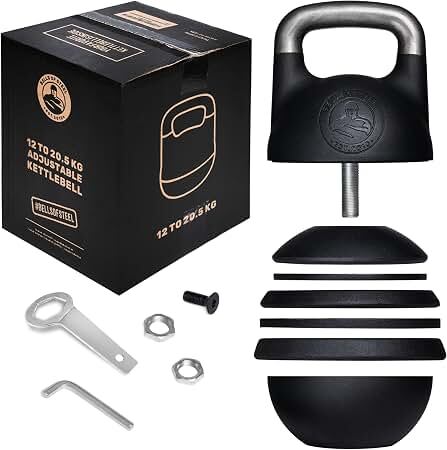
Titan Fitness engineered this unit to span a massive weight spectrum, starting at a 12-kilogram shell and expanding up to 32 kilograms using six internal cast iron plates. The included plates weigh 6 kg, 4 kg, two 3 kg units, and two 2 kg units. This configuration allows the kettlebell to step through nearly every standard competition weight increment from 12 kg to 32 kg, effectively replacing an entire rack of nineteen individual bells for most training scenarios.
The upper limit of 70.4 pounds addresses a significant gap in the adjustable kettlebell market. Many competitors cap out at 40 or 50 pounds, leaving advanced lifters unable to perform heavy cleans, snatches, or farmer carries with a single unit. By accommodating loads up to 32 kilograms, this model supports progressive overload for experienced athletes who require substantial resistance for lower-body and posterior chain exercises without needing to purchase separate fixed bells.
Manual plate loading requires tools and time
The primary friction point of this equipment is the adjustment mechanism, which demands manual intervention using wrenches. Unlike dial-based systems that shift weight in seconds, changing increments on this model requires unscrewing a bottom bolt to access an internal nut. Users must then manually remove or insert specific cast iron plates before reassembling and tightening the unit. This process can take up to two minutes per adjustment, forcing athletes to plan their workouts around static weights rather than performing rapid drop sets.
Gym Radar user reviews emphasize that this mechanical complexity makes frequent weight changes impractical during circuit training. One owner noted they eventually stopped adjusting the bell entirely and left it at its maximum 32-kilogram setting because the effort required to change increments outweighed the convenience of having multiple weights in one shell. The process is also physically awkward, as disassembly requires holding the heavy unit upside down or balancing it on one's lap while manipulating internal components.
Internal plates lack factory weight labels
A significant oversight in the manufacturing process is that the six internal cast iron plates arrive without any printed weight markings. Users are forced to identify each plate by trial and error or mark them themselves using stickers, paint markers, or crayons before they can accurately program their workouts. This lack of labeling adds an unnecessary layer of friction during assembly, particularly for those who frequently change weights.
Cast iron build stability when properly tightened
When the internal components are secured correctly, the unit offers a highly stable and well-balanced feel. Garage Gym Reviews found that once the bottom bolt is fully tightened, the bell does not rattle or shift during vigorous movements like swings or snatches. The cast iron construction provides a dense, durable mass that resists deformation over time, making it suitable for long-term home gym use.
Handle diameter supports comfortable gripping
The handle features a 35-millimeter diameter, which aligns with standard competition specifications and provides a secure grip for both single-hand and double-hand exercises. The ergonomic design of the handle allows it to rest comfortably against the forearm during front rack positions, reducing pressure points during high-repetition movements like turkish get-ups or long sets of presses.
Paint flaking and sharp manufacturing edges
Long-term durability concerns extend beyond the adjustment mechanism. Gym Radar users reported that the paint finish on the cast iron shell begins to flake after several years of regular use, which is a common cosmetic issue with budget-friendly steel equipment but still detracts from the premium competition aesthetic. Additionally, one YouTube reviewer noted sharp fragments and rough edges inside the bell cavity resulting from manufacturing processes, warning that users must handle the internal plates carefully to avoid cuts during assembly.
Strengths
- +Competition-style shell maintains a consistent footprint across all weight settings, allowing for smooth snatches and cleans.
- +Adjustable from 12 kg to 32 kg (approximately 26.5 lbs to 70.4 lbs), effectively replacing up to 19 individual kettlebells.
- +Cast iron construction provides a durable build that remains stable and well-balanced when properly tightened.
- +Ergonomic handle design offers a comfortable grip for high-repetition movements like Turkish get-ups.
Watch-outs
- −Weight adjustment is time-consuming, requiring tools to unscrew internal bolts and manually add or remove plates.
- −Internal weight plates are not factory-labeled, forcing users to identify them by trial or mark them themselves.
How it compares
This model shares the consistent competition-style shape and 35mm handle diameter of the Bells of Steel kettlebell, ensuring proper balance for snatches and cleans. However, it requires tools to unscrew internal bolts for adjustment, whereas the Bells of Steel version allows manual plate swapping without extra hardware.
Rating sources
“It works as intended and is a good option for saving space.”
Our 4.3 score is the average of the 2 scored reviews above; 5 more reviewed it without printing a score and are not in the average. Ratings marked * were derived from the reviewer’s written analysis or video transcript — the publisher didn’t print an explicit numeric score, so we inferred one from their own words. Click through to verify. More about methodology.