Built to Girevoy Sport Union standards, this kettlebell maintains a consistent shape and 35mm handle diameter that reviewers credit for proper balance during dynamic movements. Garage Gym Reviews found it durable enough to withstand drops without internal rattling, while Your Average Guy Style noted the manual plate adjustment is secure but time-consuming compared to dial systems. Lifehacker identified the 12kg minimum weight as a significant drawback for beginners or petite users who need lighter loads for strict overhead pressing. This unit fits advanced athletes seeking incremental progression in limited space, whereas novices should look elsewhere for lighter starting options.
Full review
Competition dimensions and handle geometry
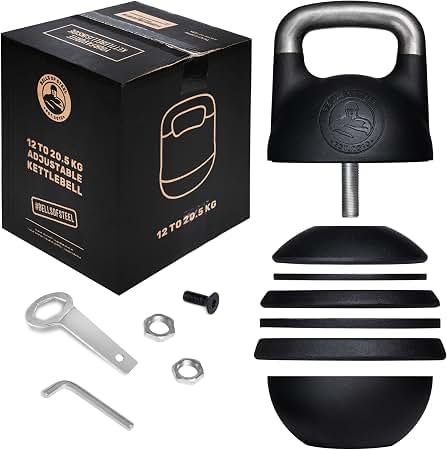
The Bells of Steel Adjustable Competition Style Kettlebell is built to the exact dimensional standards required by major governing bodies, including the Girevoy Sport Union, the International Kettlebell and Fitness Federation, and the International Union of Kettlebell Lifting. This adherence to standard means that despite being an adjustable unit capable of holding multiple iron plates, it maintains a uniform shell size regardless of the weight loaded inside. Garage Gym Reviews notes that this consistent shape allows for proper balance during dynamic movements like snatches and cleans, ensuring the bell flops over onto the wrist in the same predictable manner as a fixed-weight competition kettlebell.
Barbend highlights that these specific dimensions are crucial for athletes who prioritize technique over raw bulk. The handle diameter measures 35 millimeters, or roughly 1.4 inches, which is standard for competition-grade equipment. This thickness provides a secure grip without being excessively thick, allowing users to maintain control during high-repetition swings or overhead presses.
Manual plate adjustment process
Adjusting the weight on this unit is a manual process that requires tools and time, standing in stark contrast to dial-based adjustable dumbbells. To change weights, users must use an included Allen key to loosen the bolt at the base of the kettlebell shell. Once the bottom nut is removed, the outer steel shell can be lifted off to reveal a threaded rod with internal bolts. Users then slide on or remove specific iron weight plates before reattaching the shell and securing it back in place with the wrench and Allen key.
Your Average Guy Style describes this process as taking only a couple of minutes once familiar, but acknowledges that it is not suitable for rapid weight changes during a workout. Garage Reviews points out that if a user plans to perform supersets or drop sets involving frequent weight shifts, they should consider purchasing two separate kettlebells pre-loaded with different weights rather than adjusting one unit back and forth. The adjustment mechanism prioritizes structural integrity over speed, meaning the time investment is upfront before the actual exercise begins.
Incremental weight progression
The base configuration of this kettlebell allows for 18 different weight increments ranging from 12 kilograms to 20.5 kilograms. This range is achieved through a combination of the empty shell, which weighs approximately 12 kilograms, and a set of included iron plates: one 3-kilogram plate, two 2-kilogram plates, one 1-kilogram plate, and one 0.5-kilogram plate. The inclusion of these smaller increments is a significant feature for progressive overload, allowing users to make micro-adjustments that are often impossible with fixed cast-iron bells.
For those requiring heavier loads, an expansion pack is available that adds additional iron plates, bringing the maximum weight capacity up to 32 kilograms and offering a total of 41 distinct weight options. Lifehacker notes that this capability allows users to fill in the gaps between standard kettlebell sizes, such as creating a precise 20-kilogram load when they only own 16- and 24-kilogram fixed bells. This granularity supports both strict pressing progressions and heavy swing training within a single piece of equipment.
Durability and drop resistance
Constructed from powder-coated steel for the shell and traditional iron for the internal plates, the Bells of Steel adjustable kettlebell is built to withstand significant abuse. Your Average Guy Style confirms that the unit can be safely swung, rolled across the floor, and even dropped without fear of damaging the bell or compromising its structural integrity. The internal structure holds each plate securely in place, preventing rattling or shifting during explosive movements.
This robust construction means users can treat it with less caution than plastic-housed alternatives, making it a viable option for home gyms where equipment might be set down hard after heavy sets.
Minimum weight limitations
The primary limitation of this adjustable kettlebell is its minimum starting weight. The base shell alone weighs 12 kilograms, which equates to approximately 26 pounds. Lifehacker identifies this as a significant barrier for beginners, petite users, or those recovering from injury who may need lighter loads to learn proper technique. Many novice lifters find that 12 kilograms is too heavy for strict overhead presses or long sets of snatches, making the adjustable unit unsuitable for their initial training phase.
For these users, Bells of Steel offers a separate 6-kilogram to 12-kilogram model with different handle geometry, but it lacks the same incremental precision. Additionally, while the base unit goes up to 32 kilograms with expansion, some advanced athletes performing two-handed swings may find even this maximum weight insufficient for long-term strength gains, requiring them to eventually supplement with a T-handle setup or heavier fixed bells.
Space and cost efficiency
The most compelling argument for the Bells of Steel adjustable kettlebell is its ability to replace an entire rack of fixed weights in a fraction of the space. By consolidating these options into one unit, users save both money and room, which is particularly valuable for apartment dwellers or those with limited garage gym real estate.
Your Average Guy Style emphasizes that the lifetime warranty further enhances the value proposition, providing peace of mind against manufacturing defects. While the initial purchase price is higher than a single cast-iron kettlebell, the cost per weight increment drops dramatically compared to buying individual bells. This makes it an ideal investment for athletes who want to train across a wide spectrum of loads without maintaining a massive inventory of equipment.
Strengths
- +Maintains a traditional competition kettlebell shape and dimensions, ensuring proper balance and comfortable movement during swings, snatches, and cleans.
- +Offers highly incremental weight adjustments with included 0.5 kg and 1 kg plates, allowing for precise progressive overload within the base range.
- +Constructed from durable steel and iron components that reviewers found stable and safe to drop without internal parts coming loose or rattling.
Watch-outs
- −Weight adjustment is time-consuming as it requires manually unscrewing bolts and physically swapping iron plates rather than using a quick dial or pin mechanism.
- −The minimum starting weight of 12 kg (approx. 26 lbs) may be too heavy for beginners, petite users, or those needing lighter loads for strict overhead pressing.
How it compares
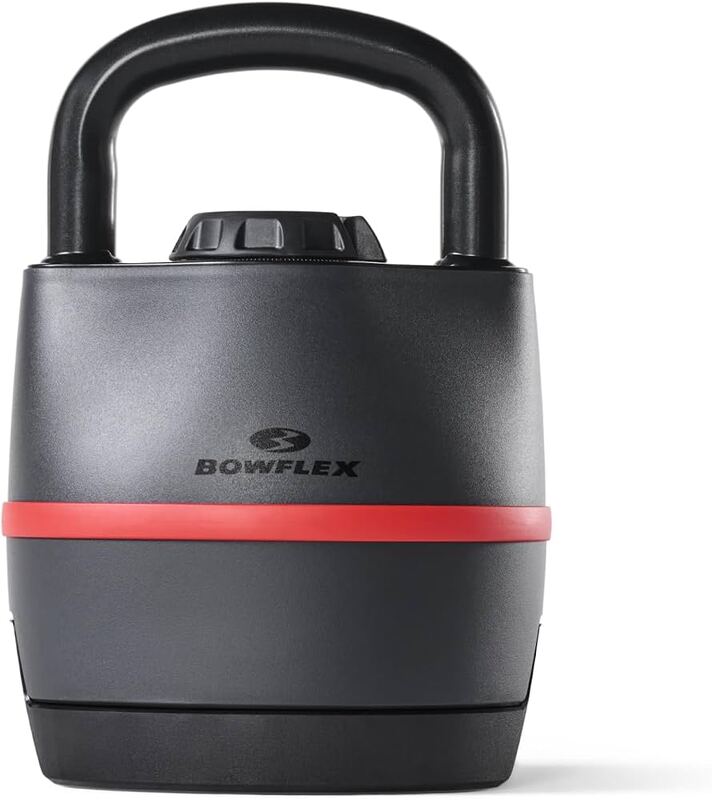
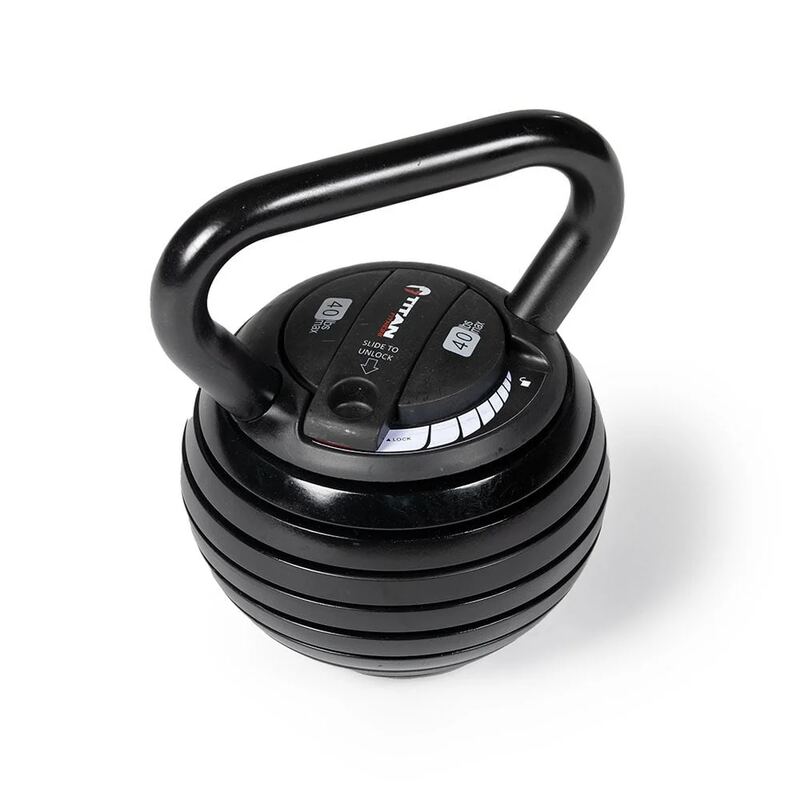
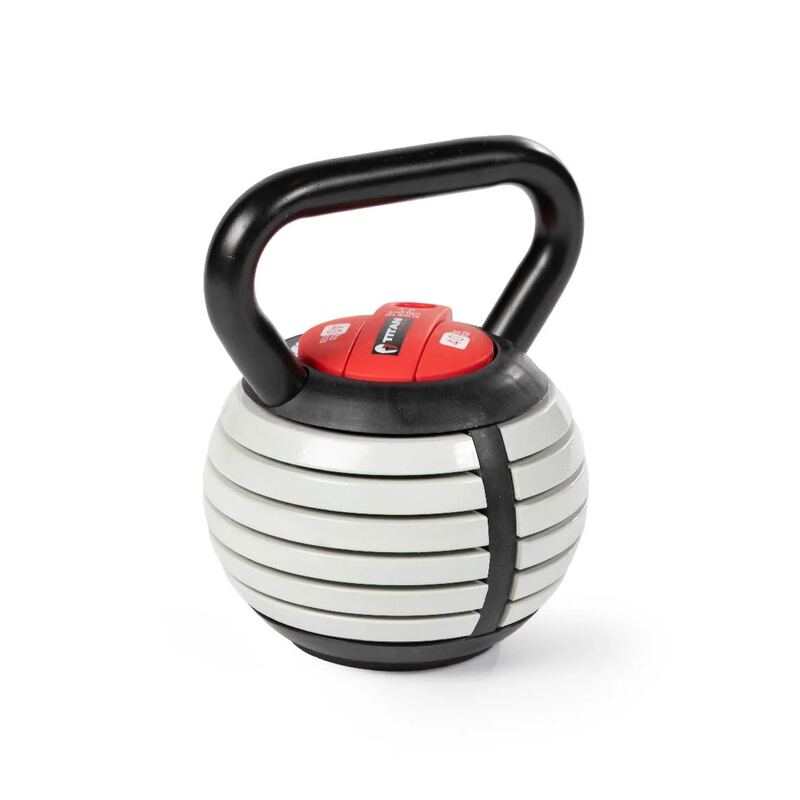
Unlike the Titan Adjustable Competition Style Kettlebell, which requires tools to adjust weight, this model allows for manual plate swapping without additional hardware, though both share a consistent competition-style shape. It offers finer 0.5 kg increments compared to the coarser cast iron plates of its sibling, but shares the same time-consuming adjustment process and lacks the quick-dial convenience found in the Bowflex SelectTech 840.
Rating sources
Our 4.2 score is the average of the 1 scored review above; 5 more reviewed it without printing a score and are not in the average. More about methodology.