Buyers who set up a JBL or UE speaker at a backyard party and decided it wasn't loud enough are the Soundboks Go's market. RTINGS, TechHive and GearJunkie all confirm it is overpowering for indoor use and right for genuine outdoor entertaining: backyard concerts, tailgates, lakeside parties. Its 20 lb weight and $699 price put it in a different category from the rest of this list, but on pure loudness no other speaker here competes.
Full review
Built for large crowds rather than small spaces
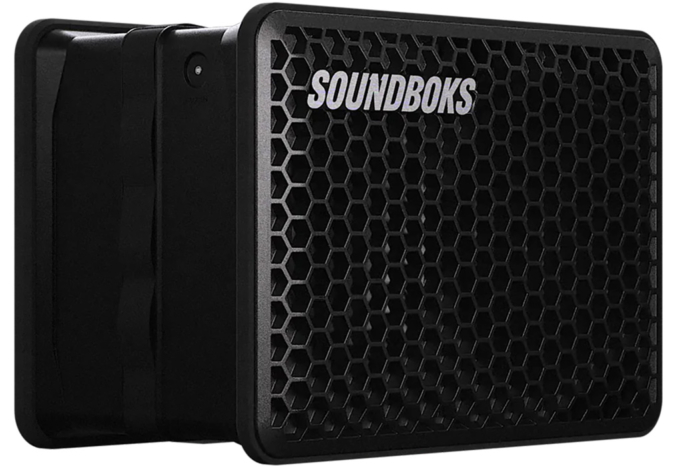
The Soundboks Go is a fundamentally different proposition than the rest of this list — a 10-inch woofer and silk-dome tweeter driven by 144W of class-D amplification, in a cabinet roughly the size of a small kick drum. RTINGS describes it as 'a smaller version of the SOUNDBOKS (Gen. 3),' which is accurate: this is the company's portable take on their professional-grade event speakers, not a consumer Bluetooth product scaled up. GearJunkie's framing captures the design philosophy: 'Less a portable speaker made to sound great, and more a great speaker made to be portable.'
TechHive observed the speaker 'sounds great almost everywhere at higher volumes, but it has too much oomph to be effective in small indoor spaces.' This is the key insight — the Soundboks Go is calibrated for outdoor distances of 20+ feet and crowds of 30+ people. At close-range listening on a small patio it's overbearing. Dissent exists: LBTech criticised the sound as 'unusually murky and stuffy' indoors and harsh outdoors, while TechHive and GearJunkie were positive about the same speaker. Read both before committing to the price.
Unmatched loudness for large outdoor crowds
121 dB maximum SPL in Bass+ mode, 119 dB in standard outdoor mode. For context: a jet engine at 100 feet is roughly 130 dB. The JBL Boombox 3 and UE Hyperboom both top out closer to 100 dB. The Soundboks Go is loud enough to genuinely concern the neighbours — GearJunkie warned 'just be mindful of your surroundings, as this speaker can overpower the world around it.'
For backyard concerts, large tailgates, or any outdoor event with 50+ attendees, this is the only speaker on this list that doesn't need to be paired with a second unit to cover the crowd. TeamUP lets you daisy-chain multiple Soundboks for even bigger setups — useful if you're hosting outdoor weddings or DJ-ing actual parties. For a normal 20-person BBQ, this is overkill.
Rugged for outdoor use but heavy and bulky to carry
The Soundboks Go is built like live-event equipment: rigid plastic chassis with the IP65 electronics coating protecting the internal amp and driver wiring against dust and water spray. The BatteryBoks battery itself is IPX6-rated. This is not a speaker you can submerge — the Bose SoundLink Max, JBL Boombox 3, and JBL Xtreme 4 all carry stronger IP67 ratings — but for sustained outdoor use in dust, dirt, light rain, and rough handling, the Soundboks build quality is unmatched.
At 20 lb, the speaker has a top-mounted carry handle plus optional shoulder strap ($59 from Soundboks). GearJunkie noted the strap is 'not ideal for carrying long distances' even with the strap, and recommended jury-rigging carabiners for camping use. This is genuinely a two-handed item to load into a car.
Swappable batteries enable endless playback
40 hours at mid-volume, dropping to 10 hours at maximum 121 dB output. The BatteryBoks is swappable — when one runs down, you slot in a fresh battery, which means professional or semi-pro users can run the speaker indefinitely with rotating batteries. Spare BatteryBoks cost roughly $200, which is steep but matches the use case. None of the other speakers on this list offer this kind of professional swap-and-go battery system.
GearJunkie's observation: 'Exceptional longevity distinguishes this model—40 hours at mid-volume in Power mode. The swappable battery design enables virtually uninterrupted playback during extended outdoor use.' For multi-day outdoor events — camping trips, weekend tournaments — this is genuinely useful. For a Saturday BBQ, the single-charge runtime alone is plenty.
App and Smart Features
The Soundboks app gives you a 3-band EQ plus three preset profiles: Power (loud), Bass+ (more bass at the expense of mids), and Indoor (tamed dynamics for smaller rooms). TeamUP lets you connect multiple Soundboks for synchronised playback across a large outdoor area. Bluetooth 5.0 with SBC codec only — no aptX, no LDAC, no AAC. This is acceptable for the use case (you're not chasing detail at 110 dB), but Hi-Fi-focused buyers will note the gap.
There's no Wi-Fi, no AirPlay, no voice assistant integration, and no microphone. The Soundboks Go is single-purpose: a portable, very loud, very rugged Bluetooth + 3.5mm speaker. TechHive flagged that initial pairing was a challenge, so it is worth setting the speaker up before — not during — an event.
One reviewer called the sound murky and stuffy indoors
The genuine drawbacks are weight (20 lb is too much for casual portability), price ($699 MSRP is roughly 2x the Hyperboom and 1.4x the Boombox 3), and the divisive sound profile. LBTech's review is the harshest, calling the speaker 'unusually murky and stuffy' indoors and saying it 'fails to deliver the necessary punchy mid-bass and treble for a party speaker.' That's a minority view — TechHive, GearJunkie, RTINGS, and AndroidGuys were positive — but it's a real disagreement worth noting before spending $699.
Secondary complaints: only Bluetooth and 3.5mm inputs (no AUX, no optical, no USB DAC), limited onboard controls, and the IP65 rating (not IP67). TechHive specifically called out “Limited inputs” and the lack of support for high-res codecs such as aptX or LDAC as drawbacks. For the intended pro-portable use case, none of this is dealbreaking — but it does justify the question 'do I actually need 121 dB?' before purchasing.
Rated for 121 dB at outdoor events of 50-plus
Buy the Soundboks Go if you genuinely host outdoor events for 50+ people, you live somewhere with neighbours far enough away that 121 dB is acceptable, you value swappable batteries for professional or semi-pro use, and you can carry or transport a 20 lb speaker without it becoming a chore. The Soundboks Go is the loudest, most rugged, most professionally-built speaker on this list — and the most expensive.
Skip it if you'll mostly listen on a patio (it's overpowering at close range), if you want easy one-hand portability (the Bose SoundLink Max or JBL Xtreme 4 are much easier to carry), if you need IP67 for poolside submersion risk (Boombox 3, SoundLink Max, or Xtreme 4 are better), or if $700 is too steep for a Bluetooth speaker (the Boombox 3 covers 80% of the same outdoor use case for less).
Swappable batteries avoid the sealed-battery failure mode
At $699 MSRP, the Soundboks Go is the most expensive speaker on this list — and on a dollars-per-dB basis, also one of the strongest values if you actually need the SPL. For comparison: the JBL Boombox 3 at $499 maxes out roughly 20 dB quieter; matching the Soundboks Go's volume with consumer speakers would require pairing multiple Boombox 3s, which still wouldn't get you the same low-frequency impact.
GearJunkie's verdict — 'Premium, Powerful, and (Just) Portable' — captures the Soundboks Go's value proposition. This isn't the value pick for casual buyers; it's the right pick for buyers who actually need a portable PA-grade speaker and would otherwise spend more on a real PA setup. For everyone else on this list's buying audience, the Hyperboom or Boombox 3 will serve better at lower cost.
The swappable battery model also creates a meaningful long-term value story. A pair of BatteryBoks at $200 each gives effectively unlimited runtime for outdoor events and removes the sealed-battery failure mode that turns the Bose, JBL Boombox 3, and UE Hyperboom into e-waste at year 5–7. For semi-professional DJs, fitness instructors who teach outdoors, or anyone who runs the speaker hard for 4+ hours a day on weekends, the math pencils out faster than it looks. For someone using it once a month at a family BBQ, the cost is harder to justify.
Strengths
- +121 dB maximum SPL — the loudest portable Bluetooth speaker in this list by a wide margin
- +144W class-D amplification with a 10-inch woofer for genuine bass impact at distance
- +Replaceable, swappable batteries — 40 hours at mid-volume, 10 hours at maximum SPL
- +Built for live-event abuse: IP65 electronics coating plus shockproof housing
- +Bluetooth 5.0 with TeamUP feature for daisy-chaining multiple Soundboks for events
Watch-outs
- −20 lb (9 kg) and roughly the size of a small kick-drum — needs a shoulder strap to carry
- −IP65 rating only — not safe for submersion or sustained rain
- −$699 MSRP is more than 2x the Xtreme 4 or Hyperboom
- −Only Bluetooth and 3.5mm inputs — no AUX, no USB DAC, no optical, no Wi-Fi
- −Firmware updates have caused multi-hour outages reported by reviewers
How it compares
The Soundboks Go is the only speaker in this list that genuinely competes with PA equipment — its 121 dB max SPL is roughly 10–15 dB louder than the JBL Boombox 3 or UE Hyperboom, and 20+ dB louder than the JBL Xtreme 4 or Bose SoundLink Max. The cost is portability and price: at 20 lb it's the heaviest by a wide margin, and the $699 MSRP is 75–100% above the Hyperboom and Boombox 3. There's also genuine dissent in reviewer opinions — LBTech found the sound harsh at high volumes where TechHive and GearJunkie praised it.
Rating sources
“The SOUNDBOKS Go is a party speaker designed to look like a smaller version of the SOUNDBOKS (Gen. 3), and is portable enough for you to easily bring the party.”
“It sounds great almost everywhere at higher volumes, but it has too much oomph to be effective in small indoor spaces.”
Archived — this review is no longer available at the publisher. The score above is the one they published.
“Less a portable speaker made to sound great, and more a great speaker made to be portable”
Our 3.7 score is the average of these published ratings. Ratings marked * were derived from the reviewer’s written analysis or video transcript — the publisher didn’t print an explicit numeric score, so we inferred one from their own words. Click through to verify. More about methodology.