Want serious volume from a self-contained battery-powered box? The Boombox 3 is the default backyard-party pick. Tom's Guide, SoundGuys and Stereoguide all agree it sounds wide, loud and bass-heavy without distorting at the top of its volume range, and the IP67 rating plus 24-hour battery let a daytime cookout roll into a night hang without a stop. Weight is one trade-off; the missing multipoint feature reviewers flagged at launch is the other.
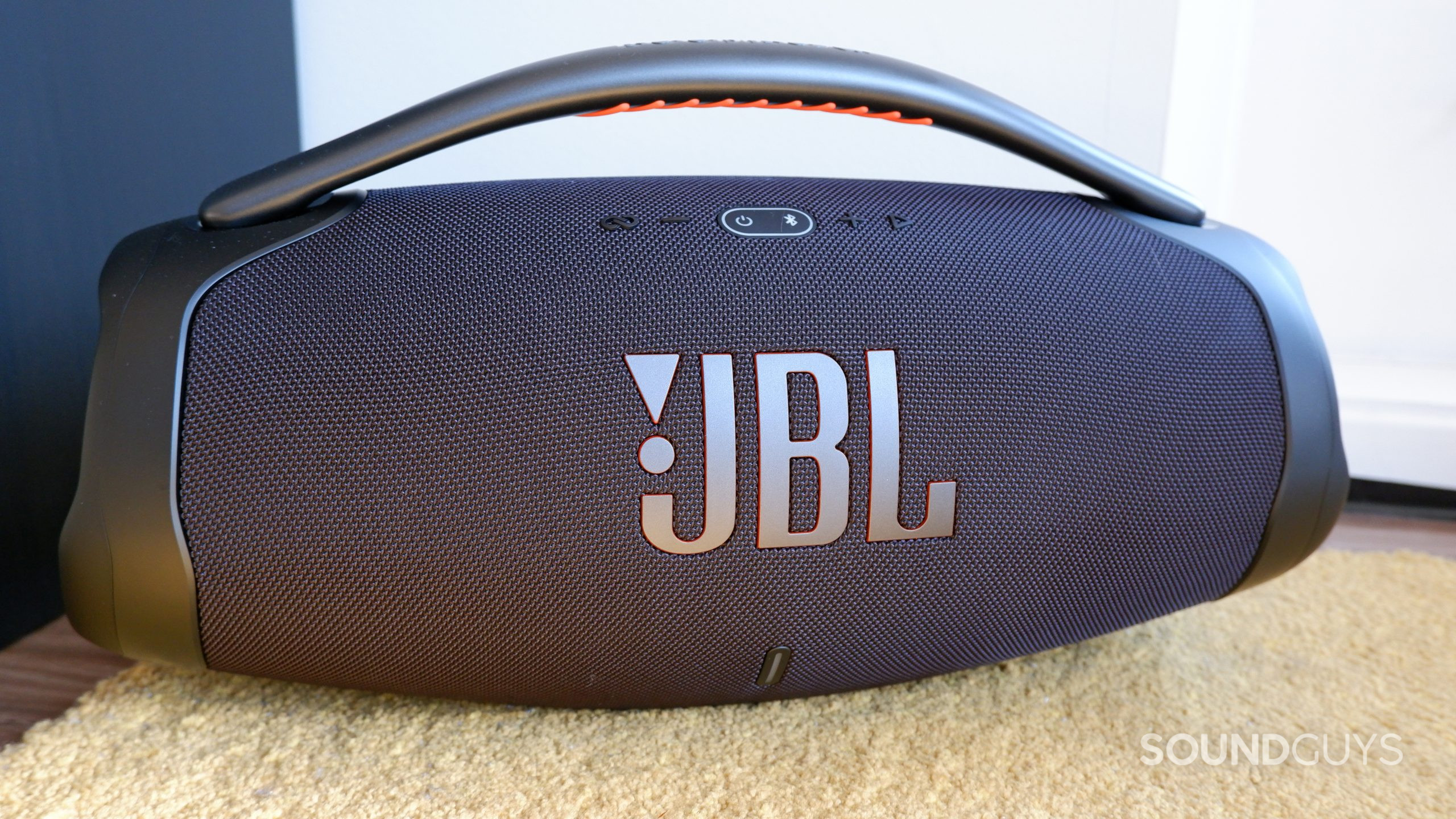
Full review
Bass and clarity thrive at high volumes
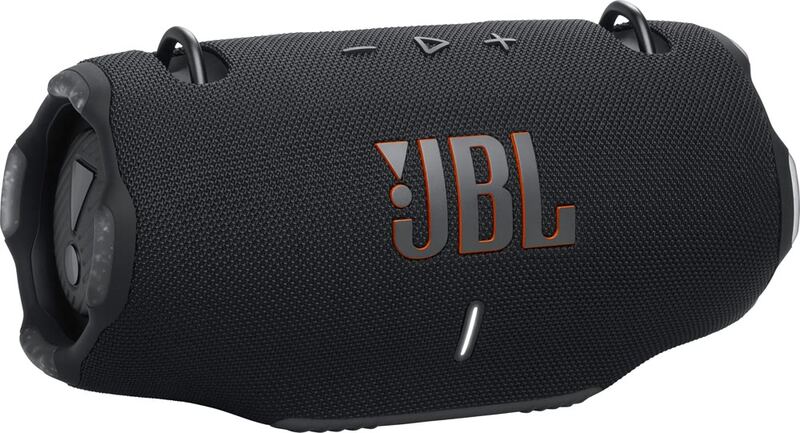
The JBL Boombox 3 was tuned for the open air, and reviewers consistently call out how well its bass survives the move from a small room to a backyard. SoundGuys describes the speaker as 'very bass-heavy' with 'enjoyable bassy sound' that works at house, pool, and beach parties, while Stereoguide notes a 'balanced sound tuning, where also mids and trebles blend in harmoniously' once you turn the volume past about halfway. The 3-way driver array — a single subwoofer, two midrange drivers, and two tweeters — splits the work better than the two-way layouts in the Xtreme 4 or SoundLink Max, which is why mids stay legible when 20 people are talking over the music.
Tom's Guide ran it side-by-side with smaller party speakers and concluded that 'Boombox 3 sounds better than those options at higher volume,' a key point for outdoor listening since most Bluetooth speakers compress dynamics and harshen the upper mids as they approach maximum SPL. Stereoguide's measurement of the JBL's behaviour as volume climbs found 'the subwoofer seemed to really get going when the volume control was turned halfway up,' so don't judge the bass at conversational levels — this speaker is designed to be cranked.
Powerful output and durability for outdoor use
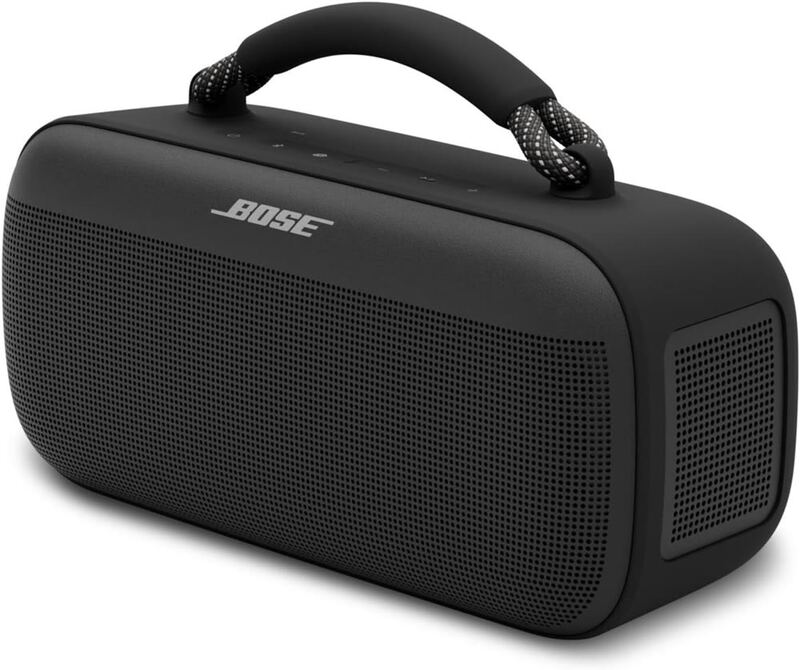
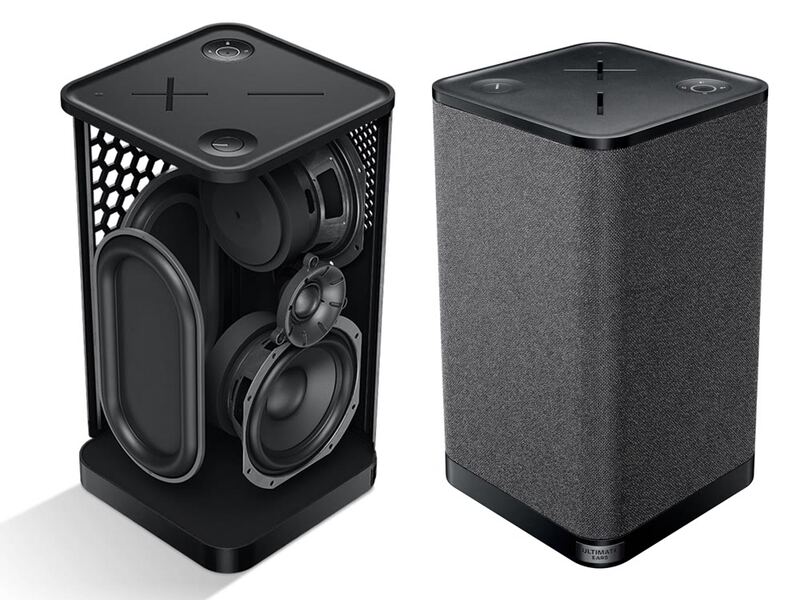
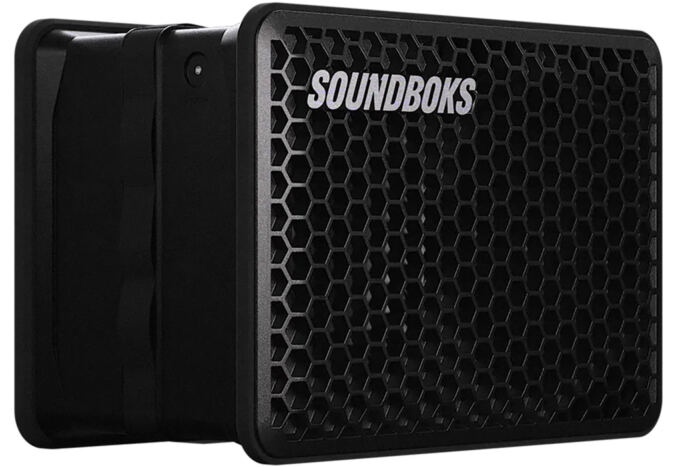
On battery the Boombox 3 produces 136W RMS, climbing to a full 180W when plugged into AC power. SoundGuys called it 'a solid speaker for anything from house parties to pool parties to beach parties' and 'loud enough to keep a sizeable party going in a single room,' and Tom's Guide called the soundstage 'wide' enough to cover a backyard without the muddy mono image you get from smaller speakers. That puts its real-world coverage above the JBL Xtreme 4 (70W battery) and the Bose SoundLink Max but below the UE Hyperboom or any of the Soundboks line, which are designed for larger crowds.
A practical note from SoundGuys: its 'durable IP67 rating' means 'you can be sure it can survive wherever you take it.' That matters for outdoor use because you'll be moving it from garage to patio to truck bed all summer, and the rigid handle plus rubber end caps survive that handling better than the softer rope handles on the Bose or the strap-only Xtreme 4.
Rugged build with reliable IP67 water resistance
The Boombox 3 is rated IP67, meaning full dust ingress protection and submersion in up to one meter of fresh water for 30 minutes. Tom's Guide noted that 'with an IP67 durability rating, you don't need to worry if a sudden storm sweeps in or if it gets dunked in the pool,' which matches what SoundGuys and Stereoguide observed in their own splash tests. The catch — and SoundGuys flags this — is that the rubber port flap covering the USB and aux jacks must be fully closed for the rating to hold; leaving it cracked while charging in the rain defeats the seal.
Build is plastic and rubber over a metal-cored handle. The handle isn't padded but it spreads weight evenly across the palm, which is more important than it sounds when you're carrying 14.7 lb across a long lawn. The signature waterproof fabric grille resists scuffing from being set down on concrete or gravel.
Decent runtime but slow charging and no replaceable battery
JBL's 24-hour rating is measured at moderate volume with a single Bluetooth source. Reviewers across Tom's Guide, SoundGuys, and Stereoguide all accept the figure as broadly accurate; the catch, as Stereoguide noted, is a 6.5-hour recharge from empty, so you can't top it up between an afternoon pool party and an evening BBQ in under a few hours of downtime. The Boombox 3 also doubles as a 10,000 mAh power bank — useful for charging the DJ's phone, but obviously eats into runtime.
Compared to the Soundboks Go's 40 hours and the Hyperboom's 22-hour measured runtime, the Boombox 3 sits roughly in the middle of the field. The replaceable battery design of the Xtreme 4 is a feature the Boombox 3 lacks — when this battery degrades after 3–5 years, the whole speaker is e-waste.
Bluetooth, App, and Smart Features
Bluetooth 5.3 with SBC codec only — no LDAC, no aptX Adaptive — is the headline feature gap. For backyard listening this is largely a non-issue (you're not chasing high-resolution detail at 95 dB), but Hi-Fi reviewers consistently flag it as a missed opportunity at the price. SoundGuys explicitly tested the advertised multipoint feature and reported 'advertised Bluetooth multipoint doesn't function properly' — a real annoyance if you're rotating DJ duties between two phones.
The JBL Portable app gives you a basic three-band EQ (bass / mid / treble) and PartyBoost controls for daisy-chaining additional JBL speakers. Stereoguide and SoundGuys both wanted finer-grained EQ control, especially given the speaker's bass-forward default tuning. There's no Wi-Fi, no AirPlay, and no Alexa/Google integration on the standard Boombox 3 — those features live in the separate Boombox 3 Wi-Fi variant.
6.5-hour recharge and no shoulder strap
The two recurring complaints across reviews are weight and price. SoundGuys flags 'the first negative is the price: it's high,' and at 14.7 lb the Boombox 3 sits in awkward territory — too heavy to carry casually, too light to feel like a 'permanent' patio speaker. The handle is hard metal with no padding, which gets uncomfortable on a long walk. There's no shoulder strap option from JBL.
Beyond ergonomics, the missing features stack up: no microphone for speakerphone use, no aptX/LDAC, no working multipoint, no Wi-Fi or smart-assistant support, and a long 6.5-hour recharge time. For $499 you're paying for the sound and the IP67 rating; everything else is mid-tier. Stereoguide also noted that competing speakers in the same price bracket (notably the UE Hyperboom) deliver more controllable EQ via app.
Built for 15 to 30 person deck parties
Buy the Boombox 3 if you host outdoor gatherings of 15–30 people on a deck, patio, or driveway, want a true battery-powered speaker (not a Wi-Fi-tethered one like the Sonos Move 2), and need IP67 durability for rain and pool splashes. It is the cleanest single-speaker solution in this category — load it in the car, carry it to the lake, run it for a full day on one charge.
Skip it if you'll mostly listen indoors or on a small balcony (the Bose SoundLink Max is more proportionate and easier to live with), if you want the loudest possible speaker (the Soundboks Go pushes 121 dB versus the Boombox 3's roughly 100 dB), or if you need Wi-Fi multi-room integration (the Sonos Move 2 fits that brief instead).
Sealed battery means replacement, not a swap, at 3-5 years
At $499 MSRP — frequently discounted to $400 or below — the Boombox 3 is priced about $100 less than the UE Hyperboom and $100 more than the JBL Xtreme 4. Tom's Guide and Stereoguide both judge it good value for the sound-per-dollar at this size, with the caveat that you're paying for raw output and IP67 ruggedness rather than smart features or codec support. Stereoguide observed that competing wireless speakers in the same price bracket typically deliver less bass response while charging extra for app or Wi-Fi features the Boombox 3 leaves off.
If you find it on sale near $350–$400, it becomes the clear best-value backyard speaker on this list. At full MSRP, the Bose SoundLink Max and UE Hyperboom both make stronger cases on premium materials and feature depth respectively, but neither matches the Boombox 3's combination of carry-anywhere battery operation and large-party volume.
Long-term cost of ownership is the area where the Boombox 3 is weakest in this list. The sealed battery — non-replaceable, unlike the JBL Xtreme 4 or Soundboks Go — means typical battery degradation at 3–5 years will push you toward a full replacement rather than a swap. Factor that in if you intend to keep the speaker for the full decade-plus life of the rest of its hardware. Spare yourself the headache by buying on sale and treating the unit as a 5–7 year asset rather than a forever speaker.
Strengths
- +180W total output on AC (136W on battery) genuinely fills a backyard or driveway
- +IP67 dust and water rating shrugs off pool splashes and sudden downpours
- +24-hour rated battery comfortably covers an all-day BBQ on a single charge
- +Built-in 10000 mAh power bank charges phones from the rear USB-A port
- +PartyBoost lets you stereo-pair a second Boombox 3 for a wider sound field
Watch-outs
- −14.7 lb (6.7 kg) with a hard metal handle — not a one-hand carry to the park
- −Bluetooth multipoint is advertised but reviewers report it doesn't reliably work
- −App EQ is a basic three-band slider with no per-frequency control
- −Bluetooth 5.3 with SBC codec only — no LDAC or aptX Adaptive
How it compares
The Boombox 3 delivers more raw output (180W AC / 136W battery) than the smaller JBL Xtreme 4 (70W battery / 100W AC) and the Bose SoundLink Max, but the UE Hyperboom edges past it on stereo soundstage thanks to its larger cabinet, and the Soundboks Go hits a much higher peak SPL (121 dB vs the Boombox 3's roughly 100 dB territory). Pick the Boombox 3 over the Hyperboom if you want a true battery + handle combo you can carry to the lake — the Hyperboom's IPX4 rating and heavier static form factor are happier on a patio.
Rating sources
“JBL Boombox 3 sounds good, and it gets very loud. Turning it up high doesn't make the audio sound bad.”
“The latest generation of this portable outdoor speaker delivers big bass and a wide sound at impressive volume.”
“balanced sound tuning, where also mids and trebles blend in harmoniously”
Our 4.0 score is the average of these published ratings. More about methodology.