Musictech found remarkable low-frequency reproduction that is much bigger and tighter than expected from a speaker of its size. The mid-woofer paired with two angled tweeters creates stereo separation, while Trueplay tuning helps establish the wider sweet spot noted by Trusted Reviews for smaller rooms. However, the USB-C port requires purchasing a separate adapter for Ethernet hardwiring or connecting standard 3.5mm audio devices. Touch controls can be difficult to see or use due to a lack of tactile feedback and visibility in certain lighting conditions.
Full review
Sound profile and driver configuration
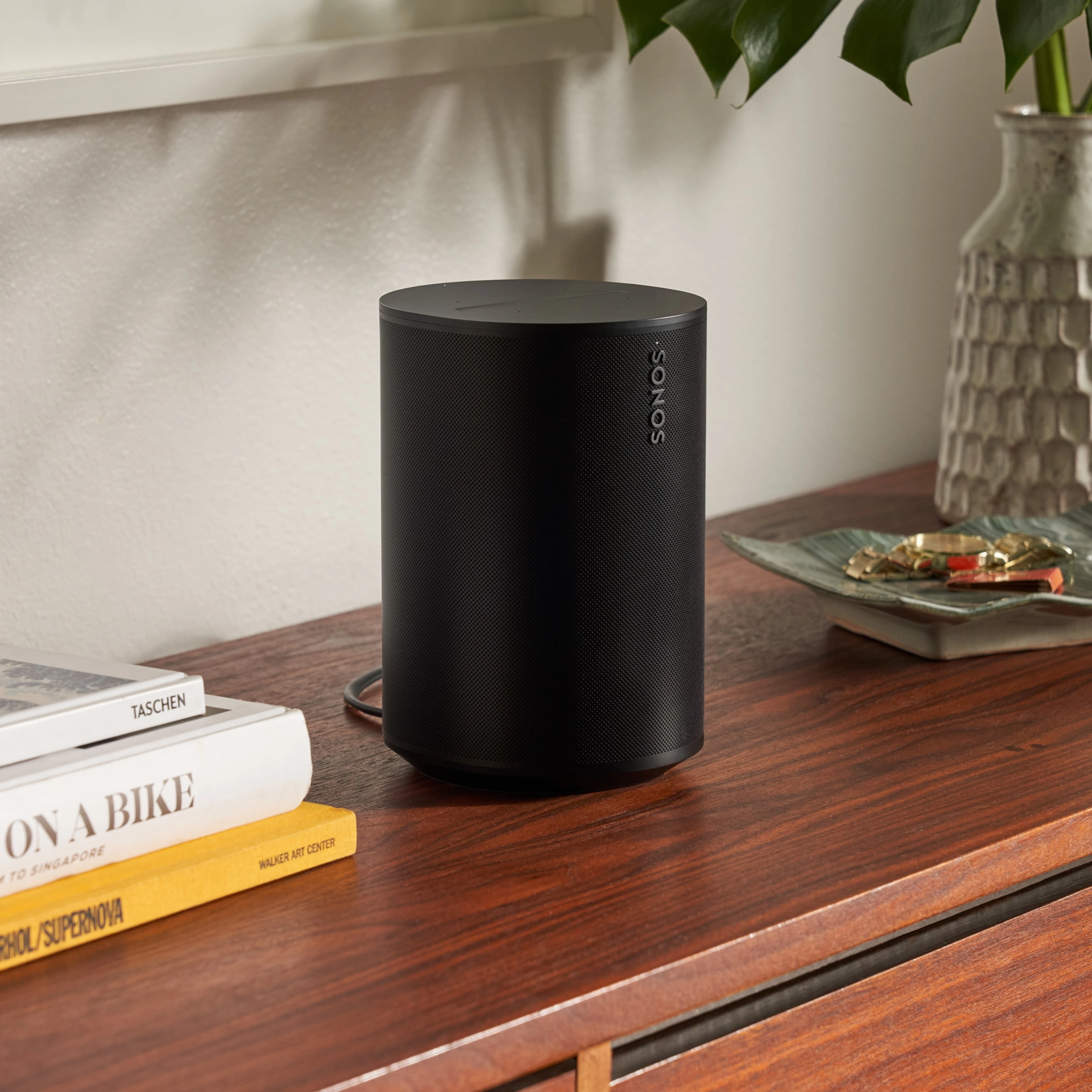
The Sonos Era 100 utilizes a mid-woofer paired with two angled tweeters to generate its audio output. This specific driver arrangement allows the speaker to produce stereo separation rather than relying on mono playback, which is a notable shift for compact smart speakers of this physical size. The acoustic design aims to widen the listening area so that the stereo effect remains perceptible even when the listener is not sitting directly in front of the unit.
Musictech found remarkable low-frequency reproduction from the Era 100, noting that the bass output is much bigger and tighter than expected for a speaker of its calibre. The three class-D digital amplifiers work in tandem with this driver setup to deliver powerful audio without significant distortion at high volumes. Even without manual equalization adjustments, the mid and high frequencies maintain vibrance, creating a rich and balanced soundstage that fills small to medium-sized rooms effectively.
Room tuning capabilities via Trueplay
The Era 100 relies on Sonos' Trueplay technology to calibrate its equalizer settings based on the specific acoustics of the room it occupies. This process involves playing a preset signal and monitoring how sound reflects off nearby surfaces, subsequently adjusting the audio output to compensate for those reflections. Trusted Reviews noted that this tuning capability significantly contributes to the speaker's wider sweet spot compared to previous models in the lineup.
The app offers two distinct methods for executing this calibration depending on the user's mobile device. iOS users can utilize Advanced Trueplay, which requires an iPhone and its built-in microphone to perform a thorough sweep of the room. Android users are limited to Quick Tune, which does not rely on the phone's hardware in the same way but still provides necessary acoustic adjustments. Both methods ensure that the speaker adapts to its environment rather than delivering a flat, unrefined audio profile.
Physical controls and touch interface
The top surface of the Era 100 features capacitive touch controls that manage playback, track skipping, and volume adjustments via a central slider. While these controls are responsive to taps and swipes, they present practical usability challenges in certain lighting conditions. The lack of tactile feedback means users must visually locate the specific zones for increasing or decreasing volume, which can be difficult if the speaker is placed on a dark surface or viewed from an angle.
The physical design includes a repositioned LED light indicator that sits at the front edge of the top panel to show status without requiring the user to walk around the unit. Despite this improvement in visibility, the touch interface remains a point of contention for those who prefer distinct physical buttons. The reliance on smooth surfaces means accidental touches can occur during cleaning or when placing items near the speaker.
Microphone privacy and hardware switches
Privacy concerns regarding always-on microphones are addressed through two distinct methods built into the Era 100. Pressing the speech bubble button on the top surface disables the voice assistant functionality while leaving other microphone-enabled features operational. This allows users to maintain basic smart capabilities without risking accidental wake words triggering unwanted responses.
For stricter privacy requirements, a hardware switch located on the rear panel completely disconnects power from the microphones. When this switch is engaged, both voice operation and Trueplay room tuning are disabled entirely. Trusted Reviews highlighted this physical cutoff as a critical feature for users who want absolute assurance that their conversations cannot be captured or transmitted by the device.
Connectivity options and adapter requirements
The Era 100 supports Wi-Fi, Bluetooth streaming, and AirPlay 2 for wireless music delivery. It also includes a USB-C port on the rear panel that can function as an audio line-in or provide hardwired Ethernet connectivity to the router. However, this versatility comes with a significant caveat regarding included accessories. The unit does not ship with any adapters, forcing users who want to connect legacy devices like turntables via a 3.5mm mini-jack to purchase separate hardware.
Musictech noted that connecting standard audio equipment requires purchasing specific Sonos adapters, such as the Line-In Adapter or the Combo Adapter for Ethernet. These accessories are sold separately and add to the overall cost of ownership. The absence of included cables means that users upgrading from older models with built-in ports must factor in additional expenses to replicate previous connectivity setups.
App ecosystem and local library support
The Sonos app serves as the central hub for managing the Era 100, offering extensive control over streaming services, equalization settings, and multi-room audio grouping. Users can link accounts from major platforms like Spotify and Apple Music, as well as access local music libraries stored on networked hard drives or computers. This capability allows audiophiles to stream uncompressed or FLAC files directly from their personal collections without relying solely on cloud-based subscriptions.
The app also includes manual equalization adjustments and volume limit options for further customization. While the interface is generally praised for its comprehensiveness, some users have noted that it currently lacks support for saving custom EQ presets. This limitation requires manual re-adjustment of sound profiles every time the speaker is reset or moved to a new network environment.
Design evolution and physical footprint
The Era 100 replaces the discontinued Sonos One with a taller, sleeker design that maintains a similar width but increases in depth. The gentle curvature of the enclosure gives it a slimmer appearance while adhering to Sonos' industrial aesthetic. Its dimensions allow it to fit easily onto kitchen countertops or into standard bookshelves without dominating the visual space.
The build quality reflects a premium feel with solid materials that resist wobbling during bass-heavy playback. The color options remain limited to black and white, ensuring consistency across different rooms in a home setup. Despite its compact size, the speaker weighs enough to feel substantial and stable on any surface.
Strengths
- +Musictech found remarkable low-frequency reproduction that is much bigger and tighter than expected from a speaker of its size.
- +Trusted Reviews noted the wider sweet spot compared to previous models, making it easier to enjoy stereo separation in smaller rooms.
- +Trueplay tuning is available on iOS devices using either Quick Tune or Advanced Tuning with the included calibration microphone.
Watch-outs
- −The USB-C port requires purchasing a separate adapter for Ethernet hardwiring or connecting standard 3.5mm audio devices.
- −Touch controls can be difficult to see or use
How it compares
The Sonos Era 100 features remarkable low-frequency reproduction that is much bigger and tighter than expected from a speaker of its size. The mid-woofer paired with two angled tweeters creates stereo separation, while Trueplay tuning helps establish the wider sweet spot noted by Trusted Reviews for smaller rooms.
Rating sources
Counts as 4.52/5 in our score — this publisher's 156 scores on the site average 4.15, so its scores are adjusted up to compare fairly with other publishers.
Counts as 4.16/5 in our score — this publisher's 181 scores on the site average 4.00, so its scores are adjusted up to compare fairly with other publishers.
Counts as 4.45/5 in our score — this publisher's 43 scores on the site average 4.22, so its scores are adjusted down to compare fairly with other publishers.
Counts as 4.54/5 in our score — this publisher's 33 scores on the site average 4.70, so its scores are adjusted down to compare fairly with other publishers.
Our 4.4 score is the average of the 5 scored reviews above, each adjusted for how strictly its publisher scores; 1 more reviewed it without printing a score and is not in the average. More about methodology.