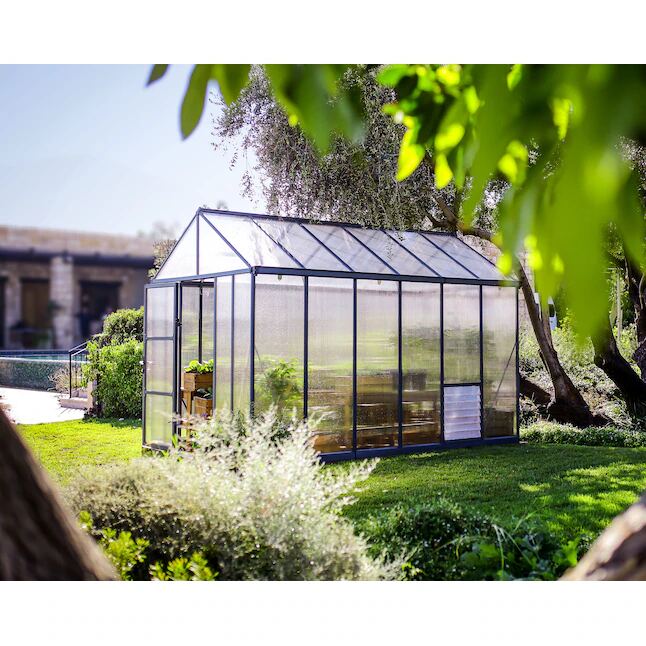
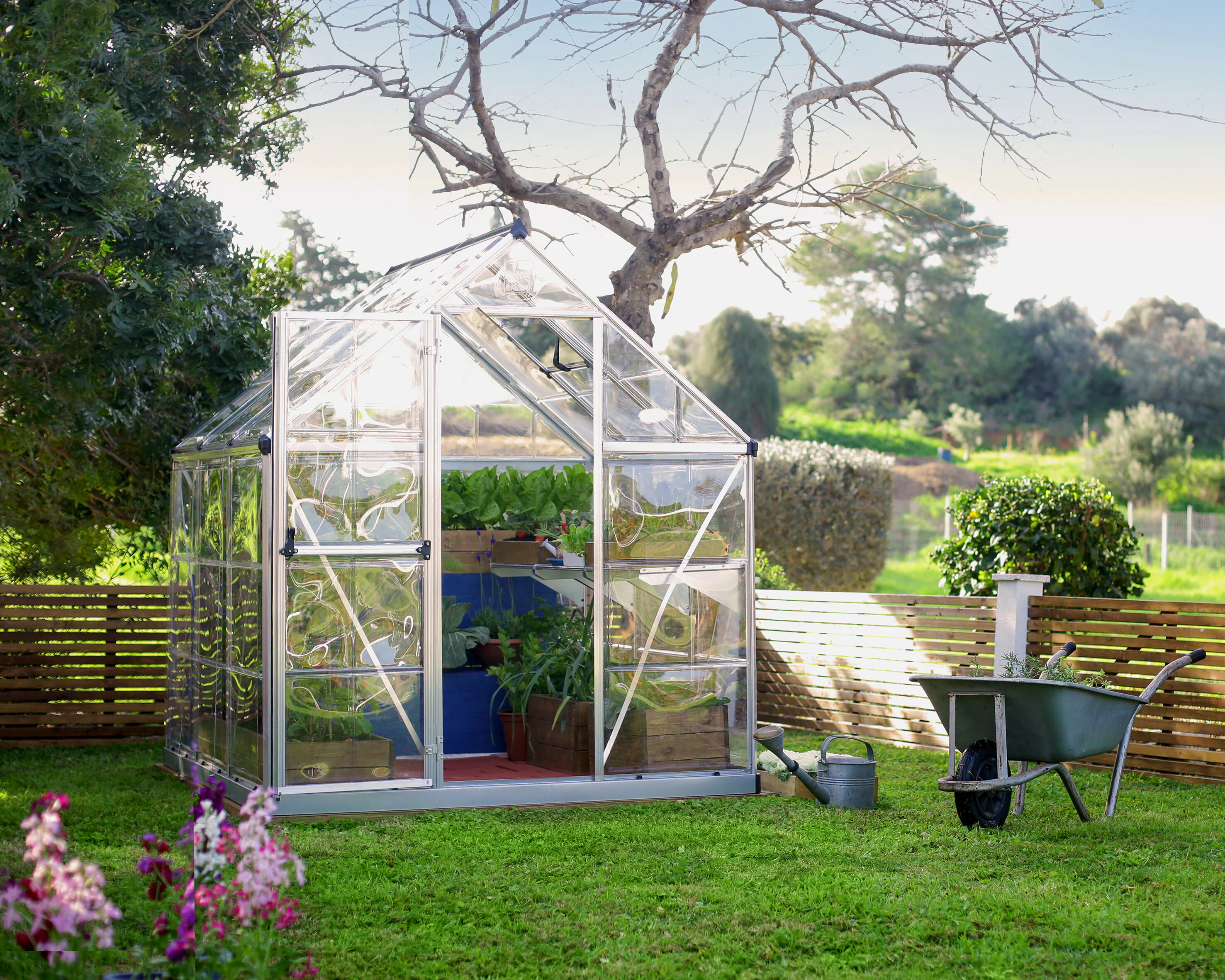
The Palram Canopia Nature Harmony greenhouse combines clear side panels for 90 percent light transmission with diffused roof panels to prevent foliage burn, a hybrid design that Garden Street notes balances glass-like clarity with protective diffusion. Its rust-resistant aluminum frame and galvanized steel base provide structural stability in high winds, while UV-protected polycarbonate panels resist discoloration over time, as Redemption Permaculture found after years of use. Assembly is complex and typically requires two people with several hours of dedicated time to manage tight-fitting joints and precise alignment. This model fits gardeners seeking durable season extension who are willing to invest effort in construction, but those needing year-round winter growing or easy setup should look elsewhere.
Full review
Hybrid glazing balances light and diffusion
The Palram Canopia Nature Harmony greenhouse utilizes a hybrid polycarbonate panel system that separates the roof from the walls to optimize plant conditions. Meanwhile, the roof panels feature a ribbed or diffused design that scatters sunlight more evenly across the interior space. This specific configuration prevents harsh direct beams from burning foliage while still allowing maximum illumination to penetrate deep into the structure.
Garden Street notes that this dual-panel approach offers the advantages of both glass-like clarity and protective diffusion. The clear walls allow gardeners to see clearly inside the greenhouse, which is useful for monitoring plant health without entering the space. The diffused roof ensures that light reaches lower leaves and ground-level plants uniformly. This design choice addresses a common complaint with single-glazing greenhouses where top-heavy shading occurs due to concentrated overhead sunlight.
Polycarbonate panels resist discoloration over time
A primary selling point of the Harmony greenhouse is its UV-protected polycarbonate construction. Unlike glass, which can shatter under impact, these panels are described as virtually unbreakable and highly resistant to weathering. Garden Street confirms that the material does not opacify or yellow over time, maintaining its clarity for years. This durability makes it a safer alternative to traditional greenhouses, especially in areas prone to hail or falling branches.
Redemption Permaculture reports owning their Hybrid Hobby Greenhouse for several years and notes that the panels have held up exceptionally well against abuse. The reviewer initially found the panels felt flimsy during assembly but observed no cracking or discoloration after extended use. This long-term resilience suggests that the UV layer effectively protects the plastic from solar degradation, a common failure point in cheaper greenhouse kits.
Aluminum frame and steel base ensure structural stability
The structural integrity of the Harmony relies on a rust-resistant aluminum frame mounted on a galvanized steel base. This combination prevents corrosion, which is critical for outdoor structures exposed to constant moisture and soil contact. The heavy-duty nature of these materials allows the greenhouse to withstand significant environmental stress without warping or collapsing.
Canopia states that their greenhouses are engineered to handle wind loads up to 56 miles per hour and snow loads of up to 20.5 pounds per square foot. Redemption Permaculture attests to this stability, noting that they attached the frame to a heavy four-by-four base which kept the greenhouse grounded through years of high-wind storms. The galvanized steel base provides a solid anchor point that distributes weight evenly across the foundation.
Assembly requires multiple people and several hours
Building the Harmony is not a quick task; it demands significant time and physical effort. Garden Street reports that assembly typically takes four to five hours and strongly advises having someone skilled at reading complex instruction manuals present. The process involves numerous small parts, tight-fitting joints, and precise alignment of panels into aluminum channels.
YouTube reviewers echo this sentiment, noting that the greenhouse is not as simple as assembling standard flat-pack furniture. One reviewer found that plastic joints fit very tightly and required lubrication with WD-40 to slip the aluminum pieces together without damaging the frame. Another user had to call on family help because the instructions were too complex to manage alone. Skipping steps or failing to read ahead often leads to misaligned panels that are difficult to correct later.
Rain gutters require modification to function properly
While the Harmony includes built-in rain gutters, their out-of-the-box performance is flawed. A YouTube reviewer who assembled a seven-foot model reported that the gutter system leaks through gaps and fails to redirect water effectively without intervention. To make it functional, they had to apply silicone sealant along the seams and modify the downspout area.
This issue highlights a common theme in polycarbonate greenhouse assembly where factory tolerances may not perfectly align with real-world weather conditions. Gardeners expecting immediate rainwater collection capabilities will need to invest additional time in sealing gaps. Without these modifications, water may drip directly onto plants or pool around the base of the structure.
Interior temperature spikes demand active ventilation
The greenhouse excels at trapping heat but struggles to dissipate it during peak summer conditions. This extreme heat can damage sensitive plants if not managed immediately.
To combat this, users must rely on adjustable roof vents and door openings. One reviewer installed a small fan to circulate air during hot spells, while another recommended an automatic roof vent opener that activates based on temperature thresholds. Without these additions or manual intervention, the greenhouse can become an oven for seedlings in mid-summer climates.
Height limitations affect user comfort and plant space
This means taller users will experience cramped conditions when moving inside or tending to plants on benches. A YouTube reviewer who is six feet tall found themselves crammed inside and unable to move comfortably without bending.
To solve this, some owners build raised wooden bases using stacked two-by-six beams. This elevation raises the entire structure by about a foot, providing crucial headroom for adults and extra vertical space for growing plants. While not required, this modification significantly improves the usability of the interior workspace.
Insulation levels limit winter heating viability
The single-layer polycarbonate panels provide minimal thermal retention compared to double-wall or glass alternatives. A YouTube reviewer in Zone 9b noted that they do not heat the greenhouse because it lacks sufficient insulation to justify the energy cost. Without a heat source, the interior temperature drops to match outdoor conditions once the sun sets.
This limitation makes the Harmony best suited for season extension and frost protection rather than year-round growing in cold climates. Gardeners in colder regions may need to wrap the interior with bubble wrap or invest in expensive heating systems to maintain viable winter growth.
Strengths
- +UV-protected polycarbonate panels are virtually unbreakable and resist discoloration over time.
- +Rust-resistant aluminum frame paired with a galvanized steel base provides structural stability in high winds.
- +Hybrid glazing design features diffused roof panels for even light dispersion and clear side panels for 90% light transmission.
Watch-outs
- −Assembly can be time-consuming and requires careful instruction reading
How it compares
The Palram Canopia Nature Harmony Greenhouse features a hybrid glazing design with diffused roof panels, offering better light dispersion than the clear-only panels of the Outsunny Walk-in Greenhouse. It shares the aluminum frame construction of the Glory but provides a more compact footprint suitable for smaller yards.
Rating sources
“The overall versatility of this greenhouse and the excellent quality of materials make this model our top pick in this review…”
“Overall its a pretty solid greenhouse.”
“it's holding up really really well... I feel like it's holding up so much better just because we took that extra effort and it was extra effort”
Our 4.4 score is the average of the 1 scored review above; 4 more reviewed it without printing a score and are not in the average. Ratings marked * were derived from the reviewer’s written analysis or video transcript — the publisher didn’t print an explicit numeric score, so we inferred one from their own words. Click through to verify. More about methodology.