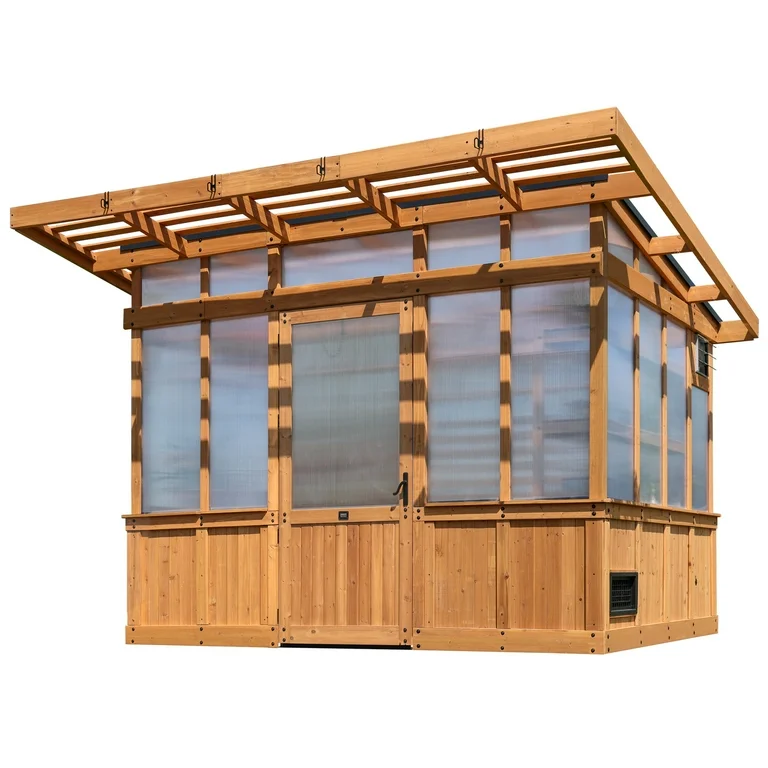
The Backyard Discovery Poppy 11 utilizes solid cedar wood and commercial-grade four-wall polycarbonate panels to deliver superior durability and heat retention. Automated climate management is handled by a thermostat-controlled exhaust fan and passive vents, while the patented PowerPort system provides convenient electrical access for tools and devices. However, assembly is complex and time-consuming, requiring multiple helpers to manage heavy freight boxes and thousands of fasteners over several days. This model fits gardeners who prioritize long-term structural integrity and integrated features, but those seeking quick setup or minimal labor should look elsewhere.
Full review
Cedar construction and four-wall polycarbonate durability
The structural foundation of the Backyard Discovery Poppy 11 relies on solid cedar wood, a material choice that reviewers consistently highlight for its natural resistance to rot, decay, and insects. Unlike aluminum or PVC alternatives, this timber frame provides substantial weight and rigidity without requiring heavy steel supports. The light brown finish blends seamlessly into traditional backyard settings while offering the durability needed for year-round outdoor exposure. Reviewers note that cedar ages gracefully in high-moisture environments typical of greenhouses, making it a superior choice for long-term structural integrity compared to softer woods or synthetic materials.
The glazing system utilizes commercial-grade four-wall polycarbonate panels rather than standard twin-wall options. The increased thermal mass allows the greenhouse to maintain stable internal temperatures during colder months without excessive reliance on supplemental heating. Reviewers emphasize that this level of insulation is rare in kits under thirty thousand dollars, providing a significant advantage for gardeners operating in regions with harsh winters or unpredictable temperature swings.
Weather resistance specifications are robust across all tested models. According to Love Your Land, the Poppy 11 slant roof design supports up to four thousand two hundred pounds of snow load, which translates to approximately thirty inches of accumulation before structural compromise becomes likely. When properly anchored, the structure withstands wind speeds reaching one hundred miles per hour. This Pro-Tek testing rating ensures that gardeners in exposed locations or high-altitude regions like Colorado can trust the frame to survive severe storms without catastrophic failure.
Ventilation mechanics and automated climate control
Climate management inside the Poppy 11 combines passive airflow with active mechanical systems. Two casement windows open manually to allow gardeners to regulate air exchange based on immediate conditions, while a wall-mounted thermostat controls an integrated exhaust fan. The fan activates automatically when internal temperatures exceed the user-set threshold, typically around seventy degrees Fahrenheit or seventy-five degrees depending on individual configuration. This automated response prevents overheating during sunny spring days and maintains consistent humidity levels that protect delicate seedlings from fungal issues.
The ventilation strategy extends beyond just heat removal. Reviewers describe opening the casement windows first thing in the morning to establish cross-ventilation before the exhaust fan engages, creating a layered approach to air circulation. Two additional passive vents located near the floor further assist in drawing cool air into the base of the structure while warm air escapes through the upper fan outlet. This multi-point airflow design encourages natural pollination for flowering plants and reduces stagnant pockets that could otherwise foster disease.
Temperature control precision is a standout feature for serious growers who require specific microclimates. The wall-mounted controller allows users to adjust settings up or down with simple buttons, giving granular command over the internal environment. Reviewers appreciate that the fan runs silently enough not to disturb outdoor living spaces while effectively cycling air through the 77-square-foot interior. This level of automation removes guesswork from climate management, allowing gardeners to focus on planting rather than constant monitoring.
Interior layout and integrated power systems
The interior workspace is organized around a dedicated four-tier shelving unit that maximizes vertical growing space within the 77-square-foot footprint. Reviewers praise this built-in rack for keeping pots, trays, and tools off the floor while providing ample surface area for seed starting operations. The shelving accommodates supplemental grow lights securely, eliminating the need to hang fixtures from overhead beams where they might interfere with ventilation or structural access. Plant hooks attached to the framework offer additional flexibility for hanging baskets or trailing vines.
Power accessibility is handled through a patented PowerPort system featuring three electrical outlets and three USB ports housed in a weather-resistant enclosure. Reviewers note that this setup allows gardeners to charge phones, run small pumps, or operate tools without relying on extension cords snaking across the floor. The landing shelf within the port box provides a stable surface for devices being charged, preventing water damage from accidental spills near watering stations.
Water management is simplified by an integrated hose hookup system that connects directly to exterior spigots and feeds into the interior via fabric-wrapped hoses. Reviewers highlight the inclusion of matching sprayers as a thoughtful touch that keeps watering equipment organized and ready for use. The ability to run water lines from nearby home connections makes routine maintenance efficient, while the built-in gutter system channels rainwater away from the foundation without requiring external drainage solutions.
Assembly complexity and freight handling challenges
Construction of the Poppy 11 is a substantial undertaking that requires careful planning and significant labor. The kit arrives in five heavy freight boxes containing pre-cut components, but reviewers warn that unpacking and organizing thousands of screws and fasteners demands patience and space.
The BILT app serves as the primary guide during construction, offering 3D interactive steps that can be zoomed, rotated, and read aloud. Reviewers describe this digital assistance as monumental in reducing confusion during complex framing stages. However, even with guided instructions, reviewers recommend enlisting three to four people for optimal efficiency: one person reading directions, another locating parts, and two handling the physical assembly. Attempting this project alone is strongly discouraged due to the weight of cedar beams and the precision required for roof alignment.
Freight delivery adds an extra layer of logistical difficulty. Reviewers note that moving heavy wooden crates into position before construction begins requires planning access routes and potentially equipment like dollies or ramps. The initial unpacking phase can feel overwhelming when confronted with the sheer volume of hardware, but reviewers stress that laying out all components in assembly order beforehand significantly streamlines the process.
Aesthetic integration and outdoor utility
The architectural design of the Poppy 11 features a pergola-style roof that extends visual appeal beyond mere functionality. Reviewers appreciate how the solid cedar frame and black metal fixtures create a modern yet rustic appearance that complements traditional garden aesthetics. The structure does not resemble a utilitarian plastic tunnel but rather serves as an intentional landscape feature that enhances backyard curb appeal while providing serious growing capabilities.
Exterior utility is enhanced by included hooks designed to hang flower pots or decorative elements outside the greenhouse, creating an inviting entryway during spring and summer months. The door includes a sweep seal and optional chain latch to manage breezes without compromising security. Reviewers note that these small details reflect thoughtful engineering throughout the entire package, ensuring that every component serves a purpose beyond basic shelter.
The combination of natural materials and modern technology makes this greenhouse suitable for both novice gardeners seeking an attractive addition to their yard and experienced growers requiring reliable climate control. The solid cedar construction ensures longevity, while the automated systems reduce daily maintenance burdens. Shoppers who value durability and integrated functionality will find this model a strong fit; those prioritizing quick assembly or minimal upfront labor should consider alternative kits.
Strengths
- +Constructed from solid cedar wood which provides natural decay resistance and durability
- +Features commercial-grade four-wall polycarbonate panels for superior heat retention compared to standard double-wall options
- +Includes a temperature-activated exhaust fan with wall-mounted controller for automated climate management
- +Comes equipped with an integrated power port featuring electrical outlets and USB ports
Watch-outs
- −Assembly is complex, requiring multiple people and significant time to complete
How it compares
The Backyard Discovery Poppy 11 is a more compact alternative to the Belrose 11, fitting into smaller spaces while still offering solid cedar construction. Unlike the Palram Canopia Glory which uses aluminum, the Poppy relies on wood for natural decay resistance, though it lacks the integrated gutter system found in many Palram models.
Rating sources
“this is an outstanding greenhouse and the company is fantastic and I love everything about it.”
“Overall, this greenhouse combines durability, smart functionality, and attractive design, making it an excellent investment for serious home gardeners.”
Our 5.0 score is the average of the 1 scored review above; 1 more reviewed it without printing a score and is not in the average. Ratings marked * were derived from the reviewer’s written analysis or video transcript — the publisher didn’t print an explicit numeric score, so we inferred one from their own words. Click through to verify. More about methodology.