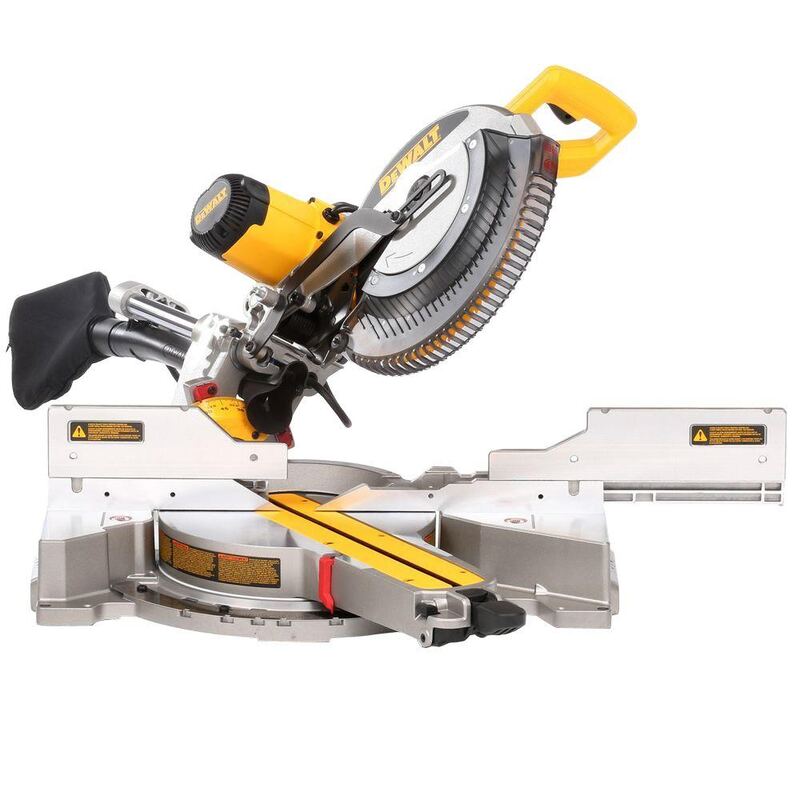
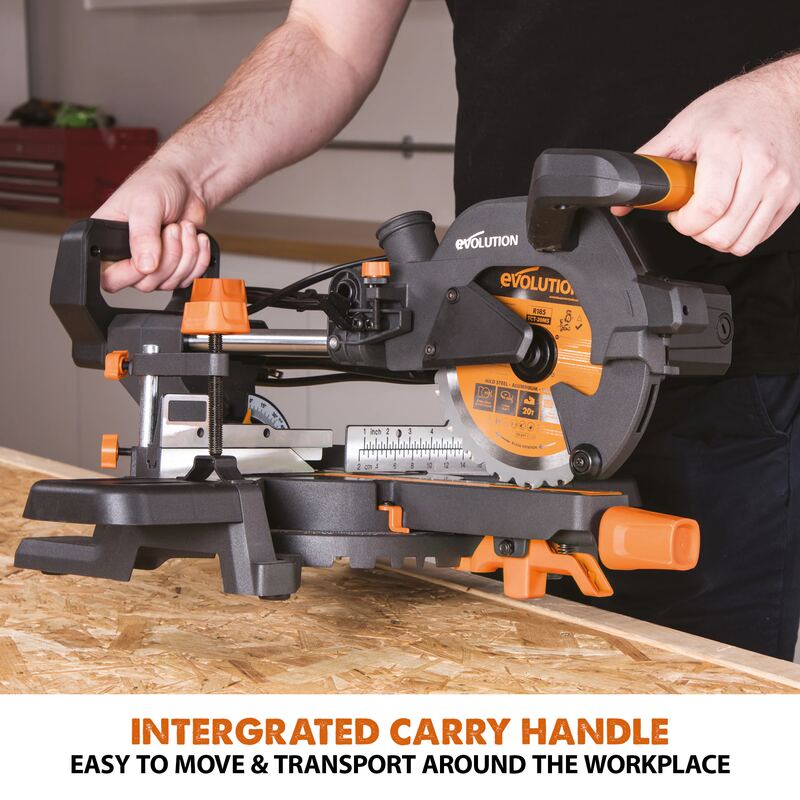
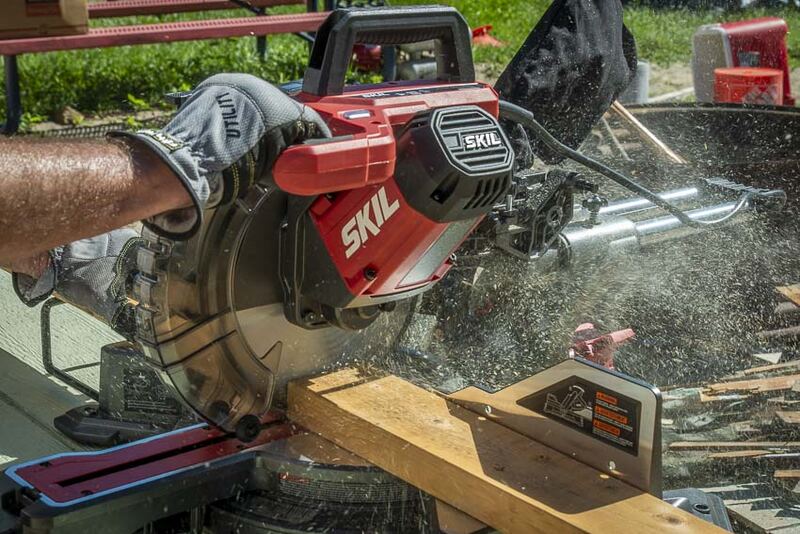
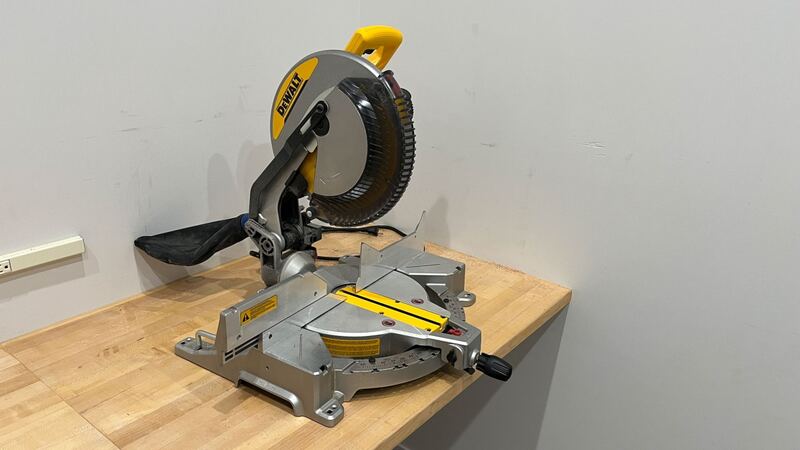
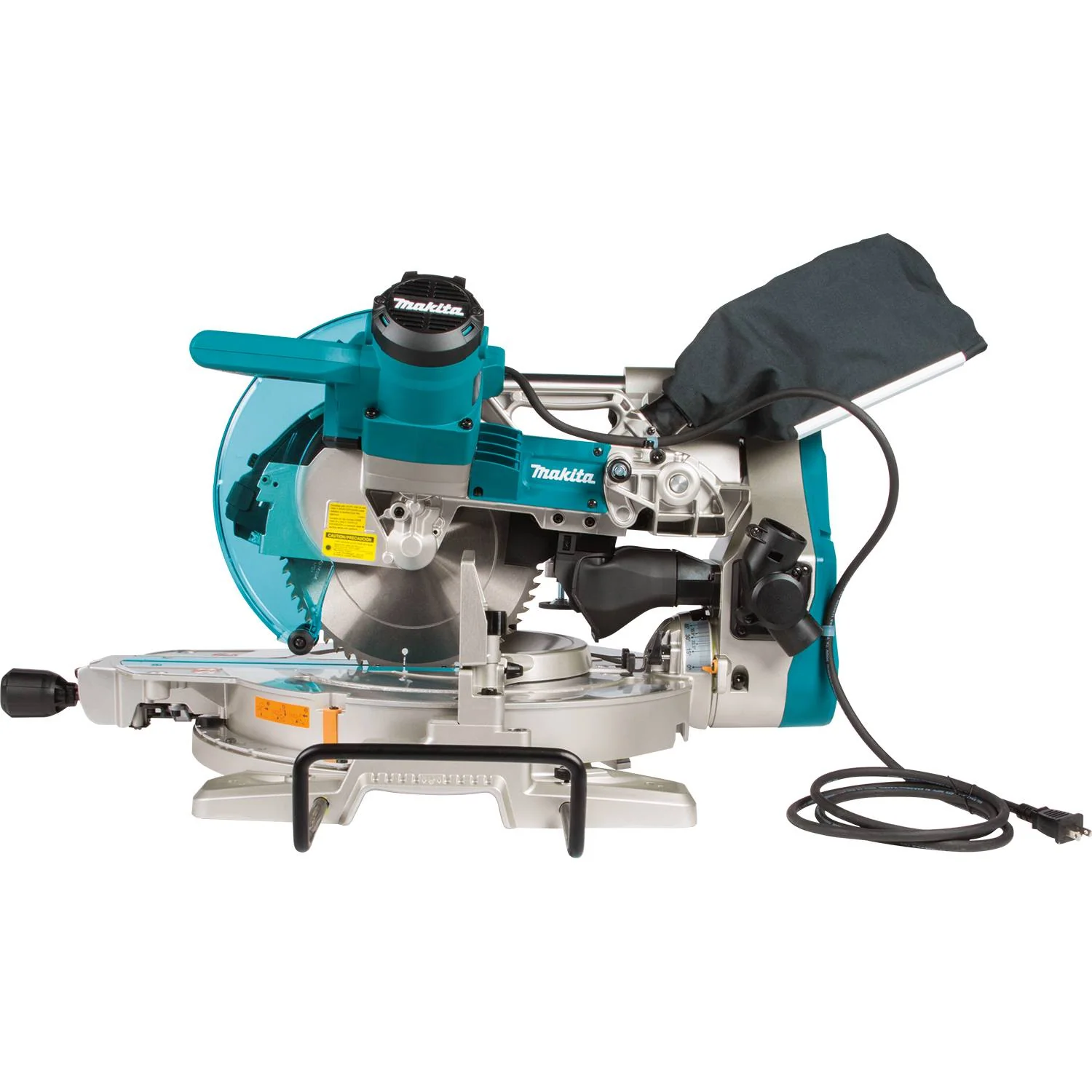
The Makita LS1019L combines a compact dual-bevel head with a front-mounted two-steel-rail sliding system, allowing it to sit flush against a wall while delivering 12-inch crosscut capacity. Electropro.blog found that this design saves bench depth and maintains accuracy across the slide, though Woodworkingadvisor notes its 3,200 RPM no-load speed is slower than several competitors in its class. The tool’s substantial 57.9 lb weight ensures stability during operation but requires two hands for transport, limiting mobility on large job sites. This saw fits professional finish carpenters who prioritize space efficiency and precise cut quality over raw cutting speed or portability.
Full review
Dual-bevel cuts eliminate board flipping
The Makita LS1019L features a dual-bevel head that tilts up to 48 degrees in both the left and right directions. This mechanism allows woodworkers to execute compound angles on crown molding without physically turning the workpiece over to match the opposite bevel direction. Woodworkingadvisor notes that this capability saves significant time during complex trim installations because it removes the need for re-marking or flipping boards when switching between opposing cut angles.
Electropro.blog confirms the 0 to 48-degree range in both directions and highlights positive detents at 0, 22.5, 33.9, and 45 degrees. The override mechanism is located on the back of the saw head as a simple thumb tab, allowing for quick adjustments when working outside standard angles. This setup ensures that professional finishers can maintain a consistent workflow without interrupting their rhythm to reposition heavy or awkward stock.
2-steel-rail system saves bench depth
Unlike traditional sliding miter saws that use bulky round rails extending from the rear, this model utilizes a compact 2-steel-rail sliding system positioned in front of the motor. Electropro.blog explains that placing both rails forward allows the saw to operate flush against a wall, saving approximately 12 inches of bench depth compared to conventional rear-sliding designs. This spatial efficiency is particularly valuable for carpenters working in tight shops or on crowded job sites where every inch of clearance matters.
The sliding mechanism relies on case-hardened steel rails and a linear ball-bearing system designed to minimize deflection during the cut stroke. Woodworkingadvisor emphasizes that this engineering choice maintains accuracy across the full length of the slide, ensuring that cuts remain precise even when pushing through wide material. Electropro.blog adds that the slide action includes slight built-in resistance, which provides better control over the saw head and prevents it from running away on thin stock during aggressive cuts.
10-inch blade matches 12-inch capacity
The cutting envelope of this tool is engineered to rival larger equipment. It achieves a 12-inch crosscut capacity at 90 degrees and an 8-1/2 inch cut at a 45-degree miter angle. Electropro.blog details that the saw can handle nested crown molding up to 6-5/8 inches and vertical baseboards up to 5-1/4 inches, effectively matching the capabilities of many 12-inch sliding miter saws while maintaining a smaller physical footprint.
Mostlytools reports that the 15-amp motor provides ample power to slice through hardwoods like oak and maple without bogging down. During evaluations involving thick stock such as 8/4 hard maple for workbench tops, the tool maintained consistent cutting performance. The direct-drive gearbox eliminates belt maintenance while delivering robust torque, allowing users to tackle demanding framing and finish carpentry tasks with a single compact machine.
3,200 RPM slower than class competitors
The motor operates at a no-load speed of 3,200 RPM, which Woodworkingadvisor identifies as notably slower than several competing models in the same category. While the electronic speed control maintains constant velocity under load to prevent stalling, the lower base RPM means that cutting speeds on softwoods and standard trim may be slightly reduced compared to higher-RPM alternatives. This specification is a deliberate engineering trade-off for durability rather than raw speed.
Despite the slower rotation, reviewers note that the cut quality remains excellent. Electropro.blog observed that using the included 60-tooth carbide blade produced finish-ready edges with no tear-out on poplar wainscoting projects. The soft-start feature also mitigates the initial torque spike, keeping the workpiece stable during the cut initiation phase even at this moderate operating speed.
57.9 lbs requires two-handed transport
At 57.9 pounds, the saw is not considered a lightweight or one-hand-carry tool by Woodworkingadvisor standards. While it weighs roughly half as much as comparable 12-inch sliding miter saws, making it more portable within that specific class, it still demands two hands for safe lifting and transport. The weight contributes to stability during operation but limits its utility for tradespeople who need to move the tool frequently across large job sites without a dedicated stand or cart.
The substantial mass is distributed over a solid cast aluminum base that provides a rigid foundation for accurate cutting. Electropro.blog notes that despite the heavy overall weight, the compact design of the 2-steel-rail system keeps the center of gravity manageable when mounted on compatible stands like the WST06. Users should plan their workspace layout to minimize the need for frequent relocation given the tool's heft.
Laser guide aids cut alignment
An integrated laser guide projects a sharp line onto the workpiece before the blade engages, allowing users to align their cut marks precisely without lifting the protective guard. Woodworkingadvisor highlights this feature as useful for verifying alignment quickly, ensuring that the kerf matches the intended mark exactly. The visibility of the laser helps reduce margin of error during repetitive cuts where speed and accuracy are both critical.
Tool.report describes the overall build quality as robust, noting that the saw arrived factory-aligned with dead-on accuracy right out of the box. Mostytools corroborates this experience, stating that positive miter stops at key angles like 0, 15, 22.5, and 45 degrees allow for quick adjustments without constant measuring. This combination of precise detents and laser guidance makes the tool highly suitable for professional finish carpenters who require repeatable results.
Dust collection needs shop vacuum
The saw features dual dust collection ports designed to connect directly to a shop vacuum, keeping the work area cleaner during extended use. Electropro.blog reports that while the dust extraction is above average for this class of tool, it does not capture all debris on its own. The direct-drive motor generates significant airflow, but relying solely on the included dust bag results in noticeable sawdust accumulation around the fence and base.
Woodworkingadvisor advises clearing dust from the vents and rails after each use to maintain optimal performance. Sawdust buildup on the 2-steel-rail system can increase friction over time if not wiped down with a dry rag. Connecting a high-volume shop vacuum through the dual ports effectively manages this debris, preserving the smooth slide action and protecting the internal components from abrasive dust ingress.
Strengths
- +2-steel-rail sliding system allows the saw to operate flush against a wall while maintaining a 12-inch crosscut capacity at 90 degrees.
- +Cuts nested crown molding up to 6-5/8 inches and vertical baseboards up to 5-1/4 inches, matching many 12-inch miter saws.
- +Laser guide projects a cut line on the workpiece for precise alignment without lifting the blade guard.
Watch-outs
- −3,200 RPM no-load speed is slower than several competitors in its class.
- −57.9 lbs weight requires two hands to carry and is not considered lightweight by some reviewers.
How it compares
The Makita LS1019L features a compact dual-bevel head with a front-mounted two-steel-rail sliding system that allows it to sit flush against a wall. However, its 3,200 RPM no-load speed is slower than the faster motors found in the SKIL MS6305-00 and DeWalt DWS715.
Rating sources
“Overall, super happy with the Makita LS1019L. This is a great tool for a newbie or a professional.”
“That is premium territory but the build quality matches.”
Our 4.5 score is the average of the 2 scored reviews above; 5 more reviewed it without printing a score and are not in the average. Ratings marked * were derived from the reviewer’s written analysis or video transcript — the publisher didn’t print an explicit numeric score, so we inferred one from their own words. Click through to verify. More about methodology.