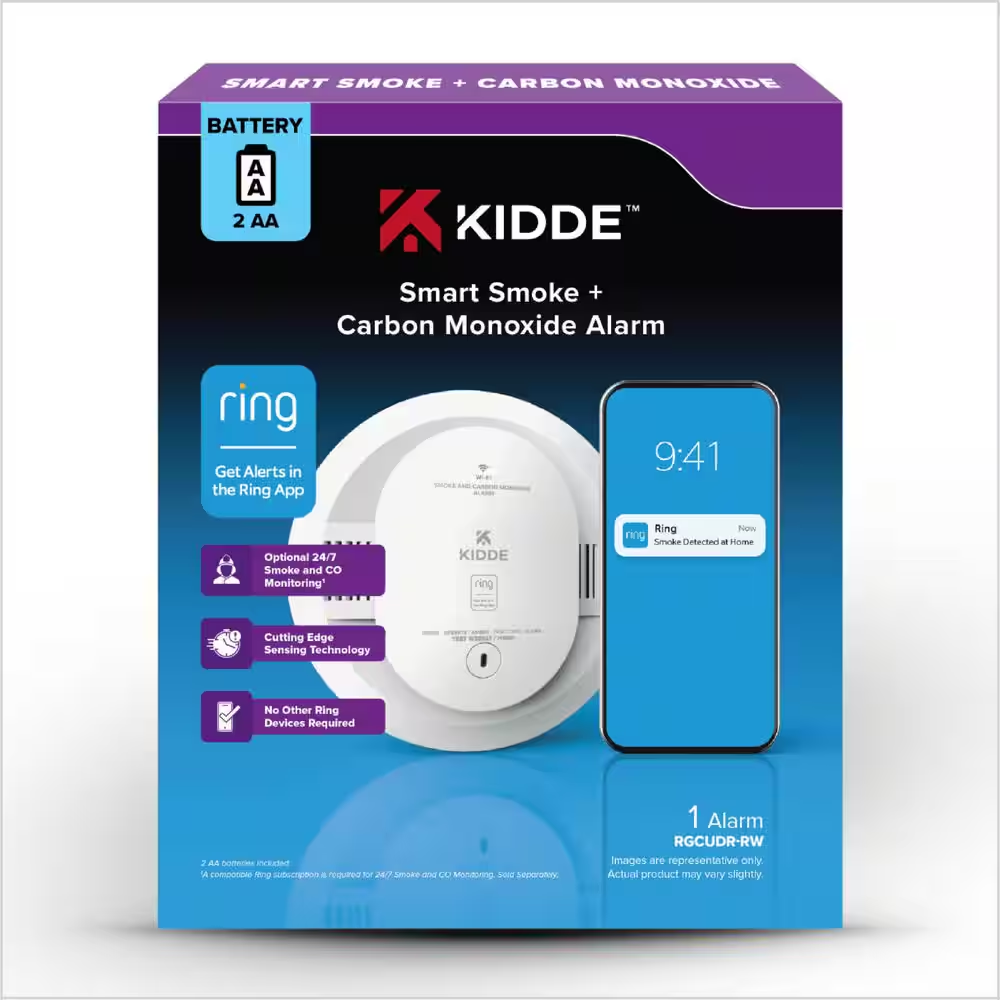
The Kidde Ring-Enabled Smart Smoke and Carbon Monoxide Detector offers dual detection for fast-flaming and slow-smoldering fires alongside continuous carbon monoxide monitoring. PCMag found that its smart connectivity effectively prevents users from disabling alarms by sending immediate push notifications for low batteries or power outages, while Eric DIY noted the device requires a proprietary wiring harness during installation. The unit supports interconnection with other hardwired Kidde detectors and reports through the Ring app, though PCMag notes it does not interact with Alexa or other Ring devices, and it relies on standard AA backup batteries rather than sealed cells. This model fits households seeking comprehensive digital oversight of their fire safety infrastructure, but those wanting long-life maintenance-free backups or broader third-party automation support should look elsewhere.
Full review
Dual detection handles smoke and carbon monoxide
The Kidde Ring-Enabled Smart Smoke and Carbon Monoxide Detector combines two distinct safety systems into a single ceiling-mounted unit. It monitors for both fast-flaming fires and slow-smoldering combustion events, which addresses the wide variety of modern household fire risks including synthetic furniture and electronics. Simultaneously, it continuously tracks carbon monoxide levels to catch this invisible hazard before concentrations become dangerous. This dual-sensor approach ensures that residents receive protection against the two most common lethal threats in residential environments without needing separate devices for each.
When a threat is detected, the unit triggers an immediate local alarm and sends instant push notifications to paired smartphones. The audible alerts are not generic beeps; they feature distinct voice prompts that clearly identify whether the danger is smoke or carbon monoxide. This specific vocalization helps occupants respond quickly and appropriately during high-stress situations, particularly at night when visibility is low and panic can set in.
Smart alerts prevent battery removal
A common failure point for traditional hardwired alarms is the tendency of homeowners to remove batteries or disconnect power after nuisance alarms triggered by cooking smoke. PCMag noted that this practice leaves homes completely unprotected against real fires. The Kidde detector addresses this vulnerability through its smart connectivity features, which send maintenance and system alerts directly to a user's phone. Whether it is a low battery warning, a power outage, or an actual fire event, the device ensures the homeowner is aware of the status remotely.
This constant digital oversight eliminates the frustration that often leads people to disable their alarms. By providing real-time monitoring and instant notifications regardless of location, the unit maintains its protective function even when no one is physically present in the house. The system keeps users informed about the health of the device itself, ensuring that a silent failure does not occur during an emergency.
Hardwired installation requires new harness
Eric DIY documented the physical replacement process for existing hardwired units and found that upgrading to this smart model often requires replacing the mounting bracket. Installers must disconnect the house wiring, attach the new pigtail with color-coded connections (white to white, black to black), and secure it before twisting the new unit into place. Smart Home Insights adds that the detector fits older Kidde bases and that the included wiring pigtail makes connecting the power straightforward.
Once mounted, the device powers on automatically using household electricity while relying on two AA batteries for backup power during outages. Eric DIY reported that connecting the units to the internet is straightforward; users can scan a QR code located on the side of the detector to link it to their Ring app and Wi-Fi network within minutes. This setup process allows homeowners to upgrade multiple detectors in a house systematically, ensuring all units are online and communicating with the central hub.
Interconnection links hardwired alarms
For larger homes or those with multiple floors, the detector supports interconnection with other hardwired Kidde units. When one alarm triggers due to smoke or carbon monoxide, every connected alarm in the network sounds simultaneously. This synchronized alerting is critical for ensuring that occupants on distant floors or in separate wings of a house are warned immediately, regardless of which specific room initiated the alarm.
This hardwired interconnection works alongside the smart app notifications to create a layered defense system. While the local sirens provide immediate physical warning, the digital alerts ensure that homeowners away from home can take action remotely. The combination of physical and digital alerting methods provides comprehensive coverage for both present and absent residents.
Smart integration relies on Wi-Fi
The smart features of this detector are dependent on a stable 2.4 GHz Wi-Fi connection to function as intended. PCMag observed that the alarm uses the Ring app for notifications but does not interact with Ring cameras or Alexa smart home devices, which it called a missed opportunity to make the device truly smart.
This reliance on Wi-Fi means that if the network goes down, the smart notifications stop working, though the local alarms continue to function due to the hardwired power and AA battery backup. The integration allows any alert to be visible across multiple devices in a household, giving users full control over their safety settings without constantly checking individual detectors. However, the requirement for a specific network frequency may complicate installation in homes with only 5 GHz networks or congested Wi-Fi environments.
AA backup batteries need regular replacement
Unlike some competitors that utilize long-life sealed lithium cells, the Kidde Ring-Enabled Smart Smoke and Carbon Monoxide Detector relies on standard AA batteries for its backup power supply. This design choice means that homeowners must remember to replace these batteries periodically rather than relying on a decade-long maintenance-free cell. While this allows for easy replacement using widely available components, it introduces an ongoing maintenance task that sealed-cell units eliminate.
The smart app helps mitigate the risk of forgotten battery changes by sending low-battery warnings directly to users' phones. This feature ensures that even if homeowners neglect their manual maintenance schedule, they will still receive a digital reminder before the backup power fails. The inclusion of this warning system is particularly valuable given that AA batteries are often overlooked in traditional alarm setups.
Mid-range pricing justifies dual detection
The price reflects the combination of dual detection capabilities, smart notifications, voice alerts, and interconnection features. When compared to standard hardwired alarms that lack connectivity, the extra cost is justified by the real-time monitoring and enhanced peace of mind provided by the app integration.
For households looking to modernize their fire safety infrastructure, this device offers a strong value proposition by addressing both physical protection and digital awareness. The ability to monitor multiple units simultaneously through a single interface reduces the complexity of managing home safety systems. While not the cheapest option on the market, its comprehensive feature set makes it a compelling choice for tech-forward homeowners.
Strengths
- +Dual detection capabilities monitor both smoke (fast flaming and slow smoldering) and carbon monoxide simultaneously.
- +Features voice alerts that clearly distinguish between smoke and carbon monoxide dangers during an alarm event.
- +Supports interconnection with other hardwired Kidde units so all connected detectors sound when one is triggered.
Watch-outs
- −Smart features depend on Wi-Fi and the Ring app; PCMag notes it does not interact with Alexa or other Ring devices.
- −Includes only AA battery backup rather than a long-life sealed lithium cell found in some competitors.
How it compares
The Kidde Ring-Enabled Smart Smoke and Carbon Monoxide Detector is hardwired like the First Alert SC5 Hardwire Smart Smoke and CO Alarm, but it backs up on AA batteries where the SC5 uses a lithium backup, and it costs less. It reports through the Ring app, while the SC5 works with the Google Home app only. The X-Sense SC07 Smoke & CO Alarm runs on a CR123A lithium battery instead of house wiring.
Rating sources
Counts as 3.66/5 in our score — this publisher's 181 scores on the site average 4.00, so its scores are adjusted up to compare fairly with other publishers.
“For the combination of dual detection, smart notifications, voice alerts, and interconnection, it's a strong value.”
“I've had them in there for a couple days now and they're doing great.”
Our 3.7 score is the average of the 1 scored review above, each adjusted for how strictly its publisher scores; 2 more reviewed it without printing a score and are not in the average. More about methodology.